Floor Insulation Cost UK 2026
Floor insulation costs £20 to £60 per m² depending on whether you have suspended timber or solid concrete floors. A suspended timber floor costs £20 to £40/m² to insulate from below, while solid floor insulation costs £30 to £60/m². DIY is a genuine option for suspended floors if you have access from underneath.
£20-£40/m²
Suspended floor
£30-£60/m²
Solid floor
£60-£120
Annual saving
£8-£15/m²
DIY materials
Prices updated April 2026 · Based on industry data and contractor submissions.
Quick answer
How much does floor insulation cost?
For a typical 3-bed semi with about 60 m² of ground floor, insulating a suspended timber floor from below costs £1,200 to £2,400. Solid floor insulation (adding rigid boards on top with a new floor surface) costs £1,800 to £3,600. If you have access from below and fancy a DIY job, materials alone cost £480 to £900. Floor insulation saves roughly £60 to £120 per year on heating bills, but the comfort improvement, no more cold feet, is immediate.
Floor Insulation Prices by Type
Installed prices including materials and labour, plus total cost for a typical 3-bed semi (60 m² ground floor).
Suspended timber floor (from below)
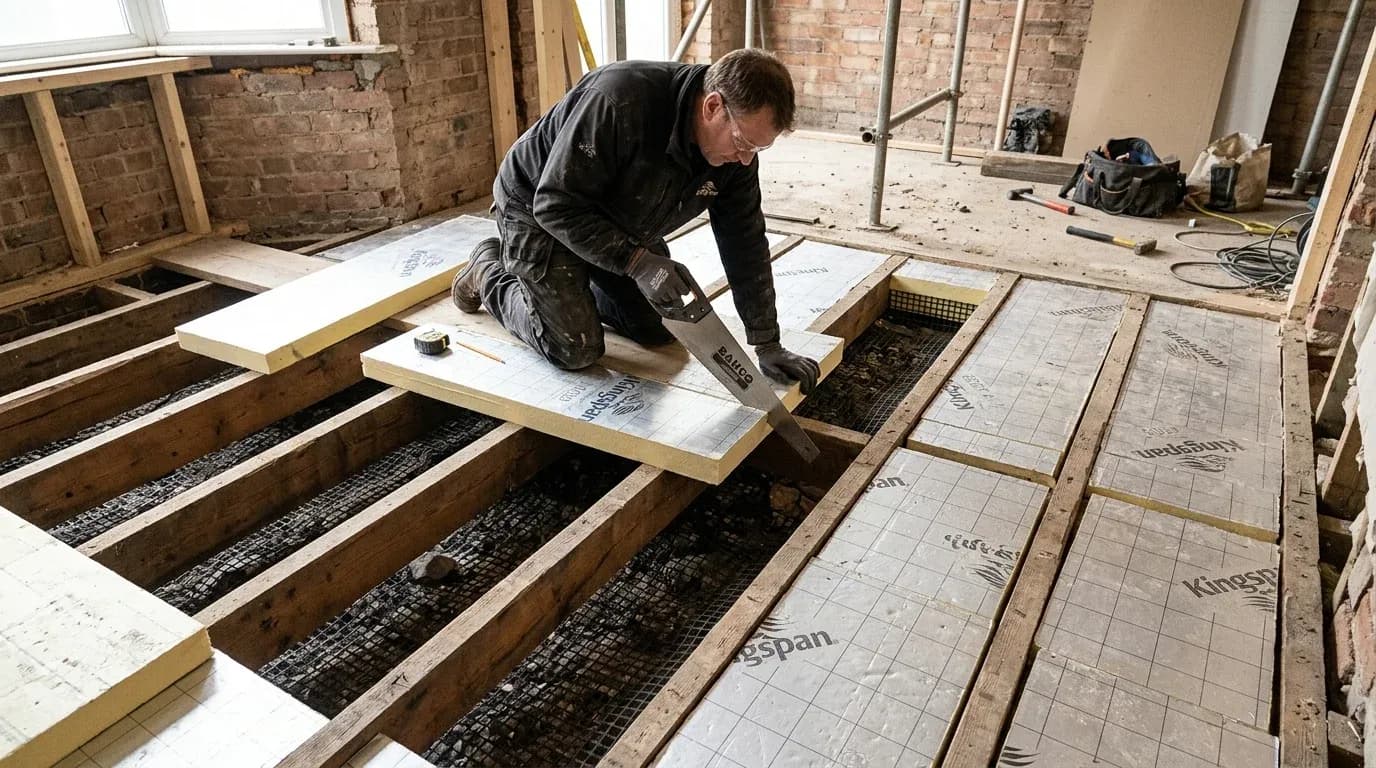
Mineral wool or PIR boards pushed between joists from underneath
£20 to £40/m²
per m²
£1,200 to £2,400 total
Solid concrete floor (overlay)
PIR boards on top of existing floor, new screed or chipboard over
£30 to £60/m²
per m²
£1,800 to £3,600 total
Spray foam (under suspended floor)
Sprayed onto underside of floorboards from crawl space
£25 to £50/m²
per m²
£1,500 to £3,000 total
DIY suspended floor (materials only)
Mineral wool batts and netting, fitted from below
£8 to £15/m²
per m²
£480 to £900 total
Prices before government grants. Some households qualify for subsidised or free floor insulation.
Suspended vs Solid Floor: What Have You Got?
Suspended timber floor
Common in houses built before the 1960s. The floor sits on timber joists with a ventilated void underneath.
- How to tell: Look for airbricks on the outside walls near ground level. Tap the floor - a hollow sound means it is suspended.
- Insulation: Mineral wool or PIR boards pushed between joists from below. Easier if you have a cellar or accessible crawl space.
- DIY? Yes, if you can get underneath. Awkward but straightforward.
Solid concrete floor
Standard in houses built from the 1960s onwards. A concrete slab sits directly on the ground.
- How to tell: No airbricks, no hollow sound when you tap it. Feels solid and cold in winter.
- Insulation: Rigid PIR or EPS boards laid on top of the slab, with a new floor surface over. Raises the floor level by 75-150 mm.
- DIY? Not recommended. Involves damp-proofing, floor levels, and door adjustments.
Floor Insulation Materials Compared
Different materials suit different floor types and budgets.
| Material | Cost/m² |
|---|---|
| Mineral wool batts | £5 to £12/m² |
| PIR rigid boards (Celotex/Kingspan) | £12 to £25/m² |
| EPS boards | £6 to £12/m² |
| Spray foam (open cell) | £20 to £35/m² |
| Spray foam (closed cell) | £30 to £50/m² |
| Sheep wool batts | £10 to £20/m² |
Closed-cell spray foam also acts as a moisture barrier, which can be useful in damp-prone areas under suspended floors.
DIY Floor Insulation: A Practical Guide
If you have a suspended timber floor with access from below, DIY insulation is one of the most accessible home improvement jobs. Here is what is involved.
Check access
You need to get under the floor. A cellar with full headroom is ideal. A crawl space works but is less comfortable. If there is no access at all, you would need to lift floorboards from above, which is more disruptive.
Measure the joist spacing
Joists are typically 400 mm or 600 mm apart. Buy insulation batts to match - they are designed to friction-fit between standard joist spacings. Cut slightly oversized for a tight fit.
Fit the insulation
Push mineral wool batts or PIR boards between the joists from below. For mineral wool, use nylon garden netting stapled to the joists to hold it in place. PIR boards can be friction-fitted or held with battens.
Seal the edges
Use expanding foam to fill any gaps around pipes, cables, and the edges where the floor meets the walls. Draughts through gaps will undermine the insulation.
Leave ventilation
Do not block the airbricks or seal the underfloor void completely. Ventilation prevents moisture buildup and timber rot. The insulation goes between the joists, not across the entire underside.
Safety note: Wear a dust mask (FFP3), goggles, and gloves when handling mineral wool. Work in short stints if the crawl space is confined. If there is any sign of asbestos (common in properties built before 2000), stop and get a professional survey before disturbing anything.
Additional Costs to Budget For
| Extra Item | Typical Cost |
|---|---|
| Lifting and relaying floorboards | £15 to £30/m² |
| New chipboard or plywood overlay | £10 to £20/m² |
| Self-levelling screed | £15 to £25/m² |
| Damp proof membrane | £3 to £8/m² |
| Door trimming | £30 to £60 per door |
| Skirting board refitting | £5 to £10/m |
Floor Insulation Costs by Region
Average installed cost for a suspended timber floor in a typical 3-bed semi (60 m²), by UK region.
| Region | Typical Cost | vs National |
|---|---|---|
| London | £2,400 | +26% |
| South East | £2,100 | +11% |
| East of England | £2,000 | +5% |
| South West | £1,900 | Average |
| Midlands | £1,800 | -5% |
| Yorkshire | £1,650 | -13% |
| North West | £1,700 | -11% |
| North East | £1,550 | -18% |
| Scotland | £1,650 | -13% |
| Wales | £1,600 | -16% |
Before government grants. DIY materials cost the same regardless of region.
How to Get Your Floor Insulation for Less
Practical ways to reduce costs on floor insulation.
DIY if you have access from below
If your house has a cellar or accessible crawl space, insulating a suspended timber floor is a genuine DIY job. Mineral wool batts pushed between the joists and held in place with nylon netting cost roughly £8-£15 per square metre for materials. You save £12-£25 per square metre in labour. It is not glamorous work - you will be on your back in a tight space - but it is straightforward and the materials are available from any builders merchant.
Check government grant eligibility
Floor insulation is covered under the ECO4 scheme, which runs until 31 December 2026 for households on qualifying benefits or in fuel-poor homes. If you are on a lower income or renting privately and your home sits in EPC band D to G, the Warm Homes: Local Grant through your council can help too. The Great British Insulation Scheme closed to new applicants on 31 March 2026. Even partial funding takes the sting out of the cost. Check gov.uk or contact your energy supplier.
Combine with other insulation work
If you are already getting loft insulation or cavity wall insulation done, ask the installer about floor insulation at the same time. You may get a better rate because they are already on site with their equipment. Some government grant schemes also cover multiple insulation measures in one go, which means less paperwork and potentially better funding.
Address draughts first for instant comfort
Before investing in full floor insulation, deal with draughts. Gaps between floorboards, around skirting boards, and where pipes come through the floor can be sealed with flexible filler, draught-proofing strips, or expanding foam for under £50. This alone makes a noticeable difference to comfort and is the cheapest insulation measure you can do.
Think about floor levels before choosing a method
Adding insulation on top of a solid floor raises the floor level by 75-150 mm. This means trimming every door, adjusting skirting boards, and potentially changing the position of radiators and kitchen units. If this sounds like too much disruption, consider insulating from below (if there is a crawl space) or accepting that solid floor insulation may need to wait until a full renovation.
Official Resources
Trusted sources for further reading and professional guidance.
Energy Saving Trust: Floor insulation guide
Independent advice on floor insulation types, costs, and potential energy savings for UK homes.
Gov.uk: Building Regulations Part L
Minimum U-value requirements for floor insulation under Building Regulations.
TrustMark: Government endorsed quality scheme
Required for government-backed insulation grants. Find TrustMark registered insulation installers.
What to Expect: The Floor Insulation Process
Floor insulation typically takes 1-2 days depending on the floor type and access. Suspended timber floors are the easiest to insulate; solid floors require more work.
- 1
Floor type assessment
The floor construction is identified, suspended timber, solid concrete, or beam-and-block. Each type requires a different insulation approach and material.
- 2
Access and preparation
For suspended floors, floorboards are lifted to access the void below. For solid floors, the existing floor covering is removed. Any damp issues are addressed before insulation begins.
- 3
Insulation installation
For suspended timber floors, rigid insulation boards or mineral wool batts are fitted between the joists, supported by netting. For solid floors, rigid PIR boards are laid on top of a damp-proof membrane.
- 4
Draught sealing
Gaps between floorboards, around skirting boards, and at pipe penetrations are sealed to prevent cold draughts. This is especially important on suspended timber floors with ventilated voids.
- 5
Vapour barrier and boarding
A vapour control layer is fitted over the insulation where required. Floorboards or chipboard are re-laid on suspended floors; a screed or boards are laid over solid-floor insulation.
- 6
Floor covering and finishing
The final floor covering, carpet, laminate, or tiles, is laid. Door bottoms may need trimming if the floor level has risen, and threshold strips are fitted at doorways.
Frequently Asked Questions
How much does floor insulation cost?
Floor insulation costs £20-£40 per square metre for a suspended timber floor, £30-£60 per square metre for a solid floor, and £25-£50 per square metre for spray foam applied under a suspended floor. For a typical 3-bedroom semi-detached house with about 60 square metres of ground floor, total costs range from £1,200 to £3,600 depending on the method.
Can I insulate my floor myself?
Suspended timber floors are often suitable for DIY insulation if you have access from below (via a cellar or crawl space). You push mineral wool batts or PIR boards between the joists from underneath, held in place with netting or battens. It is awkward work in a tight crawl space but perfectly doable. Solid floor insulation is not a DIY job as it involves either digging up the floor or adding a new insulated layer on top, both of which affect floor levels and damp proof courses.
Is floor insulation worth it?
Floor insulation typically saves £60-£120 per year on heating bills for a 3-bed semi, according to the Energy Saving Trust. The payback period is 10-30 years for professional installation, which makes it one of the slower insulation measures to pay back. However, the comfort improvement is immediate and noticeable - cold floors are one of the main complaints in older UK homes. It also reduces draughts from underneath the house.
What type of floor do I have?
Houses built before the 1960s usually have suspended timber floors on the ground floor - you can tell by looking for airbricks on the outside walls near ground level, or by tapping the floor (a hollow sound means suspended). Houses built from the 1960s onwards typically have solid concrete floors. Upper floors in most UK houses are suspended timber regardless of the building age.
Can I get a grant for floor insulation?
Floor insulation is covered by the ECO4 scheme, which runs until 31 December 2026 and funds free insulation for households on qualifying benefits or in fuel-poor homes. Lower-income homeowners and private renters in EPC bands D to G can also get help through the Warm Homes: Local Grant, delivered by local councils until 31 March 2028. The Great British Insulation Scheme closed to new applicants on 31 March 2026. Floor insulation is less commonly funded than loft and cavity wall insulation, but it is available. Check with your energy supplier or your local council, or use the Find ways to save energy tool on gov.uk.

Written by Chris Kervin, Co-Founder, Less.co.uk
Last updated: · Pricing based on industry data and installer quotes · Methodology
Ready to insulate your floors for less?
Compare free quotes from qualified insulation installers near you. Check government grant eligibility at the same time.
Get Free QuotesFree, no obligation · Qualified installers · Government grant check included
More insulation guides
Compare real quotes for your job
Prices move a lot with your postcode, the access on site and the spec you choose. Get up to 3 free quotes from vetted local tradespeople and see what yours actually comes to, with no obligation to book.