How Much Does Underfloor Heating Cost in 2026?
Underfloor heating installation cost starts at £40 per m² for electric systems and £80 per m² for wet systems, both fully fitted. Electric mat systems, the usual pick for a bathroom, cost £50-£75 per m² installed. Wet (water-based) systems cost £80-£120 per m² for new builds, or £100-£150 per m² for low-profile retrofits. A typical bathroom costs £250-£600, while a whole house runs to £4,000-£9,600.
£40 to £75/m²
Electric UFH
£80 to £150/m²
Wet UFH
From £250
Bathroom (5m²)
£4k-£9.6k
Whole house
Prices updated April 2026 · Based on industry data and contractor submissions.
Electrical connections for UFH must comply with Building Regulations Part P. A Part P registered electrician must make the final connection to the consumer unit. Wet systems in new builds must meet Part L (energy efficiency). Always use a qualified installer for wet system pipework and pressure testing.
Underfloor Heating Installation Cost at a Glance
The installation cost below covers the full job: materials, labour, thermostat, and connection to your existing electrical supply or heating system.
Electric mat system (retrofit)
Thin mats laid under tiles - ideal for bathrooms and kitchens
£62/m²
£50 to £75/m²
Electric cable system
Loose cables for irregular-shaped rooms - cheaper but slower to fit
£50/m²
£40 to £60/m²
Wet system (new build / screed)
Pipes in screed - the standard choice for new builds and extensions
£100/m²
£80 to £120/m²
Wet system (low-profile retrofit)
Aluminium spreader plates - for renovations without digging up floors
£125/m²
£100 to £150/m²
Thermostat per zone
Programmable or smart thermostat to control each room independently
£200
£100 to £300
Cost by Room Size
| Room | Electric | Wet |
|---|---|---|
| Bathroom (5m²) | £250 to £375 | £400 to £600 |
| Kitchen (15m²) | £750 to £1,125 | £1,200 to £1,800 |
| Living room (20m²) | £1,000 to £1,500 | £1,600 to £2,400 |
| Whole house (80m²) | £4,000 to £6,000 | £6,400 to £9,600 |
Labour Cost Breakdown
| Trade | Cost |
|---|---|
| Electrician (electric UFH) | £150 to £250/day |
| Plumber / heating engineer (wet UFH) | £200 to £300/day |
| Floor screeder (wet systems) | £15 to £25/m² |
| Tiler / floor fitter | £150 to £300/day |
Labour for electric systems is minimal - the mat is quick to lay and only needs an electrician for the connection. Wet systems require more trades and take longer.
Get Free Underfloor Heating Quotes
Compare prices from trusted local underfloor heating installers near you. Fill in a few details and receive up to 4 free, no-obligation quotes.
Electric vs Wet Underfloor Heating
This is the first decision you need to make. Here is a head-to-head comparison to help you choose.
| Factor | Electric | Wet (Water) |
|---|---|---|
| Install cost per m² | £40 to £75 | £80 to £150 |
| Running cost per m²/hr | 2.5 to 3.7p | 0.7 to 1.5p (gas) / 0.6 to 1.2p (heat pump) |
| Floor height added | 3 to 5mm | 15 to 75mm depending on type |
| Warm-up time | 20 to 30 minutes | 30 min - 4 hours |
| Best for | Single rooms, retrofits | Whole house, new builds |
| DIY potential | Yes (except electrical connection) | No - needs qualified plumber |
| Works with heat pump | Not directly | Perfect pairing |
| Lifespan | 20 to 30 years | 50+ years |
| Maintenance | None | Annual system check |
Choose electric if:
- You are retrofitting a single room (bathroom, en-suite, kitchen)
- You want minimal disruption and do not want to raise floor levels
- You are on a tight budget for installation
- The room has tile or stone flooring
Choose wet if:
- You are building a new house, extension, or conservatory
- You are doing a major renovation where floors are being replaced
- You want whole-house underfloor heating with low running costs
- You have or plan to install a heat pump
Running Costs: Electric vs Wet UFH
Running costs vary hugely depending on the system type and your heat source. These figures assume 4 hours of heating per day during the heating season (roughly October to April).
| System | Per m²/hr | Whole house (80m²) |
|---|---|---|
Electric UFH | 2.5 to 3.7p/m²/hr | £1,800 to £2,650 |
Wet UFH (gas boiler) | 0.7 to 1.5p/m²/hr | £500 to £1,080 |
Wet UFH (heat pump) | 0.6 to 1.2p/m²/hr | £430 to £860 |
Standard radiators (gas) | N/A | £900 to £1,300 |
Electric UFH in a single bathroom is cheap to run. At £110-£170 per year for a 5m² bathroom, that is roughly 50-75p a day - a small price for warm tiles every morning. The running cost only becomes a concern when you scale electric UFH to a whole house.
For whole-house heating, wet UFH with a heat pump is by far the cheapest option to run - roughly half the cost of standard radiators with a gas boiler.
What Affects the Cost of Underfloor Heating?
New build vs retrofit
This is the single biggest factor. In a new build or extension where screed is being poured anyway, adding wet UFH is relatively cheap - you are just adding the pipes and manifold. Retrofitting into an existing house means either raising the floor height (and adjusting doors, skirting, and transitions) or using more expensive low-profile systems. The retrofit premium can double the cost per m².
System type - electric vs wet
Electric systems are cheaper to install but more expensive to run. Wet systems cost more upfront but save money over time. For a single bathroom, electric wins on total cost. For a whole house, wet systems pay back their higher installation cost within a few years through lower running costs.
Floor area
Larger areas bring the cost per m² down because the fixed costs (manifold, thermostat, electrician or plumber connection) are spread across more floor space. A 5m² bathroom might cost £75/m² for electric, while an 80m² whole house might average £50-£60/m² for the same system type.
Floor finish and preparation
If your existing floor needs levelling, insulating, or removing before UFH can be installed, this adds to the cost. Self-levelling compound costs £10-£20/m². Floor insulation boards add £5-£15/m². These are not always included in UFH quotes, so check what is covered.
Number of zones
Each heating zone needs its own thermostat (£100-£300) and, for wet systems, its own manifold port. More zones give you better control but add to the cost. Most homes need 3-6 zones - one per main room or area. Bathrooms and kitchens are usually separate zones.
Your location
Labour rates vary across the UK. London and the South East run 10-20% above the national average. The materials themselves cost the same everywhere - it is the labour and travel time that push prices up in more expensive regions.
Underfloor Heating Costs by Region
Average installed prices for a wet underfloor heating system per m² by UK region. Electric system prices vary less because the materials are a larger proportion of the total cost.
| Region | Avg Wet UFH/m² | vs National |
|---|---|---|
| London | £115/m² | +15% |
| South East | £108/m² | +8% |
| East of England | £105/m² | +5% |
| South West | £102/m² | +2% |
| Midlands | £100/m² | Average |
| Yorkshire | £95/m² | -5% |
| North West | £97/m² | -3% |
| North East | £90/m² | -10% |
| Scotland | £93/m² | -7% |
| Wales | £92/m² | -8% |
Based on industry data. Prices for a mid-range wet underfloor heating system, fully installed. Regional variation is driven primarily by labour costs.
How to Get Your Underfloor Heating for Less
Whether you are fitting UFH in a single bathroom or an entire house, these tips can knock hundreds or thousands off the bill.
DIY the electric mat, pay a sparky for the connection
Electric mat systems are designed for DIY installation - you lay the mat on the floor and tile over it. The only part that must be done by a professional is the final electrical connection to the consumer unit, which a Part P registered electrician can do in an hour or two. This can save you £300-£500 in labour on a typical bathroom.
Get three quotes and compare scope carefully
Prices vary massively between installers - particularly for wet systems. A whole-house wet UFH quote might range from £7,000 to £12,000 for what looks like the same job. Make sure each quote covers the same scope: manifold, pipework, screed (if applicable), thermostats, and connection to your existing boiler or heat pump.
Install UFH during a renovation, not as a standalone project
The biggest cost of wet underfloor heating is not the system itself - it is the disruption and floor finishing. If you are already laying a new floor, building an extension, or renovating a kitchen, the incremental cost of adding UFH drops significantly because the floor is being replaced anyway.
Pair wet UFH with a heat pump for the lowest running costs
Wet underfloor heating runs at 35-45 degrees C - exactly the sweet spot for a heat pump. Running costs with a heat pump can be as low as 0.6-1.2p per m² per hour, compared to 2.5-3.7p for electric. The Boiler Upgrade Scheme offers a £7,500 grant towards a heat pump. If you are installing a new heating system anyway, wet UFH plus a heat pump is the cheapest combination to run long-term.
Use a smart thermostat with scheduling
A decent programmable or smart thermostat costs £100-£300 per zone but pays for itself within a year or two by avoiding heating empty rooms. Set it to warm the bathroom before your alarm goes off and drop the temperature when you leave for work. Wet systems with screed have good thermal mass - they hold heat for hours after switching off.
Pay the deposit on a credit card for Section 75 cover
A whole-house wet system runs into several thousand pounds, and most installers ask for a deposit before they start. Pay at least part of the bill on a credit card and, as long as the amount is over £100 and up to £30,000, Section 75 of the Consumer Credit Act makes the card provider jointly liable if the firm folds or never finishes the work. It costs nothing extra. Steer clear of large cash deposits, which leave you with no comeback if things go wrong.
Comparing quotes is the simplest way to pay less
Getting three or four quotes and comparing them is how most homeowners avoid overpaying. It takes a couple of minutes, with no obligation.
Get my free quotesWhat to Expect: The Underfloor Heating Installation Process
Whether you are fitting electric mats in a bathroom or running a full wet system through a new build, the process follows a similar path. Here's how a typical installation works.
- 1
System design and survey
A qualified installer surveys the property to assess insulation levels, floor construction, and heat loss. They produce a room-by-room design specifying pipe spacing (wet) or mat layout (electric), zone allocation, and thermostat positions. For wet systems, this also includes manifold placement and connection to your boiler or heat pump.
- 2
Floor preparation
The subfloor is checked for level and cleaned thoroughly. For wet systems, rigid insulation boards are laid to direct heat upwards and prevent energy loss into the ground. For electric retrofit installations, the existing floor covering is removed and the surface is primed if needed. Any damp issues or structural concerns are dealt with at this stage.
- 3
Laying the heating element
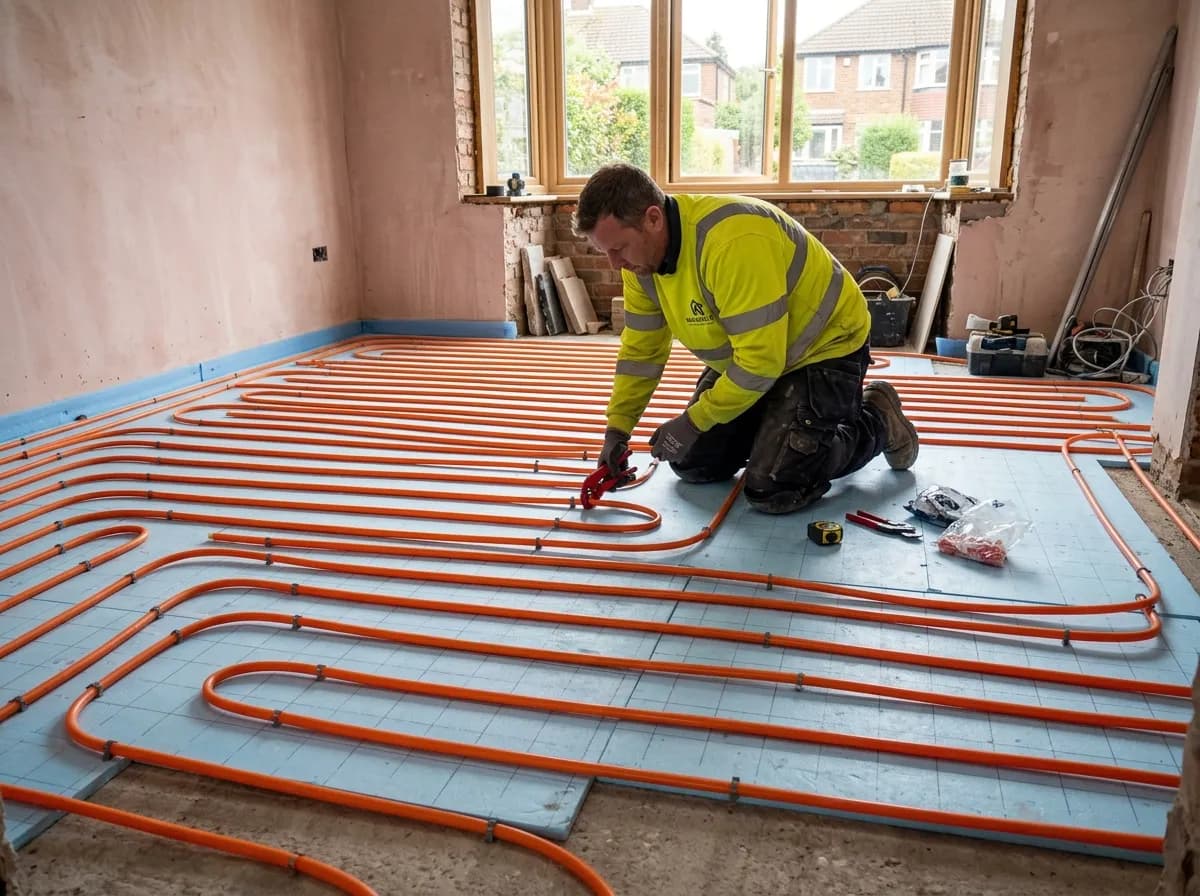
For wet systems, plastic pipes are clipped or stapled to the insulation boards in the spacing specified by the design - typically 150-200mm apart. For electric systems, heating mats or loose cables are rolled out and secured to the subfloor. Both types are tested for continuity and resistance before being covered.
- 4
Screed or levelling compound
Wet systems are covered with a liquid or sand-and-cement screed, typically 50-75mm deep. This encases the pipes and acts as a thermal mass, storing and distributing heat evenly. Electric mats are covered with a thin self-levelling compound or tiled directly over with flexible adhesive. Screed needs several days to cure before the system is switched on.
- 5
Thermostat installation
A thermostat is wired into each heating zone. The floor sensor probe is positioned in the screed or adhesive between heating elements so it reads the actual floor temperature accurately. Smart thermostats can be connected to Wi-Fi for remote scheduling and control, which is well worth the extra spend.
- 6
Commissioning and testing
The system is gradually brought up to temperature over several days to avoid cracking the screed. Wet systems are pressure-tested and the manifold is balanced so each zone heats evenly. The installer checks all thermostats respond correctly, verifies there are no leaks or faults, and hands over all documentation including warranty details and operating instructions.
Frequently Asked Questions
How much does underfloor heating installation cost?
Underfloor heating starts at £40 per m² installed for an electric cable system and £80 per m² installed for a wet system in a new build. On a room basis that works out at £250 to £600 for a 5m² bathroom and £4,000 to £9,600 for an 80m² whole house, depending on which system you choose.
How much does electric underfloor heating cost per m²?
Electric mat underfloor heating costs £50-£75 per m² installed, while electric cable systems cost £40-£60 per m². The mats are quicker to fit and more popular for bathrooms and kitchens. Cable systems are cheaper but take longer to install and suit irregular-shaped rooms better.
How much does wet underfloor heating cost?
Wet (water-based) underfloor heating costs £80-£120 per m² installed for new builds where screed is being laid. Retrofit low-profile systems cost £100-£150 per m² because they use aluminium spreader plates instead of screed. A typical 80m² whole-house wet system costs between £6,400 and £9,600.
Is underfloor heating expensive to run?
Wet underfloor heating is cheaper to run than radiators - roughly 0.7-1.5p per m² per hour with a gas boiler, or 0.6-1.2p with a heat pump. Electric underfloor heating costs around 2.5-3.7p per m² per hour, which makes it more expensive for whole-house heating but perfectly affordable for a single bathroom or kitchen.
Is underfloor heating worth it?
Wet underfloor heating is worth it if you are doing a new build, extension, or major renovation where floors are being replaced anyway. The incremental cost over radiators is modest and running costs are lower. Electric UFH is worth it in bathrooms and kitchens for the comfort of warm tiles underfoot - most homeowners consider it a small luxury that genuinely improves daily life.
Can you install underfloor heating yourself?
Electric mat systems are a common DIY project - laying the mat is straightforward. However, the final electrical connection to the consumer unit must be done by a Part P registered electrician. Wet systems are not a realistic DIY job because they involve plumbing, manifold setup, pressure testing, and screed or floor finishing.
How long does underfloor heating last?
Wet underfloor heating pipes have a lifespan of 50 years or more - the pipes are buried in the floor and have no moving parts to wear out. Electric systems typically last 20-30 years. The thermostat and manifold components may need replacing sooner, but the heating elements themselves are very long-lasting.

Written by Chris Kervin, Co-Founder, Less.co.uk
Last updated: · Pricing based on industry data and installer submissions · Methodology