Roof Insulation Cost UK 2026
Roof insulation costs £20 to £80 per m² depending on the type. Pitched roof insulation between rafters costs £20 to £50/m², flat roof insulation £30 to £70/m², and room-in-roof insulation £40 to £80/m². Loft floor insulation is the cheapest option at just £5 to £15/m².
£20-£50/m²
Pitched roof
£30-£70/m²
Flat roof
£200-£400
Annual saving
3-8 yrs
Payback
Prices updated April 2026 · Based on industry data and contractor submissions.
Quick answer
How much does roof insulation cost?
Roof insulation costs depend heavily on what type you need. Simple loft floor insulation (mineral wool rolls laid between joists) costs £300 to £900 for a typical 3-bed house. Insulating between rafters for a loft conversion costs £1,200 to £3,000. Flat roof insulation costs £600 to £2,100. Room-in-roof insulation (the full package for a habitable loft) runs to £2,400 to £4,800.
Roof Insulation Prices by Type
Installed prices including materials and labour. Prices per square metre and total cost for a typical 3-bed semi.
Pitched roof (between rafters)
Mineral wool or PIR boards fitted between rafters
£20 to £50/m²
per m²
£1,200 to £3,000 total
Flat roof (warm roof system)
Insulation above the deck, under new waterproof membrane
£30 to £70/m²
per m²
£600 to £2,100 total
Room in roof
Between and under rafters, plus stud walls and floor
£40 to £80/m²
per m²
£2,400 to £4,800 total
Loft floor (cold roof)
Mineral wool rolls on the loft floor - cheapest option
£5 to £15/m²
per m²
£300 to £900 total
Prices before government grants. Many households qualify for free or subsidised loft insulation.
Warm Roof vs Cold Roof Insulation
Warm roof
- + Insulation above or between the rafters
- + Keeps the entire roof structure warm
- + Reduces condensation risk in the roof void
- + Necessary for habitable loft rooms
- - More expensive (£20-£80/m²)
- - Professional installation needed
Cold roof
- + Insulation on the loft floor (ceiling level)
- + Much cheaper (£5-£15/m²)
- + Easy DIY job with mineral wool rolls
- + Fine for storage-only lofts
- - Loft space stays cold (pipes need lagging)
- - Not suitable if loft is living space
Which should you choose? If your loft is just storage space, cold roof (loft floor) insulation is the most cost-effective option. If you are converting the loft into a bedroom, office, or living space, you need warm roof insulation between or above the rafters. For flat roofs, warm roof is almost always the better approach because it avoids condensation issues.
Roof Insulation Materials Compared
Each material has different thermal performance, cost, and suitability for different roof types.
| Material | Cost/m² |
|---|---|
| Mineral wool rolls | £5 to £10/m² |
| Mineral wool batts | £8 to £15/m² |
| PIR boards (Celotex/Kingspan) | £15 to £30/m² |
| Spray foam | £20 to £45/m² |
| EPS boards | £8 to £15/m² |
| Multifoil | £10 to £20/m² |
PIR boards (Celotex, Kingspan) offer the best insulation value per millimetre of thickness, making them ideal where space is limited.
Flat Roof Insulation
Flat roof insulation is particularly important because flat roofs lose heat faster than pitched roofs. An uninsulated flat roof over a kitchen extension, for example, can account for a significant chunk of your heating bill.
Warm flat roof (recommended)
Insulation is placed above the roof deck, with the waterproof membrane on top. This keeps the entire roof structure warm, virtually eliminates condensation, and is the Building Regulations preferred method. Cost: £30 to £70/m² including the membrane. Best done when the flat roof needs recovering anyway.
Cold flat roof (budget option)
Insulation is placed between the ceiling joists below the roof deck. Cheaper at £15 to £30/m², but requires careful ventilation above the insulation to prevent condensation. Not recommended for new work by Building Regulations, but sometimes the only practical option for existing flat roofs where the membrane is still in good condition.
Additional Costs to Budget For
| Extra Item | Typical Cost |
|---|---|
| Vapour control layer | £2 to £5/m² |
| Plasterboard and skim (room in roof) | £15 to £25/m² |
| Scaffolding (flat roof access) | £300 to £800 |
| Flat roof membrane replacement | £40 to £80/m² |
| Ventilation improvements | £200 to £600 |
| Building Regulations application | £200 to £400 |
Roof Insulation Costs by Region
Average cost for pitched roof insulation (between rafters) for a typical 3-bed semi, by UK region.
| Region | Typical Cost | vs National |
|---|---|---|
| London | £2,800 | +27% |
| South East | £2,400 | +9% |
| East of England | £2,300 | +5% |
| South West | £2,200 | Average |
| Midlands | £2,100 | -5% |
| Yorkshire | £1,900 | -14% |
| North West | £2,000 | -9% |
| North East | £1,800 | -18% |
| Scotland | £1,950 | -11% |
| Wales | £1,900 | -14% |
Before government grants. Loft floor insulation is often available for free through government schemes.
How to Get Your Roof Insulation for Less
Practical ways to reduce costs without cutting corners on quality.
Check government grant eligibility first
The Great British Insulation Scheme closed to new applicants on 31 March 2026, but two routes still fund roof insulation. ECO4 runs until 31 December 2026 and pays for insulation if someone in the home claims a qualifying benefit. The Warm Homes: Local Grant, run through your council, helps lower-income homeowners and private renters in EPC bands D to G. Loft floor insulation is one of the most commonly funded measures because it is cheap to install and delivers immediate savings. Check gov.uk before paying full price.
DIY the loft floor insulation
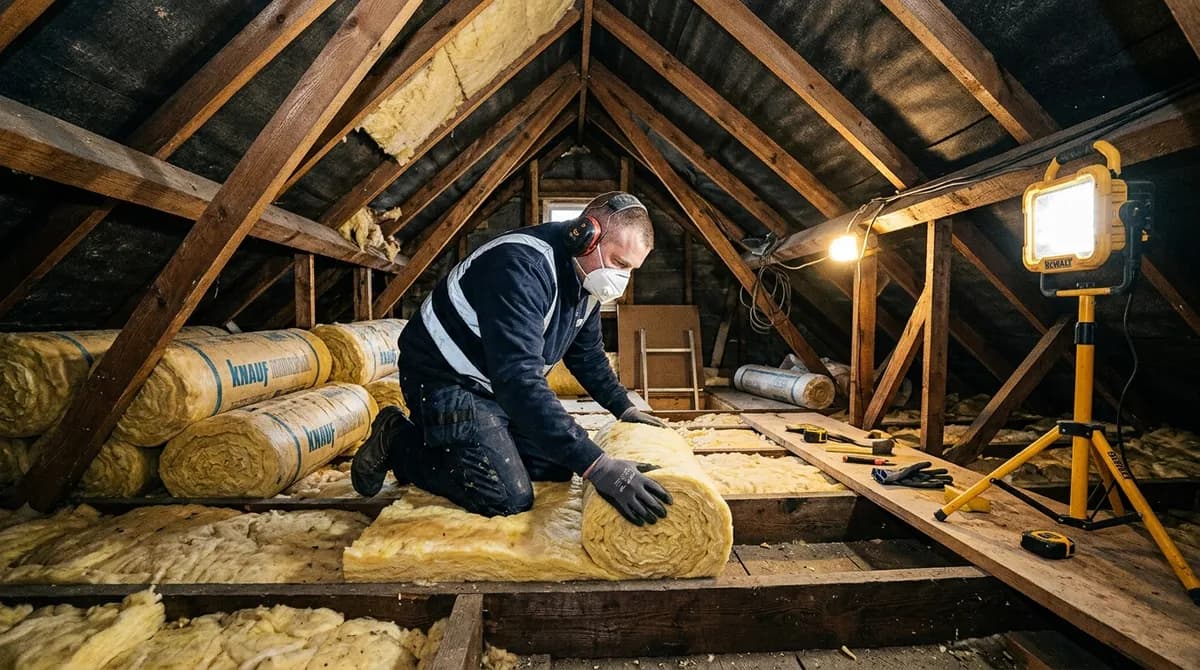
Laying mineral wool rolls across the loft floor is a genuine DIY job. Rolls cost £5-£10 per square metre from any builders merchant. You need 270 mm total thickness (one layer between joists, one across). Wear a dust mask, goggles, and gloves. The whole job takes a day for a typical 3-bed house and saves you £200-£500 in labour compared to paying an installer.
Combine with a flat roof replacement
If your flat roof needs recovering anyway, adding insulation at the same time adds relatively little to the total cost. The roof deck is already exposed, so the insulation can be laid directly on top before the new membrane goes down. Doing it separately later means stripping the new membrane, adding insulation, and re-covering - doubling the cost.
Use PIR boards for the best performance per millimetre
If space is tight between rafters, PIR rigid boards (brands like Celotex and Kingspan) deliver better thermal performance per millimetre than mineral wool. You get the same insulation value from 75 mm of PIR as 150 mm of mineral wool. They cost more per square metre, but in a room-in-roof conversion where every millimetre of headroom matters, they are worth the premium.
Get the ventilation right to avoid condensation
Warm roof insulation needs a vapour control layer on the warm side and adequate ventilation above the insulation (for cold roof setups). Getting this wrong causes condensation, which leads to timber rot and mould. An experienced roofer or insulation installer will know the Building Regulations requirements. Do not try to save money by skipping the vapour barrier - it costs £2-£5 per square metre and prevents problems that cost thousands to fix.
Official Resources
Trusted sources for further reading and professional guidance.
Energy Saving Trust: Roof and loft insulation
Independent advice on roof insulation types, costs, and energy savings for UK homes.
Gov.uk: Building Regulations Part L
Minimum insulation standards and U-value requirements under Building Regulations.
NIA: National Insulation Association
Find NIA-registered insulation installers and check industry standards.
What to Expect: The Roof Insulation Process
Roof insulation typically takes 1-2 days depending on whether it's a pitched roof, flat roof, or room-in-roof installation. Here's how the process works.
- 1
Roof survey and specification
The roof type (pitched, flat, or room-in-roof) is assessed and any damp or ventilation issues are identified. The insulation type and thickness are specified to meet Building Regulations Part L.
- 2
Ventilation checks
Adequate roof ventilation is confirmed or improved. Pitched roofs need a 50mm air gap above the insulation to prevent condensation, ventilation tiles or soffit vents may be added.
- 3
Insulation fitting between rafters
Rigid insulation boards (PIR or phenolic foam) are cut to size and friction-fitted between the rafters. For flat roofs, insulation is laid on top of the deck or between joists.
- 4
Vapour control layer
A vapour control membrane is stapled across the underside of the rafters to prevent warm, moist air from the room below reaching the cold roof structure.
- 5
Overboarding (if needed)
Where the rafter depth is insufficient for the required insulation thickness, an additional layer of insulation board is fixed below the rafters before plasterboarding.
- 6
Plasterboard and finishing
Plasterboard is screwed to the rafters (or battens) over the insulation and vapour barrier, then skimmed or dry-lined ready for decoration.
Frequently Asked Questions
How much does roof insulation cost per square metre?
Roof insulation costs £20-£50 per square metre for a pitched roof (between rafters), £30-£70 per square metre for a flat roof, and £40-£80 per square metre for a room-in-roof installation. These prices include materials and professional installation. Loft roll insulation laid on the loft floor is much cheaper at £5-£15 per square metre.
What is the difference between warm roof and cold roof insulation?
A warm roof has insulation above or between the rafters, keeping the entire roof structure warm and reducing condensation risk. A cold roof has insulation at ceiling level (on the loft floor), leaving the roof space cold. Warm roof insulation costs more but is necessary if you use the loft as living space. Cold roof insulation is cheaper and perfectly fine if you just need an insulated loft floor.
Is it worth insulating a flat roof?
Yes, flat roof insulation is well worth it if the roof is uninsulated. An uninsulated flat roof can lose 25% of a home's heat. Insulating a flat roof costs £30-£70 per square metre for a warm roof system and can save £200-£400 per year on heating bills. If the flat roof needs recovering anyway, adding insulation at the same time is significantly cheaper than doing it separately.
Can I insulate my roof myself?
Loft roll insulation on the loft floor is a straightforward DIY job. You buy mineral wool rolls from a builders merchant and lay them between and across the joists. Between-rafter insulation and flat roof insulation are more complex and usually need a professional, especially if Building Regulations approval is required. Room-in-roof insulation should always be done by a qualified installer.
Do I need Building Regulations approval for roof insulation?
Adding loft roll insulation on the floor of an existing loft does not usually require Building Regulations approval. However, insulating between rafters as part of a loft conversion, or adding insulation to a flat roof when re-roofing, does require Building Regulations sign-off. The insulation must meet minimum U-value requirements, currently 0.16 W/m²K for a roof in a new build or 0.18 W/m²K for an existing building.

Written by Chris Kervin, Co-Founder, Less.co.uk
Last updated: · Pricing based on industry data and installer quotes · Methodology
Ready to insulate your roof for less?
Compare free quotes from qualified insulation installers near you. Check government grant eligibility at the same time.
Get Free QuotesFree, no obligation · Qualified installers · Government grant check included
More insulation guides
Compare real quotes for your job
Prices move a lot with your postcode, the access on site and the spec you choose. Get up to 3 free quotes from vetted local tradespeople and see what yours actually comes to, with no obligation to book.