Loft Insulation Cost UK 2026
Loft insulation costs £300 to £600 professionally installed with 270 mm mineral wool. DIY costs as little as £150 to £250 in materials. It is one of the quickest ways to cut your heating bills - the Energy Saving Trust estimates annual savings of £100 to £235 depending on your property.
£400
Professional install
£200
DIY materials
£165
Annual saving
270 mm
Recommended depth
Prices updated April 2026 · Based on published trade rates and UK market data.
Quick answer
How much does loft insulation cost?
Professional loft insulation with 270 mm mineral wool costs £300 to £600 for a typical 3-bed house. Topping up existing insulation is cheaper at £150 to £400. DIY mineral wool rolls cost £150 to £250 in materials. Blown-in insulation costs £400 to £800 professionally but handles awkward spaces better. Many households qualify for free insulation through ECO4 or the council-run Warm Homes: Local Grant.
Loft Insulation Prices by Type
Prices for a typical 3-bed semi-detached loft (approximately 40 m²). Professional and DIY costs shown where applicable.
| Type | Professional |
|---|---|
Mineral wool rolls (270 mm) Laid between and across joists | £300 to £600 |
Top-up (100 mm to 270 mm) Adding a cross-layer to existing insulation | £150 to £400 |
Blown-in mineral wool Machine-blown loose fill | £400 to £800 |
Blown-in cellulose Recycled newspaper fibre, machine-blown | £350 to £750 |
Rigid insulation board PIR or phenolic boards between joists | £500 to £1,000 |
Spray foam (roof slope) Open or closed-cell foam on underside of roof | £1,200 to £2,500 |
Prices exclude government grants. Check eligibility before paying - many households qualify for free installation.
Get free loft insulation quotes
Tell us about the job and local insulation installers will get in touch with prices. Free, with no obligation to book.
Why 270 mm Is the Recommended Depth
Building Regulations requirement
Current Building Regulations (Part L) require 270 mm of mineral wool insulation (or equivalent thermal performance) for new loft insulation installations. This applies when you are doing the work as part of a building project. If you are simply topping up your own loft voluntarily, there is no legal requirement to reach 270 mm - but it makes financial sense to do so because the cost difference between 200 mm and 270 mm is minimal.
The first 100 mm does the most
Going from no insulation to 100 mm makes the biggest difference to heat loss. Going from 100 mm to 270 mm adds a further worthwhile improvement but with diminishing returns. Beyond 270 mm, the energy saving per additional millimetre is so small that the material cost is hard to justify. That is why 270 mm is the sweet spot - it is where the cost-benefit curve levels off.
Top-up vs fresh install
If you already have 100 mm of insulation, you only need to add a 170 mm cross-layer on top. This costs less and is quicker than a fresh install. Check that your existing insulation is dry and reasonably fluffy - if it has been compressed by stored items or is damp, it is not performing properly and may need replacing rather than topping up.
Loft Insulation Materials Compared
How the four main types stack up on cost, performance, and practicality.
| Factor | Mineral Wool | Blown-in |
|---|---|---|
| Cost per m² | £5 to £8 | £8 to £12 |
| Thermal performance | Good | Good |
| DIY friendly? | Yes | No |
| Awkward spaces | Average | Excellent |
| Moisture risk | Low | Low |
| Mortgage impact | None | None |
DIY Loft Insulation: What You Need to Know
Mineral wool loft insulation is one of the easiest DIY jobs in the house. Here is what to get right.
The basics
- ✓ Lay the first layer (100 mm) between the joists
- ✓ Lay the second layer (170 mm) across the joists at right angles
- ✓ Leave a 25 mm gap at the eaves for ventilation
- ✓ Insulate the loft hatch with a kit or rigid board offcut
- ✓ Lag any water pipes and tanks in the loft - insulating the floor makes the loft colder
Watch out for
- ✗ Recessed downlights - do not insulate directly over non-fire-rated downlights. They overheat and are a genuine fire risk. Either replace them with fire-rated LED downlights or fit insulation caps over them first
- ✗ Blocking eaves ventilation - the gap at the eaves allows air to flow under the roof felt, preventing condensation. Push the insulation right to the edge and you will get damp roof timbers
- ✗ Electrical cables - lay insulation over cables, not under them. Cables buried under insulation can overheat. If in doubt, have an electrician check the cable ratings
Government Grants for Loft Insulation
Free or subsidised loft insulation is available through two main schemes.
ECO4 (Energy Company Obligation)
Funded by the major energy suppliers, ECO4 provides free insulation to households receiving qualifying benefits or living in fuel-poor properties. It has been extended and runs until 31 December 2026. Loft insulation is one of the most commonly installed measures under the scheme.
Warm Homes: Local Grant
The Great British Insulation Scheme closed to new applicants on 31 March 2026. It has been replaced by the Warm Homes: Local Grant, delivered by local councils for lower-income homeowners and private renters whose homes sit in EPC bands D to G. It runs until 31 March 2028 and can fund loft insulation alongside other measures. Apply through your local council, or check the current options on GOV.UK.
Loft Insulation Costs by Region
Average professional installation cost for 270 mm mineral wool in a 3-bed semi, by UK region.
| Region | Typical Cost | vs National |
|---|---|---|
| London | £550 | +22% |
| South East | £500 | +11% |
| East of England | £470 | +4% |
| South West | £450 | Average |
| Midlands | £420 | -7% |
| Yorkshire | £400 | -11% |
| North West | £410 | -9% |
| North East | £380 | -16% |
| Scotland | £400 | -11% |
| Wales | £390 | -13% |
Before grants. DIY material costs are similar nationwide - delivery charges may vary.
How to Get Your Loft Insulation for Less
This is one of the cheapest home improvements you can make - and there are ways to make it cheaper still.
Paying someone? Get at least three quotes
Get at least three quotes and compare them line by line. Prices for the same job often vary by 20 to 40% between firms. Check each one includes the full 270 mm depth, loft legs or boarding if you need storage, and lagging for pipes and tanks.
Do it yourself with mineral wool rolls
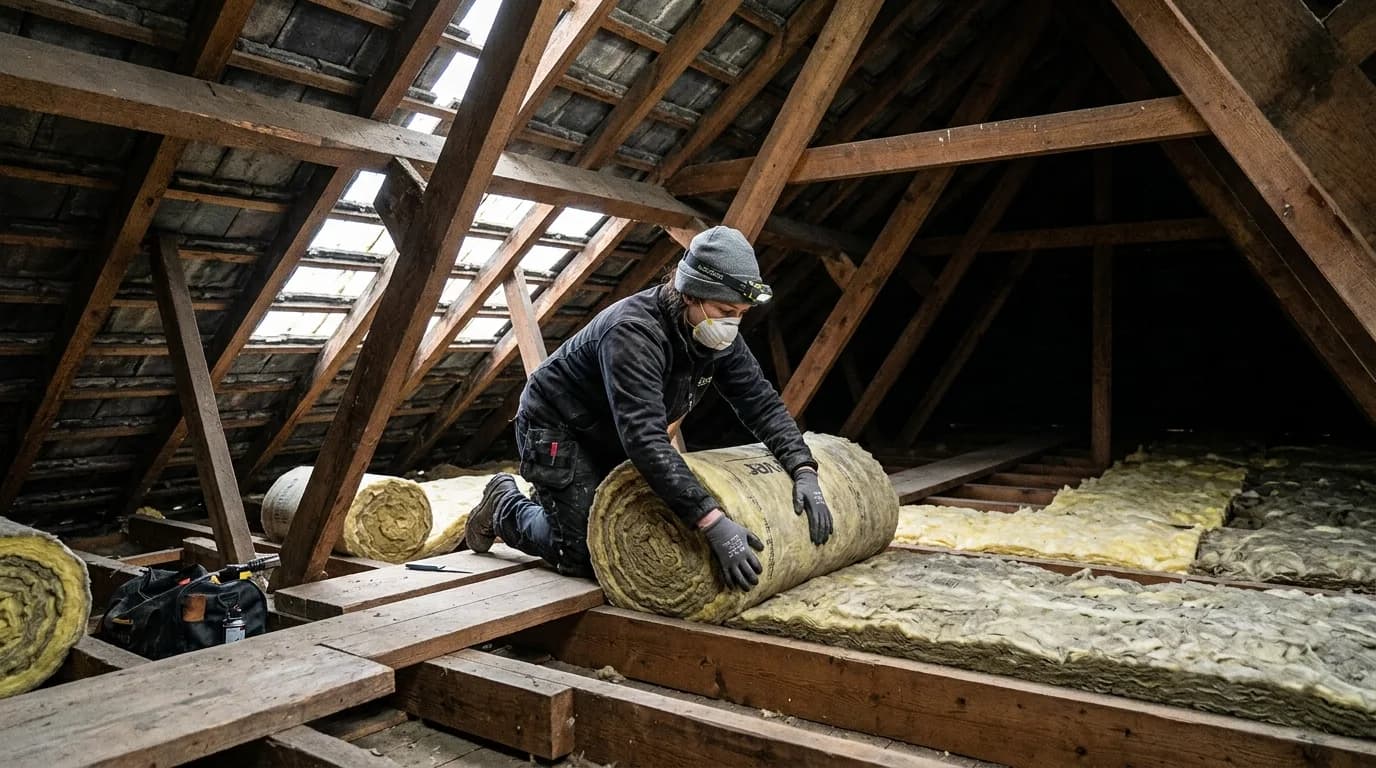
Loft insulation is one of the few home improvement jobs where DIY genuinely saves money without much risk. Mineral wool rolls cost £150 to £250 from a builders' merchant for a typical 3-bed loft. You lay the first layer between the joists and the second layer across them. The whole job takes a Saturday afternoon. Just wear a dust mask, goggles, and gloves - mineral wool fibres are itchy.
Check for free insulation through government schemes
ECO4 funds free or subsidised loft insulation for households on qualifying benefits or in fuel-poor homes, and runs until 31 December 2026. If you are on a lower income and your home sits in EPC band D to G, the council-run Warm Homes: Local Grant can cover insulation too. Always check before paying - there is no point spending £400 on something you could get for nothing.
Top up existing insulation instead of starting fresh
If you already have 100 mm of insulation, topping up to 270 mm costs roughly half the price of a fresh install because the first layer is already in place. You just lay a new cross-layer of mineral wool on top. Check that the existing insulation is dry and in reasonable condition first - if it is wet or compressed, it needs replacing, not topping up.
Think twice before choosing spray foam
Spray foam insulation on the underside of the roof slope can cause issues with some mortgage lenders, makes future roof repairs harder, and creates moisture problems if not installed correctly. For a standard storage loft, mineral wool is cheaper, simpler, and has no drawbacks. Save spray foam for loft conversions where insulating the roof slope is the only option.
Insulate your loft hatch too
An uninsulated loft hatch is a significant heat loss point that most people overlook. A loft hatch insulation kit costs £15 to £30 and takes ten minutes to fit. You can also buy draught-strip tape for the hatch frame for a few pounds. Without this, you are essentially leaving a hole in your insulation.
Free, with no obligation to book.
What to Expect: The Loft Insulation Process
Loft insulation is one of the quickest and most cost-effective energy upgrades, a professional can insulate a typical loft in half a day. It's also a popular DIY job.
- 1
Loft inspection and preparation
The loft is inspected for damp, condensation, or structural issues. Any existing insulation is checked for depth and condition. The area is cleared of stored items and boarding if necessary.
- 2
Draught proofing and sealing gaps
Gaps around pipes, cables, and the loft hatch are sealed to prevent warm air escaping. This step is essential, insulation works much less effectively if air can bypass it.
- 3
First layer between joists
Mineral wool rolls (100mm) are laid between the ceiling joists, cutting to fit snugly around obstacles. Electrical cables are laid on top of the insulation, not trapped beneath it.
- 4
Second layer across joists
A second layer (170mm) is laid at right angles across the top of the joists, bringing the total to the recommended 270mm depth for Building Regulations compliance.
- 5
Loft hatch and pipe insulation
The loft hatch is insulated and draught-stripped. Water pipes and tanks in the loft are lagged to prevent freezing, as the insulation will make the loft space colder.
Frequently Asked Questions
How much does loft insulation cost for a 3-bed house?
Professional loft insulation for a 3-bedroom semi-detached house costs £300 to £600 in 2026, depending on the material and whether it is a fresh install or a top-up. Mineral wool rolls are cheapest. Blown-in insulation costs more but is faster and better for awkward spaces. If you are happy to do it yourself, mineral wool rolls from a builders' merchant cost £150 to £250 in materials for a typical loft.
How thick should loft insulation be?
The recommended depth for mineral wool loft insulation is 270 mm (roughly 10.5 inches). This meets current Building Regulations for new builds and major renovations. Many older homes have just 100 mm or less, which means they are losing a significant amount of heat through the roof. Topping up from 100 mm to 270 mm typically saves around £20 to £30 a year on heating bills, because the first 100 mm does most of the work.
Can I install loft insulation myself?
Yes, mineral wool roll insulation is one of the most straightforward DIY jobs you can do. The rolls are laid between and across the joists - no specialist tools or skills required. You need a dust mask, goggles, gloves, and long sleeves because mineral wool fibres irritate the skin. The main things to watch out for are not blocking the eaves ventilation (leave a gap at the edges) and not insulating directly over recessed downlights unless they are fire-rated - this is a fire hazard.
Is spray foam loft insulation a good idea?
Spray foam applied to the underside of the roof slope has become controversial. While it provides excellent thermal performance, it can cause problems with moisture if the roof cannot breathe properly, and some mortgage lenders are reluctant to lend on properties with spray foam insulation. It can also make future roof repairs more difficult and expensive. For a standard loft that you want to keep as storage space, mineral wool between the joists is almost always the safer and cheaper option. Spray foam makes more sense when you are converting the loft into a habitable room.

Written by Chris Kervin, Co-Founder, Less.co.uk
Last updated: · Pricing based on published trade rates and UK market data · Methodology
Ready to get your loft insulated for less?
Compare free quotes from local insulation installers. If you might qualify for free insulation through a government scheme, check that first.
Get Free Loft Insulation QuotesFree, no obligation · Local installers · Check grants on GOV.UK first
More home improvement costs