Cavity Wall Insulation Cost UK 2026
Cavity wall insulation costs £500 to £1,500 for a typical 3-bed semi-detached house. Many households qualify for free insulation through government schemes. It is one of the most cost-effective energy efficiency upgrades you can make - the Energy Saving Trust estimates annual savings of £185 to £350 on heating bills.
£900
3-bed semi
£295
Annual saving
2 to 5 yrs
Pays for itself
2 to 4 hrs
Installation time
Prices updated April 2026 · Based on industry data and contractor submissions.
Quick answer
How much does cavity wall insulation cost?
Cavity wall insulation costs £500 to £1,500 for a typical 3-bedroom semi-detached house in 2026. A mid-terrace is cheaper at £350 to £600 because there are fewer external walls. A 4-bed detached costs £1,100 to £2,500. Installation takes just 2 to 4 hours in most cases. Many households get it for free through government energy efficiency schemes.
Cavity Wall Insulation Prices by Property Type
Prices for mineral wool cavity wall insulation including installation. EPS beads and polyurethane foam cost more.
Mid-terrace (2-bed)
£450
£350 to £600
End-terrace (2-bed)
£600
£450 to £800
Semi-detached (3-bed)
£900
£500 to £1,500
Detached (3-bed)
£1,200
£800 to £1,800
Detached (4-bed)
£1,600
£1,100 to £2,500
Bungalow (2-bed)
£650
£450 to £900
Prices exclude government grants. Check eligibility before paying - you may qualify for free installation.
How to Check If Your Walls Are Cavity Walls
The age test
Most houses built from the 1930s onwards in England and Wales have cavity walls. Houses built before 1920 almost certainly have solid walls. The 1920s-1930s is a grey area where both types exist. Scottish properties followed a different building tradition - many houses up to the 1980s have solid stone walls.
The brick pattern test
Look at your external brickwork. If all the bricks are laid lengthways (stretcher bond - the same pattern you see on a garden wall), you probably have a cavity wall. If you can see alternating rows of lengthways and end-on bricks (Flemish bond or English bond), you have solid walls. Rendered or clad walls hide this clue, so you will need a different method.
The wall thickness test
Measure the wall thickness at a window or door reveal (the bit that sticks out inside the opening). Cavity walls are typically 250 to 270 mm thick. Solid brick walls are around 220 mm. Stone walls can be thicker than both, so this test is less reliable on stone-built properties.
The borescope test (definitive)
An installer or surveyor drills a small hole (about 10 mm) through the mortar joint and inserts a tiny camera. This shows the actual cavity - its width, condition, and whether it is already insulated. This is the only way to be completely certain and is well worth the cost (£100 to £250) before committing to a job.
Insulation Materials Compared
Three main materials are used for cavity wall insulation. Each has its strengths.
| Material | Cost |
|---|---|
| Mineral wool | £ Lowest |
| EPS beads (bonded) | £ Medium |
| Polyurethane foam | £ Highest |
All three materials carry a 25-year CIGA guarantee when installed by a registered installer.
When Cavity Wall Insulation Is Not Suitable
Cavity wall insulation works brilliantly in most UK homes, but there are situations where it can cause problems. Knowing when to walk away is as important as knowing when to go ahead.
Higher-risk situations
- ✗ Narrow cavity (under 50 mm) - there is not enough space for the insulation to work properly, and bridging between the inner and outer leaves can transfer moisture inwards
- ✗ Severe exposure zone (zone 4) - properties on the west coast of Scotland, Wales, Cornwall, and other wind-driven rain hotspots are at higher risk of moisture penetrating through the insulation
- ✗ Existing wall defects - cracked render, missing mortar joints, or damaged pointing allow water into the wall before it reaches the cavity. Fix these first or insulation will trap the moisture inside
- ✗ Rubble-filled cavities - some older properties have cavities partially filled with mortar droppings or debris, preventing even distribution of insulation material
If insulation has already been installed and is causing damp, extraction costs £1,500 to £3,000.
Government Grants for Cavity Wall Insulation
Two main schemes currently fund cavity wall insulation for eligible households.
ECO4 (Energy Company Obligation)
ECO4 is open until 31 December 2026 and is funded by the major energy suppliers. It provides free insulation to households that receive qualifying benefits (Universal Credit, Pension Credit, Child Tax Credit, and others) or that live in fuel-poor properties. There is no ECO5; the government's Warm Homes Plan is the long-term replacement. Check gov.uk for the latest on available funding.
Warm Homes: Local Grant
The Great British Insulation Scheme closed to new applicants on 31 March 2026. The Warm Homes: Local Grant has taken its place. It is delivered by local councils for lower-income homeowners and private renters whose property is in EPC band D to G, and it runs until 31 March 2028. Insulation and heating upgrades are covered, so it is worth contacting your council to see what help you can get. Apply through your local council, or check the options on gov.uk.
Additional Costs to Budget For
| Extra Item | Typical Cost |
|---|---|
| Cavity wall extraction (failed insulation) | £1,500 to £3,000 |
| Re-insulation after extraction | £500 to £1,500 |
| Borescope survey | £100 to £250 |
| Render repairs (after drilling) | £50 to £150 |
| Scaffolding (3+ storey properties) | £300 to £800 |
Cavity Wall Insulation Costs by Region
Average cost for a 3-bed semi-detached house (mineral wool), by UK region.
| Region | Typical Cost | vs National |
|---|---|---|
| London | £1,200 | +33% |
| South East | £1,050 | +17% |
| East of England | £950 | +6% |
| South West | £900 | Average |
| Midlands | £850 | -6% |
| Yorkshire | £800 | -11% |
| North West | £820 | -9% |
| North East | £750 | -17% |
| Scotland | £800 | -11% |
| Wales | £780 | -13% |
Before grants. Many households pay nothing after government scheme funding is applied.
How to Get Your Cavity Wall Insulation for Less
Smart moves to keep costs down - starting with checking whether you need to pay at all.
Check if you qualify for free insulation first
The ECO4 scheme and the Warm Homes: Local Grant fund free or heavily subsidised cavity wall insulation for eligible households. Even if you are not on benefits, you may qualify for the Warm Homes: Local Grant through your council if your property is in EPC band D to G. Contact your energy supplier or local council before paying full price.
Get a borescope survey before committing
A proper borescope inspection costs £100 to £250 and tells you exactly what the cavity looks like - its width, whether there are obstructions (rubble, mortar snots, wall ties), and whether the cavity is clean enough for insulation. It is the best money you can spend on this job because it prevents the much more expensive problem of unsuitable insulation causing damp.
Combine with loft insulation for a bigger saving
If your loft insulation is also below the recommended 270 mm, getting both done at once makes sense. Some installers offer a package deal, and government grants often cover both. The combined energy saving is significantly more than either measure alone - the Energy Saving Trust estimates cavity wall plus loft insulation saves a typical household £300 to £500 a year on heating bills.
Use a CIGA-registered installer
The Cavity Insulation Guarantee Agency (CIGA) provides a 25-year guarantee that transfers with the property. Using a CIGA-registered installer means you have independent recourse if problems arise - not just the installer's own warranty. It also reassures buyers if you sell the house, because solicitors routinely ask for the CIGA certificate during conveyancing.
Know when cavity wall insulation is not the right answer
Not every house is suitable. Properties in severe wind-driven rain zones (western Scotland, Cornwall, Welsh coast), houses with narrow cavities under 50 mm, and homes with known wall defects are higher risk. If your house falls into any of these categories, ask the installer specifically about suitability before proceeding. External wall insulation may be the better option, though it costs considerably more.
What to Expect: The Cavity Wall Insulation Process
Cavity wall insulation is one of the quickest home improvement jobs going. Most houses are done in 2 to 3 hours with minimal disruption.
- 1
Pre-installation survey
A surveyor checks the property to confirm it has suitable cavity walls (typically 50mm+ gap). They use a borescope to inspect the cavity for debris, existing insulation, or dampness that could cause problems.
- 2
Drilling injection holes
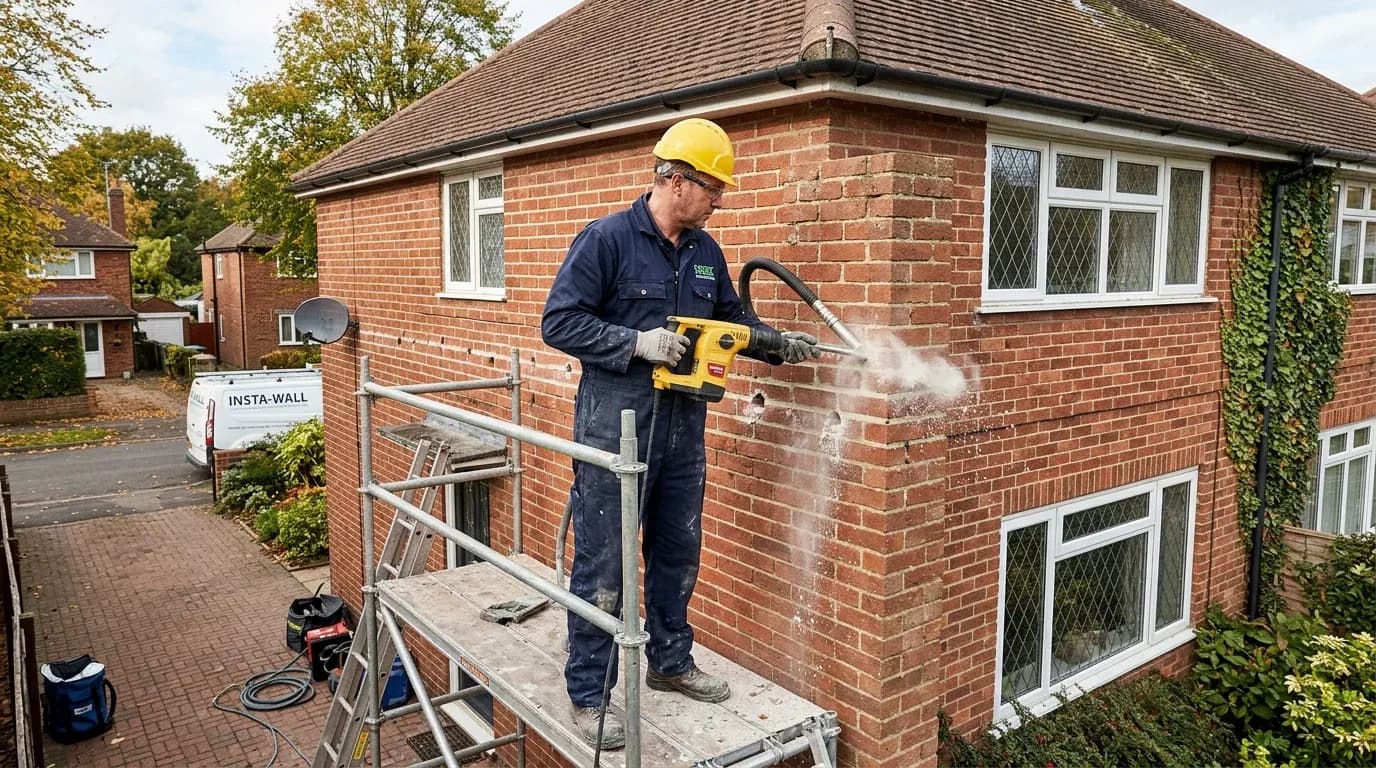
Small holes (around 22mm diameter) are drilled into the mortar joints at regular intervals across the external walls, usually about 1 metre apart horizontally and vertically. On rendered walls, the holes go through the render and outer brick leaf.
- 3
Injecting the insulation material
The chosen material, mineral wool fibre, expanded polystyrene (EPS) beads, or polyurethane foam, is pumped into the cavity through each hole using specialist equipment. The installer works systematically to ensure full coverage.
- 4
Sealing and making good
Each drill hole is filled with colour-matched mortar and pointed to blend with the existing brickwork. On rendered walls, the holes are patched and smoothed. The installer checks that no material has escaped through vents or gaps.
- 5
Post-installation check and guarantee
The installer issues a 25-year CIGA guarantee (Cavity Insulation Guarantee Agency) and provides documentation. They confirm the work was carried out to PAS 2030 standards by a TrustMark-registered installer, which is required for grant-funded work.
Frequently Asked Questions
How much does cavity wall insulation cost for a 3-bed semi?
Cavity wall insulation for a typical 3-bedroom semi-detached house costs between £500 and £1,500 in 2026, depending on the insulation material and the size of the property. Mineral wool is at the lower end, EPS beads in the middle, and polyurethane foam at the top. Many households qualify for free or heavily subsidised insulation through government schemes like ECO4 and the Warm Homes: Local Grant.
How do I know if my walls are cavity walls?
Most houses built after the 1930s in the UK have cavity walls. You can usually tell by looking at the brickwork - if all the bricks are laid lengthways with no headers (bricks laid end-on), it is likely a cavity wall. The simplest check is to measure the wall thickness at a window or door reveal. Cavity walls are typically 250 to 270 mm thick, while solid walls are around 220 mm. For a definitive answer, an installer can drill a small hole and use a borescope to inspect the cavity.
Can cavity wall insulation cause damp?
It can, but usually only when the property was not suitable for cavity wall insulation in the first place. Properties in severe exposure zones (western coasts and highlands), homes with very narrow cavities (under 50 mm), or walls with existing defects like cracked render or missing mortar are higher risk. When insulation is installed in a suitable property by a registered installer following current standards, damp problems are rare. If insulation has already been installed and is causing problems, extraction and remediation typically costs £1,500 to £3,000.
Can I get free cavity wall insulation?
Yes, many UK households qualify for free or heavily subsidised cavity wall insulation through the Energy Company Obligation (ECO4) scheme or the Warm Homes: Local Grant, which replaced the now-closed Great British Insulation Scheme. Eligibility depends on your benefits status, household income, and your property's EPC rating. Even if you do not qualify for full funding, partial grants can bring the cost down significantly. Your energy supplier, local council, or a registered installer can check your eligibility.

Written by Chris Kervin, Co-Founder, Less.co.uk
Last updated: · Pricing based on industry data and verified contractor submissions · Methodology
Ready to get your cavity walls insulated for less?
Compare free quotes from registered insulation installers near you. Check government grant eligibility at the same time.
Get Free QuotesFree, no obligation · Registered installers · Government grant check included
More home improvement costs
Compare real quotes for your job
Prices move a lot with your postcode, the access on site and the spec you choose. Get up to 3 free quotes from vetted local tradespeople and see what yours actually comes to, with no obligation to book.