How Much Does a New Driveway Cost in 2026?
A new driveway for an average UK home costs between £2,000 and £8,000 depending on size, material, and any groundwork required. Priced by area, driveway cost runs from £20 to £40 per square metre for gravel up to £70 to £120 per square metre for block paving. Gravel and tarmac are the cheapest options. Resin-bound and block paving cost more but look significantly better and last longer.
£4,500
Average cost
£1,800
Tarmac from
£3,500
Block paving from
£4,000
Resin-bound from
Prices updated April 2026 · Based on published trade rates and UK market data.
Planning permission notice. Driveways over 5 square metres require planning permission unless they use permeable materials such as gravel, permeable block paving, or resin-bound aggregate. Impermeable surfaces over 5 sqm require a planning application. Check the rules on the Planning Portal.
New Driveway Prices by Material
All prices below are for a 40 sqm driveway - a typical double drive for a three-bedroom semi-detached house. Prices include supply, labour, and a standard sub-base. They exclude dropped kerb work and removal of an existing surface.
| Material | Average Cost | Price Range |
|---|---|---|
| Gravel driveway (40 sqm) | £1,800 | £1,200 to £2,800 |
| Tarmac / asphalt driveway (40 sqm) | £3,200 | £2,200 to £4,500 |
| Pattern imprinted concrete (40 sqm) | £4,500 | £3,000 to £6,500 |
| Block paving driveway (40 sqm) | £5,500 | £3,500 to £8,000 |
| Resin-bound driveway (40 sqm) | £5,000 | £3,500 to £7,000 |
| Marshalls or natural stone (40 sqm) | £7,500 | £5,000 to £12,000 |
Prices based on a 40 sqm drive. Price per sqm reduces for larger areas. Excludes dropped kerb, surface removal, and drainage work unless stated.
Get Free Driveway Quotes
Tell us about your driveway and local installers will get in touch with prices. Free, with no obligation to book.
Your details go to our quote partner, Leads.work, who pass them to a few local firms that cover your area. They'll contact you about the job, which may include a phone call. It's free for you, and we're paid a referral fee. How your details are used
Driveway Cost by Material - Full Comparison
Choosing the right driveway material is about more than just the upfront cost. A tarmac driveway costs less to lay but may need resealing after a decade. Block paving costs more initially but lasts 25 years or longer with minimal upkeep. Premium manufacturers such as Marshalls, the UK's leading hard landscaping supplier, offer a wide range of block paving and natural stone options. Here is how every common material stacks up for a standard 50 m² driveway.
| Material | Cost per m² | 50 m² Driveway | Lifespan | Maintenance |
|---|---|---|---|---|
| Gravel | £20 to £40 | £1,000 to £2,000 | 10 to 15 years | Needs topping up every few years |
| Tarmac | £40 to £70 | £2,000 to £3,500 | 15 to 20 years | May need resealing after 10 years |
| Block paving | £70 to £120 | £3,500 to £6,000 | 25 to 30 years | Occasional re-sanding of joints |
| Resin bound | £40 to £70 | £2,000 to £3,500 | 20 to 25 years | Very low - occasional jet wash |
| Pattern imprinted concrete | £50 to £90 | £2,500 to £4,500 | 20 to 25 years | Needs resealing every 3 to 5 years |
| Indian sandstone | £70 to £120 | £3,500 to £6,000 | 30+ years | Occasional cleaning and repointing |
Prices include supply, labour, and standard sub-base preparation. Actual costs vary by location and ground conditions.
Driveway Cost by Size: 1 Car, 2 Car and Larger
Driveway cost in the UK depends heavily on how much ground you need to cover. A single-car drive of 20 m² is straightforward. A large drive with turning space pushes past 60 m² and the costs reflect that. Here is what you can expect to pay for the three most popular materials at each size.
| Driveway Size | Description | Block Paving | Tarmac | Resin Bound |
|---|---|---|---|---|
| Small (20 m²) | Single car | £1,500 to £2,500 | £800 to £1,400 | £1,200 to £2,000 |
| Medium (40 m²) | Two cars | £3,000 to £4,500 | £1,600 to £2,800 | £2,400 to £3,500 |
| Large (60 m²) | Two cars + turning | £4,500 to £6,500 | £2,400 to £4,200 | £3,500 to £5,000 |
| Very large (80 m²+) | Multiple cars | £6,000 to £9,000 | £3,200 to £5,600 | £4,500 to £7,000 |
Prices include supply, labour, and sub-base. Excludes dropped kerb, surface removal, and drainage.
How much does a 1 car driveway cost?
A single-car drive of around 20 m² costs £800 to £1,400 in tarmac, £1,200 to £2,000 in resin-bound, and £1,500 to £2,500 in block paving. Small drives are the ones where the per square metre rate stings most, because the contractor still has to bring the same team, the same digger and the same skip whether the area is 20 m² or 60 m².
How much does a 2 car driveway cost?
A two-car drive of around 40 m² is the most common size. Expect £1,600 to £2,800 for tarmac, £2,400 to £3,500 for resin-bound and £3,000 to £4,500 for block paving. Add turning space and you are into the 60 m² bracket, where block paving runs £4,500 to £6,500.
Driveway Cost per Square Metre
Most driveway contractors quote per square metre, so this is the number worth having in your head before anyone comes round to measure up. Installed and including a standard sub-base, driveway cost per m² in the UK breaks down like this:
- Gravel£20 to £40 per m²
- Tarmac£40 to £70 per m²
- Resin bound£40 to £70 per m²
- Pattern imprinted concrete£50 to £90 per m²
- Block paving£70 to £120 per m²
- Indian sandstone£70 to £120 per m²
Two things to watch when you compare quotes on a per m² basis. First, the rate should be falling as the area grows, so a 60 m² drive ought to be cheaper per square metre than a 20 m² one. Second, check what the rate actually covers. A quote of £70 per m² that excludes removing the old surface (£300 to £800) and a drainage channel (£300 to £700) is not really £70 per m². Measure your drive, multiply by the rate above, then add those extras separately.
What Affects the Cost of a New Driveway?
Size of the driveway
The most obvious factor. Prices are often quoted per square metre, and the cost per sqm tends to reduce as the area increases - a contractor mobilising to site has fixed costs regardless of job size. A single-car drive of around 20 sqm costs considerably less than a double drive of 40 sqm, but not exactly half, because preparation and access work is similar for both.
Material choice
This is the biggest variable. Gravel is the cheapest material by a significant margin, followed by tarmac. Block paving, resin-bound, and natural stone all cost more but offer better appearance, durability, and kerb appeal. Pattern imprinted concrete sits in the mid-range but is prone to cracking and costly to repair, so it has fallen out of favour with many driveway specialists.
Existing surface condition and removal
If your current driveway surface needs to be broken up and removed, expect to add £300 to £800 to the cost depending on the material and area. Removing old concrete is more labour-intensive than tarmac. If the existing sub-base is in poor condition and needs to be dug out and reinstated, costs can increase further.
Sub-base depth and drainage requirements
A properly laid driveway requires a compacted MOT Type 1 sub-base - typically 100 to 150mm deep. If the ground is soft, the sub-base needs to be deeper. Poor drainage from the existing ground or proximity to drains can also add cost. Drainage channels (linear drainage) along the edge of a driveway add £300 to £700 but are sometimes required by planning regulations.
Dropped kerb
If you do not already have a dropped kerb, you will need to apply to your local council for one. The application and installation cost typically runs £800 to £2,000. This is separate from your driveway quote - you apply to the council, they appoint their own contractor, and you pay the council directly.
Location
Labour costs vary significantly across the UK. London and the South East command the highest rates - up to 28% above the national average. Northern England, Scotland, and Wales typically come in below average. See the regional breakdown further down the page.
Additional and Hidden Costs
The driveway surface quote is rarely the whole story. These are the most common additional costs homeowners encounter.
| Extra Item | Typical Cost |
|---|---|
| Removal of existing driveway surface | £300 to £800 |
| Dropped kerb (council application and installation) | £800 to £2,000 |
| Drainage channel installation | £300 to £700 |
| Gate automation | £600 to £2,000 |
| EV charger point installation | £700 to £1,200 |
Driveway Resurfacing Cost vs a Full Replacement
Not every tired-looking drive needs digging out. If the sub-base underneath is still sound, resurfacing lays a fresh wearing surface over what is already there and skips the £300 to £800 you would otherwise pay to break up and cart away the old driveway. That is the whole saving, so the sums are easy to do: take the material rate you want from the per square metre figures above and leave out the removal line.
When resurfacing works
Tarmac that has gone grey and crumbly on top but is still flat and firm underfoot is the classic candidate. So is block paving where the blocks themselves are worn or stained but the edgings and sub-base have not moved. A contractor should walk the drive with you and show you why the base is sound rather than simply asserting it.
When you need the full job
Dips, ruts, rocking blocks, weeds coming up through the middle, or water sitting on the surface after rain all point to a failed sub-base. Resurfacing over that buys you a couple of years at most and the same faults come back through. Dig it out, add a drainage channel at £300 to £700 if water has nowhere to go, and lay the new surface properly.
Watch the material switch
Resurfacing usually means staying with the same family of material. Going from tarmac at £40 to £70 per m² to block paving at £70 to £120 per m² is a replacement, not a resurface, because the depth and the edge detail both change. Be wary of anyone quoting resurfacing prices for a change of material.
Planning Permission and Drainage Rules
One of the most overlooked aspects of a new driveway is planning permission. The rules changed in 2008 and many homeowners still do not realise they apply. Getting this wrong can mean enforcement action and having to rip up a brand-new surface.
The 5 m² rule
If you are paving over more than 5 square metres of your front garden with an impermeable surface, you need planning permission. This applies to standard tarmac, solid concrete, pattern imprinted concrete, and standard block paving laid on a non-permeable base. Most driveways are larger than 5 m², so this rule catches the majority of projects.
Permeable surfaces - no permission needed
You can avoid the planning application entirely by choosing a permeable material. Gravel, permeable block paving (laid with wider joints on a permeable sub-base), and resin-bound aggregate all count as permeable. Alternatively, if you direct rainwater runoff into a lawn, border, or soakaway rather than onto the pavement or road, you also avoid the need for permission - even with an impermeable surface.
Non-permeable surfaces that need drainage
Tarmac, standard concrete, and standard block paving are all non-permeable. If you choose one of these for an area over 5 m², you either need to install a drainage channel that directs water back into your garden or a soakaway, or apply for planning permission. A linear drainage channel costs £300 to £700 and is often cheaper and quicker than the planning route.
Dropped kerb costs and process
If you do not already have a dropped kerb, you need to apply to your local council. The combined council application fee and installation cost is typically £800 to £2,000. You cannot do this work yourself - the council appoints their own highways contractor. Allow 4 to 8 weeks for approval, so apply well before your driveway installation is booked.
For the full rules, see the government guidance on permeable surfacing. For detailed technical guidance on sub-bases, laying patterns, and drainage design, Pavingexpert.com is a trusted independent resource used widely across the trade. If your property is in a conservation area or is a listed building, stricter rules may apply - check with your local planning authority first.
Driveway Prices by Region
These are average installed prices for a mid-range block paving driveway (40 sqm) in each region of the UK.
| Region | Average Cost | vs National |
|---|---|---|
| London | £5,700 | +28% |
| South East | £5,100 | +13% |
| East of England | £4,800 | +7% |
| South West | £4,800 | +7% |
| Midlands | £4,500 | Average |
| Yorkshire | £4,000 | -11% |
| North West | £4,100 | -9% |
| North East | £3,800 | -16% |
| Scotland | £4,000 | -11% |
| Wales | £3,900 | -13% |
Based on industry data. Prices for a 40 sqm mid-range block paving driveway, fully installed.
How to Get Your New Driveway for Less
A few straightforward moves can shave hundreds - sometimes over a thousand pounds - off the final bill without compromising on quality or materials.
Get the dropped kerb sorted first
Council approval for a dropped kerb takes 4 to 8 weeks and you cannot legally use the driveway without one. Apply to your local council before booking the driveway contractor - it should be the first step in the process, not an afterthought.
Resin-bound vs block paving - worth comparing
Resin-bound and block paving come in at similar price points, but resin-bound requires less maintenance (no weeds growing between joints, no settling of individual blocks) and is permeable so no planning permission needed. For a low-maintenance premium finish, it is well worth getting quotes for both.
Get three quotes - prices vary enormously
Driveway contractors price jobs very differently. Some quote high and expect to negotiate; others are simply more competitive. Getting three written quotes for the same specification is the single most reliable way to avoid overpaying. A saving of £500 to £1,500 is common on a mid-range job.
Choose permeable materials to avoid planning permission
Using a permeable surface - gravel, permeable block paving, or resin-bound aggregate - means you do not need planning permission for driveways over 5 sqm. This saves the cost and delay of a planning application (£548 in England, more in some areas) and removes the risk of refusal.
Bundle with neighbouring properties
If your neighbours also need their driveway done, one contractor working on multiple drives in the same street saves on setup, materials delivery, and skip hire. Contractors will often offer a meaningful discount for this - it is worth knocking on doors before you book.
Spring and autumn are the best times to book
Driveway contractors are busiest in summer. Booking in March-April or September-October means more contractor availability, less scheduling pressure, and often slightly better prices. Tarmac and resin also perform better in milder temperatures during laying.
Comparing quotes is the simplest way to pay less
Getting three or four quotes and comparing them is how most homeowners avoid overpaying. It takes a couple of minutes, with no obligation.
Get my free quotesWhat to Expect: The Driveway Installation Process
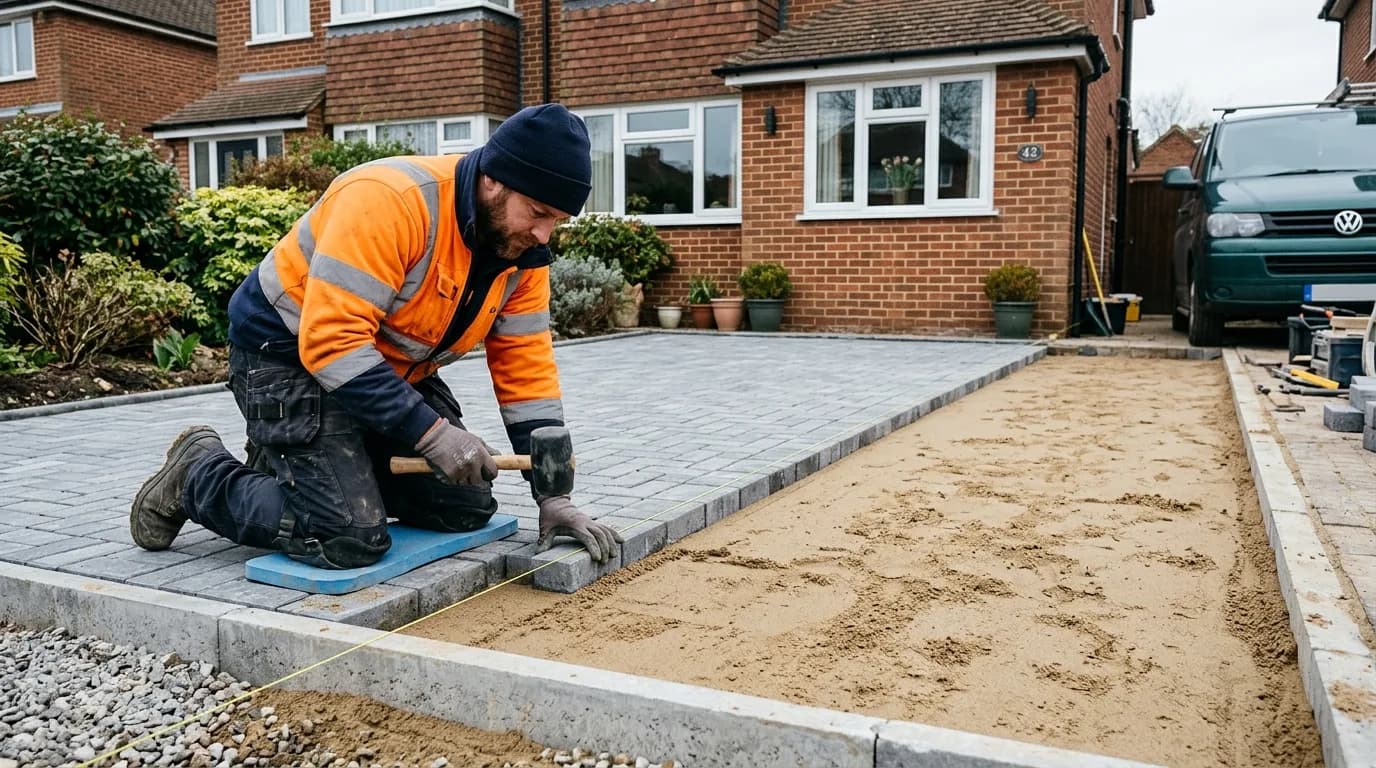
Here is how a typical new driveway installation runs from start to finish, so you know what to expect at each stage. If you want to find a reputable installer, the British Association of Landscape Industries (BALI) maintains a directory of accredited landscaping and driveway contractors.
- 1
Survey and quote
A reputable driveway contractor will visit to assess the ground, measure the area, check access, and discuss materials. A proper survey matters - contractors who quote without visiting can give wildly inaccurate prices once they see the actual site conditions.
- 2
Dropped kerb application (if required)
If you do not already have a dropped kerb, apply to your local council as early as possible - approval takes 4 to 8 weeks. Your contractor cannot start until this is confirmed, or at least underway with a clear approval timeline.
- 3
Existing surface removal
The old surface is broken up and removed, usually by mini-digger and grab lorry. Depending on the material, this can be done in a few hours or take the better part of a day. The sub-base is assessed and any soft spots are dug out and made good.
- 4
Sub-base and edging installation
A compacted MOT Type 1 sub-base is laid and compacted. Edging kerbs are set to define the perimeter and hold the surface in place. This stage is the foundation of a long-lasting driveway - cutting corners here leads to failure regardless of the surface material.
- 5
Surface material installation
The chosen surface - tarmac, block paving, resin, or other - is laid and finished. Block paving is jointed with kiln-dried sand and compacted. Resin-bound is trowelled to a smooth finish. Tarmac is rolled and compacted while hot.
- 6
Drainage and finishing
Any drainage channels are fitted and connected to existing surface water drainage. The site is cleaned, edging is finished, and you will be advised on curing times - for example, resin-bound needs 24 to 48 hours before use, and new tarmac should not be driven on for 24 hours in warm weather.
Frequently Asked Questions
How much does a new driveway cost in the UK?
A new driveway for an average UK home typically costs between £2,000 and £8,000 depending on size, material, and any groundwork required. Gravel driveways are the cheapest option from around £1,200, while natural stone and Indian sandstone can exceed £10,000 for a large area. The most popular choice - block paving for a 40 sqm driveway - averages around £5,500.
How much does a driveway cost per square metre?
Installed and including a standard sub-base, driveway cost per square metre runs from £20 to £40 for gravel, £40 to £70 for tarmac and resin bound, £50 to £90 for pattern imprinted concrete, and £70 to £120 for block paving or Indian sandstone. The rate should come down as the area grows, so a 60 sqm drive ought to work out cheaper per square metre than a 20 sqm one. Always check what the rate covers - removing the old surface (£300 to £800) and a drainage channel (£300 to £700) are usually quoted separately.
What is the cheapest driveway option?
Gravel is the cheapest driveway by a clear margin at £20 to £40 per square metre, which is £1,000 to £2,000 for a 50 sqm drive. It is also permeable, so there is no planning application to pay for. The trade-off is upkeep: gravel migrates towards the road, needs topping up every few years, and lasts 10 to 15 years rather than the 25 to 30 you get from block paving. Tarmac is the next cheapest at £40 to £70 per square metre and needs far less attention.
Do I need council permission to build a driveway?
Two separate permissions are involved and people often confuse them. Planning permission covers the surface itself and is only needed if you are laying more than 5 square metres of impermeable material. Council permission for a dropped kerb is separate, and you need it whatever surface you choose, because crossing the pavement and the public footway is the council's business rather than yours. Budget £800 to £2,000 for the dropped kerb and allow 4 to 8 weeks for approval.
Can I turn my front garden into a driveway?
In most cases yes, but there are two hurdles. If you are paving more than 5 square metres of front garden with an impermeable surface you need planning permission, which costs £548 in England. Choose a permeable surface instead - gravel, permeable block paving or resin-bound aggregate - and that requirement disappears. Separately, you need the council to approve and install a dropped kerb at £800 to £2,000, because you cannot legally drive over a standard kerb. Conservation areas and listed properties have tighter rules, so check with your council first.
Does a new driveway add value to a house?
Off-street parking is one of the features buyers filter for, particularly in terraced streets and anywhere with residents' parking schemes, so a driveway widens the pool of people interested in the house. The finish matters as much as the fact of it. Block paving and resin-bound both read as a deliberate improvement, whereas a cracked pattern imprinted surface can read as a job that now needs redoing. We do not publish a figure for the uplift because it varies far too much by street and by house type to be worth quoting.
Do I need planning permission for a new driveway?
Planning permission is required for driveways over 5 square metres if the surface is impermeable (solid concrete, standard tarmac, or pattern imprinted concrete). Driveways made from permeable materials - gravel, permeable block paving, or resin-bound aggregate - do not require planning permission regardless of size. If you are in a conservation area or your property is listed, different rules may apply.
What is the difference between block paving and tarmac?
Tarmac (asphalt) is cheaper, quicker to install, and suits larger drives well. It looks more utilitarian but is durable and easy to repair. Block paving costs around 70% more but looks significantly smarter, adds kerb appeal and property value, and individual blocks can be lifted and re-laid if services need to be accessed. For a front driveway where appearance matters, most homeowners prefer block paving.
What is the difference between resin-bound and resin-bonded?
Resin-bound aggregate mixes resin and stone together before laying, creating a smooth, permeable surface that looks high-end and does not require planning permission. Resin-bonded has resin applied first and then stone scattered on top - it looks similar initially but is not permeable, requires planning permission over 5 sqm, and stone can work loose over time. For quality and longevity, resin-bound is the better choice.
How long does a new driveway last?
A well-laid tarmac driveway lasts 15 to 20 years with minimal maintenance. Block paving and resin-bound can last 20 to 25 years or more if properly installed on a solid sub-base. Gravel is the least durable - expect to top up or refresh it every 5 to 10 years. The quality of the sub-base preparation is the single biggest factor in longevity regardless of surface material.
How much does a dropped kerb cost?
A dropped kerb costs between £800 and £2,000, most of which is the council's application and installation fee. You must apply to your local council for permission - you cannot simply lower the kerb yourself. Approval typically takes 4 to 8 weeks. You cannot legally drive over a standard kerb, so if you do not already have a dropped kerb, this must be sorted before or alongside your driveway installation.
What is the best driveway material?
It depends on your priorities. For pure value, gravel is the cheapest upfront but needs ongoing maintenance. Tarmac is great if you want a low-cost, durable, no-fuss surface. Block paving offers the best combination of appearance, durability, and long-term property value. Resin-bound is the premium choice if you want a sleek, modern look with no planning issues. Avoid pattern imprinted concrete - it looks good initially but is prone to cracking and difficult to repair.
How long does a new driveway take to install?
A tarmac driveway for an average home typically takes 1 to 2 days. Block paving takes 2 to 4 days depending on size and complexity of the pattern. Resin-bound is usually 1 to 2 days once the sub-base is in place. If significant groundwork is required - deep excavation, new drainage channels, or a new sub-base from scratch - add another 1 to 2 days to any of these timelines.
How much does block paving cost per square metre?
Block paving costs between £70 and £120 per square metre fully installed, including supply, labour, and a standard sub-base. Premium blocks from manufacturers like Marshalls or Tobermore sit at the higher end. For a typical 40 sqm double driveway, that works out at £2,800 to £4,800 all in.
Free, with no obligation to book.

Written by Chris Kervin, Co-Founder of Less.co.uk
Last updated: · Pricing based on published trade rates and UK market data · Methodology