House Extension Cost & Build Guide 2026
How much does a house extension cost? In 2026, expect to pay £1,500 to £3,000 per square metre, with most single-storey rear extensions coming in between £30,000 and £60,000 finished. Before you approach a builder, you will need to sort out planning permission (or check your permitted development rights), Building Regulations, and possibly the Party Wall Act.
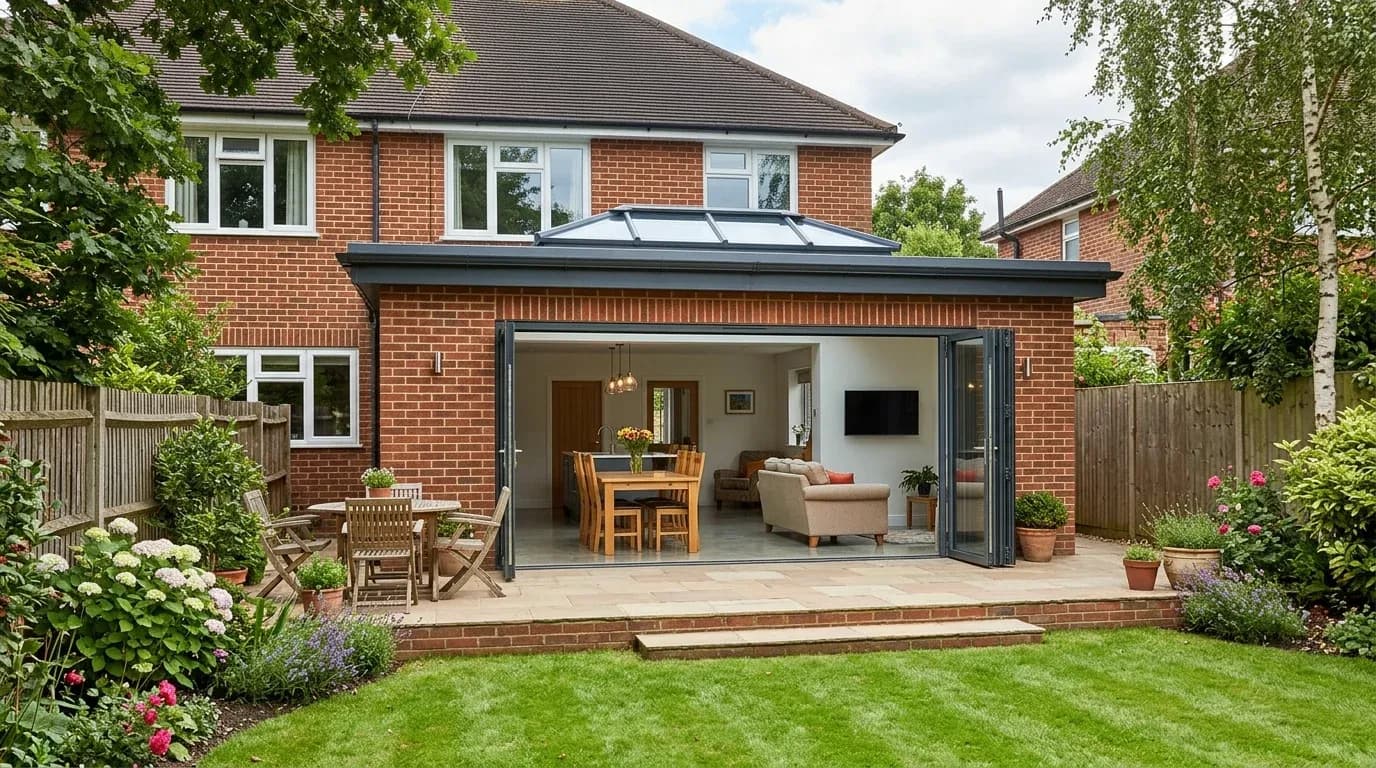
Most extensions need Building Regulations approval even under Permitted Development. Planning permission and Building Regulations are two separate processes. Your builder must notify Building Control before work starts, and the extension will need a completion certificate before you sell the property.
Quick answer
How much does a house extension cost?
Extensions typically cost between £1,500 and £3,000 per square metre in the UK. A 25m² single-storey rear extension runs between £40,000 and £70,000 finished. London and the South East are at the upper end of that range. The finish specification - windows, flooring, kitchen if it is a kitchen extension - adds significantly to the final bill.
View the full extension cost guideWhat does building an extension involve?
An extension project involves several distinct phases before any construction begins. Skipping steps here is how projects stall or go wrong.
Architect draws plans, you check permitted development limits, apply for planning permission if required
Party Wall Notices served on affected neighbours (if applicable), structural engineer engaged
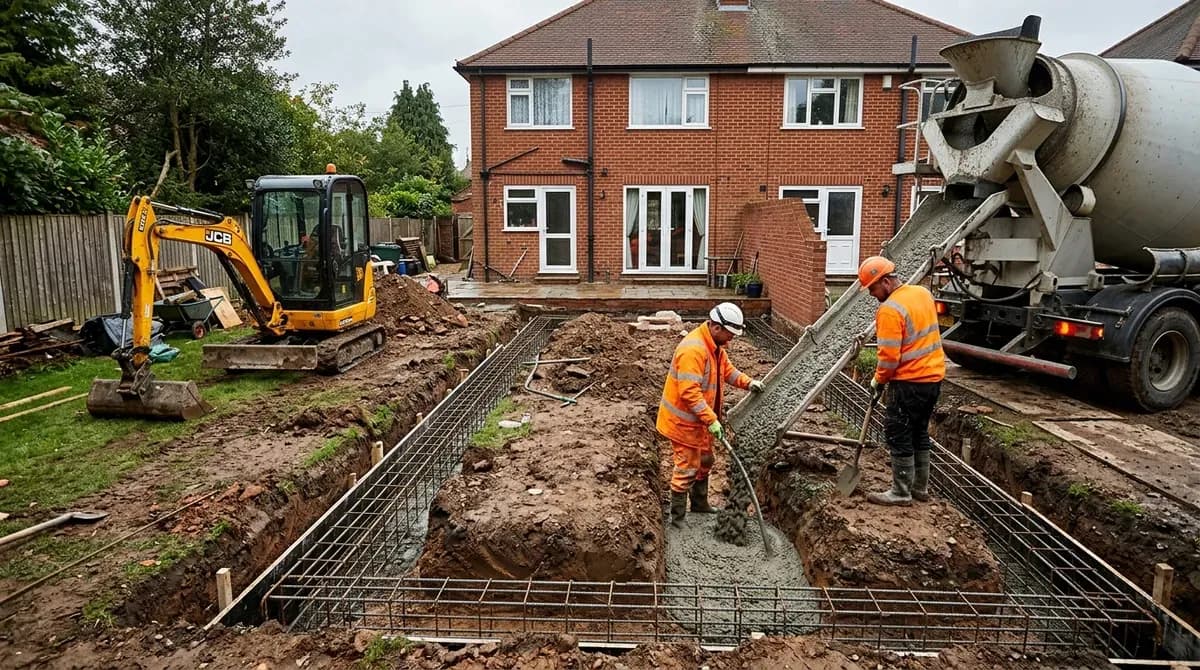
Builder starts on site: groundworks and foundations, followed by structural frame, walls, and roof
First fix services (plumbing, electrics), then plastering, flooring, and finishing. Building Control inspects at key stages and issues completion certificate
Things to think about before you hire
Permitted Development or full planning?
Check the government's Planning Portal to see whether your proposed extension falls within PD rights before spending money on architects. If it does not - or if you are in a conservation area, have an Article 4 direction, or the property is listed - you need planning permission. A planning refusal does not stop you applying again with a revised design, but it costs time.
Single or double storey?
A single-storey extension is simpler, faster, and more likely to fall within PD rights. A double-storey extension gives you more space per pound spent on foundations but almost always requires full planning permission, triggers more detailed structural requirements, and will get more scrutiny from neighbours. Weigh the additional space against the added cost and complexity.
Foundation type
The ground conditions on your plot determine what kind of foundations are needed. Most extensions in the UK use strip foundations - relatively straightforward and predictable in cost. If there are trees nearby, clay soil, or evidence of previous subsidence, you may need piled foundations, which add thousands to the build cost. A good builder will recommend a soil survey before quoting.
Insulation specification
Building Regulations Part L sets minimum insulation standards for new extensions. However, minimum is not always the right choice - it is far cheaper to increase insulation thickness during construction than to retrofit it later. If you are adding a kitchen extension, underfloor heating is much easier to lay before the screed goes in than after.
How to find a good builder for an extension
Get an architect to draw proper plans first
Going to builders with a rough sketch - or just a description - makes it impossible to compare quotes. Proper architectural drawings (typically £1,500 to £3,000 for a single extension) give every builder the same brief, which means quotes are actually comparable. The drawings also go to Building Control for sign-off.
Use a main contractor, not a self-managed team
Coordinating your own groundworker, bricklayer, roofer, plumber, and electrician saves money on paper. In practice, delays cascade and disputes about whose fault something is are almost guaranteed. A main contractor takes responsibility for the whole build and manages the sub-trades. The premium is worth it for most people.
Check FMB membership
The Federation of Master Builders (FMB) vets its members and offers a free dispute resolution service. FMB membership is not a guarantee of quality, but it is a meaningful signal that a builder has met a minimum standard. Check membership at fmb.org.uk before inviting anyone to quote.
Get at least three quotes on identical drawings
Quotes for extension work can vary by 30 to 40% for the same job. Three quotes on the same set of drawings gives you a realistic range and makes it much easier to challenge anything that looks out of line. The cheapest quote is not always the right choice - check what is and is not included.
Ask about Building Control notifications
The builder must notify Building Control before starting (and at key stages during the build). Ask specifically who is responsible for this and confirm they have done it. An extension built without Building Control sign-off will cause problems when you sell.
Extension guides
Extension cost calculator
House extension cost guide
Extension cost per m²
Single storey extension cost
Double storey extension cost
Porch cost guide
Loft conversion guide
Loft conversion cost guide
New kitchen cost guide
Porch cost guide
House extension FAQs
Do I need planning permission for a house extension?
Not always. Most single-storey rear extensions fall under Permitted Development (PD) rights, which means you can build without a full planning application, provided you stay within the PD limits. For a single-storey rear extension, that means up to 4 metres for a detached house (3 metres for a semi-detached or terraced house); larger rear extensions of up to 8 metres (6 metres for attached homes) are possible under the prior approval process. Double-storey extensions almost always need full planning permission. If your house is listed or in an Area of Outstanding Natural Beauty, PD rights are restricted or removed entirely.
How long does it take to get planning permission?
A householder planning application takes 8 weeks from validation for a decision in most cases, though some councils take longer. Add two to four weeks for the application to be prepared and submitted by an architect or planning consultant. In total, budget three to four months from the point you engage an architect to the point you have permission in hand.
Do I always need Building Regulations approval?
Yes, for almost all extensions. Building Regulations approval is separate from planning permission - it covers the structural and technical requirements of the build (foundations, insulation, fire safety, drainage). Even if your extension is permitted development and does not need planning permission, it still needs Building Regs sign-off. Your builder should register the work with Building Control before construction begins.
What is the Party Wall Act and does it apply to me?
The Party Wall etc. Act 1996 applies if you are building within 3 to 6 metres of a neighbour's foundation, or doing work on a shared wall (such as a side extension against a semi-detached neighbour's wall). You must serve a Party Wall Notice on affected neighbours before work starts. If neighbours agree, the process is straightforward. If they dissent, a Party Wall Surveyor must be appointed - your cost to fund, in most cases.
How long does a house extension take to build?
A single-storey rear extension typically takes eight to twelve weeks on site once foundations are dug. A larger double-storey extension takes four to six months. This is the construction phase only - add two to four months for design and planning (if required) before a spade goes in the ground.
Get free quotes from extension builders near you
Fill in the short form on our extension cost page and local builders will get in touch with prices. Free, with no obligation to book.