How Much Does a Single Storey Extension Cost in 2026?
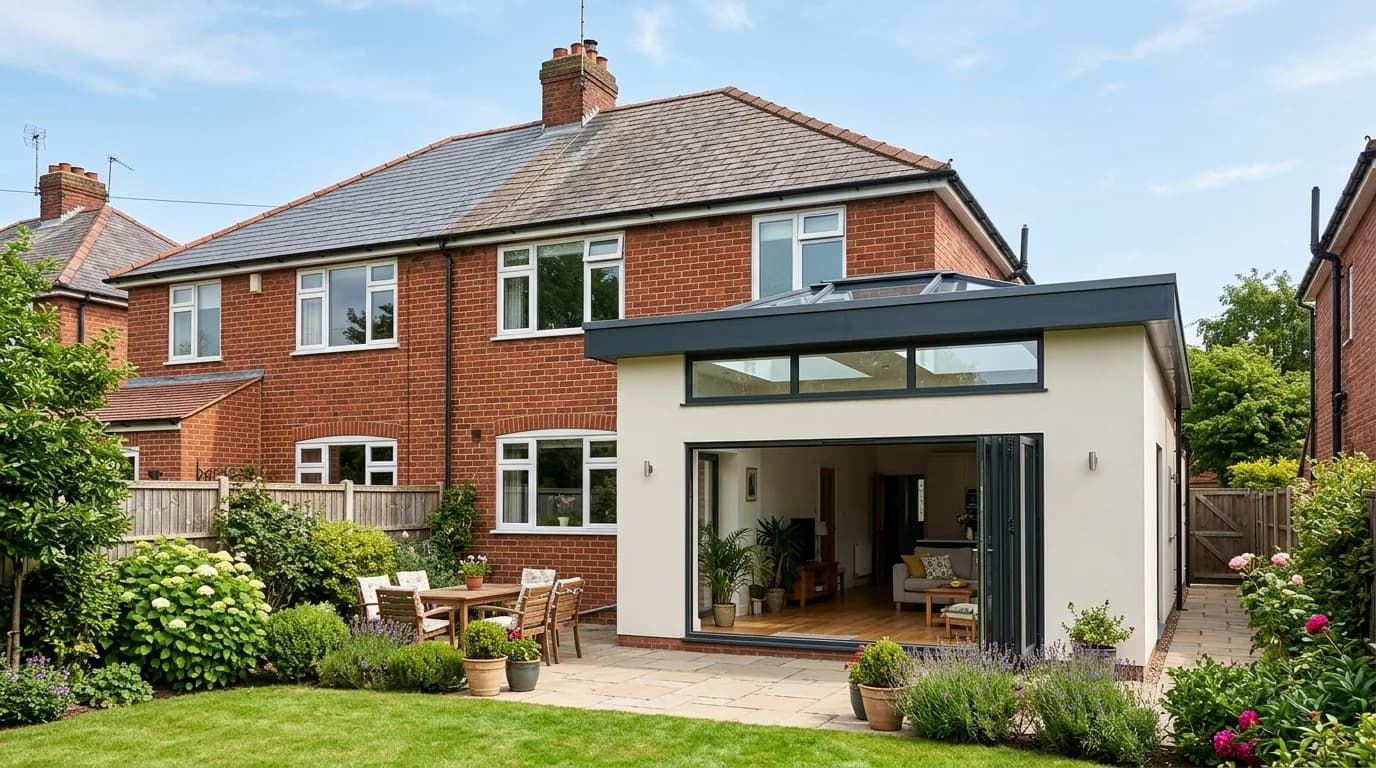
A standard single storey rear extension costs £20,000 to £45,000 for a 3m x 4m to 4m x 6m footprint. That works out at roughly £1,500 to £2,500 per square metre including foundations and a basic finish - though bi-fold doors, kitchens, and premium flooring push costs higher.
£20k-£45k
Typical range
£1,500 to £2,500
Cost per m²
8 to 12 weeks
Build time
3 to 4 metres
PD max depth
Prices updated April 2026 · Based on industry data and contractor submissions.
Building Regulations approval is required for all extensions, even those built under Permitted Development. Your builder must register the work with Building Control before construction starts.
Single Storey Extension Prices by Size
All prices include foundations, walls, roof, windows, plastering, electrics, and a basic finish. They exclude VAT, professional fees, kitchen fitting, and premium add-ons.
| Size | Average |
|---|---|
| Small (3m × 3m = 9m²) | £20,000 |
| Medium (3m × 4m = 12m²) | £26,000 |
| Large (4m × 6m = 24m²) | £40,000 |
| Very large (4m × 8m = 32m²) | £50,000 |
Excludes VAT (20%), professional fees, and interior fit-out. Prices based on standard spec in the Midlands - adjust up for London/South East, down for the North.
Cost Per Square Metre
A single storey extension typically costs £1,500 to £2,500 per m² including foundations and a standard finish. The per-metre cost drops as the extension gets larger - fixed costs like foundations and roof structure are spread over a bigger area.
Budget spec
£1,200 to £1,600/m²
Standard windows, basic plastering, painted finish
Mid-range spec
£1,600 to £2,200/m²
Aluminium windows, good insulation, quality flooring
Premium spec
£2,200 to £3,500/m²
Bi-fold doors, underfloor heating, bespoke kitchen, engineered flooring
What Is and Is Not Included
Typically included
- Foundations and groundworks
- External walls (block and brick or render)
- Roof structure and weatherproofing
- Standard uPVC windows and doors
- Internal plastering
- First and second fix electrics
- Basic plumbing connections
- Building Control notifications
Usually NOT included
- Kitchen fitting and appliances
- Bi-fold or sliding patio doors
- Premium flooring (engineered, porcelain)
- Underfloor heating
- Roof lantern or skylight
- Decorating and painting
- External landscaping
- Professional fees (architect, engineer)
Common Add-On Costs
These are the extras that push a basic extension into a finished living space. Budget for them separately so the final bill does not come as a shock.
| Item | Cost |
|---|---|
| Bi-fold or sliding doors (per set) | £2,500 to £6,000 |
| Velux / roof windows (per window) | £800 to £1,500 |
| Underfloor heating (per m²) | £50 to £80 |
| Kitchen fitting (mid-range) | £8,000 to £15,000 |
| Engineered wood flooring (per m²) | £40 to £80 |
| Porcelain floor tiles (per m²) | £50 to £100 |
| Flat roof lantern / skylight | £1,200 to £3,500 |
| External landscaping / patio | £2,000 to £5,000 |
Permitted Development Rules for Single Storey Extensions
Most single storey rear extensions can be built without planning permission under Permitted Development rights. Here are the key limits:
Detached houses
Up to 4 metres rear projection under standard PD. Up to 8 metres under the Prior Approval (Larger Home Extension) scheme - your council must be notified and neighbours consulted, but it is not a full planning application.
Semi-detached and terraced houses
Up to 3 metres rear projection under standard PD. Up to 6 metres under the Prior Approval scheme. The smaller allowance reflects the closer proximity to neighbours.
Height limits
Maximum eaves height of 3 metres. If within 2 metres of a boundary, maximum height is 3 metres overall. These limits apply to all single storey extensions under PD.
Where PD does not apply
Flats and maisonettes have no PD rights for extensions. Properties in conservation areas, Areas of Outstanding Natural Beauty, the Broads, National Parks, and World Heritage Sites have reduced PD rights. Listed buildings need Listed Building Consent for any external alteration. Check for Article 4 directions with your local authority.
How Long Does a Single Storey Extension Take?
A typical build takes 8 to 12 weeks on site. Add pre-construction time for design and approvals.
- 1
Weeks 1 to 2: Foundations and groundworks
Digging foundations, pouring concrete, laying drainage. The ground conditions determine how long this phase takes - good ground means strip foundations and a quick start. Clay soil or nearby trees may require piled foundations.
- 2
Weeks 2 to 4: Walls
Blockwork walls go up, with cavity insulation and external brick or render. Window and door openings are formed. Steel beams are installed where the extension meets the existing house.
- 3
Weeks 4 to 6: Roof
Roof structure, insulation, and weatherproofing. Once the roof is on, the extension is watertight and internal work can begin regardless of weather.
- 4
Weeks 5 to 8: First fix
Plumbing and electrical runs are installed before the walls are plastered. Underfloor heating pipes go in at this stage if specified. Building Control inspects before plastering covers the work.
- 5
Weeks 7 to 10: Plastering and second fix
Internal plastering, followed by second fix electrics (sockets, switches, lights), plumbing (taps, radiators), and joinery (skirting, door frames).
- 6
Weeks 9 to 12: Finishing
Flooring, kitchen fitting if applicable, decoration, and snagging. Building Control carries out a final inspection and issues the completion certificate.
How to Get Your Single Storey Extension for Less
Smart decisions before construction starts can save you thousands without compromising the finished result.
Keep the shape simple
A rectangular footprint with a lean-to or flat roof is the cheapest configuration. Every corner, angle change, and change in roof pitch adds labour and materials. An L-shaped or wrap-around extension costs significantly more per square metre than a straightforward rear box.
Use standard materials where they are not on show
Premium materials make sense in visible areas - the kitchen worktop, the floor, the bi-fold doors you look through every day. But the roof membrane, internal blockwork, and insulation do not need to be top-of-the-range. A good builder will suggest where standard spec is perfectly adequate.
Get the shell built first, finish later
Ask your builder to price the structural shell - foundations, walls, roof, windows, and making it weathertight. You can then manage the internal fit-out (plastering, flooring, decorating, kitchen) yourself or with separate trades. This lets you spread costs and shop around for the finish work.
Build in autumn or early winter
Builder availability peaks in spring and summer. Starting groundworks in September or October often means better prices and faster scheduling - builders are keener to fill their books. Foundations and walls cope fine in colder weather. Avoid starting in December to January when short daylight hours slow progress.
Use Permitted Development and skip the planning fee
If your extension qualifies under PD rights, you save the £548 planning fee, avoid an 8 to 12 week wait, and remove the risk of refusal. A Lawful Development Certificate (£274) formally confirms PD status and is worth getting for peace of mind - and for when you sell the property.
Useful resources
- Planning Portal: Extensions, Single-storey extension permitted development limits
- Building Regulations, What approvals your extension needs
- Federation of Master Builders, Find vetted builders
What to Expect: The Single Storey Extension Process
A single storey extension typically takes 8 to 12 weeks from breaking ground. Here's a realistic look at each stage.
- 1
Design and planning
An architect draws up plans and submits them for Building Regulations approval. If your extension falls outside permitted development limits, a planning application is also required.
- 2
Foundations and groundwork
Trenches are dug to the required depth (typically 1 metre or deeper depending on soil and nearby trees). Concrete strip or trench-fill foundations are poured and left to cure.
- 3
Brickwork and walls
Blockwork inner walls and facing brick outer walls are built up to damp-proof course level, then continued to plate height. Cavity insulation is installed between the two skins.
- 4
Roof structure and covering
Roof joists or trusses are fitted and the roof is covered with felt, battens, and tiles or a flat roof membrane. Lead flashings are dressed into the existing house wall.
- 5
Windows, doors, and weatherproofing
External doors and windows are fitted and sealed. The opening between the existing house and the new extension is formed by installing a structural steel beam (RSJ) with Building Control sign-off.
- 6
First and second fix, then finishing
Electricians and plumbers run cables and pipes (first fix), then plastering, flooring, skirting, sockets, and lighting are completed (second fix). Building Control issues a completion certificate.
Frequently Asked Questions
How much does a single storey extension cost in 2026?
A single storey extension typically costs £20,000 to £45,000 depending on size and specification. A small 3m × 3m rear extension starts from around £20,000, while a large 4m × 6m extension with standard finishes comes in at £35,000 to £45,000. London and the South East add 25 to 40% on top of these figures.
Do I need planning permission for a single storey extension?
Many single storey rear extensions fall under Permitted Development (PD) rights, meaning no planning application is needed. PD allows a rear extension of up to 4 metres for a detached house, or 3 metres for a semi-detached or terraced house, without planning permission. Extensions under the Prior Approval scheme can extend to 8 metres (detached) or 6 metres (semi/terraced). Check with your local planning authority, as PD rights may have been removed in conservation areas or by Article 4 directions.
How long does a single storey extension take to build?
A typical single storey extension takes 8 to 12 weeks on site from digging foundations to practical completion. Add 4 to 12 weeks before that for design, Building Regulations approval, and planning permission if required. Most projects take around 4 to 6 months from start to finish, including the pre-construction phase.
What is the cost per square metre for a single storey extension?
The cost per square metre for a single storey extension is typically £1,500 to £2,500 for a standard specification including foundations, walls, roof, windows, and basic internal finishes. Budget builds can come in below £1,500/m² in lower-cost regions. Premium specifications with bi-fold doors, underfloor heating, and high-end finishes can reach £3,000 to £3,500/m².
Is a single storey extension worth it?
A well-designed single storey extension typically adds more value than it costs, particularly in areas with higher property prices. A kitchen-diner extension is one of the most reliable value-adders - opening up the ground floor of a semi-detached house can add 5 to 10% to the property value. In lower-value areas the return is less predictable, so weigh the cost against what you would gain by moving house instead.
What is included in a single storey extension quote?
A standard builder's quote should cover foundations, external walls, roof structure and covering, windows and external doors, internal plastering, first and second fix electrics and plumbing, and a basic floor finish. It typically does not include kitchen fitting, premium flooring (engineered wood, tiles), bi-fold or sliding doors, underfloor heating, landscaping, or professional fees (architect, structural engineer, Building Regulations).

Written by Chris Kervin, Co-Founder of Less.co.uk
Last updated: · Pricing based on industry data and verified contractor submissions · Methodology
Compare real quotes for your job
Prices move a lot with your postcode, the access on site and the spec you choose. Get up to 3 free quotes from vetted local tradespeople and see what yours actually comes to, with no obligation to book.
More home improvement costs