House Extension Cost Per m² in 2026
A standard single storey extension costs £1,500 to £2,500 per m². In London, that rises to £2,200 to £3,500/m². In the North, you can often get it done for £1,200 to £2,000/m². Double storey extensions work out cheaper per m² because the foundations and roof are shared.
£1,500 to £2,500
Single storey
£1,200 to £2,000
Double storey
+25 to 40%
London premium
-10 to 15%
North discount
Free, no obligation. Quotes from local builders near you.
Cost Per m² by Extension Type
The type of extension you build has a big impact on the per-metre cost. Side returns and premium single storey builds cost more per m²; double storey and over-garage extensions offer better value.
| Extension type | Cost per m² |
|---|---|
| Single storey rear (budget spec) | £1,200 to £1,600/m² |
| Single storey rear (mid-range) | £1,600 to £2,200/m² |
| Single storey rear (premium) | £2,200 to £3,500/m² |
| Side return extension | £1,800 to £2,800/m² |
| Wrap-around extension | £1,700 to £2,600/m² |
| Double storey rear (mid-range) | £1,200 to £2,000/m² |
| Over-garage extension | £1,000 to £1,800/m² |
Prices based on Midlands averages, excluding VAT and professional fees.
Cost Per m² by Region
Labour rates are the main driver of regional price differences. London builders charge 25 to 40% more than the national average, while rates in the North East and Wales can be 10 to 15% below.
| Region | Single storey | vs National |
|---|---|---|
| London | £2,200 to £3,500/m² | +35% |
| South East | £1,900 to £2,900/m² | +17% |
| East of England | £1,750 to £2,700/m² | +9% |
| South West | £1,650 to £2,600/m² | +4% |
| Midlands | £1,500 to £2,500/m² | Average |
| Yorkshire & Humber | £1,350 to £2,200/m² | -9% |
| North West | £1,400 to £2,300/m² | -7% |
| North East | £1,250 to £2,100/m² | -15% |
| Scotland | £1,350 to £2,200/m² | -9% |
| Wales | £1,300 to £2,150/m² | -11% |
Mid-range specification. Excludes VAT, professional fees, and interior fit-out.
Quick Cost Calculator
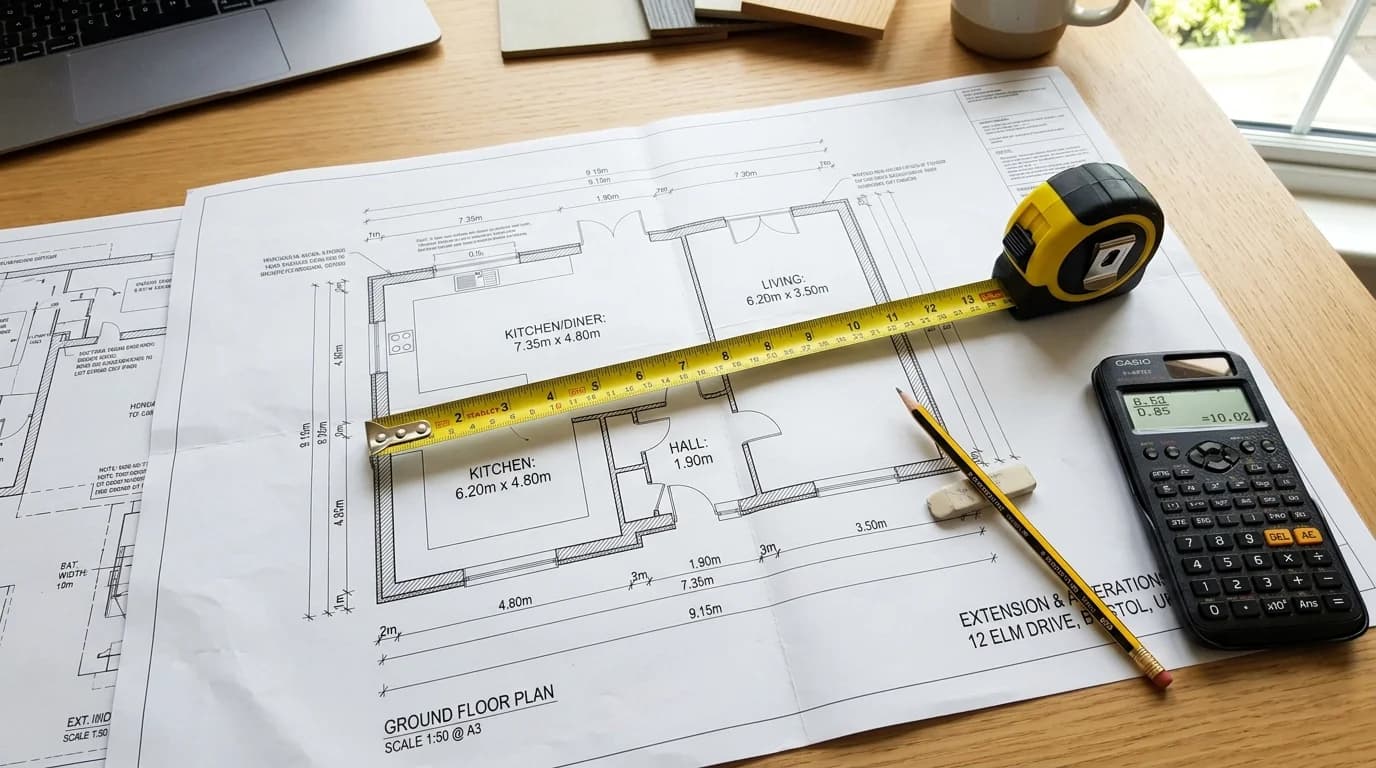
Use this formula as a rough guide: length x width = area in m², then multiply by the cost per m² for your region and spec level.
Example:
A 4m x 5m extension = 20m² x £2,000/m² = approximately £40,000
Before VAT and professional fees
This gives you a ballpark figure for budgeting. Always get at least three quotes from builders for an accurate price - real quotes account for your specific site conditions, access, and chosen specification.
Common sizes with estimated costs (mid-range spec, Midlands)
| Size | Floor area | Mid-range est. |
|---|---|---|
| 3m × 3m | 9m² | £18,000 |
| 3m × 4m | 12m² | £24,000 |
| 4m × 5m | 20m² | £40,000 |
| 4m × 6m | 24m² | £48,000 |
| 4m × 8m | 32m² | £64,000 |
| 5m × 8m | 40m² | £80,000 |
Mid-range at £2,000/m², premium at £3,000/m². Excludes VAT and professional fees.
What Affects the Cost Per m²?
Specification level
This is the single biggest variable. A budget extension with standard uPVC windows, basic flooring, and no extras comes in at the lower end. Add bi-fold doors (£3,000 to £6,000), underfloor heating (£50 to £80/m²), a roof lantern (£1,500 to £3,500), and a fitted kitchen (£8,000 to £20,000+) and the per-metre cost can double.
Location
Labour costs drive most of the regional variation. London rates for skilled trades are 25 to 40% above the Midlands average. The South East sits 10 to 20% above. Northern England and Wales are typically 10 to 15% below. Material costs are more uniform, but delivery charges vary.
Extension size
Larger extensions have a lower cost per m² because fixed costs - foundations, roof structure, scaffolding hire, skip hire - are spread over more floor area. A 10m² extension might cost £2,200/m², while a 30m² extension of the same spec could come in at £1,700/m².
Ground conditions
Standard strip foundations on good ground are straightforward. Clay soil, tree roots within influencing distance, or a high water table may require trench-fill or piled foundations - adding £2,000 to £8,000 to the groundworks and pushing up the per-metre cost significantly on smaller extensions.
Site access
If there is no side access to the rear garden, all materials must come through the house or over it. This slows the build, increases labour costs, and may require a crane for steel beams or roof trusses. Restricted access can add 5 to 10% to overall costs.
Roof type
A flat or lean-to roof is the cheapest option. A pitched roof with tiles matching the existing house costs more but looks better and is often required for planning approval on visible elevations. A glazed flat roof or large roof lantern adds both material cost and structural complexity.
Useful resources
- Planning Portal: Extensions, Permitted development rules for extensions
- Building Regulations Part A, Structural safety requirements
- RICS, Find a chartered surveyor for project advice
Frequently Asked Questions
How much does a house extension cost per square metre in 2026?
A single storey extension costs £1,500 to £2,500 per square metre in the UK for a standard specification. Double storey extensions work out cheaper per m² at £1,200 to £2,000 because the foundations and roof are shared across two floors. London and the South East run 25 to 40% above these figures. Budget spec starts from £1,200/m², while premium finishes with bi-fold doors, underfloor heating, and high-end kitchens can push costs beyond £3,500/m².
Why does the cost per m² vary so much?
The main factors are location (labour rates vary by 30 to 40% across the UK), specification level (budget vs premium finishes), extension size (larger extensions have a lower cost per m² due to economies of scale), and ground conditions (poor soil or nearby trees can require expensive foundations). Access to the site also matters - a restricted rear garden with no side access adds cost because materials must be carried through the house.
Is the cost per m² for a double storey extension the same as single storey?
No - the cost per square metre for a double storey extension is typically lower than for a single storey. This is because the most expensive elements (foundations, roof, scaffolding) are built once and shared across both floors. A single storey extension might cost £2,000/m², while the same footprint built as a double storey might cost £1,500/m² when the total area of both floors is considered.
Does the cost per m² include VAT?
Prices quoted per square metre typically exclude VAT (20%), professional fees (architect, structural engineer, Building Regulations), and interior fit-out (kitchen, premium flooring, decorating). When budgeting, add 20% for VAT on top of the builder's quote, plus £3,000 to £10,000 for professional fees depending on the size and complexity of the project.
How do I calculate the cost of my extension?
Multiply the floor area in square metres by the cost per m² for your region and specification level. For example, a 4m × 5m single storey extension in the Midlands at mid-range spec: 20m² × £2,000/m² = approximately £40,000 before VAT and professional fees. This gives a rough budget figure - get at least three builder quotes for an accurate price.
What is the cheapest type of extension per m²?
A large double storey extension offers the lowest cost per square metre - typically £1,100 to £1,500/m² for a budget to mid-range specification. Single storey extensions cost more per m² because the expensive foundations and roof serve only one floor. The cheapest single storey option is a simple rectangular rear extension with a flat or lean-to roof, standard windows, and basic finishes.

Written by Chris Kervin, Co-Founder of Less.co.uk
Last updated: · Pricing based on industry data and verified contractor submissions · Methodology
Compare real quotes for your job
Prices move a lot with your postcode, the access on site and the spec you choose. Get up to 3 free quotes from vetted local tradespeople and see what yours actually comes to, with no obligation to book.
More home improvement costs