Roof Repair Cost UK 2026: How Much Does a Roof Repair Cost?
Roof repair cost in the UK is typically £150 to £700 for a minor job, and the average roof repair cost works out at around £350. That covers slipped or cracked tiles, a small leak, and rebedding ridge tiles. Where several areas of wear, patchy felt failure or isolated timber decay are involved, the cost of a roof repair climbs to £500 to £2,000. Past that point a full strip and re-tile, at £4,500 to £9,000 on a terrace or semi, is usually the better value. Below is the price for each common repair, what pushes it up, and how the rates shift by region.
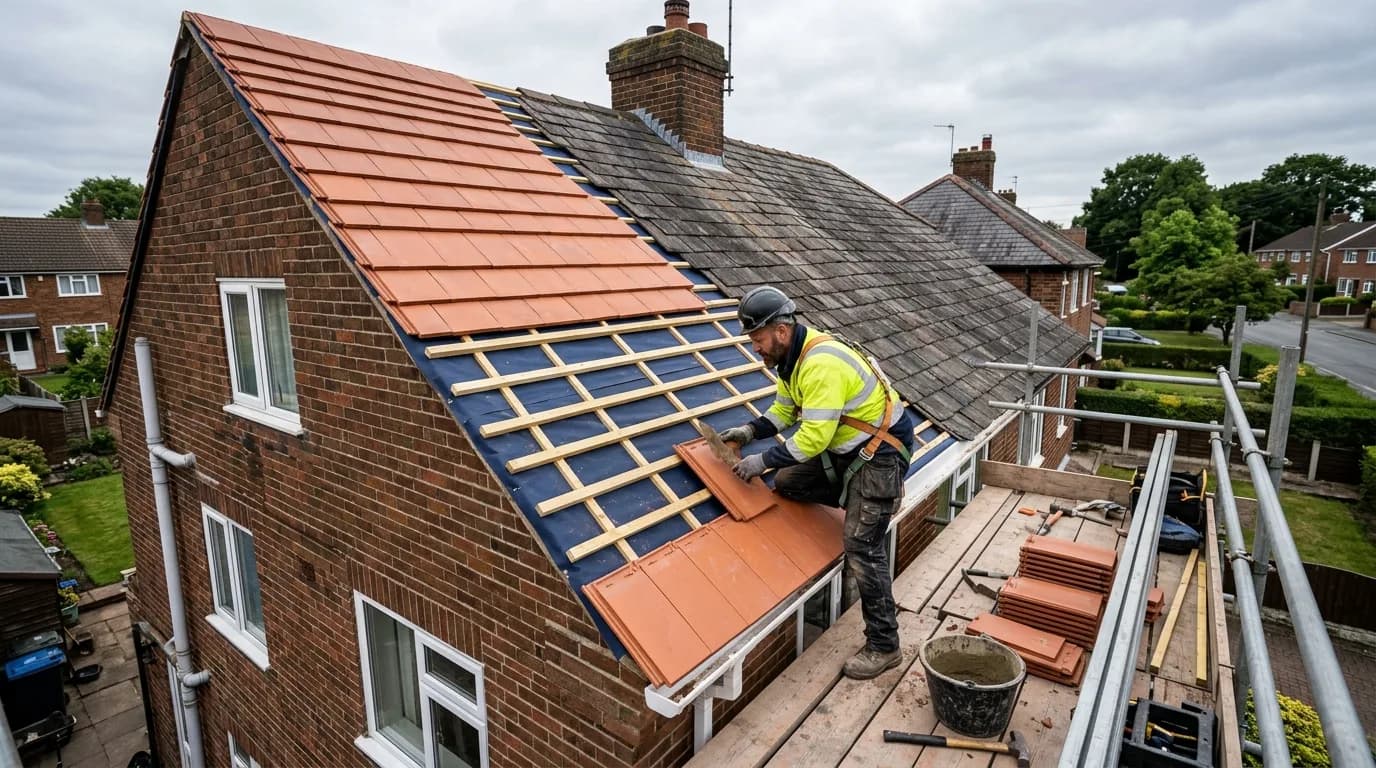
£150 to £700
Minor roof repair
£350
Average repair
£150
Flat roof patch from
£500 to £2,000
Bigger repairs
Prices updated April 2026 · Based on published trade rates and UK market data.
Roof repairs are working-at-height jobs and belong with a properly insured roofer. A like-for-like repair does not need Building Regulations approval, but work that touches load-bearing timbers does. Use a contractor registered with the National Federation of Roofing Contractors (NFRC) or the TrustMark scheme - membership is vetted and gives you a route for complaint if things go wrong.
Roof Repair Costs at a Glance
These roof repair cost figures cover labour, materials and site clear-up for a two-storey house. Access is the one thing to check separately, because a full scaffold adds £500 to £1,200 and many small repairs do not need one.
Minor roof repair
Slipped or cracked tiles, a small leak, ridge tile rebedding
£150 to £700
average £350
Lifted felt, a single split, or a blocked outlet causing ponding
£150 to £500
Chimney repointing
Often flagged during a roofing survey rather than reported by the homeowner
£200 to £600
Guttering replacement
Worth doing while the access is already up
£400 to £1,200
Moderate roof repair
Several areas of wear, patchy felt failure, isolated timber decay
£500 to £2,000
Roof window fitting
Per window, including the flashing kit
£600 to £1,200
Fascias and soffits replacement
UPVC is the common choice and needs very little upkeep
£800 to £2,500
Full strip and re-tile (terrace or semi)
Where repairing no longer stacks up against replacing
£4,500 to £9,000
average £6,500
Prices based on published trade rates and UK market data. What you pay varies with roof pitch, access, and where in the country you live.
If the roof is closer to the end of its life than a patch job, our roof replacement cost guide covers full strip and re-tile prices by property type and region.
Get Free Roof Repair Quotes
Compare prices from local roofers near you. Fill in a few details and get free, no-obligation quotes.
Your details go to our quote partner, Leads.work, who pass them to a few local firms that cover your area. They'll contact you about the job, which may include a phone call. It's free for you, and we're paid a referral fee. How your details are used
What Affects Your Roof Repair Cost
How you get up there
Access moves a small roofing bill more than anything else on this list. A repair reachable from a scaffold tower or a roof ladder can be a half-day job. The same repair on a steep pitch, on a third storey, or spread along a whole elevation needs a full scaffold at £500 to £1,200, which can cost more than the repair itself. Always ask a quote to itemise access separately.
Whether the fault has been found yet
Replacing a tile you can already see is priced work. Tracing a leak is not, because water rarely enters where the stain appears on the ceiling. Some roofers charge for the diagnostic visit and set it against the repair if you go ahead with them. Worth asking about upfront, as it is a common source of surprise on the final bill.
The roof covering
Concrete interlocking tiles are the cheapest to patch and the easiest to source a match for. Clay is dearer. Natural slate needs skilled labour to strip and reset without cracking the neighbouring slates, so a slate repair takes longer than the same job on a tiled roof. On flat roofs, felt and GRP are patched in completely different ways.
Matching an old covering
Finding tiles that match a roof laid decades ago is often harder than the repair. Discontinued profiles and weathered colours mean a reclaimed match, and reclamation yard prices are what they are. A patch of visibly newer tiles is the cheaper option if you can live with how it looks.
What the roofer finds underneath
A slipped tile is sometimes just a slipped tile. Sometimes it is the visible end of a batten that has rotted, or felt that has gone brittle across a whole slope. A repair quoted at £150 to £700 can turn into the £500 to £2,000 band once the covering comes off, which is why a roofer who checks the loft as well as the outside before quoting is worth having.
Where you live
Materials cost much the same wherever you buy them. Labour and scaffolding do not. London roofers typically charge around 35% above the national average, while the North East, Wales and Yorkshire sit 10 to 16% below it. The full regional table is further down this page.
Roof Repair Cost by Type of Repair
The table further up groups jobs by how big they are. A roofer prices by what has failed and where it sits on the roof, so this is the same money broken down the way a quote actually arrives. Access is on top of every line here.
| Repair | Typical cost |
|---|---|
| Slipped or cracked tilesLifting the neighbouring tiles, refixing or swapping the damaged ones, and matching an old profile if the roof is not a recent one | £150 to £700 |
| Ridge and hip tilesRaking out cracked mortar bedding along the top of the roof and rebedding, or refixing with a dry ridge system | £150 to £700 |
| Flashing repairsResealing or replacing the lead where the roof meets a chimney, a party wall or a roof window. A small patch is minor work, a whole run of lead being renewed is not | £150 to £700 |
| Valley repairsClearing a blocked valley is quick. Relining one means lifting the tiles down both slopes to get at the channel underneath, so it should be priced on its own rather than folded into a general figure | Quoted per job |
| Chimney repointingRaking out and replacing the mortar joints in the stack. The flashing where the stack meets the roof is a separate item, so check which one you are being quoted for | £200 to £600 |
| Flat roof patchA lifted seam, a single split, or a blocked outlet that is letting water pond in one spot on a garage, dormer or extension | £150 to £500 |
| Guttering replacementTaking off tired plastic gutter and downpipes and refitting. Worth pairing with any other work while the access is already paid for | £400 to £1,200 |
| Fascias and soffitsReplacing the boards behind the gutter line, usually in UPVC, once they have gone soft. Almost always done at the same time as the guttering | £800 to £2,500 |
| Battens, felt and timberStripping back a section to replace rotten battens, brittle underlay or a decayed rafter end. Once this is spread across a slope rather than confined to one patch, replacing beats repairing | £500 to £2,000 |
Based on published trade rates and UK market data. Valley work is left open because the price turns entirely on whether the channel is being cleared or relined.
Two things to take from this. Several of these repairs share the same access, so a roofer already scaffolded for the tiles can do the gutters and the chimney for the cost of the work alone. And the jobs at the top of the table are the ones that turn into the jobs at the bottom if they are left, which is where most large roofing bills come from.
Leaking Roof Repair Cost
A leak with an obvious source, a slipped tile or a cracked ridge, sits inside the £150 to £700 minor repair band. A leak that has been quietly running for a while is a different job, and once several areas of wear or isolated timber decay are involved it moves into the £500 to £2,000 range. The spread comes down to how long the roofer spends finding the entry point, because water travels along battens and rafters before it drops through a ceiling.
Where roofers look first
- Flashings, the lead or mortar joints where the roof meets a chimney, a party wall, or a roof window. Old roofs leak here more than anywhere else.
- Ridge and hip tiles, where cracked mortar bedding lets water in along the top of the roof. Rebedding sits inside the minor repair band.
- Valleys, where two slopes meet and the rain off both is funnelled into one channel. Debris blocks them and the water backs up under the tiles.
- The underlay. Bitumen felt was standard in houses built before the 1990s. It cannot breathe and it degrades, so an old roof can be watertight at the tiles and still let water through.
- Blocked gutters. Water overflowing behind a gutter runs down the fascia and into the roof edge. The cheapest fix on the list, and worth ruling out before anyone goes up a ladder.
Before the roofer arrives: go into the loft on a wet day with a torch and look for where the water is actually tracking, not just where it is dripping. Photograph it. Five minutes of that can take a chunk out of the diagnostic time you are paying for.
Flat Roof Repair Cost
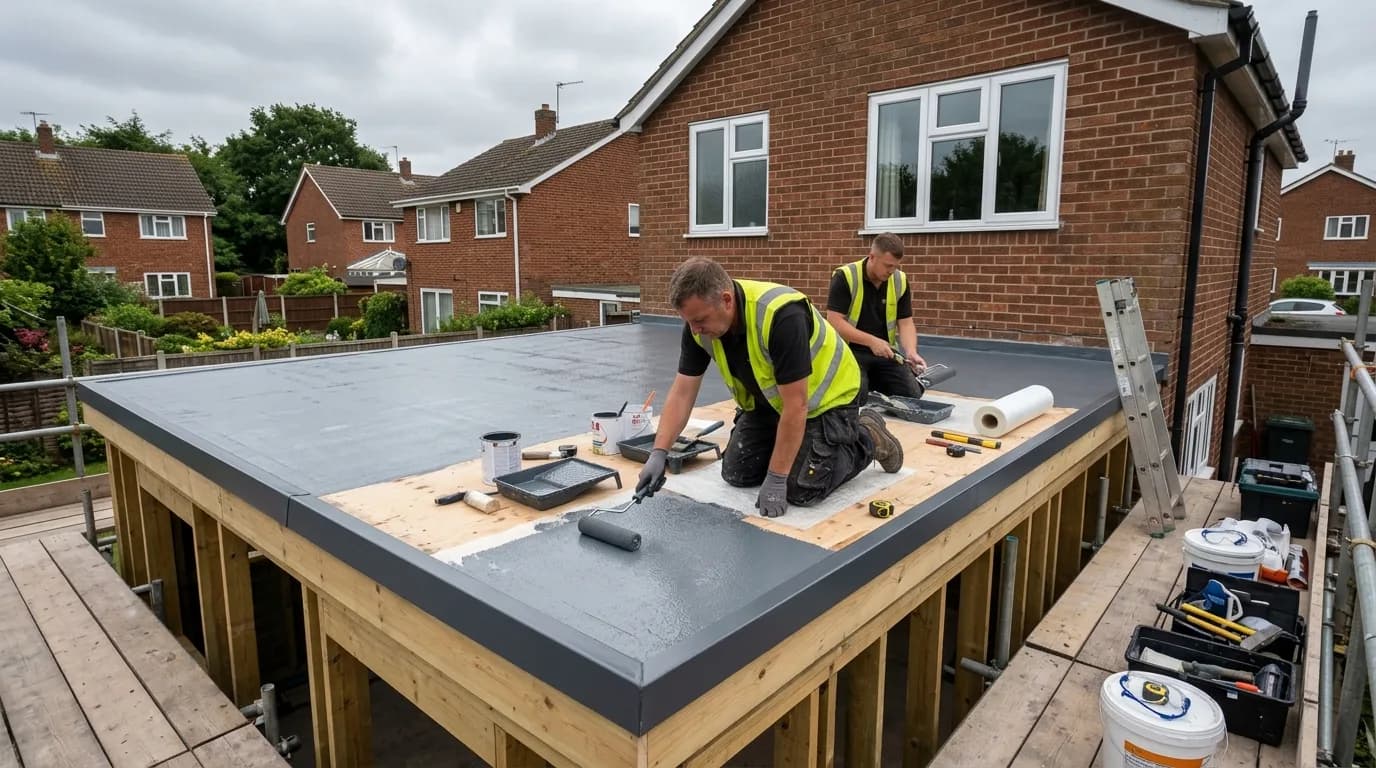
A localised flat roof repair costs £150 to £500. That is a small area of felt that has lifted, a single split, or a blocked outlet causing water to pond in one spot. Garages, dormers, porches and single-storey extensions are where most of these jobs happen, and access is usually straightforward, which keeps the price down.
Where a patch stops being sensible is when the roof is leaking in more than one place, the felt has gone brittle and is cracking across its surface, or the timber decking underneath has started to rot. At that stage a patch buys months rather than years. A flat roof replacement up to 30 square metres runs £2,800 to £5,500, and a well-laid GRP fibreglass roof can last 25 years or more against 10 to 20 for older felt systems.
Full prices by material are in our flat roof cost guide and our fibreglass roof cost guide.
Access and Extra Costs
These two sit outside the repair price itself and are the ones most likely to make two quotes look further apart than they really are.
| Extra Item | Typical Cost |
|---|---|
| Scaffolding hire | £500 to £1,200 |
| Building Regs notification (structural changes) | £300 to £700 |
Roof Repair Cost by Region
Roofing materials cost roughly the same across the UK, so what shifts a repair bill from one region to the next is the day rate for labour and for scaffolding. The column below shows how far each region sits from the national average, measured on our tile re-roofing rates. Apply the same direction of travel to a repair: on a £350 job the difference is tens of pounds, on a £2,000 job it is hundreds.
| Region | Re-tile rate per sq m | Labour vs National |
|---|---|---|
| London | £120/sqm | +35% |
| South East | £105/sqm | +18% |
| East of England | £98/sqm | +10% |
| South West | £95/sqm | +7% |
| Midlands | £89/sqm | Average |
| North West | £82/sqm | -8% |
| Yorkshire | £80/sqm | -10% |
| Scotland | £80/sqm | -10% |
| Wales | £78/sqm | -12% |
| North East | £75/sqm | -16% |
Based on industry data. Per sq m rates are for a strip and re-tile with concrete interlocking tiles, scaffolding included, and are shown here as the clearest available measure of how roofing labour is priced in each region.
Roof Repair or Full Replacement?
Not every roof problem needs a full replacement, and knowing when a repair will do is where most of the saving is.
Minor repairs
Repair£150 to £700
Slipped tiles, small flashing repairs, ridge tile rebedding. Always worth repairing. These are quick fixes a decent roofer can sort in a morning.
Moderate damage
Repair if under 30 years£500 to £2,000
Several areas of wear, patchy felt failure, isolated timber decay. If the roof is under 30 years old and the structure is sound, targeted repairs usually still make sense.
Major structural issues
ReplaceFull replacement
Widespread tile failure, a sagging ridge line, extensive timber rot, or daylight visible from several points in the loft. Patching individual areas rarely holds for long at this stage, and a full strip and re-tile at £4,500 to £9,000 on a terrace or semi is better value than repeated call-outs.
Rule of thumb: if the cost of repairs exceeds 30% of what a full roof replacement would cost, replacing the lot is usually the smarter move. Run that check against a real replacement quote for your own roof rather than a national figure, because the strip and re-tile range on a terrace or semi is a wide one at £4,500 to £9,000. You get a new roof with a proper guarantee instead of a patchwork that needs attention again in a couple of years.
Emergency and Out-of-Hours Roof Repairs
A roof that has opened up in a gale is priced differently from the same repair booked in for a Tuesday, because you are paying a roofer to drop what they are already on. It is worth knowing how an emergency job is normally split up before you ring round.
Making it safe is a separate job from fixing it
The first visit is usually about stopping the water and the danger, not repairing anything: sheeting over the opening, taking down tiles that are hanging and could come off onto a pavement, and getting the electrics isolated if water is anywhere near them. The permanent repair comes afterwards, in daylight, and is priced as ordinary work, so it still falls into the £150 to £700 or £500 to £2,000 bands depending on what is found. Ask whether the call-out charge comes off the repair if you use the same firm for both, because plenty of roofers will do that and few will offer it unprompted.
Is it actually an emergency?
Water coming into the house, tiles that could fall on somebody, or an area of covering that has gone completely: those are worth paying the premium for. A damp patch on a bedroom ceiling that has been there a fortnight is not, and waiting for a booked visit is the cheaper route. In the meantime, move what you can out of the way, put a bucket under it, and if the ceiling is bulging with trapped water, pierce it in one spot to let it drain rather than letting the plasterboard come down in one go.
Storms are when the doorstep traders come out
The day after bad weather is exactly when someone turns up saying they were working nearby and noticed your ridge. Nobody should be talking you into a full strip and re-tile at £4,500 to £9,000 on your doorstep in the middle of a storm. Get the roof made safe by someone you have checked, then take your time over the permanent repair with three quotes, the same as you would for any other job.
Storm Damage, Insurance and Grants
When buildings insurance pays
Buildings insurance normally covers sudden one-off events: storm damage, a fallen tree, impact damage. It does not cover wear and tear, so a roof that has simply reached the end of its life is your bill rather than the insurer's. Photograph the damage before anyone touches it, and ring your insurer before arranging repairs, because most policies want to see the damage or send a loss adjuster before work goes ahead. Paying a roofer first and claiming afterwards is how people end up covering the lot themselves.
Making the roof safe in the meantime
Policies expect you to prevent further damage while a claim is being sorted, so temporary weatherproofing, sheeting over an open section, is usually reasonable and worth doing. Keep the receipt and tell your insurer what you have done. Do not start the permanent repair until they have said to go ahead.
Are there grants for roof repairs?
There is no general government grant for repairing a roof covering. The main national energy schemes fund insulation and heating measures, not tiles, felt or flashing, so a leaking roof does not qualify on its own. Two things are still worth checking: some councils run discretionary home repair or safety assistance for older and disabled homeowners, so ring your local council and ask what is available in your area, and if the roof is being opened up anyway it may be the right moment to look at loft insulation, where support schemes do exist.
What a Roof Repair Quote Should Include
Most of the confusion over roof repair cost comes from comparing quotes that are not describing the same job. Run each one against this list before you decide, and the gaps between them usually explain themselves.
- Access, priced on its own line. Scaffold or tower, and what it costs. A scaffold at £500 to £1,200 buried inside a single figure is the most common reason two quotes look far apart.
- What is being replaced, and with what. New tiles or reclaimed, lead or a modern flashing tape, felt or a breathable membrane. A quote that says only "repair roof" is not a quote.
- Whether finding the leak is charged. Some roofers charge for the diagnostic visit and set it against the repair if you go ahead. Fine either way, as long as you know before the bill.
- Waste removal. Old tiles and stripped felt are heavy and someone has to take them away.
- Whether VAT is in the number. Sole traders under the threshold do not charge it, so an unregistered roofer and a VAT-registered firm are not directly comparable on the headline figure.
- Days on site. If the work is priced on time rather than as a fixed job, ask for the day rate and how many days, so you can see what you are agreeing to.
- The guarantee, in writing. How long, and what it actually covers. A verbal promise is worth what it sounds like.
- Public liability insurance and registration. Roofing is work at height, which the Health and Safety Executive treats as one of the highest risk activities in building work. Ask for the insurance certificate and check the firm on the NFRC register.
One more thing that is not on the quote: never pay the full amount up front. A deposit towards materials on a bigger job is normal. The whole sum before anyone has been on the roof is not.
How to Get Your Roof Repair for Less
Roofing is one of the trades where a bit of homework before you pick up the phone makes a real difference to the final bill.
Get at least three quotes
Roofing prices vary more than almost any other trade, and rogue traders are a real problem in this sector. Three quotes from NFRC-registered roofers will tell you what a repair should actually cost where you live. If one comes in well under the others, ask why before you take it, because it usually means something has been left out of the price.
Pay for access once, not twice
Scaffolding costs £500 to £1,200 and goes up whether the roofer is replacing three tiles or fifty. If the gutters are sagging, the fascias are tired, or the chimney needs repointing at £200 to £600, get it all done in the same visit. Paying for the scaffold twice, once now and again next year for a job you already knew was coming, is the easiest cost on this page to avoid.
Ask whether a tower will do
A full scaffold is not needed for every repair. A single slipped tile, a cracked ridge, or a small flat roof patch is often reachable from a tower, and the saving on access can be more than the repair itself. A roofer who quotes a full scaffold for a half-day job should be able to explain why it is necessary. If the explanation is vague, get another quote.
Do not let a repair be talked into a replacement
Some roofers will push for a full job when the roof is fixable. A few hundred pounds of work, rebedding ridge tiles, replacing a handful of slates, patching felt, can buy years on a roof that is structurally sound. Ask anyone recommending a full replacement to show you why from inside the loft as well as from outside. If they cannot give you a clear answer, get a second opinion before committing to £4,500 or more.
Clear the gutters before they turn into a roof bill
Most of the repairs on this page start as something small that nobody dealt with. Blocked gutters push water back behind the fascia and into the roof edge. Moss holds damp against the tiles and washes down into the outlets. Branches overhanging the slope drop debris into the valleys and scrape the surface in a gale. None of that costs much to sort, and all of it is cheaper than the repair it turns into. After a proper storm, take a torch into the loft and look for daylight or fresh damp before it has time to spread.
Check your insurance before you reach for your own money
If the damage came from a storm, a fallen branch, or another sudden accident, it may be a buildings insurance claim rather than a bill you pay. Photograph everything before anyone touches it and ring your insurer first, as most policies want to see the damage or send a loss adjuster before work goes ahead. Wear and tear built up over years is not covered, but a one-off event often is.
Ignore the cold caller who spotted your roof from the road
Someone knocking to say they have noticed slipped tiles while working nearby is the classic opening for roofing overcharging. You have no way to check what they claim to have seen, and the price tends to climb once they are up there. Take the name, then look them up on nfrc.co.uk or TrustMark and get your own quotes instead.
Comparing quotes is the simplest way to pay less
Getting three or four quotes and comparing them is how most homeowners avoid overpaying on a repair. It takes a couple of minutes, with no obligation.
Get my free quotesPrice Up the Bigger Job
If the roofer has told you a repair is not going to hold and you want a number before the quotes land, our free roofing calculator asks for your roof type, the covering you want, your roof area, whether scaffolding and new fascias are needed, and your postcode. It returns an estimate broken out by cost, priced for your region rather than for the country as a whole.
It takes about a minute and there is nothing to sign up for. The point of it is to give you a number to hold your quotes against, so you can tell a fair price from a chancer.
Open the roofing cost calculatorRoof Repair Cost FAQs
How much does a roof repair cost in the UK?
Roof repair cost in the UK is typically £150 to £700 for a minor job, with the average landing around £350. That band covers slipped or cracked tiles, a small leak, and rebedding ridge tiles. Where there are several areas of wear, patchy felt failure, or isolated timber decay, the repair moves into the £500 to £2,000 range. Anything beyond that and you are usually looking at a full strip and re-tile instead, which starts at £4,500 for a terrace or semi.
How much should I pay for roof repairs?
For a small job on a two-storey house, £150 to £700 is the sensible range to expect, and around £350 is the average. The single biggest thing to check on a quote is access, because scaffolding costs £500 to £1,200 on its own and two quotes at the same headline price can mean very different jobs depending on whether a full scaffold is included or the roofer is working off a tower. Get three quotes, ask each roofer to itemise access separately from labour and materials, and you will see very quickly which price is fair.
How much does it cost to fix a leaking roof?
A leak with an obvious source, such as a slipped tile or a cracked ridge, sits in the £150 to £700 minor repair band. A leak that has been running for a while is a different job: once several areas of wear or isolated timber decay are involved, the cost moves into the £500 to £2,000 range. The reason for the spread is that water rarely comes in where the stain appears on your ceiling, so the roofer is paying for time spent tracing it back to the entry point before any repair happens.
How much does a flat roof repair cost?
A localised flat roof repair costs £150 to £500. That covers a small area of felt that has lifted, a single split, or a blocked outlet causing ponding. If the roof is leaking in more than one place, the felt is brittle and cracking across its surface, or the timber decking underneath has started to rot, a patch is only delaying things and a replacement is the better call. A flat roof replacement up to 30 square metres runs £2,800 to £5,500.
How much does it cost to replace a few roof tiles?
Replacing a handful of slipped or cracked tiles sits in the £150 to £700 minor repair band, with £350 the average across minor jobs. The tiles are rarely the expensive part of it. What you are actually paying for is getting someone safely up to them, and then finding a match, which on a roof laid decades ago can mean a reclaimed tile rather than something off the shelf. If the same few tiles keep slipping in every gale, ask the roofer to look at the battens and the nail fixings underneath rather than just putting them back.
How much does an emergency roof repair cost?
An out-of-hours or same-day call-out is priced above the same repair booked in for a weekday, because you are paying for a roofer to drop what they are already on. It usually comes as two pieces of work rather than one: a make-safe visit to sheet over the opening and clear anything loose, then the permanent repair, which is priced as ordinary work and still lands in the £150 to £700 or £500 to £2,000 bands depending on what is found underneath. Ask whether the call-out charge comes off the repair if you use the same firm for both. If water is not actively coming in, waiting for a booked visit is the cheaper route.
What is the cheapest way to repair a roof?
Most of the saving is in not paying for access twice. Scaffolding costs £500 to £1,200 and has to go up whether the roofer is replacing three tiles or fifty, so if the gutters, fascias or chimney also need attention, get them done in the same visit. Ask whether the job can be done off a tower instead of a full scaffold, because plenty of small repairs can. Then get three quotes from NFRC-registered roofers, because roofing prices vary more than almost any other trade.
Does house insurance cover roof leaks in the UK?
It depends what caused the leak. Buildings insurance normally covers sudden one-off events such as storm damage, a fallen tree, or impact damage, and a claim in those circumstances is worth pursuing. What it does not cover is wear and tear: a roof that has simply reached the end of its life is your bill, not the insurer's. Photograph the damage before anyone touches it and ring your insurer before arranging repairs, because most policies want to see the damage or send a loss adjuster before work goes ahead.
Can I get a grant to repair my roof in the UK?
There is no general government grant for repairing a roof covering. The main national energy schemes fund insulation and heating measures rather than tiles, felt or flashing, so a leaking roof does not qualify on its own. Two routes are worth checking before you pay: some councils run discretionary home repair or safety assistance for older and disabled homeowners, so ring your local council and ask what they offer, and if the damage was caused by a storm it is a buildings insurance matter rather than a grant one. If you are having loft insulation looked at as well, that part of the work may be eligible where the roof repair is not.
Do I need scaffolding for a roof repair?
Not always. Plenty of small repairs on a pitched roof are done from a scaffold tower or a properly footed ladder with a roof ladder over the tiles, which costs far less than a full scaffold. A full scaffold, at £500 to £1,200, becomes necessary when the roofer needs to work along a whole elevation, when the pitch is steep, or when the job runs over more than a day. Ask which one your quote assumes, because it is the largest single variable in a small roofing bill.
How long does a roof repair take?
Most jobs in the £150 to £700 minor band are a morning's work once the roofer is up there, which is why access is so much of the price. A repair that needs a full scaffold takes longer in calendar time than in labour time, because the scaffold has to be booked in, put up and taken down again around the half-day of actual roofing. Anything in the £500 to £2,000 range, where several areas are being dealt with or timber is being replaced, normally runs beyond a single day. Ask for the number of days as well as the price, because it tells you whether a quote has been thought through.
What should a roof repair quote include?
A quote worth comparing sets out access separately from the work, says what is being replaced and whether the tiles are new or reclaimed, includes taking the waste away, states whether VAT is in the figure, and puts the guarantee in writing with a note of what it actually covers. It should also say whether a charge for tracing the leak is being set against the job if you go ahead. Two quotes that look far apart are often just one that has included the scaffold at £500 to £1,200 and one that has left it out, so itemised quotes are the only ones you can hold against each other fairly.
Can I repair my own roof?
Clearing a gutter or knocking moss back from a single-storey roof is within reach of a careful homeowner. Anything on a pitched roof at two storeys is not, and falls from height are one of the biggest causes of serious injury in building work in Britain. There is also a money argument as well as a safety one: a repair you do yourself carries no guarantee, and if a botched patch lets water into the timbers you will pay for the damage as well as the original fault. Buildings insurance can also take a dim view of unqualified work on the structure.
When is a roof repair no longer worth it?
The usual rule of thumb is that if the cost of repairs exceeds 30% of what a full roof replacement would cost, replacing the lot is the smarter move. Work out that threshold against a real quote for your own house rather than a national average, because a strip and re-tile on a terrace or semi runs anywhere from £4,500 to £9,000. The other signals are structural rather than financial: a sagging ridge line, widespread tile failure, extensive timber rot, or daylight visible from several points in the loft. At that stage patching individual areas rarely holds for long.
Do I need planning permission or Building Regulations approval for a roof repair?
A like-for-like repair to a roof covering needs neither. Planning permission only comes into it if you live in a conservation area or a listed building, where the materials and appearance may have to match what is already there, so check with your local planning authority first. Building Regulations apply once the work touches load-bearing timbers or covers a large proportion of the roof area, and notifying the council for structural changes costs £300 to £700. A roofer who tells you a simple tile replacement needs Building Regs approval is worth a second opinion.
Why does roof repair cost vary so much by region?
Materials cost much the same wherever you buy them, so what moves the price is the day rate for labour and for scaffolding. London roofers typically charge around 35% above the national average, the South East around 18% above, and the North East, Wales and Yorkshire sit 10 to 16% below it. On a small repair that difference is tens of pounds rather than hundreds, but it is the reason a price a friend quotes you from another part of the country is not a useful benchmark for your own.
Free, with no obligation to book.

Written by Chris Kervin, Co-Founder of Less.co.uk
Last updated: · Pricing based on published trade rates and UK market data · Methodology