Fibreglass (GRP) Roof Cost UK 2026
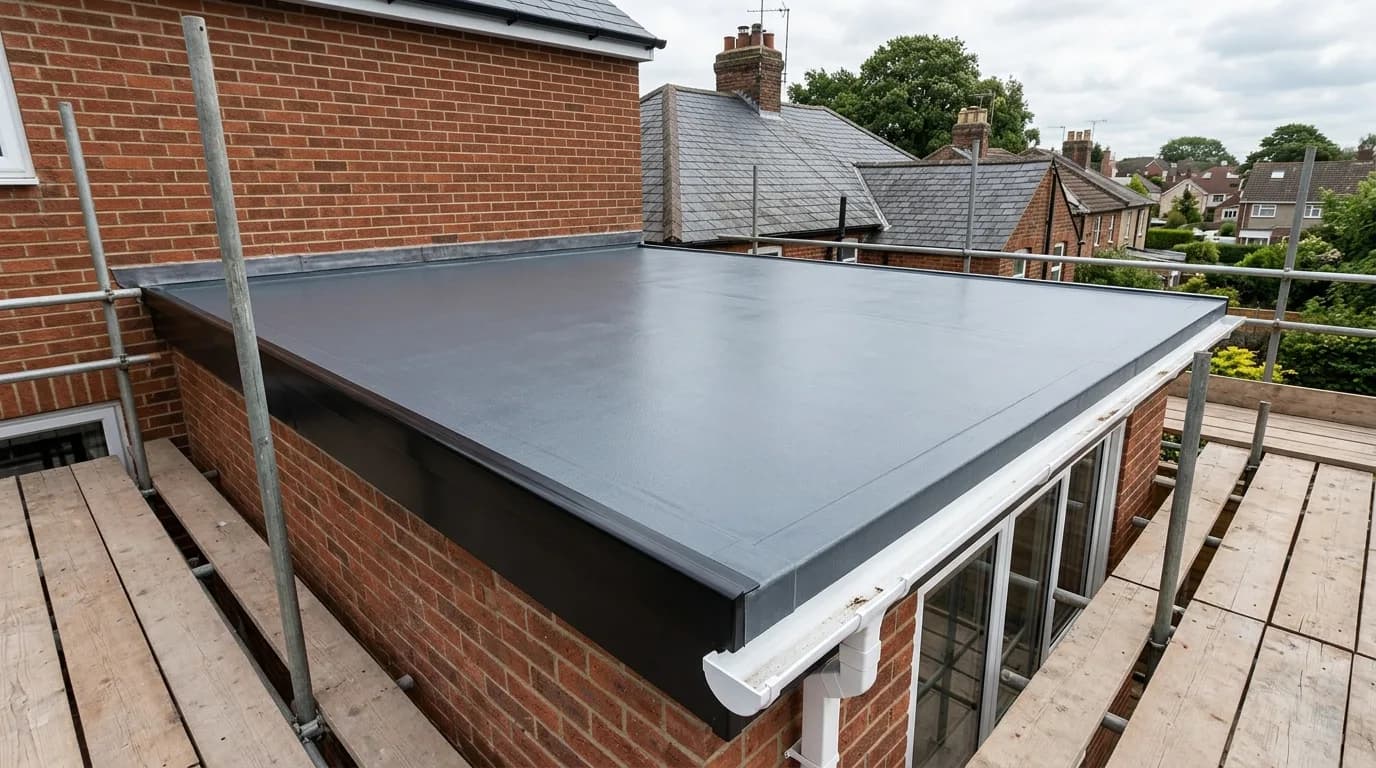
A fibreglass roof costs £70 to £100 per m² including materials and labour. A typical extension flat roof of around 20 m² costs £1,400 to £2,500. GRP (glass-reinforced polyester) creates a seamless, walkable, hard-wearing finish that lasts 25 to 30 years - making it the go-to choice for extensions, dormers, and balconies.
£85
Average per m²
£1,800
Extension roof
25 to 30 yrs
Lifespan
Yes
Walkable
Prices updated April 2026 · Based on industry data and contractor submissions.
Building Regulations. Flat roof replacements typically need to meet current insulation standards under Part L. Your roofer should handle compliance, but confirm this is included in the quote. Use an NFRC-registered contractor for peace of mind.
Quick answer
How much does a fibreglass roof cost?
A fibreglass (GRP) roof costs £70 to £100 per m² in 2026, including stripping the old covering, new decking if needed, and fitting. A garage roof (15 m²) costs £1,050 to £2,000. An extension roof (20 m²) costs £1,400 to £2,500. Prices are higher than felt or EPDM but the finish is harder-wearing and fully walkable.
Fibreglass Roof Prices by Application
Total project costs for GRP fibreglass including stripping existing covering, decking, and fitting.
Porch roof (approx. 5 m²)
£600
£400 to £800
Dormer roof (approx. 8 m²)
£900
£650 to £1,200
Garage roof (approx. 15 m²)
£1,500
£1,050 to £2,000
Extension roof (approx. 20 m²)
£1,800
£1,400 to £2,500
Large flat roof (approx. 40 m²)
£3,500
£2,800 to £4,500
Balcony/terrace (approx. 15 m²)
£1,800
£1,200 to £2,500
Insulation upgrade to Building Regs may add £20 to £40/m². Scaffolding quoted separately if needed.
How a Fibreglass Roof Works
The same technology as boat hulls
GRP stands for glass-reinforced polyester. It is the same material used to build boat hulls, swimming pools, and water tanks - all applications where a waterproof, durable surface is essential. A fibreglass roof is built up on site in layers: a resin basecoat, glass fibre matting, more resin, and a topcoat. The result is a single, seamless shell with no joints or seams to fail.
Applied in situ, not pre-manufactured
Unlike EPDM (which arrives as a pre-made membrane) or felt (which comes in rolls), fibreglass is built up on the actual roof. The glass fibre mat is laid into wet resin, rolled out to remove air bubbles, and left to cure. This means the finished roof is one continuous piece - it moulds around upstands, outlets, and awkward shapes without the joints and seams that cause leaks on other flat roof systems.
Needs the right conditions to cure
GRP resin is temperature-sensitive. It needs dry conditions and temperatures above 5°C to cure properly. If the temperature drops or rain gets onto uncured resin, the result is a brittle, poorly bonded surface that will crack and fail. This is the single most important factor in choosing when to have the work done - spring and early autumn are the safest seasons.
When Fibreglass Is the Right Choice
GRP is not the cheapest flat roof option, so it makes sense to use it where its strengths matter most.
Choose fibreglass for...
- ✓ Balconies and roof terraces - fully walkable and hard-wearing
- ✓ Extensions - seamless finish looks clean, especially on modern builds
- ✓ Dormers - moulds neatly around upstands and awkward shapes
- ✓ Roofs needing regular access - HVAC equipment, solar panels, maintenance hatches
Consider EPDM instead for...
- • Garage roofs - EPDM costs less and nobody walks on a garage roof
- • Large flat roofs - EPDM is faster to install on big areas
- • Winter installations - EPDM adhesive is more tolerant of cold than GRP resin
Fibreglass vs EPDM vs Felt vs Lead
How GRP compares with the other main flat roof materials on price, lifespan, and features.
| Material | Cost/m² |
|---|---|
| Fibreglass (GRP) | £70 to £100 |
| EPDM rubber | £55 to £75 |
| Felt (torch-on) | £40 to £55 |
| Lead | £80 to £120 |
Fibreglass Roof: Pros and Cons
Advantages
- ✓ Seamless finish - no joints to fail
- ✓ Fully walkable - ideal for terraces
- ✓ 25 to 30 year lifespan
- ✓ Hard-wearing and impact-resistant
- ✓ Available in colours (grey is standard)
- ✓ Manufacturer-backed warranties available
Disadvantages
- ✗ More expensive than felt or EPDM
- ✗ Must be installed in dry, warm weather
- ✗ Strong smell during installation (resin fumes)
- ✗ Harder to repair than EPDM if damaged
- ✗ Can crack on very large roofs with movement
- ✗ Quality depends heavily on installer skill
Additional Costs to Budget For
These extras regularly appear alongside fibreglass roof quotes. Ask about each one before work starts.
| Extra Item | Typical Cost |
|---|---|
| Decking replacement (OSB/plywood) | £15 to £25/m² |
| Insulation upgrade (Part L) | £20 to £40/m² |
| Edge trim and drip detail | £15 to £25 per linear metre |
| Scaffolding or tower | £200 to £600 |
| Fascia and soffit renewal | £150 to £400 |
| Skip hire for old materials | £200 to £350 |
Fibreglass Roof Costs by Region
Average price per m² for GRP fibreglass roof replacement (labour and materials), by UK region.
| Region | Price per m² | vs National |
|---|---|---|
| London | £100/m² | +25% |
| South East | £90/m² | +12% |
| East of England | £85/m² | +6% |
| South West | £82/m² | +3% |
| Midlands | £80/m² | Average |
| Yorkshire | £72/m² | -10% |
| North West | £74/m² | -8% |
| North East | £68/m² | -15% |
| Scotland | £72/m² | -10% |
| Wales | £70/m² | -12% |
Based on industry data for GRP fibreglass systems. EPDM and felt will be lower.
How to Get Your Fibreglass Roof for Less
Practical ways to reduce the cost without compromising on the quality of the finished roof.
Only choose GRP if you need a walkable surface
If nobody will walk on the roof regularly, EPDM rubber gives you a similar lifespan at a lower cost. Fibreglass is worth the premium for balconies, terraces, and roofs that need regular access for maintenance. For a garage or dormer that sits there quietly for 30 years, EPDM is often the smarter spend.
Get it done in spring or early autumn
GRP fibreglass needs dry conditions and temperatures above 5°C to cure properly. If the resin does not cure fully, the roof will be brittle and fail early. Spring and early autumn give the best combination of suitable weather and roofer availability. Avoid scheduling GRP work in the middle of winter - a good roofer will tell you to wait rather than risk a poor cure.
Bundle with fascia and gutter work
If your guttering, fascias, or soffits need attention, doing them at the same time as the roof saves on scaffolding and labour. The roofer is already set up with access, and the overlap typically saves £200 to £400 compared to two separate jobs.
Insist on a manufacturer-backed warranty
A properly installed GRP roof should come with a manufacturer-backed guarantee of 15 to 25 years, not just the installer’s own labour warranty. The manufacturer guarantee survives even if the installer goes out of business. Ask to see the guarantee documentation before paying the final balance, and check that the installer is an approved applicator for the system they are using.
Use an NFRC-registered roofer
The National Federation of Roofing Contractors (NFRC) is the main trade body for UK roofing. Members are vetted and inspected, and the NFRC offers a free dispute resolution service if things go wrong. It is not a guarantee of quality, but it is a meaningful filter when choosing between three quotes from contractors you have never used before.
What to Expect: The Fibreglass Roof Process
GRP roofing is a specialist job that requires dry conditions and careful preparation. Here's what happens on a typical installation.
- 1
Remove the old roof covering
The existing felt or membrane is stripped off and the timber deck is exposed. Any damaged or rotten boards are replaced with 18mm marine-grade plywood.
- 2
Prepare and board the deck
New OSB3 or plywood boards are laid across the joists with small expansion gaps. The surface must be completely flat and dry before fibreglass is applied.
- 3
Fit GRP edge trims and upstands
Pre-formed fibreglass trims are bonded to the roof edges with resin. Upstands are formed where the roof meets walls, ensuring a watertight seal at every junction.
- 4
Lay the fibreglass matting and resin
Chopped strand mat (CSM) is rolled out across the roof and saturated with catalysed polyester resin using a roller. Overlaps are carefully bonded to form a single, seamless membrane.
- 5
Apply the topcoat
Once the resin has cured, a UV-stable topcoat is applied in the chosen colour (usually grey). This protects the GRP from sunlight and gives the roof its finished appearance.
- 6
Cure and inspect
The roof is left to fully cure for 24 hours. The installer then checks all edges, upstands, and outlets for any pinholes or defects before handing over.
Frequently Asked Questions
How much does a fibreglass roof cost per m²?
A fibreglass (GRP) roof costs between £70 and £100 per square metre in 2026, including materials and labour. This makes it one of the more expensive flat roof options but it lasts 25 to 30 years, is walkable, and produces a seamless waterproof finish. The exact price depends on the roof size, access, and whether the existing decking needs replacing.
How long does a fibreglass roof last?
A properly installed fibreglass roof lasts 25 to 30 years, and some last considerably longer. The GRP laminate itself does not degrade significantly over time - the main risks are poor installation (insufficient resin, missed areas, bad joins) and physical damage from impact. Compared to felt (10 to 20 years), fibreglass offers a significantly longer service life, though EPDM rubber (30 to 50 years) can edge it on longevity.
Is fibreglass better than EPDM for a flat roof?
It depends on the application. Fibreglass is harder-wearing and can be walked on regularly, making it the better choice for balconies, roof terraces, and any flat roof that doubles as an outside space. EPDM rubber is more flexible, easier to repair, handles temperature extremes better, and costs less. For a garage roof, dormer, or extension that nobody walks on, EPDM is usually the more sensible choice. For a balcony or terrace, fibreglass wins.
Can you walk on a fibreglass roof?
Yes, a fibreglass roof is fully walkable once cured. It creates a hard, durable surface similar to the hull of a boat. This is one of its main advantages over felt and EPDM, which can be damaged by regular foot traffic. If you plan to use a flat roof as a terrace or balcony, or if it needs to be accessed regularly for maintenance, fibreglass is the most suitable material.

Written by Chris Kervin, Co-Founder of Less.co.uk
Last updated: · Pricing based on industry data and verified contractor submissions · Methodology
Ready to get your fibreglass roof for less?
Compare free quotes from local roofing contractors near you. Getting three quotes is the single best way to make sure you are paying a fair price.
Get Free QuotesFree, no obligation · Local roofing contractors · Compare multiple quotes
More home improvement costs
Compare real quotes for your job
Prices move a lot with your postcode, the access on site and the spec you choose. Get up to 3 free quotes from vetted local tradespeople and see what yours actually comes to, with no obligation to book.