How Much Does Laminate Flooring Cost in 2026?
Laminate flooring costs £6 to £20 per m² for materials alone, depending on thickness and quality. Add £8 to £15 per m² for professional fitting and £2 to £5 per m² for underlay, giving a total from around £16 per m² fully fitted. A typical bedroom costs around £240 to £360 mid-range; a living room £400 to £600. And yes, you can fit it yourself.
£6/m²
Materials from
£8/m²
Fitting from
£2/m²
Underlay from
£16/m²
Total from
Prices updated April 2026 · Based on industry data and contractor submissions.
Laminate Flooring Cost by Quality Grade
Laminate flooring is sold in grades from budget to premium, measured primarily by thickness (in mm) and wear resistance (the AC rating). Thicker boards feel more solid underfoot, hold up better at edges and joins, and tend to look more convincing. Here is what each grade costs in 2026.
| Grade | Supply Only | Fitted Price |
|---|---|---|
| Budget | £6 to £10/m² | £14 to £25/m² |
| Mid-range | £10 to £15/m² | £20 to £30/m² |
| Premium | £15 to £25/m² | £25 to £40/m² |
| Herringbone / chevron | +£5 to £10/m² | +£5 to £10/m² |
Fitted prices include labour and underlay. Herringbone/chevron patterns attract a laying premium on top of the standard fitted price.
Laminate Flooring Cost by Room
These figures show the total cost of laminate flooring fully fitted per room, including materials, underlay, and professional fitting. Budget is based on 6 to 7mm AC3 laminate; mid-range on 8 to 10mm AC4; premium on 10 to 12mm AC5.
| Room | Budget | Mid-Range | Premium |
|---|---|---|---|
| Bedroom | £168 to £300 | £240 to £360 | £300 to £480 |
| Living room | £280 to £500 | £400 to £600 | £500 to £800 |
| Hallway | £112 to £200 | £160 to £240 | £200 to £320 |
| Whole house | £1,120 to £2,000 | £1,600 to £2,400 | £2,000 to £3,200 |
All prices include materials, underlay, and professional fitting. Add 10% to material quantities for waste and cutting allowance.
AC Ratings Explained: Which Grade Do You Actually Need?
The AC (Abrasion Criteria) rating tells you how resistant a laminate board is to wear, impact, and scuffing. It is the single most important number to check when comparing products. Buying a lower rating than the room needs will lead to premature wear, usually visible within a couple of years in busy areas.
| Rating | Use | Recommended? |
|---|---|---|
| AC1 | Very light domestic | Rarely |
| AC2 | Light domestic | Rarely |
| AC3 | General domestic | Yes |
| AC4 | Heavy domestic / light commercial | Yes |
| AC5 | Heavy commercial | Yes |
Rule of thumb: Use AC3 for bedrooms, AC4 for living rooms and hallways, and AC5 if you have pets, children, or a busy household. Most reputable laminate flooring sold in the UK will be rated AC3 or above, if a product does not display an AC rating, that is a red flag.
Underlay: The Bit Most People Get Wrong
Underlay costs between £2 and £5 per m² depending on type, and choosing the right one for your situation makes a bigger difference to the end result than most people expect. The wrong underlay, or no underlay at all, leads to a hollow, noisy floor that never feels quite right.
Ground floor / concrete slab: use a damp proof underlay
Concrete floors can hold moisture. Even if your floor feels dry, a damp proof membrane (DPM) underlay is essential on ground floors or any room with a concrete base. Without it, moisture will work its way up into the laminate boards over time, causing swelling and joint separation. DPM underlay costs £3 to £5/m², a small amount compared to the cost of relaying the whole floor.
Upstairs / timber floors: use acoustic underlay
On upper floors, the main concern is sound transmission, the hollow clicking noise that laminate can make when walked on. Acoustic underlay absorbs impact sound and significantly reduces the hollow feel underfoot. It is the difference between a floor that sounds solid and one that sounds like a film set. Acoustic underlay costs £3 to £5/m².
Cold rooms: consider thermal underlay
If the room sits above an unheated space, a garage, a cellar, or an uninsulated crawl space, thermal underlay adds meaningful insulation. It costs slightly more at £4 to £6/m² but reduces heat loss through the floor. Worth it if the room is noticeably cold in winter.
Pre-attached underlay: convenient but thinner
Many laminate boards come with underlay already bonded to the back. This is convenient, especially for DIY, and perfectly adequate in most situations. However, pre-attached underlay is usually only 1 to 2mm thick, whereas a separately purchased acoustic or DPM underlay is typically 3 to 5mm. For a ground floor install or a noisy room, buying separate underlay is worth the extra cost.
Laminate vs Engineered Wood vs LVT: Which Is Right for You?
Laminate, engineered wood, and luxury vinyl tile (LVT) are the three most popular hard flooring options for UK homes. They overlap in price and look similar at a glance, but they perform quite differently in practice.
Laminate flooring
Laminate is an HDF (high-density fibreboard) core with a printed photographic layer on top, protected by a clear wear layer. It cannot be sanded or refinished. It handles everyday wear well but does not cope well with standing water, avoid it in wet rooms without a water-resistant grade. Lifespan is typically 10 to 20 years. It is the most affordable hard floor option and one of the easiest to fit yourself. Cost: £14 to £40/m² fully fitted.
Engineered wood flooring
Engineered wood has a real timber top layer (typically 3 to 6mm of oak or walnut) bonded to a plywood core. It looks and feels like real wood because it is real wood on the surface. It can be lightly sanded and refinished once or twice. It works with underfloor heating and handles slight moisture fluctuations better than solid wood. It costs roughly double the price of laminate but adds more to a property's appeal. Cost: £30 to £70/m² fully fitted.
Luxury vinyl tile (LVT)
LVT is completely waterproof, making it the best choice for kitchens, bathrooms, and utility rooms. It is softer and warmer underfoot than laminate or tile, very quiet to walk on, and increasingly hard to distinguish from real wood or stone visually. Click-fit LVT is also suitable for DIY. The main trade-off is that it cannot be sanded and has a more plastic feel to the edge profile up close. Cost: £20 to £50/m² fully fitted.
Can You Fit Laminate Yourself? Yes, and Here Is Why You Should Consider It
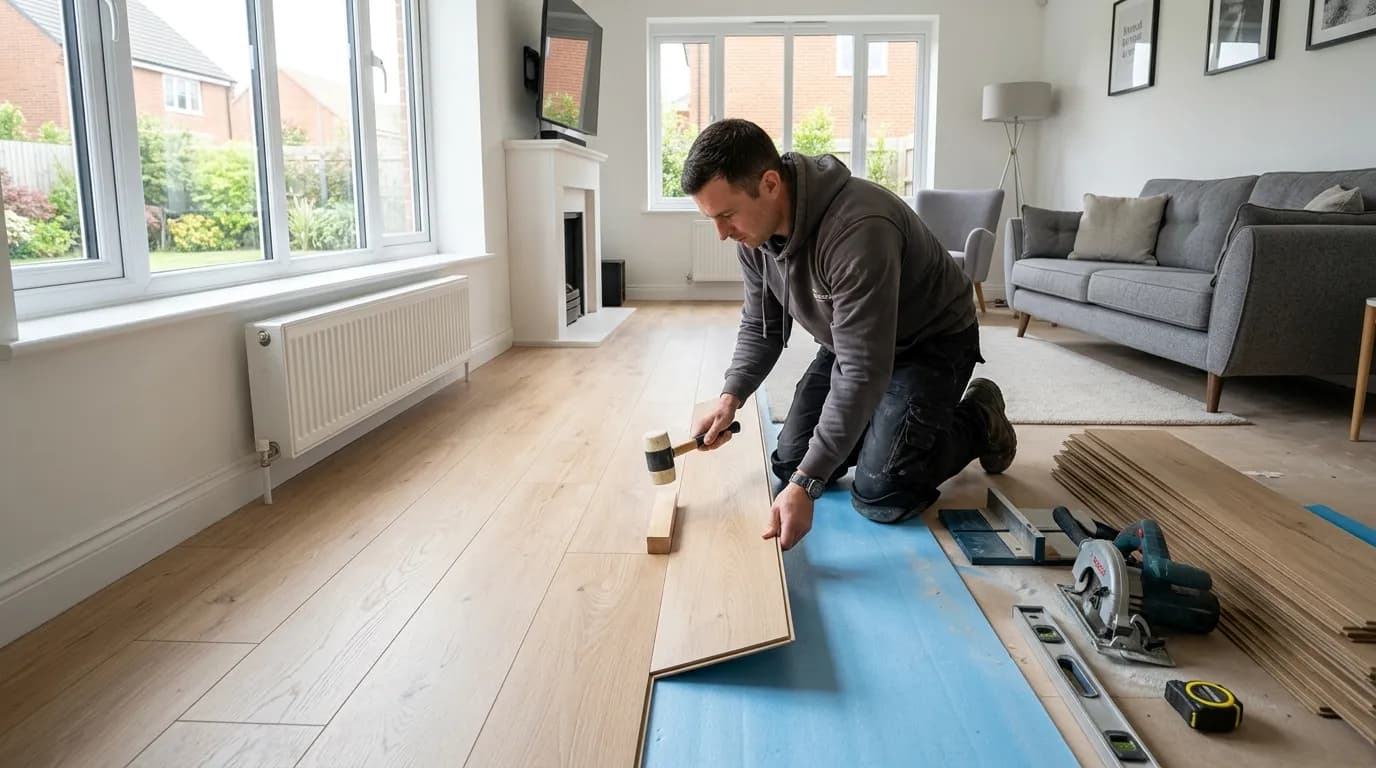
Click-lock laminate is genuinely one of the most accessible DIY home improvements. It is a floating floor, it sits on top of the underlay without being fixed to it. You do not need any special tools beyond a saw, tape measure, rubber mallet, spacers, and a pull bar. Here is what to expect.
What you need
A jigsaw or hand saw for cuts, a tape measure, a pencil, 8 to 10mm expansion spacers, a rubber mallet, a pull bar (for closing the last row), and a tapping block. Total tool cost if buying new: around £40 to £60. You will also need the laminate boards, underlay, and door bars. Many tool hire shops have floor laying kits for a day rate.
How long it takes
A standard 12m² bedroom takes most people a full day on their first attempt, about 6 to 8 hours including preparation and fitting door bars. With practice, 20m² is achievable in a day. Rooms with lots of cuts around fireplaces, bay windows, or curved walls take longer. If you have a large open-plan space with few obstacles, it goes quickly.
The preparation matters as much as the laying
The floor must be clean, dry, and flat before you start. Check the subfloor for squeaks (screw down loose boards), fill any significant dips in concrete with self-levelling compound, and let the laminate acclimatise in the room for 48 hours before laying. Rushing the prep is the most common cause of problems after installation.
What to watch out for
Always maintain a consistent expansion gap around the perimeter of the room (8 to 10mm) to allow for seasonal movement. Never glue the boards together unless the manufacturer specifies it. Cut boards from the non-visible face to avoid chipping the top surface. And always stagger the joins between rows, avoid having joins that line up across rows, which looks odd and weakens the floor structure.
Bottom line on DIY: If you are reasonably practical and not in a rush, fitting laminate yourself saves £8 to £15 per m², that is £160 to £300 on a bedroom, and up to £1,200 on a whole house. The risk of getting it wrong is low compared to other DIY jobs, and any individual board that goes badly can usually be replaced.
Popular Laminate Flooring Brands in the UK
The laminate flooring market has a huge range of brands at every price point. These are the most widely stocked and well-regarded names in the UK in 2026.
Quick-Step
£18 to £30/m²The market leader for a reason. Excellent finish quality, precise click system, and realistic wood and stone effects. The Impressive and Impressive Ultra ranges are especially popular. Widely available from flooring specialists.
Pergo
£15 to £25/m²One of the original laminate brands, the company that invented the product in the 1970s. Reliable quality, good range of finishes, and strong warranty coverage. Solid mid-to-premium choice.
Elka
£10 to £18/m²Popular mid-range brand offering good quality at a fair price. The 8mm and 10mm AC4 ranges are particularly well regarded for living rooms and family homes.
Egger
£8 to £16/m²Austrian manufacturer with a wide product range from budget to mid-premium. The Pro Laminate range (10mm, AC5) offers excellent durability at a competitive price.
Kronoswiss / Kronospan
£9 to £18/m²Swiss-origin brand with a strong reputation for consistency and durability. A reliable choice at mid-range price points.
How to Get Your Laminate Flooring for Less
Laminate flooring is one of the more affordable ways to transform a room, but there is still plenty of scope to overpay. These tips will help you get a great result without spending more than you need to.
Get at least three quotes
Fitting prices for laminate flooring can vary by 30 to 40% between fitters in the same area. Get at least three written quotes, making sure each one separates materials from labour. Ask whether underlay, door bars, and old flooring removal are included, these are common extras that can add up.
Lay it yourself and save £8 to £15 per m²
Click-lock laminate is genuinely one of the most achievable DIY flooring jobs. There is no glue, no nails, just cut the boards and click them together. A bedroom takes most people a full day the first time. Save £160 to £300 on a single room, or considerably more across a whole house.
Buy from flooring specialists, not DIY stores
Independent flooring retailers and trade suppliers typically sell the same brands at 10 to 20% less than large DIY chains. Online-only flooring retailers can offer further savings. If you are buying over 30m², it is always worth calling a local trade supplier for a quote, they often price it differently for larger orders.
Time your purchase around sales
Major flooring retailers run deep promotions in January, over bank holiday weekends, and during Black Friday. Deals of 30 to 50% off specific ranges are common. If your project is not urgent, signing up to retailer mailing lists can save you a significant amount, particularly on premium branded ranges.
Do not scrimp on the underlay
It sounds counterintuitive, but cheap underlay is one of the most common mistakes with laminate flooring. Quality underlay reduces noise, insulates the floor, and prevents the boards from feeling hollow underfoot. On a ground floor or concrete base, always use underlay with a damp proof membrane included. Spending an extra £1 to £2 per m² on underlay makes a noticeable difference to how the floor feels.
Use scotia beading instead of lifting the skirting
Laminate needs a 10mm expansion gap around the edge of the room, and there are two ways to hide it. Taking the skirting boards off, laying the floor underneath, then refitting and repainting them adds hours of labour and often a decorating bill on top. Pinning scotia or quadrant beading against the existing skirting does the same job for a few pounds a length. Ask your fitter to quote both ways, because the beading route can knock a fair bit off a whole-house price.
Match the AC wear rating to the room
Laminate is graded by an AC wear rating from AC1 up to AC5. AC3 is fine for most bedrooms and living rooms, and AC4 copes with busy hallways and family kitchens. AC5 is really a commercial grade, so paying extra for it in a normal home is money you do not need to spend. Checking the rating stops you buying a tougher floor than the room will ever wear out.
Useful Resources
What to Expect: The Laminate Flooring Process
A typical room can be fitted in a single day, but preparation is key to a long-lasting result. Here's what a professional fitter does.
- 1
Acclimatise the laminate
The unopened packs are left in the room for at least 48 hours so the boards adjust to the temperature and humidity. This prevents expansion or contraction after fitting.
- 2
Prepare the subfloor
The existing floor is checked for level (no more than 3mm variation over 1 metre). High spots are sanded down, low spots filled with levelling compound, and any old flooring or carpet is removed.
- 3
Lay the underlay
A foam or fibreboard underlay is rolled out across the subfloor, with sheets butted together and taped at the seams. On concrete subfloors, a DPM (damp-proof membrane) is laid first.
- 4
Fit the laminate boards
Boards are clicked together row by row, starting from the longest wall. A 10mm expansion gap is left around all edges, hidden later by skirting or beading. Planks are staggered for strength and appearance.
- 5
Cut around obstacles
Boards are carefully cut to fit around door frames, radiator pipes, and corners using a jigsaw or pull saw. Door frames are undercut so the laminate can slide neatly underneath.
- 6
Fit skirting, beading, and thresholds
New skirting boards or scotia beading are fitted to cover the expansion gap. Threshold strips are installed at doorways to create a neat transition between rooms.
Frequently Asked Questions
How much does laminate flooring cost per m²?
Budget laminate costs £6 to £10/m² for materials and £14 to £25/m² fully fitted including underlay. Mid-range (8 to 10mm, AC4) runs £10 to £15/m² for materials and £20 to £30/m² fitted. Premium laminate (10 to 12mm, AC5) costs £15 to £25/m² for materials and £25 to £40/m² fitted.
How much does it cost to fit laminate flooring in a living room?
A typical living room of around 20m² costs £400 to £600 for mid-range laminate fully fitted, including underlay and labour. Budget laminate in the same room would come in at £280 to £500, while premium laminate with herringbone laying pattern could reach £600 to £900.
Can I fit laminate flooring myself?
Yes, click-lock laminate is one of the most DIY-friendly home improvements available. It is a floating floor that does not need glue or nails: you just cut the boards to length and click them together. Most people complete a bedroom in a day. You need a saw, tape measure, spacers, and a pull bar. Watch a couple of YouTube tutorials before you start. The labour saving is £8 to £15 per m², which adds up to £160 to £300 on a standard bedroom.
What do AC ratings mean for laminate flooring?
AC ratings measure the abrasion and wear resistance of laminate flooring. AC3 is suitable for bedrooms and light domestic use. AC4 is rated for living rooms, hallways, and busy family areas. AC5 is a commercial grade, ideal for very high-traffic areas or rental properties where durability matters more than appearance. Always match the AC rating to the room, using AC3 in a hallway will result in premature wear.
Does laminate flooring need underlay?
Yes, in almost all cases. Underlay cushions the boards, reduces noise, evens out minor subfloor imperfections, and extends the life of the laminate. On ground floors or rooms with a concrete slab, use underlay with a built-in damp proof membrane. Upstairs on timber floors, acoustic underlay helps reduce sound transmission. Some laminate boards come with underlay pre-attached, which is convenient but usually thinner than buying separately.
What is the best laminate flooring brand?
Quick-Step is widely considered the market leader for quality and finish, with prices from around £20/m². Pergo and Kronoswiss offer excellent quality at similar price points. Elka and Egger are popular mid-range options at £10 to £16/m² that offer good durability for the money. Avoid very cheap supermarket or online-only brands without recognisable AC ratings, the quality can vary enormously.

Reviewed by Chris Kervin, Less.co.uk Home Improvement Costs Specialist
Last updated: · Pricing based on industry data and verified contractor submissions · Methodology
Compare real quotes for your job
Prices move a lot with your postcode, the access on site and the spec you choose. Get up to 3 free quotes from vetted local tradespeople and see what yours actually comes to, with no obligation to book.