How Much Does a Resin Driveway Cost in 2026?
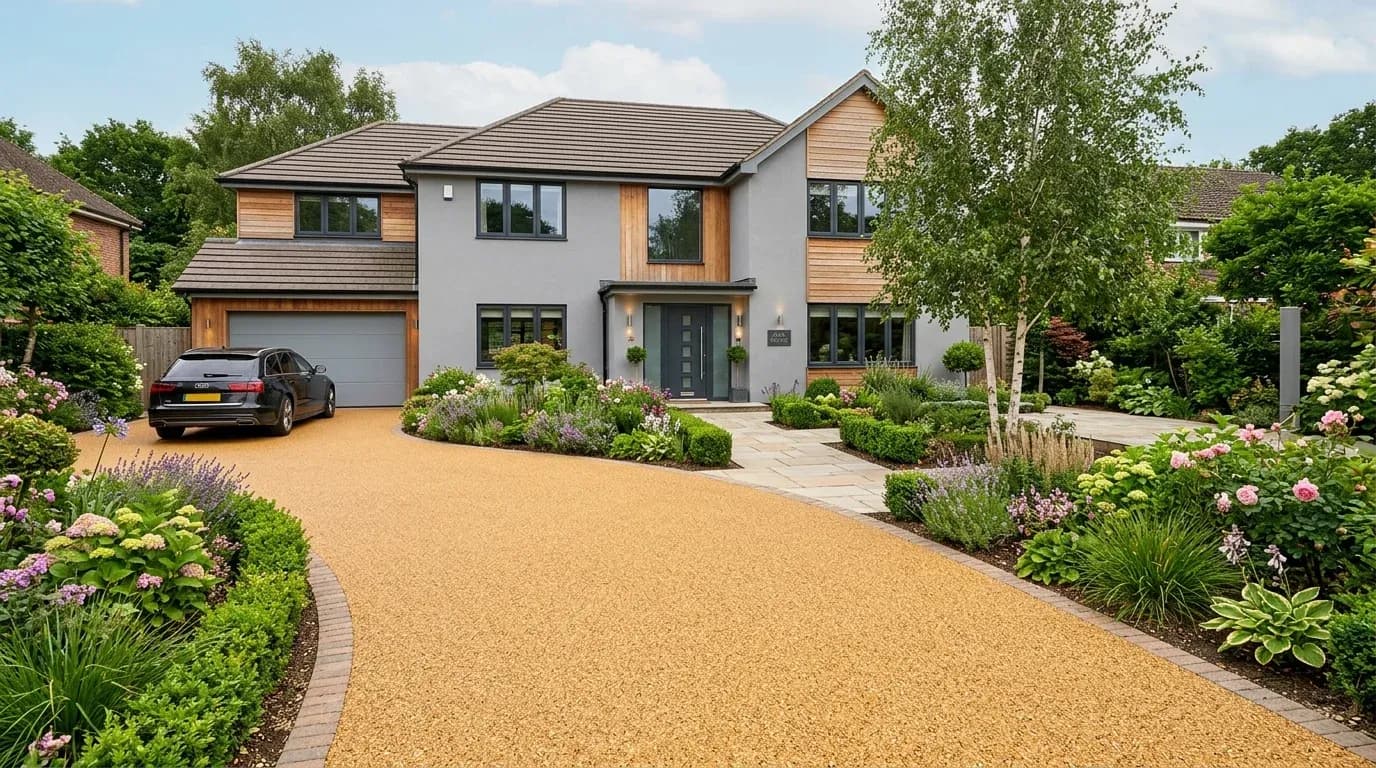
Resin driveway costs run from £40 to £70 per m² for a resin bound finish, depending on the aggregate you choose. For a typical 40m² drive that works out at £1,600 to £2,800 on an existing base, or £2,600 to £4,600 if the base has to be dug out and relaid. Here is the full breakdown, region by region.
£40
Per m² from
£1,600
40m² drive from
Resin bound
Most popular
1 to 2 days
Typical install
Prices updated April 2026 · Based on industry data and contractor submissions.
Planning permission. Resin bound driveways are permeable, so they do not normally need planning permission. If your driveway drains onto a public highway or you are in a conservation area, check with your local council first.
Resin Driveway Cost per m²
What does a resin driveway cost per square metre, supply and fit? Prices include resin, aggregate, and labour but not base preparation unless stated.
Resin bound (standard aggregate)
Natural stone mix, 15mm depth, supply and fit
£50/m²
£40 to £55/m²
Resin bound (premium aggregate)
Quartz or marble mix, 18mm depth, supply and fit
£63/m²
£55 to £70/m²
Resin bonded
Resin and scattered aggregate on existing surface
£40/m²
£30 to £50/m²
Base preparation (new)
Excavation, Type 1 sub-base, edging
£35/m²
£25 to £45/m²
Prices based on industry data. Actual costs depend on aggregate type, base condition, and your location.
Resin Driveway Cost by Project Size
What does a full resin driveway project cost? These estimates include standard natural stone aggregate on a resin bound finish.
| Project | Scope | Estimated Cost |
|---|---|---|
| Small driveway (20m²) | Resin bound on existing base | £800 to £1,400 |
| Typical driveway (40m²) | Resin bound including new base | £2,600 to £4,600 |
| Large driveway (60m²) | Resin bound including new base | £3,900 to £6,900 |
| Patio area (15m²) | Resin bound on prepared base | £600 to £1,050 |
Prices include supply, installation, and edging. Base preparation costs additional where needed.
Not sure how big your drive is?
Measure the length and the width in metres and multiply the two together. A drive that is 8m long and 5m wide is 40m², which is the size most of the figures on this page are based on. Odd shapes are easier if you split them into rectangles and add the areas up. Once you have your number, multiply it by the per m² rate for the finish you want to get a working resin driveway cost, then add base preparation if your existing surface has to come out.
Work it out with the driveway cost calculator →What Affects the Cost of a Resin Driveway?
Two drives of the same size can be quoted thousands apart. These are the things that move the number, roughly in order of how much difference they make.
The size of the area
Resin is priced per square metre, so area does most of the work. At £40 to £70 per m², every extra square metre adds to the bill in a fairly predictable way. Larger jobs sometimes attract a slightly better rate because the installer only sets up, mixes, and travels once.
Whether the existing base can stay
This is the biggest single variable. Laying onto a sound existing surface costs nothing extra. Digging out and starting again adds £25 to £45 per m² for excavation, Type 1 sub-base, and edging, plus £15 to £30 per m² to break out and cart away the old surface and £200 to £350 for a skip.
The aggregate you pick
A standard natural stone mix at 15mm depth comes in at £40 to £55 per m². Premium quartz or marble blends at 18mm push it to £55 to £70 per m². The stone is the visible part of the finish, so this is where people tend to spend, but the cheaper mixes still look good.
Resin quality and laying depth
UV-stable resin costs more than basic resin and is worth insisting on, because cheap resin yellows in sunlight. Depth matters too: driveways are normally laid at 15 to 18mm, and a quote priced on a thinner layer is not comparing like with like.
Edging and drainage
Resin has to be contained, so edging runs £15 to £25 per m. If water needs to be caught at the threshold, an ACO drainage channel adds £30 to £60 per m. Neither is optional on most drives, so check they are in the quote rather than added later.
Access and ground conditions
Steps, slopes, and uneven ground add £200 to £500 in extra preparation. Narrow access matters as well, because everything from the sub-base to the mixed resin has to be barrowed in by hand if a vehicle cannot get close.
Where you live
Labour rates set a floor on the price. The same 40m² drive with base preparation averages £3,800 in London and £2,600 in the North East, a gap of around £1,200 for identical work. See the regional table below for the rest of the UK.
Resin Bound vs Resin Bonded vs Block Paving
Not sure which surface is right for your driveway? Here is how the three most popular options compare.
| Feature | Resin Bound | Resin Bonded | Block Paving |
|---|---|---|---|
| Cost per m² | £40 to £70 | £30 to £50 | £70 to £120 |
| Lifespan | 15 to 25 years | 8 to 12 years | 20 to 30 years |
| Permeable | Yes | No | With gaps, yes |
| Maintenance | Low - occasional jet wash | Medium - loose stones | Medium - weeding joints |
| Install time (40m²) | 1 to 2 days | 1 day | 3 to 5 days |
| Planning permission | Not needed (permeable) | May be needed | Depends on drainage |
Resin bound is the go-to choice for most homeowners who want a clean, modern look with minimal maintenance. It drains naturally, so you avoid planning headaches. Block paving suits those who want a more traditional appearance or need easy spot-repairs. Resin bonded is fine for paths and light use but is not ideal for driveways that take daily traffic.
Are Resin Driveways Worth It?
On price alone, resin bound holds up well. It sits at £40 to £70 per m² against £70 to £120 per m² for block paving, it is down in 1 to 2 days rather than 3 to 5, and because it is permeable you avoid the planning permission question entirely. Laid properly it lasts 15 to 25 years and asks for little more than an occasional jet wash. The honest caveats are worth knowing before you commit.
Cheap resin yellows
Non-UV-stable resin discolours in direct sunlight, sometimes within a couple of years. The surface is structurally fine but looks patchy and tired, and there is no fix short of relaying it. This is the most common regret and the easiest to avoid.
Patch repairs show
With block paving you lift the damaged block and drop a new one in. A resin repair is a new batch of mixed resin and aggregate against a weathered surface, and the join is usually visible. Small damage tends to stay visible.
It depends entirely on the base
Resin is a surface layer, not a structure. If the ground underneath moves, cracks or settlement come through. Money saved by skipping proper base preparation is the money most likely to cost you later.
The weather sets the date
Resin needs dry conditions to cure, which is why spring and summer are peak season. A wet spell can push your start date back at short notice, so build some flexibility into your plans.
Resin bonded is a different product
Resin bonded costs less at £30 to £50 per m², but the loose aggregate scattered on top wears away and it lasts 8 to 12 years rather than 15 to 25. It is also not permeable. If a quote looks unusually cheap, check which of the two you are actually being priced for.
How to spot a resin driveway quote that is too cheap
A quote well under the ranges on this page is usually cheap for a reason rather than a bargain. Before you accept one, check that it says:
- •Which product it is, resin bound or resin bonded, in writing.
- •The laying depth, and whether it is the 15 to 18mm used on driveways.
- •The resin brand, and confirmation it is UV stable.
- •What happens to the existing surface, reused or dug out, and whether removal and skip hire are included.
- •Edging and any drainage as line items rather than something added on the day.
Get three quotes on the same written spec. That is the only way to tell whether one installer is genuinely cheaper or has simply left work out of the price.
Additional Costs to Budget For
Beyond the resin surface itself, here are the extras that can affect your final bill.
| Item | Typical Cost |
|---|---|
| Existing surface removal | £15 to £30/m² |
| Skip hire | £200 to £350 |
| Edging / kerbing | £15 to £25/m |
| Drainage channel | £30 to £60/m |
| Steps or slopes | £200 to £500 |
Resin Driveway Costs by Region
Labour rates vary across the UK. These are average prices for a 40m² resin bound driveway including base preparation.
| Region | Average Cost | vs National |
|---|---|---|
| London | £3,800 | +22% |
| South East | £3,400 | +9% |
| East of England | £3,300 | +6% |
| South West | £3,200 | +3% |
| Midlands | £3,100 | Average |
| Yorkshire | £2,800 | -10% |
| North West | £2,900 | -6% |
| North East | £2,600 | -16% |
| Scotland | £2,800 | -10% |
| Wales | £2,700 | -13% |
Based on industry data. 40m² resin bound driveway with base preparation, supply and fit.
How to Get Your Resin Driveway for Less
A resin driveway is already good value compared to many alternatives, but there are still ways to trim the cost without cutting corners.
Use your existing base if it is in good condition
If your current tarmac or concrete is solid, level, and free of major cracks, a resin bound surface can go straight on top. This saves £25 to £45 per m² in excavation and sub-base costs - on a 40m² drive, that is £1,000 to £1,800 saved. Ask the installer to assess the existing surface before assuming you need a full dig-out.
Get quotes in winter when installers are quieter
Resin driveways need dry weather to cure, so spring and summer are peak season. Installers often offer better rates for work booked in late autumn or early spring. The trade-off is that wet weather can delay the job, but you may save 10 to 15% on labour.
Choose a natural stone aggregate over quartz or marble
Standard natural stone aggregates look great and cost £40 to £55 per m². Premium options like golden quartz or marble push the price to £55 to £70 per m². Unless you specifically want a particular colour, the standard mixes give a perfectly attractive finish at a lower cost.
Check the installer uses UV-stable resin
Cheap resin yellows in sunlight within a couple of years, making the driveway look tired and patchy. UV-stable resin costs a bit more but keeps its colour for the life of the surface. Ask what resin brand and type the installer uses, and check it carries a UV stability guarantee. It is not worth saving £200 if the surface looks terrible after two summers.
Combine your driveway and patio for a bulk discount
If you are thinking about resurfacing your patio as well, doing both at the same time can save 10 to 20% compared to two separate jobs. The installer only needs to set up once, order materials in bulk, and move equipment around rather than coming back on a separate visit.
What to Expect: The Resin Driveway Installation Process
From first quote to finished drive, here is how a typical resin bound driveway installation works.
- 1
Survey and quote
An installer visits to measure the area, assess the existing surface, and discuss aggregate options and colours. They should provide a written quote that specifies whether the existing base can be reused or needs replacing.
- 2
Base preparation
If the existing surface is not suitable, it is excavated and a new Type 1 sub-base is laid and compacted. Edging is installed around the perimeter to contain the resin. This is the most important stage - a poor base leads to cracking and settlement.
- 3
Resin and aggregate mixed
The resin and chosen aggregate are mixed on site in a forced-action mixer. The mix is then laid by hand using trowels, spread to a consistent depth of 15 to 18mm. Good installers work quickly - the resin starts to set within 20 to 30 minutes.
- 4
Surface finished and cured
The surface is trowelled smooth and left to cure. In warm weather this takes 4 to 6 hours before you can walk on it, and 24 hours before driving on it. In cooler weather, curing takes longer. The installer should advise on exactly when the drive is ready for use.
- 5
Final check and handover
Once fully cured, the installer checks for any inconsistencies and cleans up the site. They should walk you through basic maintenance - an occasional jet wash is all that is needed to keep a resin driveway looking good.
Useful resources
- Gov.uk: Planning and flood risk, Permeable surface requirements for driveways
- Susdrain, Guidance on sustainable drainage and permeable surfaces
Frequently Asked Questions
How much does a resin driveway cost per m²?
A resin bound driveway costs £40 to £70 per m² depending on the aggregate colour and mix. Resin bonded surfaces are slightly cheaper at £30 to £50 per m² but are less durable. For a typical 40m² driveway, expect to pay £1,600 to £2,800 for resin bound and £1,200 to £2,000 for resin bonded.
What is the difference between resin bound and resin bonded?
Resin bound surfaces mix the resin and aggregate together before laying, creating a smooth, permeable finish that allows water to drain through. Resin bonded surfaces spread resin onto the existing surface and scatter loose aggregate on top - this creates a textured finish but is not porous, so water runs off rather than draining through. Resin bound is more durable and is the better choice for driveways.
How long does a resin driveway last?
A well-installed resin bound driveway typically lasts 15 to 25 years. The main factors affecting lifespan are the quality of the base, the resin used, and UV exposure. Cheaper resins can yellow or become brittle in direct sunlight. A resin bonded surface has a shorter lifespan of 8 to 12 years because the loose aggregate gradually wears away.
Does a resin driveway need planning permission?
If your resin driveway is permeable (resin bound is), you do not need planning permission under permitted development rules. If the surface is impermeable (resin bonded), and the area exceeds 5m², you must either get planning permission or ensure the water drains into a permeable area within your property. This rule was introduced to reduce flood risk from paved-over front gardens.
Is a resin driveway cheaper than block paving?
Resin bound driveways cost £40 to £70 per m², while block paving runs £70 to £120 per m², so resin usually works out cheaper per square metre. Resin is typically faster to install (1 to 2 days vs 3 to 5 days for block paving) which can reduce labour costs. Block paving is easier to repair in small sections. The choice often comes down to the look you prefer rather than price.
What are the downsides of a resin driveway?
The three that catch people out are resin quality, repairs, and weather. Cheap resin yellows in sunlight within a couple of years, so the surface looks tired long before it wears out. Repairs are harder than block paving, where a damaged block is simply lifted and swapped, because a resin patch rarely blends invisibly with the surrounding surface. And resin needs dry conditions to cure, so a wet week can push your installation date back. The surface is also only as good as what sits under it, so a weak or uneven base will show through as cracking or settlement.
Are resin driveways worth it?
For most homeowners, yes. At £40 to £70 per m² resin bound is cheaper per square metre than block paving at £70 to £120 per m², it goes down in 1 to 2 days rather than 3 to 5, it is permeable so it sidesteps the planning permission question, and upkeep is an occasional jet wash rather than pulling weeds out of joints. It lasts 15 to 25 years when it is laid properly on a sound base. It is worth less if you want a surface you can repair in small patches or you are covering an area that takes heavy vehicle loads.
Can you jet wash a resin driveway?
Yes, and an occasional jet wash is really all the maintenance a resin bound driveway needs. Use a wide fan nozzle at moderate pressure and keep the lance moving rather than holding a narrow jet close to one spot, because concentrated pressure can dislodge aggregate. Avoid harsh solvents. Clearing leaves and moss off in autumn also helps, since organic matter left to sit is what usually causes staining.
Can you lay a resin driveway over an existing driveway?
Yes, if the existing tarmac or concrete is solid, level, and free of major cracks, resin bound can be laid straight over the top. That is the single biggest saving available on this job because it removes base preparation at £25 to £45 per m², plus surface removal at £15 to £30 per m² and skip hire at £200 to £350. It does not work over block paving, gravel, or a surface that is already moving, because resin needs a rigid substrate to bond to. Ask the installer to assess the existing surface before you accept a quote that assumes a full dig-out.

Written by Chris Kervin, Co-Founder of Less.co.uk
Last updated: April 2026 · Pricing based on industry data and verified contractor submissions · Methodology
Ready to get your resin driveway sorted for less?
A resin driveway transforms the front of your home in a day or two. Compare a few quotes on the same spec and get the best deal.
Compare Free Driveway QuotesFree, no obligation · Local installers · Compare up to 3 quotes
More Home Improvement Cost Guides
Compare real quotes for your job
Prices move a lot with your postcode, the access on site and the spec you choose. Get up to 3 free quotes from vetted local tradespeople and see what yours actually comes to, with no obligation to book.