Concrete Driveway Cost UK 2026
A concrete driveway costs £50 to £90 per m² depending on the finish. A typical 40 m² drive comes in at £2,000 to £3,600. Concrete is one of the most durable driveway surfaces available, lasting 25 to 40 years with proper installation and minimal upkeep.
£70
Average per m²
£2,800
Typical drive (40 m²)
3 to 5 days
Installation time
25 to 40 yrs
Lifespan
Prices updated April 2026 · Based on industry data and contractor submissions.
Quick answer
How much does a concrete driveway cost?
A concrete driveway costs £50 to £90 per m² in 2026, depending on the finish. Plain brushed concrete is cheapest at £50 to £65 per m², while stamped or printed concrete runs £75 to £90 per m². A typical single-car driveway of around 40 m² costs £2,000 to £3,600. Prices include excavation, sub-base, formwork, pouring, and finishing but exclude drainage and drop kerbs.
Concrete Driveway Prices by Size
Full dig-out, compacted sub-base, steel mesh reinforcement, and brushed concrete finish. Prices are national averages.
Small drive (30 m²)
£2,100
£1,500 to £2,700
Typical drive (40 m²)
£2,800
£2,000 to £3,600
Large drive (60 m²)
£4,200
£3,000 to £5,400
Double drive (80 m²)
£5,600
£4,000 to £7,200
Overlay only (40 m²)
£1,800
£1,200 to £2,400
Excludes drop kerb, drainage, and decorative finish upgrades. Add 20 to 40% for stamped or printed concrete.
Concrete Driveway Finishes Compared
The finish you choose has the biggest impact on price. Here is what each option costs and how it performs.
| Finish | Cost per m² |
|---|---|
| Plain brushed concrete | £50 to £65/m² |
| Exposed aggregate | £65 to £85/m² |
| Stamped/printed concrete | £75 to £90/m² |
| Coloured concrete | £60 to £80/m² |
| Reinforced concrete (heavy use) | £70 to £95/m² |
What Affects the Price of a Concrete Driveway
Finish type
This is the single biggest variable. Plain brushed concrete is the most affordable option and gives a good grip underfoot and under tyres. Exposed aggregate washes away the top layer to reveal decorative stones underneath and costs 20 to 30% more. Stamped or printed concrete uses moulds and colour hardener to imitate stone, brick, or slate - it looks impressive but sits at the premium end of the scale.
Sub-base and ground conditions
Every concrete driveway needs a compacted sub-base of Type 1 crushed stone, typically 150 to 200 mm deep. If the existing ground is clay, waterlogged, or full of tree roots, more excavation and preparation is needed, which pushes costs up. Sandy, well-drained ground is the easiest and cheapest to work with.
Reinforcement
Steel mesh reinforcement (A142 or A193) is strongly recommended for any driveway that will take vehicle traffic. It adds £5 to £10 per m² but significantly reduces the risk of cracking under load. For heavier vehicles or commercial use, thicker slabs with heavier reinforcement may be specified, pushing costs towards the top of the range.
Slab thickness
A standard domestic concrete driveway is typically 100 to 125 mm thick. Heavier use - caravans, motorhomes, or regular delivery vehicles - may require 150 mm or more. Each additional 25 mm of thickness adds roughly £5 to £8 per m² in concrete volume alone.
Expansion joints
Concrete expands and contracts with temperature changes. Control joints (saw-cut grooves) are placed every 3 to 4 metres to direct any cracking along planned lines. Expansion joints with compressible filler are placed where the driveway meets the house, garage, or other fixed structures. Skipping these is a false economy - uncontrolled cracking looks terrible and is expensive to fix.
Drainage requirements
Standard concrete is not permeable. Under planning rules in England, new or replacement impermeable driveways over 5 m² of front garden need surface water drainage - typically an ACO channel drain, soakaway, or directing run-off into a planted border. This adds £200 to £600 to the project but is a legal requirement, not an optional extra.
How a Concrete Driveway Is Laid
Understanding the process helps you spot shortcuts and ask the right questions when comparing quotes.
Excavation
The existing surface and topsoil are dug out to a depth of 250 to 350 mm, depending on ground conditions. The excavated material is loaded into a skip or lorry for disposal. The formation level is checked for soft spots and compacted.
Sub-base preparation
A layer of Type 1 crushed stone (150 to 200 mm) is spread evenly and compacted with a plate compactor or roller. This provides the stable foundation that the concrete slab sits on. Without it, the slab will crack and sink unevenly over time.
Formwork and reinforcement
Timber or plastic formwork is set around the perimeter and at expansion joint locations to contain the wet concrete and define the shape of the drive. Steel mesh reinforcement is placed on spacers so it sits in the lower third of the slab, where it provides the most tensile strength.
Pouring and levelling
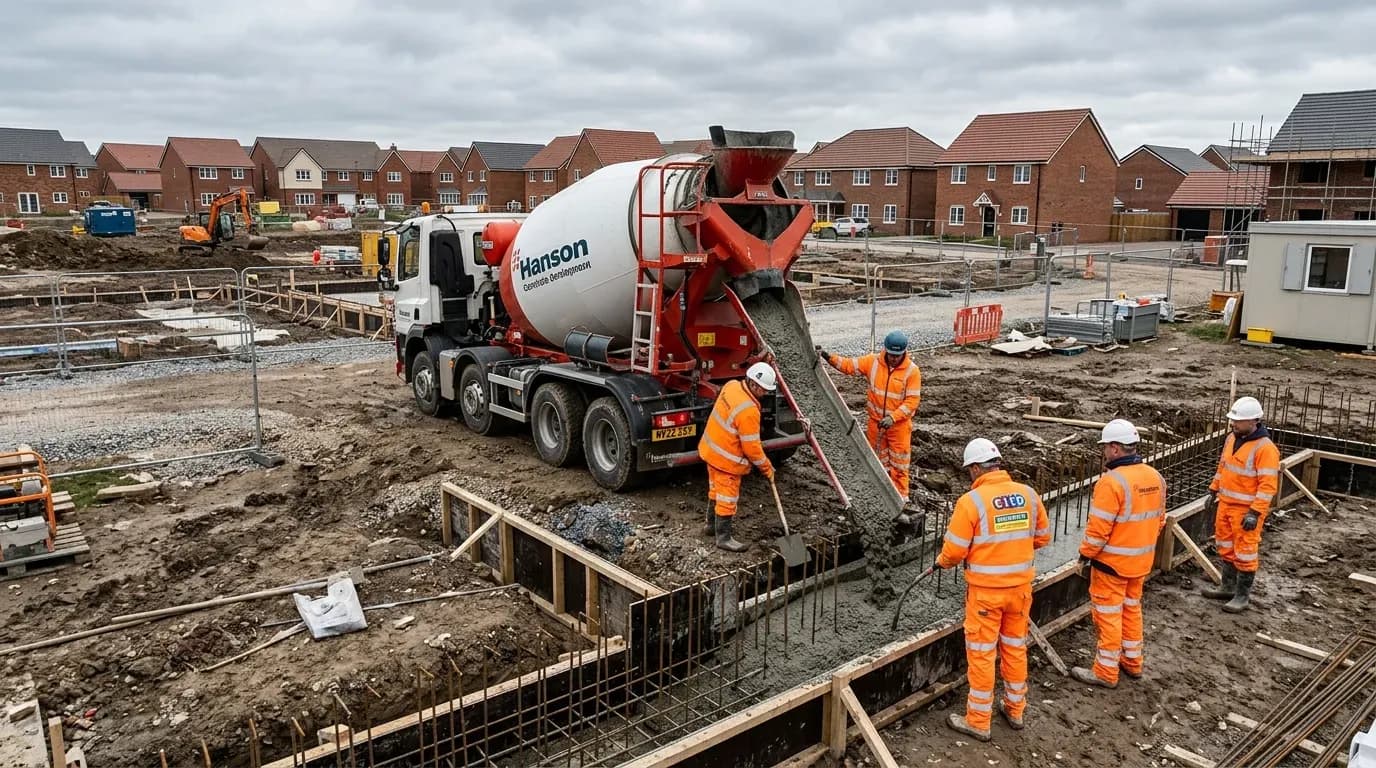
Ready-mixed concrete (typically C30 or C35 grade) is delivered by mixer truck and poured into the formwork. It is spread, vibrated to remove air pockets, and levelled with a screed bar. On larger drives, a concrete pump may be used to reach areas the truck cannot access.
Finishing
For brushed concrete, a broom is dragged across the surface to create a textured, slip-resistant finish. For exposed aggregate, a retarder is sprayed on and the top layer is washed off after partial curing. For stamped concrete, moulds are pressed into the surface and colour hardener is applied while the concrete is still workable.
Curing
Concrete needs time to reach full strength. The surface may be covered with polythene or sprayed with a curing compound to retain moisture. You should not walk on it for at least 7 days or drive on it for a minimum of 28 days. Rushing this stage is one of the most common causes of surface failure.
Concrete vs Tarmac vs Block Paving vs Resin
How concrete compares to the other main driveway options on price, lifespan, and maintenance.
| Material | Cost per m² |
|---|---|
| Concrete (plain) | £50 to £65/m² |
| Concrete (stamped) | £75 to £90/m² |
| Tarmac | £40 to £60/m² |
| Block paving | £70 to £120/m² |
| Resin bound | £40 to £70/m² |
Maintaining a Concrete Driveway
Concrete is low-maintenance compared to most driveway materials, but a small amount of care keeps it looking good and extends its life.
Regular cleaning
A pressure washer once or twice a year removes dirt, algae, and moss. For oil stains, a degreaser applied before pressure washing gives the best results. Avoid using acid-based cleaners on coloured or stamped concrete as they can strip the surface treatment.
Sealing
Stamped and coloured concrete should be resealed every 2 to 3 years to maintain the colour and protect against staining. Plain brushed concrete does not need sealing, though a penetrating sealer can help resist oil stains and freeze-thaw damage. A coat of sealer costs around £3 to £8 per m² if done professionally, or you can buy the product and apply it yourself for less.
Crack repair
Hairline cracks along control joints are normal and expected - that is exactly what the joints are for. Cracks that appear elsewhere should be filled promptly with a concrete crack filler to stop water getting in and making them worse through freeze-thaw cycles. If a section develops significant cracking or sinking, it may need cutting out and replacing rather than patching.
Winter care
Avoid using rock salt (sodium chloride) on concrete driveways, especially in the first winter. Salt accelerates surface scaling and spalling. Use sand or grit for traction instead, or a concrete-safe de-icer if needed. This is particularly important for stamped and coloured concrete, which is more vulnerable to salt damage.
Additional Costs to Budget For
These extras come up on most concrete driveway jobs. Make sure you know which are included in your quote.
| Extra Item | Typical Cost |
|---|---|
| Excavation and removal of old surface | £10 to £20/m² |
| Type 1 sub-base (150 to 200 mm) | £8 to £15/m² |
| Steel mesh reinforcement (A142 or A193) | £5 to £10/m² |
| Formwork and expansion joints | £8 to £15 per linear metre |
| Drainage channel or ACO drain | £200 to £600 |
| Drop kerb (council crossing) | £800 to £2,000 |
| Colour hardener or integral pigment | £5 to £12/m² |
| Sealer application | £3 to £8/m² |
| Skip hire | £200 to £350 |
Concrete Driveway Costs by Region
Average price per m² for a standard brushed concrete driveway installation (dig-out, sub-base, reinforcement, pour, and finish), by UK region.
| Region | Price per m² | vs National |
|---|---|---|
| London | £85/m² | +21% |
| South East | £78/m² | +11% |
| East of England | £73/m² | +4% |
| South West | £70/m² | Average |
| Midlands | £67/m² | -4% |
| Yorkshire | £63/m² | -10% |
| North West | £65/m² | -7% |
| North East | £60/m² | -14% |
| Scotland | £63/m² | -10% |
| Wales | £61/m² | -13% |
Based on industry data for plain brushed concrete. Decorative finishes will be 20 to 50% higher depending on the style chosen.
How to Get Your Concrete Driveway for Less
Practical ways to bring the cost down without compromising on quality or longevity.
Get at least 3 quotes from different contractors
Concrete driveway prices vary significantly between contractors, often by 30% or more for the same job. Getting three quotes lets you compare like-for-like and spot anyone who is overcharging or suspiciously cheap. Make sure each quote includes the same specification: concrete mix, slab thickness, sub-base depth, reinforcement, and drainage.
Choose plain brushed concrete over decorative finishes
Plain brushed concrete costs £50 to £65 per m² while stamped or printed finishes push the price to £75 to £90 per m². On a 40 m² driveway, that difference adds up to £800 to £1,000. Brushed concrete is practical, slip-resistant, and ages well. If you want a bit more character, consider exposed aggregate rather than full stamped concrete - it looks distinctive but costs less than pattern imprinting.
Book during spring or early autumn
Concrete contractors are busiest in summer. Spring and early autumn give you better availability and sometimes better prices. Concrete can be poured in cooler weather provided the temperature stays above 5 degrees Celsius and there is no risk of frost overnight during the curing period. Avoid winter entirely - concrete that freezes before it cures properly will be weak and flaky.
Check drop kerb and drainage costs upfront
If you do not already have a lowered kerb for vehicle access, you will need one from your council before any driveway work begins. This adds £800 to £2,000 and takes several weeks. Non-permeable concrete over 5 m² of front garden also requires surface water drainage. Some quotes conveniently leave these out - always ask whether they are included before comparing prices.
Keep the design simple and avoid curves
Straight edges and rectangular shapes are much cheaper to form and pour than curves and intricate patterns. Curved formwork needs to be custom-bent, which takes longer and costs more in labour. If you want visual interest, consider using a simple rectangular layout with a decorative border strip or contrasting edging instead of shaping the entire drive into curves.
Useful resources
- Gov.uk: Flood risk rules, Hard-surfacing front gardens and permeable surface requirements
- Planning Portal: Driveways, Driveway planning permission rules for England
- The Concrete Society, Technical guidance and best practice for concrete construction
- British Ready-Mixed Concrete Association, Industry standards for ready-mixed concrete
Frequently Asked Questions
How much does a concrete driveway cost per m²?
A concrete driveway costs between £50 and £90 per square metre in 2026, depending on the finish you choose. Plain brushed concrete sits at the lower end, while stamped or printed concrete with colour hardener pushes towards the top. Prices include excavation, sub-base preparation, formwork, pouring, and finishing.
How long does a concrete driveway last?
A properly laid concrete driveway lasts 25 to 40 years with minimal maintenance. The key factors are the depth and quality of the sub-base, the concrete mix specification (typically C30 or C35 for driveways), correct placement of expansion joints, and adequate curing time. Concrete that is rushed or poured in freezing conditions will crack and deteriorate much sooner.
Is a concrete driveway cheaper than block paving?
Plain brushed concrete is cheaper than block paving at £50 to £65 per m² versus £70 to £120 per m². However, stamped or printed concrete that mimics the look of block paving costs £75 to £90 per m², which narrows the gap considerably. The advantage of concrete is a seamless surface with no weeds growing between joints, though block paving is easier to repair if a section is damaged.
How long before you can drive on a new concrete driveway?
You should wait at least seven days before walking on a new concrete driveway and a minimum of 28 days before driving on it. Concrete reaches roughly 70% of its final strength after seven days and full strength at 28 days. Driving on it too early can cause surface cracking and permanent tyre marks. In cold weather, curing takes even longer.
Do concrete driveways crack?
All concrete cracks eventually - the goal is to control where and how. Expansion joints (also called control joints) are cut into the surface at regular intervals so that any cracking happens along those planned lines rather than randomly across the drive. A well-designed layout with joints every 3 to 4 metres, proper sub-base preparation, and steel mesh reinforcement keeps cracking to a minimum.
Does a concrete driveway need planning permission?
Standard concrete is not permeable, so if you are paving over more than 5 square metres of front garden, you will need either planning permission or a drainage solution such as a soakaway or channel drain to handle surface water run-off. This rule applies across England. Scotland, Wales, and Northern Ireland have similar but slightly different regulations. Your contractor should advise on what is needed for your specific situation.
Can you lay concrete over an existing driveway?
It is possible to pour a thin concrete overlay (50 to 75 mm) over an existing sound concrete surface, but it is not recommended over tarmac, gravel, or crumbling surfaces. The existing concrete must be clean, structurally sound, and properly bonded to the new layer. In most cases, a full dig-out and new pour gives a far better result and avoids problems with levels at thresholds and drainage.

Written by Chris Kervin, Co-Founder of Less.co.uk
Last updated: · Pricing based on industry data and verified contractor submissions · Methodology
Ready to get your concrete driveway for less?
Compare free quotes from local driveway contractors near you. Getting three quotes is the single best way to make sure you are paying a fair price.
Get Free QuotesFree, no obligation · Local driveway contractors · Compare multiple quotes
More home improvement costs
Compare real quotes for your job
Prices move a lot with your postcode, the access on site and the spec you choose. Get up to 3 free quotes from vetted local tradespeople and see what yours actually comes to, with no obligation to book.