How Much Does Concrete Cost in 2026?
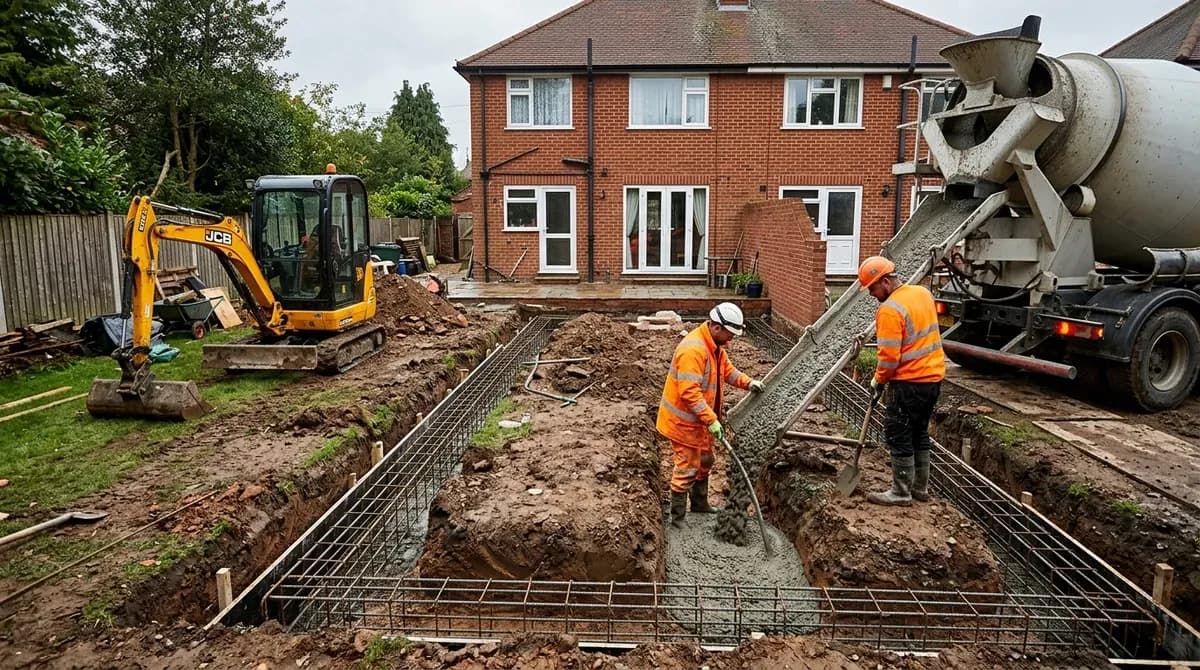
The cost of ready mix concrete per m3 is £105 to £170 delivered. Mini-mix for smaller jobs costs £130 to £180 per m³. Pumped concrete costs an extra £200 to £400 for the pump hire. Bagged concrete from a builders' merchant works out at roughly £500 per m³. Here is the full breakdown of concrete cost per m3, including how much you need for common projects.
£105 to £170
Ready-mix per m³
£130 to £180
Mini-mix per m³
£4 to £6
Bagged (per 20kg)
£200 to £400
Pump hire
Prices updated April 2026 · Based on industry data and contractor submissions.
Quick calculation. 1 cubic metre of concrete covers 10 square metres at 100mm thick. Multiply length (m) x width (m) x depth (m) to work out your volume, then add 10% for wastage.
Concrete Cost per m3 by Type
Ready-mix concrete (delivered)
Standard grades, minimum load applies
£135/m³
£105 to £170/m³
Mini-mix / volumetric
Mixed on site, smaller quantities
£130/m³
£100 to £160/m³
Bagged concrete (20kg)
From builders' merchants (B&Q, Wickes, etc.)
£5/bag
£4 to £6/bag
Minimum delivery charge
Most ready-mix suppliers
£200
£150 to £250
Concrete pump hire
When wheelbarrow access is not possible
£300
£200 to £400/half day
Get Free Concrete Quotes
Compare prices from trusted local concrete suppliers near you. Fill in a few details and receive up to 4 free, no-obligation quotes.
What Affects the Cost of Concrete?
The price you pay depends on several factors. Here are the main ones that move the needle.
Quantity ordered
A full 6m³ lorry load is the cheapest per cubic metre. Mini-mix (volumetric) trucks charge more per m³ but let you order smaller amounts without waste. Bagged concrete from a builders' merchant is the most expensive option by volume, but makes sense for very small jobs under 0.5m³.
Concrete grade and strength
Standard grades like C20 (paths and patios) cost less than higher-strength mixes like C30 (driveways) or C35 (structural). Specialist mixes with additives for waterproofing or rapid setting also carry a premium. Your supplier or builder will specify the right grade for your project.
Delivery distance and site access
Most suppliers include delivery within a set radius (typically 10 to 15 miles). Beyond that, expect a surcharge of £1 to £3 per mile. If the truck cannot get close enough to pour directly, you will need a concrete pump (£200 to £400) or extra labour to barrow the concrete into position.
Time of year
Spring and summer are peak season for concrete work, and suppliers are busier. Prices tend to be 5% to 10% higher between April and September. Ordering in autumn or winter can save money, though cold weather affects curing times and your groundworker may need to take precautions.
Pump hire
If the delivery truck cannot reach the pour site (rear gardens, uphill locations, or narrow access), you will need a concrete pump. A line pump costs £200 to £400 for a half day. A boom pump for larger or harder-to-reach jobs costs £400 to £800. This is on top of the concrete price.
Wastage allowance
Uneven ground, slightly deeper spots, and spillage mean you always need more concrete than the exact calculation. The standard allowance is 5% to 10% extra. Under-ordering means a costly second delivery, so it is better to have a small amount left over than to run short mid-pour.
How Much Does Concrete Cost for Common Projects?
These costs are for the concrete supply only. Labour, formwork, and preparation are additional.
| Project | Volume | Grade | Concrete Cost |
|---|---|---|---|
| Garden path (10m × 1m × 100mm) | 1m³ | C20 | £150 to £250 |
| Shed base (3m × 2.4m × 100mm) | 0.72m³ | C25 | £150 to £250 |
| Garage floor (6m × 3m × 100mm) | 1.8m³ | C25 | £200 to £350 |
| Driveway (5m × 3m × 150mm) | 2.25m³ | C30 | £250 to £400 |
| Strip foundations (15m × 0.6m × 0.3m) | 2.7m³ | C20/25 | £280 to £420 |
| Patio base (4m × 4m × 100mm) | 1.6m³ | C20 | £200 to £320 |
Additional Costs
| Item | Typical Cost |
|---|---|
| Reinforcement mesh (per sheet) | £8 to £15 |
| DPM (damp proof membrane) | £30 to £60 |
| Timber formwork | £20 to £50 |
| Skip hire (for excavated soil) | £200 to £350 |
| Labour (groundworker) | £200 to £300/day |
Concrete Prices by Region
Prices shown are per cubic metre for standard ready-mix concrete delivered.
| Region | Average/m³ | vs National |
|---|---|---|
| London | £160 | +20% |
| South East | £150 | +10% |
| East of England | £143 | +6% |
| South West | £139 | +3% |
| Midlands | £135 | Average |
| Yorkshire | £126 | -7% |
| North West | £127 | -6% |
| North East | £119 | -12% |
| Scotland | £131 | -3% |
| Wales | £123 | -9% |
How to Get Your Concrete for Less
Get at least three quotes
Prices for the same concrete job can vary by 30% or more between groundworkers in the same area. Get at least three written quotes so you can compare like for like, including the mix specification, site prep, and labour. The cheapest is not always the best, check reviews, ask for references, and make sure the quote includes everything.
Order the right amount first time
Under-ordering means a second delivery (another minimum charge of £150+). Over-ordering means paying for concrete you do not need and then paying to dispose of it. Measure carefully, calculate volume (length × width × depth), and add 10% for wastage. Your supplier can help you calculate if you give them the dimensions.
Use mini-mix for jobs under 2m³
Volumetric (mini-mix) suppliers mix concrete on site and you pay only for what you use. The per-metre price is higher (£130 to £180/m³ vs £105 to £170/m³), but there is no minimum load waste. For a 1m³ shed base, mini-mix at £150 beats a ready-mix minimum delivery charge of £200+ for a similar amount.
Have everything ready before the truck arrives
Ready-mix trucks typically allow 30 to 60 minutes on site. After that, you are charged waiting time (£50 to £100 per hour). Have your formwork, membrane, and mesh in place, and enough people to barrow and level the concrete quickly. If access is difficult, book a pump, it costs £200 to £400 but saves time and avoids the waiting charge.
Compare suppliers, prices vary more than you think
Ready-mix prices can vary by 20 to 30% between suppliers for the same grade and quantity. Get quotes from at least three local suppliers. Ask about delivery charges, waiting time, and whether they do part-loads. Some suppliers offer discounts for midweek or off-peak deliveries.
Check whether the price includes VAT
Ready-mix suppliers and builders' merchants often quote trade prices that leave out VAT, so a headline £100 per m³ actually costs £120 once the standard 20% is added. Before you decide one supplier is cheaper than another, confirm whether each figure is with or without VAT. Comparing an ex-VAT quote against a VAT-inclusive one can make the wrong supplier look a fifth cheaper than it really is.
Comparing quotes is the simplest way to pay less
Getting three or four quotes and comparing them is how most homeowners avoid overpaying. It takes a couple of minutes, with no obligation.
Get my free quotesWhat to Expect: The Concrete Pouring Process
Whether it is a shed base, a driveway, or strip foundations, the basic process for laying concrete follows the same steps. Here is what your groundworker will do.
- 1
Site preparation and excavation
The area is marked out and excavated to the correct depth. Topsoil and soft ground are removed, and the sub-base is compacted using a whacker plate. A layer of MOT Type 1 hardcore (75 to 150mm) is laid and compacted to create a stable foundation.
- 2
Formwork and edging
Timber formwork is built around the perimeter to contain the concrete at the correct level. The boards are pegged firmly into place, checked for level, and any expansion joints are positioned where needed. Good formwork is the difference between a neat finish and a messy one.
- 3
Reinforcement and membrane
A damp proof membrane is laid over the sub-base to prevent moisture rising through the slab. Steel reinforcement mesh (typically A142 or A193) is placed on spacers so it sits within the concrete rather than resting on the bottom. Not every job needs mesh, but driveways and structural slabs almost always do.
- 4
Pouring and levelling
The concrete is delivered by truck or mixed on site and poured into the formwork. It is spread with rakes and shovels, then levelled using a screed bar or tamping beam drawn across the top of the formwork. This is the stage where having enough hands on site really matters, ready-mix trucks charge waiting time after 30 to 60 minutes.
- 5
Finishing and curing
The surface is finished with a steel float for a smooth finish or a broom for grip. The concrete then needs at least 48 hours before light foot traffic and a full 7 days before any vehicle load. In hot or windy weather, it may be covered with polythene to stop it drying too quickly and cracking.
Frequently Asked Questions
How much does concrete cost per m³?
Ready-mix concrete delivered by a truck costs £105 to £170 per cubic metre depending on the grade and your location. Mini-mix or volumetric concrete (for smaller quantities) costs £130 to £180 per m³. Bagged concrete from a builders' merchant works out at roughly £500 per m³, significantly more expensive, but practical for very small jobs under 0.5m³.
How much concrete do I need?
To calculate the volume: multiply the length (m) × width (m) × depth (m). For example, a 5m × 2m driveway at 100mm thick = 5 × 2 × 0.1 = 1m³. As a rule of thumb, 1 cubic metre covers 10 square metres at 100mm thick. Always order 5 to 10% more than your calculation to account for uneven ground and wastage.
What grade of concrete do I need?
Common domestic grades: C20 for paths, patios, and non-structural fill. C25 for garage floors, shed bases, and general use. C30 for driveways that will take vehicle weight. C20/25 (GEN 3) for strip foundations and footings. Your builder or supplier can advise on the right grade for your specific project.
Is it cheaper to mix concrete yourself?
For very small jobs (under 0.5m³), mixing your own from bags of cement, sharp sand, and aggregate is cheaper. For anything over 1m³, ready-mix is almost always better value. A cubic metre of hand-mixed concrete takes approximately 7 bags of cement, 0.5 tonnes of sand, and 0.8 tonnes of aggregate, plus several hours of hard physical labour. Ready-mix arrives mixed, consistent, and ready to pour.
Is there a minimum order for ready-mix concrete?
Most ready-mix suppliers have a minimum delivery charge of £150 to £250, even if you only need a small amount. This makes ready-mix uneconomical for jobs under about 1m³. For smaller quantities, a mini-mix or volumetric supplier is better, they mix on site and you only pay for what you use, though the per-metre price is higher at £100 to £160/m³.

Written by Chris Kervin, Co-Founder of Less.co.uk
Last updated: April 2026 · Pricing based on industry data and verified contractor submissions · Methodology
Concrete used for structural foundations must meet the specifications set out in Building Regulations Approved Document A (structural safety). Your builder or structural engineer will specify the correct grade. For self-build projects, check with your local Building Control office before pouring any structural concrete.