Concrete: Your Complete Guide
From shed bases to driveways and foundations, concrete is the backbone of most home improvement projects. This guide covers types, grades, costs, and how to work out exactly what you need, whether you are ordering a lorry-load of ready-mix or picking up a few bags from the local builders' merchant. If your project involves foundations, check the Planning Portal for guidance on Building Regulations requirements.
Types of concrete supply
Ready-mix (delivered)
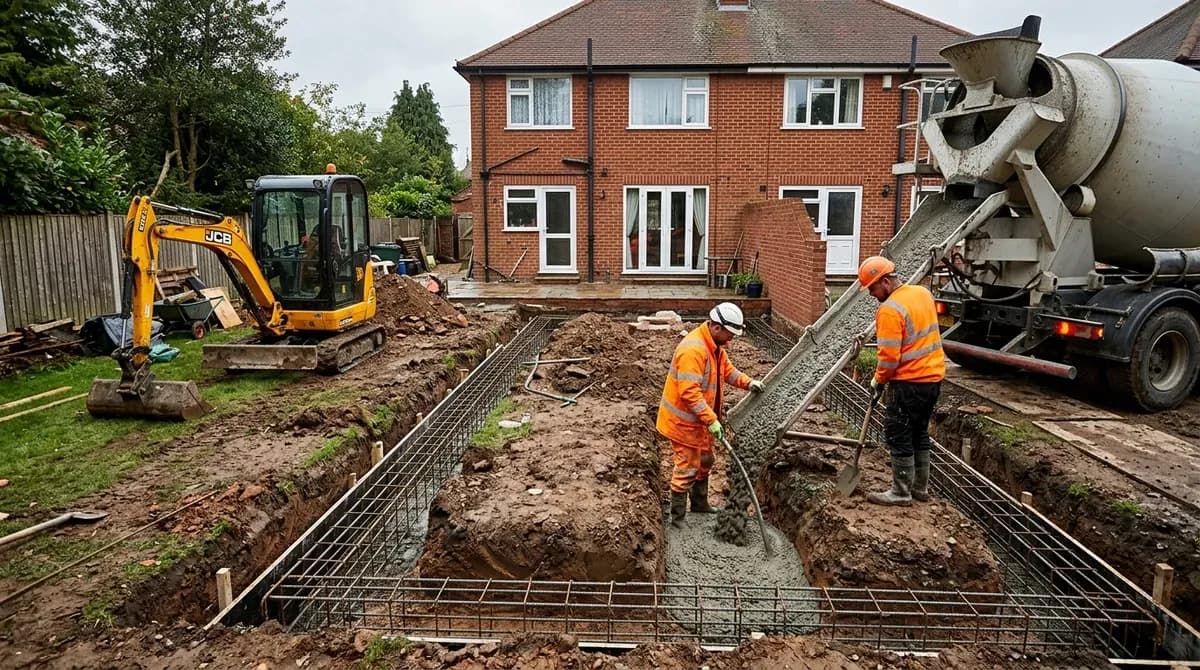
Pre-mixed concrete arrives on a truck and is poured directly into your formwork. The most efficient option for jobs over 1m³. Typical cost: £105 to £170 per m³ with a minimum delivery charge of £150 to £250.
Mini-mix / volumetric
A specialised lorry mixes concrete on site to order. You only pay for what you use, making it ideal for jobs between 0.5m³ and 2m³. Costs slightly more per metre (£100 to £160/m³) but avoids waste.
Bagged concrete
Pre-mixed bags (typically 20kg) from B&Q, Wickes, or a builders' merchant. Convenient for very small jobs like fence posts or small repairs. Works out at roughly £500/m³, expensive for larger quantities.
Hand-mixed (from raw materials)
Buy cement, sharp sand, and aggregate separately and mix on site with a mixer or by hand. Economical for small jobs if you have the time and a mixer. A cubic metre needs about 7 bags of cement, 0.5t sand, and 0.8t aggregate.
Concrete guides
Concrete cost guide
Full pricing by type, common project costs, and how to get the best price.
Concrete slab cost
Shed bases, garage bases, and extension foundations, prices per m² and by project.
Driveway cost guide
Concrete is the foundation of most driveways. See full driveway costs.
Extension cost guide
Concrete foundations are the first step. See what extensions cost.
Common questions
What type of concrete do I need?
For garden paths and patios: C20. For shed bases and garage floors: C25. For driveways: C30 (it needs to take vehicle weight). For foundations and footings: C20/25 (GEN 3). For fence posts: postcrete or C20 in small quantities. If in doubt, your concrete supplier can recommend the right grade based on your project. The Building Regulations Approved Document A sets out the minimum requirements for foundations.
How do I calculate how much concrete I need?
Multiply length (metres) x width (metres) x depth (metres) to get cubic metres. For example: a driveway 5m long, 3m wide, 150mm deep = 5 x 3 x 0.15 = 2.25m³. Add 10% for wastage and uneven ground. One cubic metre covers 10 square metres at 100mm thick, which is a useful rule of thumb.
Should I use ready-mix or mix my own?
For jobs over 1m³, ready-mix is almost always the better choice, it arrives pre-mixed, consistent, and ready to pour. For jobs under 0.5m³, hand-mixing from bags may be more practical and avoids the minimum delivery charge. For quantities between 0.5m³ and 2m³, a mini-mix (volumetric) supplier is often the best compromise: they mix on site and you pay only for what you use.
Getting the best price on concrete
Get at least three quotes from ready-mix suppliers
Concrete prices vary between suppliers, especially for ready-mix deliveries where minimum order charges and delivery fees differ. Always get at least three written quotes and make sure each one specifies the concrete grade, the quantity in cubic metres, the delivery charge, and any waiting time surcharges. If your builder is ordering the concrete, ask them to show you the supplier quotes, you should know exactly what you are paying for.