How Much Does a Wheelchair Ramp Cost in 2026?
The cost to install a wheelchair ramp ranges from £30 to £5,000 depending on the type and length. Portable threshold ramps start from £30, while a concrete wheelchair ramp cost is £1,500 to £4,000. The Disabled Facilities Grant can cover the full cost to build a wheelchair ramp for those who qualify. Here is a complete breakdown.
£30
Portable from
£1,000
Metal ramp from
£1,500
Concrete from
£30,000
DFG grant up to
Prices updated April 2026 · Based on industry data and contractor submissions.
Wheelchair Ramp Prices
What a wheelchair ramp costs in 2026, broken down by type. Permanent ramp prices include supply, groundwork, and installation.
Threshold ramp (portable)
Rubber or aluminium wedge, up to 75mm rise, no fixing needed
£90
£30 - £150
Folding portable ramp (1.5m)
Lightweight aluminium, folds for storage, 1-2 steps
£250
£100 - £400
Permanent metal ramp (2-3m)
Aluminium or steel, powder-coated, non-slip surface
£2,000
£1,000 - £3,000
Permanent concrete ramp (2-3m)
Poured concrete with brushed non-slip finish
£2,750
£1,500 - £4,000
Modular ramp system
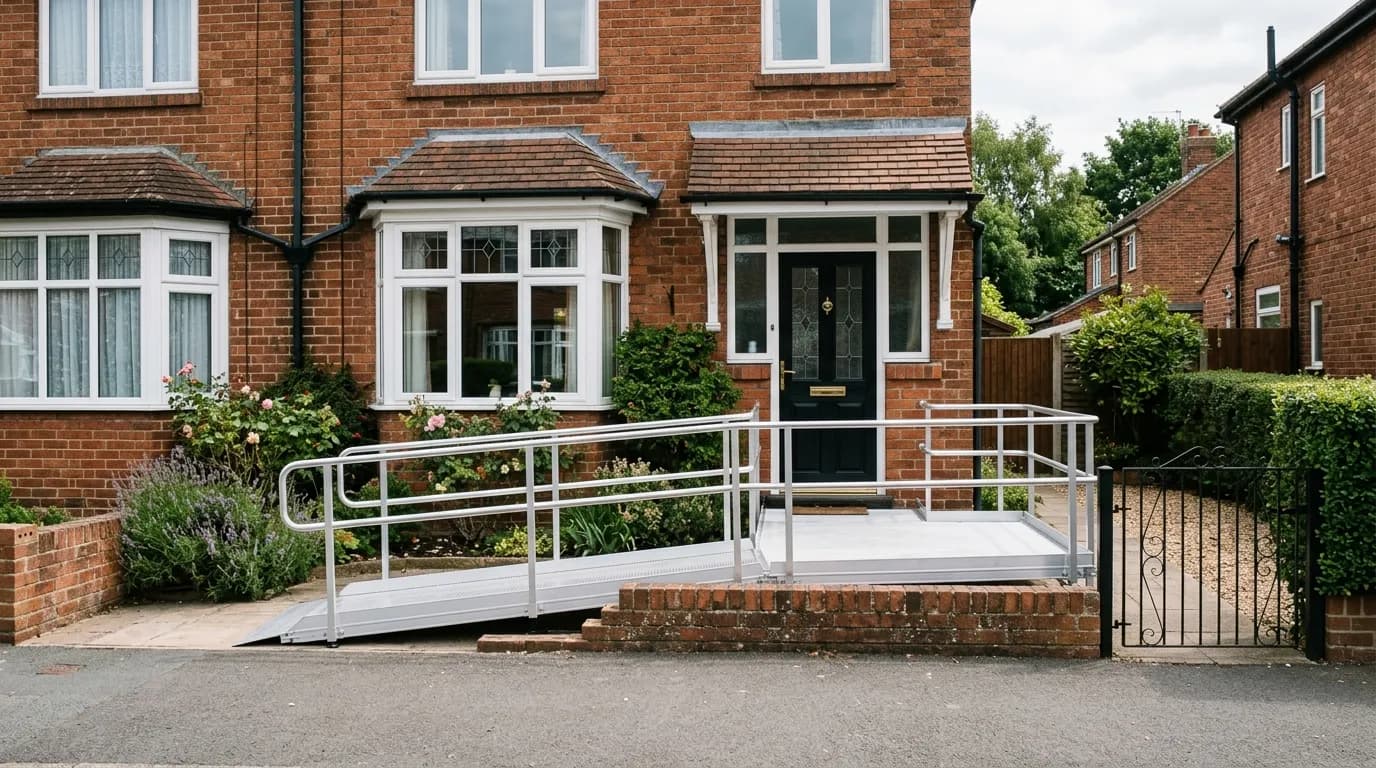
Metal ramp with handrails, platform, and landing
£3,500
£2,000 - £5,000
Handrails (per metre)
Stainless steel or aluminium, both sides
£200
£100 - £300
Level access door threshold
Low-profile threshold to remove step at doorway
£550
£300 - £800
What Affects the Cost
The price of a wheelchair ramp depends on several factors. Here is what drives the cost up or down.
Ramp length
The longer the ramp, the more it costs. Length is determined by the height difference and the required gradient. A 200mm step needs a ramp of at least 2.4 metres at 1:12, or 3 metres at the preferred 1:15 gradient.
Material
Portable aluminium ramps are the cheapest option. Permanent metal (powder-coated aluminium or steel) costs more but lasts decades. Concrete ramps are the most expensive due to groundwork and labour, but they are the most durable and low-maintenance.
Gradient requirements
A 1:12 gradient is the maximum allowed under Building Regulations. A 1:15 gradient is recommended for self-propelled wheelchair users, and shallower still for elderly or less mobile people. Gentler gradients mean longer ramps and higher costs.
Handrails
Handrails are required on both sides for any ramp with more than 600mm of rise. Stainless steel or aluminium handrails add £100 to £300 per metre, and they must extend 300mm beyond the top and bottom of the ramp.
Ground preparation and drainage
Uneven ground, soft soil, or poor drainage all add to the cost. The area around the ramp needs to drain properly so water does not pool on the surface. Groundwork can add £500 to £1,500 depending on the site.
Planning permission
Wheelchair ramps are usually permitted development and do not need planning permission. However, in conservation areas or for listed buildings you may need approval, which adds time and cost. Check with your local council before starting work.
Building Regulations
Building Regulations Part M (access). Permanent wheelchair ramps must comply with Part M of the Building Regulations. This covers maximum gradient (no steeper than 1:12), minimum width (900mm clear), handrail height (900mm to 1000mm), and landing requirements at top and bottom. A DFG-funded installation will automatically be designed to these standards. For private installations, check with your local Building Control.
Grants and Funding
The Disabled Facilities Grant can cover the full cost of a wheelchair ramp. Here is what is available across the UK.
| Grant | Maximum Amount |
|---|---|
| Disabled Facilities Grant (England) | Up to £30,000 |
| Disabled Facilities Grant (Wales) | Up to £36,000 |
| Scheme of Assistance (Scotland) | 80% to 100% of cost |
| Disabled Facilities Grant (N. Ireland) | Up to £25,000 |
Apply through your local council. More details on GOV.UK.
Wheelchair Ramp Costs by Region
Average total cost for a permanent modular ramp system (3 metres with handrails), professionally installed, by UK region.
| Region | Average Cost | vs National |
|---|---|---|
| London | £3,600 | +20% |
| South East | £3,300 | +10% |
| South West | £3,100 | +3% |
| Midlands | £3,000 | Average |
| East of England | £3,100 | +3% |
| Yorkshire | £2,700 | -10% |
| North West | £2,800 | -7% |
| North East | £2,600 | -13% |
| Scotland | £2,700 | -10% |
| Wales | £2,750 | -8% |
How to Get Your Wheelchair Ramp for Less
Apply for the Disabled Facilities Grant first
The DFG can cover the entire cost of a wheelchair ramp. Apply through your local council before paying for anything yourself. Even if you think you might not qualify on income grounds, it is worth applying - the thresholds are more generous than many people expect, and children under 18 qualify regardless of household income. The grant pays the contractor directly, so you do not need to find the money upfront.
Consider a modular ramp instead of concrete
Modular aluminium ramp systems cost about the same as concrete but have a big advantage: they can be removed, reconfigured, or taken with you if you move. A concrete ramp is permanent and may not suit a future owner. If you are renting or might move in the next few years, a modular system gives you the same functionality with more flexibility. Some companies also offer modular ramps on hire for temporary needs.
Start with a portable ramp while you wait
DFG applications take 2 to 6 months. In the meantime, a folding portable ramp (£100 to £400) can provide immediate access. You can use it at the front door now and repurpose it for the car or when visiting other properties once the permanent ramp is installed. This is especially worthwhile if someone has just come home from hospital and cannot wait months for the grant process.
Check if your council offers a fast-track DFG
Some councils now offer a fast-track DFG process for simpler adaptations like ramps and grab rails. Instead of the full 2 to 6-month process, fast-track applications can be approved in 2 to 4 weeks. Not every council offers this, but it is worth asking. Your occupational therapist or council housing team can tell you if a fast-track route is available in your area.
Do not pay VAT if you are buying privately
If you pay for a ramp yourself rather than through a grant, and it is for someone who is disabled or has a long-term chronic illness, you should not be charged VAT on it. Building a ramp to get a disabled person in and out of their home is zero-rated under VAT Notice 701/7, and most suppliers sell portable ramps to disabled buyers VAT-free too. That is 20% off the whole bill, materials and labour. You just sign a short eligibility declaration for the supplier before the work starts. It covers building a new ramp, though not simply re-grading one you already have.
Ask about free minor adaptations under £1,000
You do not always need a Disabled Facilities Grant. In England, the Care Act 2014 requires councils to provide minor adaptations costing £1,000 or less free of charge, with no means test. A threshold ramp or a small step ramp often falls under that £1,000 limit, so it can be supplied and fitted at no cost to you. Ask your council's adult social care team or occupational therapist for a minor adaptations assessment rather than going straight for the full grant, which is slower and means-tested for adults.
What to Expect: The Installation Process
Whether you go through the DFG process or pay privately, here is how a permanent wheelchair ramp installation works.
- 1
Occupational therapy assessment
An occupational therapist (if going through DFG) or the ramp installer visits your home to measure the height difference, assess the available space, and understand the user's mobility needs. This visit is usually free and takes 30 to 60 minutes.
- 2
Design and gradient calculation
The ramp layout is designed to comply with Building Regulations Part M. The gradient is calculated (ideally 1:15, maximum 1:12), landing positions are planned at the top and bottom, and handrail heights are specified. For DFG applications, the design is submitted to the council for approval.
- 3
Foundation preparation
The ground is prepared - this may involve digging out soil, laying a compacted sub-base, or pouring concrete foundations for the ramp supports. Drainage is checked to make sure water does not pool on or around the ramp. For modular systems, the supports are levelled and secured to the ground.
- 4
Ramp construction
Metal modular ramps are assembled on site - panels are bolted together and the surface is checked for level. Concrete ramps are formed with timber shuttering, poured, and finished with a brushed non-slip surface. The ramp is connected to the doorway with a level threshold or small transition plate.
- 5
Handrails and non-slip finishing
Handrails are fitted to both sides, the surface is checked for grip and level, and the gradient is verified with a spirit level. The installer makes sure the wheelchair user can navigate the ramp safely and independently. A modular metal ramp takes 1 to 2 days. A concrete ramp takes 3 to 5 days including curing time.
Frequently Asked Questions
How much does a wheelchair ramp cost?
A wheelchair ramp costs £30 to £5,000 depending on the type. A portable threshold ramp costs £30 to £150. A folding portable ramp (1.5 metres) costs £100 to £400. A permanent metal ramp (2 to 3 metres) costs £1,000 to £3,000. A permanent concrete ramp (2 to 3 metres) costs £1,500 to £4,000. A full modular ramp system with handrails and a level platform costs £2,000 to £5,000. Many of these costs can be covered by a Disabled Facilities Grant.
Does the Disabled Facilities Grant cover wheelchair ramps?
Yes. The Disabled Facilities Grant (DFG) covers wheelchair ramps as part of essential home adaptations. The grant provides up to £30,000 in England and £36,000 in Wales. It is means-tested for adults but not for children. Most wheelchair ramp installations fall well within the grant limit, so the full cost is typically covered if you qualify. Apply through your local council - an occupational therapist will assess your needs as part of the process.
How long does a wheelchair ramp need to be?
The length depends on the height difference and the gradient. At the recommended 1:15 gradient, a ramp needs 15 metres of length for every 1 metre of height. For a typical front step of 200mm (about 8 inches), you need a ramp at least 2.4 metres long at 1:12, or 3 metres at the preferred 1:15 gradient. Level landings of at least 1.2 metres are required at the top and bottom, which adds to the total length.
Can I install a wheelchair ramp myself?
Portable and folding ramps need no installation - you position them and they are ready to use. Modular metal ramp systems can be assembled by a competent DIYer, but they are heavy and need to be level and secure. Permanent concrete ramps require groundwork, formwork, and concrete pouring - this is a job for a professional builder. If you are using a Disabled Facilities Grant, the council arranges the installation through an approved contractor.
Do wheelchair ramps need handrails?
Building Regulations require handrails on both sides of any ramp that rises more than 600mm. The handrails must be between 900mm and 1,000mm above the ramp surface, and they should extend 300mm beyond the top and bottom of the ramp. For shorter ramps with less than 600mm rise, handrails are not legally required but are still recommended for safety, especially in wet weather.

Written by Chris Kervin, Co-Founder of Less.co.uk
Last updated: April 2026 · Pricing based on industry data and verified contractor submissions · Methodology
Make your home accessible for less
A wheelchair ramp can transform independence at home. Find out what it costs and whether you qualify for a grant to cover the full amount.
Compare Free QuotesFree, no obligation · Local specialists · Compare up to 3 quotes