Wheelchair Ramps & Accessibility Adaptations: Your Guide
A wheelchair ramp can make the difference between someone being able to get in and out of their own home independently or not. Whether you need a simple threshold ramp or a full permanent ramp with handrails and a level landing, this guide covers your options, the regulations, and how to access up to £30,000 in grant funding.
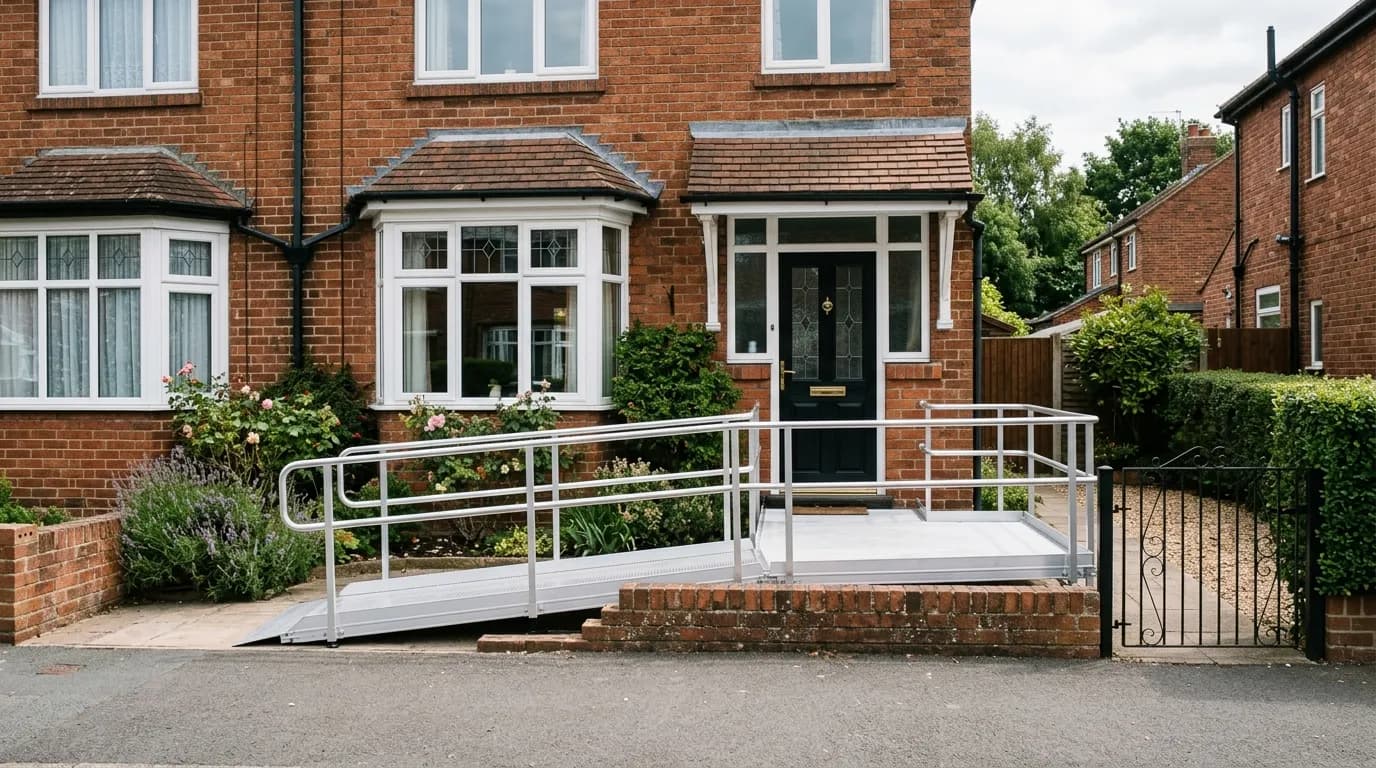
Types of wheelchair ramp
Threshold ramps (portable)
Small wedge-shaped ramps that bridge a door threshold or a single step. They sit on the floor and do not need fixing. Lightweight rubber, foam, or aluminium. Ideal for thresholds up to about 75mm high. The cheapest and simplest option - you can buy one online and have it in place the same day.
Folding portable ramps
Lightweight aluminium ramps that fold in half for storage or transport. Lengths from 0.6 metres to 3 metres. Useful for getting over one or two steps at a front or back door. No installation needed - you unfold it, position it, and use it. Good for renters or anyone who does not want a permanent fixture.
Permanent metal ramps
Aluminium or galvanised steel ramps bolted to the ground or fixed to the building. Powder-coated for weather resistance. Include non-slip surfaces, handrails, and level platforms at the top. Built to last 20 years or more with minimal maintenance. The most common choice for permanent access.
Permanent concrete ramps
Poured concrete with a non-slip finish. Very durable and can be designed to blend with existing paths and driveways. Typically finished with a brushed surface for grip. More expensive than metal and takes longer to build (3 to 5 days), but looks more permanent and can add to the property's value.
Building Regulations (Part M)
Building Regulations Approved Document M covers access to and use of buildings. For wheelchair ramps, the key requirements are:
Maximum gradient of 1:12 for ramps up to 2 metres long
Maximum gradient of 1:15 for ramps between 2 and 5 metres
Maximum gradient of 1:20 for ramps between 5 and 10 metres
Level landings of at least 1.2 metres at the top, bottom, and at any change of direction
Minimum clear surface width of 900mm
Handrails on both sides, 900mm to 1000mm above the ramp surface
Non-slip surface in all weather conditions
A 1:15 gradient is recommended over the minimum 1:12 wherever space allows, because it is easier and safer for independent use.
Disabled Facilities Grant (DFG)
The Disabled Facilities Grant is a local council grant that covers the cost of home adaptations for disabled people. It provides up to £30,000 in England and £36,000 in Wales.
The grant covers wheelchair ramps, stairlifts, level-access showers, widened doorways, and other adaptations that help a disabled person live independently at home. It is means-tested for adults (based on income and savings) but not for children under 18.
How to apply:
- 1. Contact your local council and ask for a DFG assessment
- 2. An occupational therapist visits your home to assess your needs
- 3. The council carries out a means test (for adults)
- 4. If approved, the council arranges for the work to be done
- 5. The grant pays the contractor directly - you do not need to pay upfront
The process typically takes 2 to 6 months. You can find your local council's DFG contact details on GOV.UK.
Wheelchair ramp guides
Wheelchair ramp cost guide
Full pricing for portable, modular, permanent metal, and concrete ramps. Includes handrails and level access thresholds.
Stairlifts guide
Indoor stairlifts for when a ramp is not practical - straight and curved options.
Bathroom cost guide
Level-access shower rooms and accessible bathroom adaptations.
Get at least three quotes
Wheelchair ramp installation costs vary between contractors depending on the material, the gradient, handrail specification, and groundworks involved. Get at least three written quotes from accessibility adaptation specialists so you can compare like for like. If you are applying for a Disabled Facilities Grant, the council may arrange quotes for you, but you are still entitled to suggest your own contractors. Either way, comparing prices helps you spot anything that looks out of line.
Common questions
Can I get a grant for a wheelchair ramp?
Yes. The Disabled Facilities Grant (DFG) provides up to £30,000 in England (£36,000 in Wales) for home adaptations including wheelchair ramps. The grant is means-tested for adults but not for children. You apply through your local council, and an occupational therapist assesses your needs. The process takes 2 to 6 months from application to completion. The grant covers the full cost of the ramp for most applicants, and you do not have to pay it back.
What gradient should a wheelchair ramp be?
Building Regulations Part M specifies a maximum gradient of 1:12 for ramps up to 2 metres long, 1:15 for ramps up to 5 metres, and 1:20 for ramps up to 10 metres. A gentler gradient is always better - 1:15 or shallower is easier for wheelchair users to navigate independently. For every 75mm of height change, you need at least 900mm of ramp length at 1:12. Landings must be at least 1.2 metres long at the top and bottom, and at any change of direction.
Do I need planning permission for a wheelchair ramp?
In most cases, no. A wheelchair ramp is usually classed as permitted development. However, if you live in a listed building, a conservation area, or the ramp significantly alters the front of the property, you may need planning permission. Your local council building control team can confirm. Building Regulations approval is needed if the ramp is permanent and attached to the building - your installer or the council will handle this.
How long does it take to install a wheelchair ramp?
A portable or threshold ramp can be set up in minutes. A modular metal ramp system takes 1 to 2 days to install. A permanent concrete ramp takes 3 to 5 days, including excavation, formwork, pouring, and curing time. If you are going through the Disabled Facilities Grant process, the total timeline from application to completed ramp is typically 2 to 6 months, though the actual installation is the quickest part.
Make your home accessible for less
Find out what a wheelchair ramp costs and whether you qualify for a Disabled Facilities Grant.
See 2026 prices