Underfloor Heating: Your Complete Guide
Electric underfloor heating starts from around £40-£75 per m² installed, while wet (water-based) systems cost £80-£150 per m². The right choice depends on whether you are building new, renovating, or retrofitting to an existing floor.
Electric underfloor heating must comply with Building Regulations Part P. All electrical connections should be carried out by a registered electrician. Wet systems in new builds must meet Building Regulations Part L (energy efficiency) and Part G (hot water safety).
Quick answer
How much does underfloor heating cost?
Electric mat systems cost £50-£75 per m² installed - ideal for bathrooms and kitchens. Wet (water-based) systems cost £80-£120 per m² for new builds with screed, rising to £100-£150 per m² for low-profile retrofit systems. A typical 15m² kitchen costs £750-£1,125 with electric or £1,200-£1,800 with a wet system.
View the full underfloor heating cost guideElectric vs Wet Underfloor Heating
There are two main types of underfloor heating. Your choice comes down to whether the project is a new build, a renovation, or a quick retrofit to an existing room.
Electric underfloor heating
Best for retrofitThin heating mats or cables are laid directly onto the subfloor and tiled or floored over. They add just 3-5mm to the floor height, making them perfect for retrofitting into existing rooms without raising door thresholds. Quick and cheap to install, but more expensive to run than wet systems. Best for individual rooms - bathrooms, en-suites, kitchens - rather than whole houses.
Install cost
£40-£75/m²
Running cost
2.5-3.7p/m²/hour
Floor height added
3-5mm
Warm-up time
20-30 minutes
Wet (water) underfloor heating
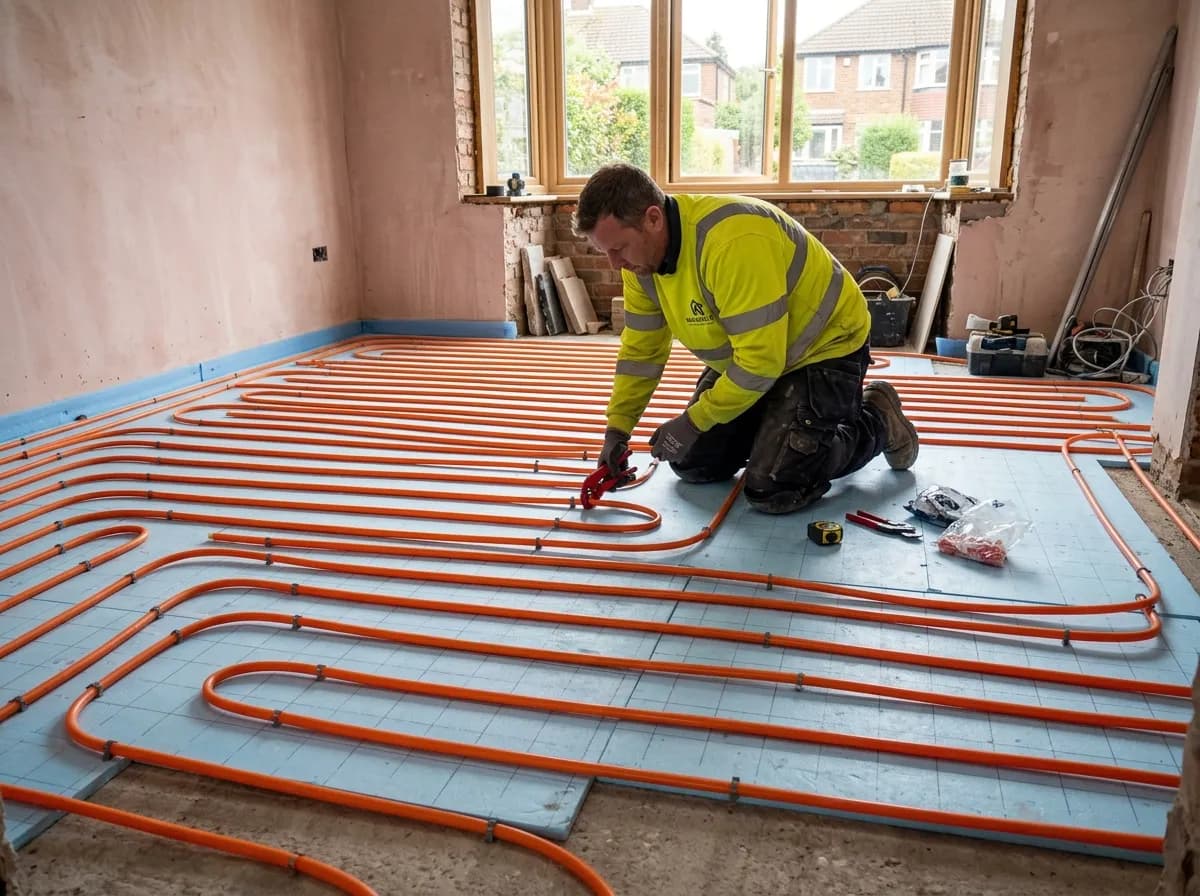
Best for new buildsPlastic pipes are laid in loops beneath the floor, carrying warm water from your boiler or heat pump. Much cheaper to run than electric, especially with a heat pump where running costs drop to just 0.6-1.2p per m² per hour. The main drawback is installation complexity - traditional systems need a 65-75mm screed layer, which makes them best suited to new builds, extensions, or major renovations where floors are being replaced anyway.
Install cost
£80-£150/m²
Running cost
0.7-1.5p/m²/hour
Floor height added
65-75mm (screed) or 15-25mm (low-profile)
Warm-up time
2-4 hours (screed) or 30-60 min (low-profile)
Which Rooms Suit Underfloor Heating?
Underfloor heating works brilliantly in some rooms and less well in others. The floor finish makes a big difference.
Rooms where UFH works well
- Bathrooms and en-suites - tile floors conduct heat perfectly, and warm tiles underfoot are a genuine luxury
- Kitchens - hard floors (tile, stone, vinyl) work well, and UFH frees up wall space that radiators would take
- Open-plan living areas - even heat across a large space without radiators breaking up the room
- Conservatories and extensions - particularly effective in new builds where you can pour screed from scratch
- Hallways and entrances - removes the need for a radiator in a narrow space
Rooms where UFH is less effective
- Bedrooms with thick carpet - heavy underlay and deep-pile carpet insulate the floor, blocking heat from reaching the room
- Rooms above uninsulated spaces - heat loss downwards wastes energy if the floor is not insulated beneath
- Very small rooms with lots of furniture - a radiator may heat the space just as well at a fraction of the cost
- Upstairs rooms in older houses - retrofitting wet systems upstairs often requires structural work to support the weight of screed
Floor finish matters: Tile, stone, and polished concrete are the best conductors - you will feel the warmth within 20 minutes. Engineered wood works well. Laminate and vinyl are fine. Solid hardwood needs careful specification. Thick carpet is the worst - keep combined carpet and underlay tog below 1.5 if you want UFH to work properly.
How Does Underfloor Heating Work?
Both electric and wet systems work on the same principle: they turn your entire floor into a large, low-temperature radiator. Because the heated surface area is so much larger than a wall-mounted radiator, UFH can run at lower temperatures and still keep the room warm.
- 1
Electric systems
A thin heating element (either a mat or loose cable) is connected to the mains via a thermostat. When the thermostat calls for heat, electricity flows through the element, which heats up and warms the floor above it. Each room or zone has its own thermostat and can be controlled independently.
- 2
Wet systems
Warm water from your boiler or heat pump circulates through loops of plastic pipe laid beneath the floor. A manifold in a cupboard or utility room controls the flow to each zone. Each zone has its own thermostat. The water temperature is typically 35-45 degrees C - much lower than the 60-70 degrees C used in radiators - which is why wet UFH works so well with heat pumps.
- 3
Heat distribution
Heat rises from the floor evenly across the entire room. There are no cold spots or hot spots like you get with radiators, where the area near the radiator is warm and the far side of the room is cooler. The room temperature is consistent from floor to ceiling.
Perfect pairing
Underfloor Heating + Heat Pumps
Wet underfloor heating and heat pumps are a natural match. Heat pumps work most efficiently at low flow temperatures (35-45 degrees C), and that is exactly the range UFH is designed for. Radiators need 60-70 degrees C to heat a room properly, which forces the heat pump to work harder and reduces its efficiency. With UFH, a heat pump can run at peak efficiency all year round, keeping your running costs as low as possible.
Read our heat pump cost guideUnderfloor heating guides
Common questions about underfloor heating
Is underfloor heating cheaper to run than radiators?
Wet underfloor heating paired with a modern condensing boiler or heat pump is typically 15-25% cheaper to run than radiators because it operates at lower water temperatures (35-45 degrees C vs 60-70 degrees C for radiators). Electric underfloor heating is more expensive to run than gas central heating, so it works best in small rooms like bathrooms where it supplements the main heating rather than replacing it entirely.
Can you put underfloor heating under any floor?
Most floor types work with underfloor heating, but some are better than others. Stone, tile, and polished concrete are ideal because they conduct heat well. Engineered wood works fine. Solid hardwood is possible but needs careful specification to avoid warping. Thick carpet with heavy underlay acts as insulation and reduces the system's effectiveness - if you want carpet, choose a low-tog rating (under 1.5 tog combined for carpet and underlay).
How long does underfloor heating take to warm up?
Electric underfloor heating warms up in 20-30 minutes, making it responsive enough to switch on and off as needed. Wet systems embedded in screed take 2-4 hours to reach temperature because the thermal mass of the screed needs to heat through first. Low-profile wet systems with aluminium spreader plates heat up faster - usually within an hour. Most people run wet systems on a timer rather than switching them on and off throughout the day.
Does underfloor heating add value to a house?
Underfloor heating is considered a premium feature by estate agents and buyers. It will not add a specific percentage to your home's value, but it can make your property more attractive and easier to sell, particularly in kitchens, bathrooms, and open-plan living spaces. Wet systems connected to a heat pump also improve your EPC rating, which increasingly matters for mortgages and rental regulations.
Can you retrofit underfloor heating without digging up the floor?
Yes. Electric mat systems can be laid directly on top of an existing subfloor and tiled over, adding just 3-5mm to the floor height. Low-profile wet systems use thin aluminium spreader plates that sit on the existing floor, adding around 15-25mm of height. Traditional wet systems with screed require the floor to be dug up or raised by 65-75mm, which is usually only practical during a renovation or new build.
Get at least three written quotes
Underfloor heating installation prices vary significantly between heating engineers and flooring specialists. The same room can be quoted at very different amounts depending on the system type, the brand of components, and whether screed or levelling compound is included. Always get at least three written quotes and check that each one specifies the system type (electric or wet), the coverage area in square metres, the manifold and thermostat models, and whether floor preparation is included. Comparing like for like is the only way to know whether you are getting a fair deal.
Quote service coming soon
Get free quotes from underfloor heating installers near you
Free, no obligation. Compare quotes from qualified installers in your area.