How Much Does a Dormer Loft Conversion Cost in 2026?
A standard rear dormer costs £35,000 to £55,000. Add an ensuite and you are looking at £45,000 to £70,000. The dormer is the most popular type of loft conversion in the UK for good reason - it gives you far more usable space than a Velux conversion, without the cost of a full mansard.
£44,000
Rear dormer
£52,000
L-shaped dormer
£52,000
With ensuite
8 to 12 weeks
Typical timeline
Prices updated April 2026 · Based on industry data and contractor submissions.
Building Regulations approval is required for all dormer loft conversions. Fire doors on all floors below are typically required too. Check Planning Portal for current Permitted Development rules before starting work.
Quick answer
How much is a dormer loft conversion?
A standard rear dormer loft conversion costs £35,000 to £55,000 in 2026. An L-shaped dormer - combining a rear and side extension - costs £40,000 to £68,000. Adding an ensuite bathroom pushes the total to £45,000 to £70,000. These figures include structural steelwork, roofing, insulation, the staircase, and basic internal finishing. They exclude full decoration, flooring, and furniture.
Dormer Loft Conversion Prices at a Glance
Prices include structural work, dormer construction, roofing, insulation, staircase, and basic internal finishing. Ensuite included where noted.
Rear dormer (standard)
Flat-roof box dormer to the rear of the property
£44,000
£35,000 to £55,000
Side dormer
Dormer to the side elevation - requires planning permission
£40,000
£32,000 to £50,000
L-shaped dormer
Rear + side dormer combined - popular on Victorian terraces
£52,000
£40,000 to £68,000
Rear dormer with ensuite
Standard rear dormer including a fitted ensuite bathroom
£52,000
£45,000 to £65,000
L-shaped dormer with ensuite
Maximum space with ensuite - the premium option
£60,000
£50,000 to £70,000
Excludes VAT, professional fees, planning costs, and full decoration unless stated.
What a Dormer Actually Gives You
Full standing headroom
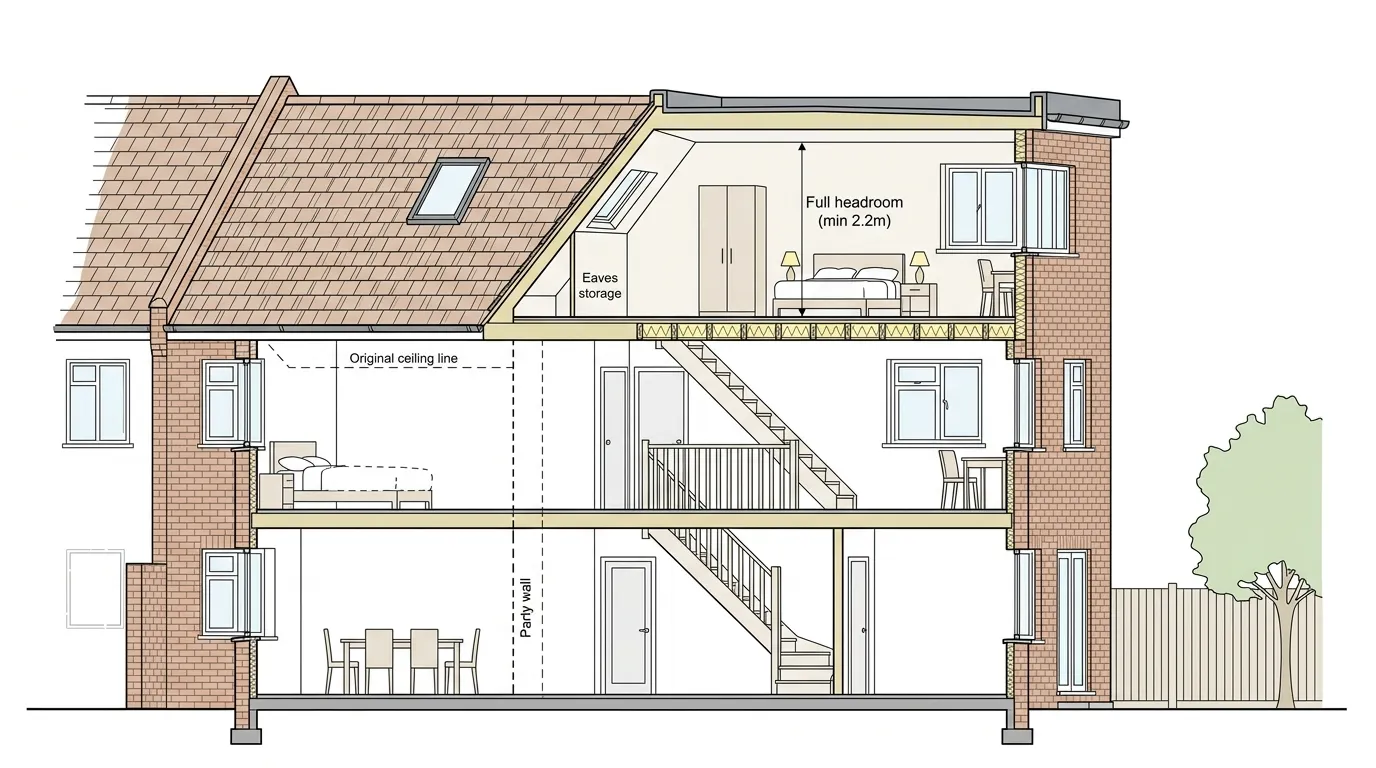
The main advantage of a dormer over a Velux conversion is headroom. The dormer box extends out from the roof slope, creating vertical walls inside. Instead of crouching under the eaves, you get a room where you can stand upright across most of the floor area. A typical rear dormer gives 2.2 to 2.4 metres of headroom right to the back wall.
Significantly more usable floor space
A Velux conversion keeps the sloping ceiling, which means the edges of the room are barely usable. A dormer pushes the wall out, turning that dead space into proper floor area. On a standard semi-detached house, a rear dormer adds roughly 30 to 40% more usable floor space than a Velux conversion on the same footprint.
Natural light from vertical windows
Dormer windows are vertical, which means they let in light more evenly and are easier to furnish around than roof lights set into a slope. You can fit standard curtains or blinds, and the windows do not overheat the room in summer the way south-facing Velux windows sometimes do.
Room for an ensuite
A dormer conversion almost always provides enough space for an ensuite bathroom. The area directly under the ridge - where the ceiling is highest - works well for the shower, with the lower-headroom areas used for the WC and basin. This is one of the main reasons people choose a dormer over a Velux conversion.
Planning Permission for Dormer Conversions
Most rear dormers fall under Permitted Development (PD), which means you do not need planning permission. But there are conditions you have to meet, and getting them wrong can cause serious problems.
Rear dormers - usually permitted
A rear dormer on a house (not a flat) generally falls within PD provided it does not extend beyond the plane of the existing roof facing the highway, does not exceed the highest part of the existing roof, and stays within the volume limits (40m³ for terraced, 50m³ for detached/semi). The materials should be similar in appearance to the existing house.
Side dormers - planning permission required
A dormer on the side elevation of a house facing a highway always needs planning permission. In practice, many local authorities also resist side dormers on aesthetic grounds, so approval is not guaranteed even when you apply.
Conservation areas and listed buildings
If your house is in a conservation area, Article 4 directions may remove your PD rights for dormers entirely. Listed buildings always require Listed Building Consent in addition to any planning permission. Check with your local planning authority before instructing any work.
Get a Lawful Development Certificate
Even when your dormer falls within PD, consider applying for a Lawful Development Certificate (LDC) from your council. It costs £274 and provides written confirmation that your conversion is lawful. This is valuable when you come to sell the property - buyers and solicitors routinely ask for evidence that loft conversions had proper approval.
Does a Dormer Conversion Add Value?
A well-finished dormer loft conversion typically adds 15 to 20%to a property's value, according to most estate agent surveys. On a £300,000 house, that is £45,000 to £60,000 of added value - which in many cases covers the cost of the work and then some.
The return is strongest when the conversion adds a bedroom that changes the property's description on Rightmove. Going from a three-bedroom to a four-bedroom house typically commands a bigger percentage jump than going from four to five. An ensuite makes a significant difference too - buyers expect a master bedroom with ensuite as standard in four-bedroom houses.
The return is weakest when the conversion creates a room that is technically habitable but not particularly practical - low headroom, steep staircase, no natural light. Building Regulations compliance alone does not guarantee a good return. The room needs to feel like a proper bedroom that buyers would happily sleep in.
Dormer vs Other Loft Conversion Types
How a dormer stacks up against the alternatives.
| Type | Cost Range |
|---|---|
| Velux (rooflight) | £22,000 to £38,000 |
| Rear dormer | £35,000 to £55,000 |
| L-shaped dormer | £40,000 to £68,000 |
| Hip-to-gable | £35,000 to £60,000 |
| Mansard | £50,000 to £80,000 |
How to Get Your Dormer Conversion for Less
Choose a rear dormer over an L-shaped if budget is tight
A rear dormer gives you a perfectly usable bedroom with ensuite for significantly less than an L-shaped. The L-shape adds floor area, but if you only need one bedroom, a standard rear dormer is often all you need.
Get quotes from dormer specialists, not general builders
Companies that specialise in loft conversions have systems, regular steel suppliers, and streamlined Building Regs processes. They tend to be quicker and cheaper than a general builder quoting a one-off job.
Pre-wire for the ensuite even if you fit it later
Ask your builder to run the soil stack, water supply, and waste pipes during the main build. Adding these later means lifting floorboards and disrupting finished work. First-fix plumbing during construction costs a fraction of retrofitting it afterwards.
Compare at least three dormer quotes on the same spec
Dormer prices vary by thousands between companies. Make sure each quote includes the same scope - structural steels, staircase, fire doors, Building Regs fees, scaffolding - before comparing the bottom line. The cheapest quote missing fire doors is not really the cheapest.
Useful resources
- Planning Portal: Loft conversions, Permitted development rules for dormer loft conversions
- Building Regulations Part B, Fire safety requirements including escape routes for loft conversions
- LABC, Local Authority Building Control for sign-off on loft conversions
What to Expect: The Dormer Loft Conversion Process
A dormer loft conversion typically takes 8 to 12 weeks. Building Regulations approval is always required, and planning permission may be needed depending on the size and position of the dormer.
- 1
Structural design and approvals
A structural engineer designs the dormer and supporting steelwork. Drawings are submitted for Building Regulations. Planning permission may be needed if the dormer faces a highway or exceeds permitted development limits.
- 2
Scaffolding and roof opening
Full scaffolding is erected and a section of the rear (or side) roof slope is stripped of tiles, felt, and battens to create the dormer opening.
- 3
Dormer construction
The dormer frame is built out from the roof, cheeks, flat roof, and front face. Steels are installed to carry the structural load. The dormer is clad (typically GRP, lead, or tile-hung) and windows are fitted.
- 4
Floor strengthening and insulation
Floor joists are reinforced or replaced to support habitable-room loads. Insulation is fitted to the dormer walls, roof, and between rafters to meet Part L requirements.
- 5
First fix and staircase
Plumbing and electrical first fix is completed. The new staircase is installed, connecting the floor below to the loft. Fire safety measures (fire doors, smoke alarms) are fitted to comply with Part B.
- 6
Plastering, second fix, and sign-off
Walls are plastered, flooring laid, skirting and architrave fitted. Final electrical and plumbing connections are made. Building Control inspects and issues a completion certificate.
Frequently Asked Questions
How much is a dormer loft conversion?
A standard rear dormer loft conversion costs between £35,000 and £55,000 in 2026. An L-shaped dormer costs £40,000 to £68,000. Prices include structural work, roofing, insulation, staircase, and basic internal finishing but typically exclude the ensuite bathroom and full decoration.
How much does a dormer loft conversion with ensuite cost?
A dormer loft conversion with an ensuite bathroom costs between £45,000 and £70,000, depending on the size of the dormer and the specification of the ensuite. A basic ensuite (shower, WC, basin) adds around £5,000 to £8,000 to the base conversion price. A higher-spec ensuite with underfloor heating, premium tiles, and a larger shower can add £8,000 to £12,000.
Do I need planning permission for a dormer loft conversion?
Most rear dormers fall under Permitted Development and do not need planning permission, provided they meet certain conditions: the dormer must not extend beyond the plane of the existing roof slope facing the highway, the materials must be similar in appearance to the existing house, and the volume must not exceed 40 cubic metres for terraced houses or 50 cubic metres for detached and semi-detached homes. Side dormers, dormers on houses in conservation areas, and dormers on listed buildings always require planning permission.
Does a dormer loft conversion add value to a house?
A dormer loft conversion typically adds 15 to 20% to a property's value, according to estate agent surveys. The return is strongest when the conversion creates an additional bedroom with an ensuite - particularly a fourth bedroom in a three-bedroom house. In higher-value areas like London and the South East, the increase in value usually exceeds the cost of the work.
How long does a dormer loft conversion take?
A rear dormer loft conversion typically takes 8 to 12 weeks from start to completion. An L-shaped dormer may take 10 to 14 weeks. Most of the structural work happens outside the house - scaffolding, dormer frame, roofing - so you can usually live in the property throughout. The last few weeks involve internal work: plastering, electrics, plumbing, and finishing.
What is an L-shaped dormer?
An L-shaped dormer combines a rear dormer with a side dormer, forming an L shape when viewed from above. It is particularly popular on Victorian terraced houses and semi-detached properties where the existing roof has a rear outrigger section. The L-shape creates significantly more usable floor space than a standard rear dormer alone - often enough for a double bedroom and an ensuite, or two single bedrooms.

Written by Chris Kervin, Co-Founder of Less.co.uk
Last updated: · Pricing based on industry data and verified contractor submissions · Methodology
Compare real quotes for your job
Prices move a lot with your postcode, the access on site and the spec you choose. Get up to 3 free quotes from vetted local tradespeople and see what yours actually comes to, with no obligation to book.
More home improvement costs