How Much Does a Velux (Rooflight) Loft Conversion Cost in 2026?
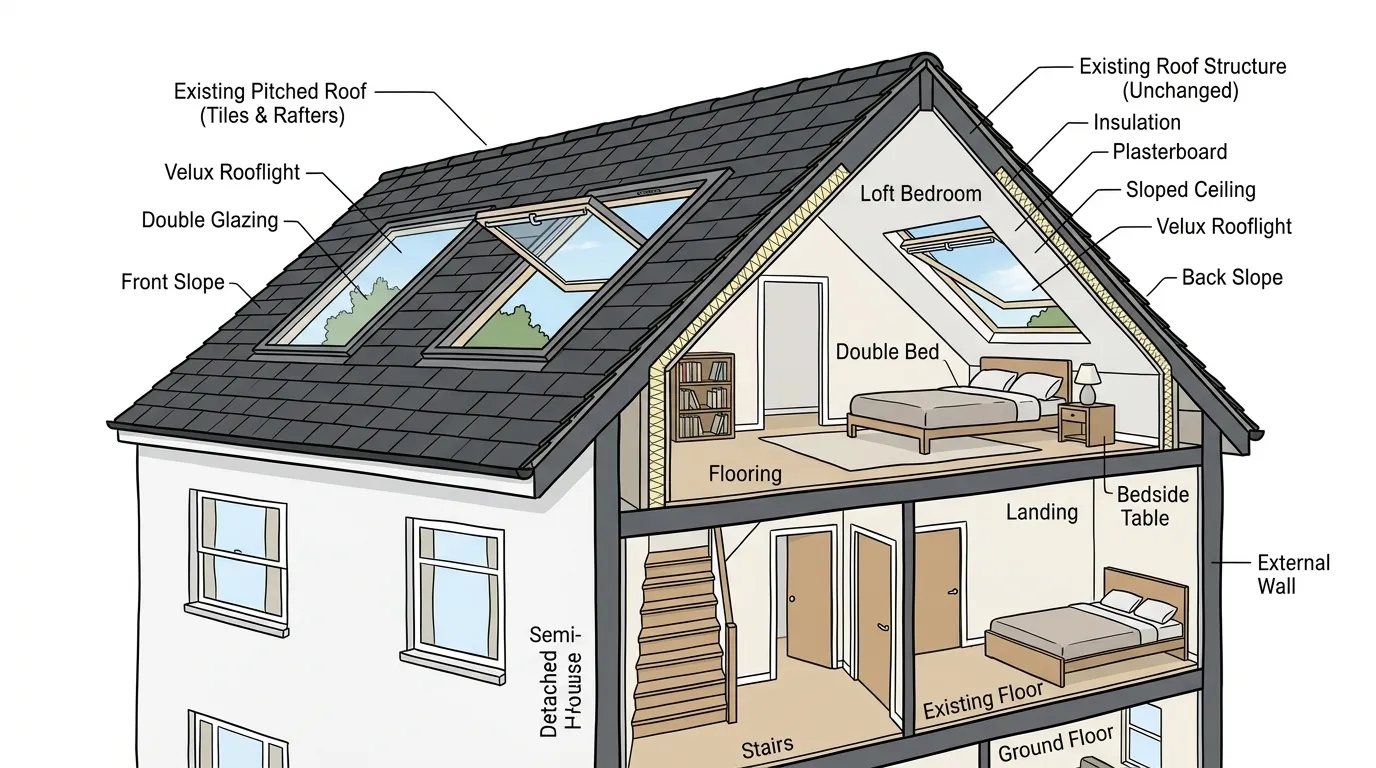
A Velux loft conversion costs £15,000 to £30,000. It is the cheapest type of loft conversion because it does not change the roof structure - windows are fitted into the existing roof slope, and the room is created within the space you already have.
£17,000
Basic conversion
£23,000
With staircase
£28,000
With ensuite
4 to 6 weeks
Typical timeline
Prices updated April 2026 · Based on industry data and contractor submissions.
Building Regulations approval is required even for a Velux conversion. A habitable loft room needs fire doors on all floors below, a proper staircase (not a loft ladder), and adequate insulation. Check the requirements with your local Building Control before starting.
Quick answer
How much does a basic loft conversion cost?
A Velux (rooflight) loft conversion - the most affordable type - costs £15,000 to £30,000. It is the cheapest because it does not change the roof structure. Windows are fitted into the existing slope, the floor is strengthened, insulation is added, and the room is plastered and finished. The price depends on whether you include a proper staircase and an ensuite.
Velux Loft Conversion Prices by Scope
What you pay depends on how far you take the conversion. All prices include structural work, insulation, rooflights, and basic finishing.
Basic conversion (rooflights, insulation, boarding)
Habitable room with loft ladder access - does not meet Building Regs for a bedroom
£17,000
£15,000 to £20,000
With fixed staircase
Full Building Regs-compliant conversion with proper staircase
£23,000
£20,000 to £28,000
With staircase and ensuite
Complete bedroom with ensuite - needs good existing headroom
£28,000
£25,000 to £32,000
Excludes VAT, professional fees, full decoration, and fire doors on floors below.
When a Velux Conversion Works
Good existing head height (2.2 metres minimum at the ridge)
The single most important factor. A Velux conversion does not add any headroom - what you have is what you get. Measure from the top of the ceiling joists to the underside of the ridge beam. At 2.4 metres or above, a Velux conversion gives you a comfortable room. At 2.2 to 2.4 metres it is tight but workable. The new floor will sit slightly higher than the existing joists once insulation and boarding are added, so account for around 50 to 80mm of lost height.
Steep roof pitch (above 35 degrees)
A steeper roof gives you more usable floor area because the sloping ceiling does not eat into the room as aggressively. Victorian and Edwardian terraced houses often have roof pitches of 40 to 45 degrees, which work well for Velux conversions. Many modern houses built since the 1960s have shallower pitches (30 to 35 degrees) and may not offer enough usable space without a dormer.
You need a bedroom, study, or playroom - not maximum space
A Velux conversion is ideal when you need a functional room without the expense of maximising every square metre. A double bedroom with rooflights and storage under the eaves is perfectly achievable. If you need a large master bedroom with ensuite and dressing area, you are probably looking at a dormer.
Budget is the priority
At half the cost of a dormer, a Velux conversion is the most cost-effective way to add a room. If you need the space but do not have £40,000+ for a dormer, a Velux conversion done well is a far better investment than a dormer done cheaply.
When a Velux Conversion Does Not Work
Low roof pitch (below 30 degrees)
A shallow roof pitch means the sloping ceiling comes down too quickly on both sides. Even if the ridge is technically above 2.2 metres, the usable floor area where you can actually stand may be too small for a practical room. In these cases, a dormer is usually the only way to get enough space.
Not enough standing room across the room
Building Regulations require a minimum of 2.2 metres headroom in the habitable area. But in practice, a room where you can only stand upright in a narrow strip down the middle is not a pleasant bedroom. If the area where the ceiling is above 1.8 metres is less than about 60% of the total floor area, the room will feel cramped.
Complex roof structure with lots of internal timbers
Some older roofs use a traditional cut-roof construction with purlins, struts, and collars throughout the loft space. These timbers have to be replaced with steel beams to open up the space, which adds significantly to the cost. If your loft is a forest of timbers, the cost advantage of a Velux conversion over a dormer shrinks considerably.
You need an ensuite but the loft is small
Fitting an ensuite into a Velux conversion is possible but only if the loft is large enough. The shower needs adequate headroom (at least 1.8 metres above the tray), and the ensuite takes up floor area that is already limited by the sloping ceiling. If both an ensuite and a decent bedroom are priorities, a dormer usually makes more sense.
Velux vs Dormer: Side by Side
The two most common types of loft conversion compared.
| Feature | Velux | Dormer |
|---|---|---|
| Typical cost | £15,000 to £30,000 | £35,000 to £55,000 |
| Changes the roofline | No | Yes - box structure added |
| Usable floor space | Limited by slope on both sides | Much more - vertical walls |
| Headroom | Only at the ridge | Full height across most of the room |
| Planning permission | Almost never needed | Usually PD for rear dormers |
| Build time | 4 to 6 weeks | 8 to 12 weeks |
| Best for | Good existing headroom, tight budgets | Maximum space, ensuite bathrooms |
How to Get Your Velux Conversion for Less
Check your headroom before committing
A Velux conversion is only worth it if your loft already has decent headroom. Measure from the top of the existing ceiling joists to the underside of the ridge beam. If it is 2.4 metres or more, a Velux conversion will work well. Between 2.2 and 2.4 metres it is borderline. Below 2.2 metres, you probably need a dormer instead.
Consider doing the decoration yourself
A Velux conversion is a simpler job than a dormer. Once the structural work, insulation, boarding, and plastering are done, the decorating (painting, flooring, skirting boards) is straightforward DIY. Doing the finishing yourself can save £2,000 to £4,000 on the overall cost.
Do not over-specify the roof windows
Velux and other manufacturers sell windows in a wide range of sizes and specifications. The electrically operated, centre-pivot, solar-powered models are significantly more expensive than manually operated top-hung versions. For most loft bedrooms, manually operated windows are perfectly adequate and cost a fraction of the price.
Get quotes specifically for Velux conversions
Some loft conversion companies focus on dormers and mansards - larger, more profitable jobs. If you want a Velux conversion, ask specifically for that. A builder experienced in Velux conversions will give you a more competitive price than one who primarily does dormers and is quoting the simpler job as an afterthought.
Useful resources
- Planning Portal: Loft conversions, Planning rules for Velux loft conversions
- Building Regulations Part L, Energy efficiency requirements for roof windows
What to Expect: The Velux Loft Conversion Process
A Velux (rooflight) loft conversion is the simplest and quickest type, typically taking 4 to 6 weeks. Because the existing roof shape isn't altered, planning permission is rarely needed.
- 1
Survey and Building Regulations application
A structural engineer checks the existing roof structure and floor joists. Drawings are submitted for Building Regulations approval, planning permission is rarely needed for a Velux conversion.
- 2
Floor strengthening
Existing ceiling joists are either doubled up or replaced with deeper timbers to meet the load requirements of a habitable room.
- 3
Velux window installation
Openings are cut into the roof slope and Velux roof windows are fitted, including flashing kits to ensure a watertight seal. Windows are positioned to maximise natural light.
- 4
Insulation and fire safety
Rigid insulation boards are fitted between the rafters to meet Part L energy standards. Fire-rated plasterboard is used on walls and ceilings, and a fire door is fitted to the new room.
- 5
Staircase installation
A new staircase is built from the landing below into the loft space. The design must comply with Building Regulations Part K for headroom and pitch.
- 6
Second fix and finishing
Electrics, plastering, skirting boards, and flooring are completed. Building Control carries out a final inspection and issues a completion certificate.
Frequently Asked Questions
How much does a Velux loft conversion cost?
A Velux (rooflight) loft conversion costs between £15,000 and £30,000 in 2026. A basic conversion with rooflights, insulation, and boarding starts around £15,000 to £20,000. Adding a proper staircase (rather than a loft ladder) brings the cost to £20,000 to £25,000. A full conversion with staircase and ensuite costs £25,000 to £30,000. These are significantly lower than dormer or mansard conversion prices because the roof structure is not altered.
What is a Velux loft conversion?
A Velux loft conversion (also called a rooflight conversion) adds windows to the existing roof slope without changing the roofline or structure. The name comes from Velux, the most well-known roof window manufacturer, though other brands like Fakro are also used. It is the simplest and cheapest type of loft conversion because no dormer or structural extension is built - the existing roof stays as it is.
Do I need planning permission for a Velux loft conversion?
Almost never. Velux conversions do not alter the roofline and fall well within Permitted Development limits. The only exceptions are listed buildings, properties in conservation areas where Article 4 directions apply, and flats (which have no PD rights for loft conversions). Building Regulations approval is still required regardless of planning permission status.
When does a Velux loft conversion work?
A Velux conversion works when the existing loft has good head height - at least 2.2 metres from floor joist to ridge, ideally 2.4 metres or more. The roof pitch needs to be steep enough to create usable floor space across a reasonable area of the room. Victorian and Edwardian terraced houses with steep roof pitches are often good candidates. Modern houses with shallow roof pitches (below about 35 degrees) usually do not have enough headroom for a Velux conversion to work well.
What is the difference between a Velux and a dormer loft conversion?
A Velux conversion fits windows into the existing roof slope and does not change the roofline. A dormer conversion adds a box-like structure to the roof, creating vertical walls and significantly more floor area and headroom. A Velux is cheaper (£15,000 to £30,000 vs £35,000 to £55,000 for a dormer) but gives less usable space. If you have good existing headroom and just need a room with light, a Velux is ideal. If you need maximum floor space, a dormer is worth the extra cost.
Can I add an ensuite to a Velux loft conversion?
It is possible but depends on the available floor space and headroom. A Velux conversion has sloping ceilings on both sides, which limits where you can fit a shower with adequate headroom. If the loft is large enough, a compact ensuite (shower, WC, basin) can fit under the ridge where the ceiling is highest. On smaller lofts, a dormer may be a better option if an ensuite is a priority, because the dormer creates the vertical walls and headroom needed for comfortable bathroom use.

Written by Chris Kervin, Co-Founder of Less.co.uk
Last updated: · Pricing based on industry data and verified contractor submissions · Methodology
Compare real quotes for your job
Prices move a lot with your postcode, the access on site and the spec you choose. Get up to 3 free quotes from vetted local tradespeople and see what yours actually comes to, with no obligation to book.
More home improvement costs