How Much Does Solid Wall Insulation Cost in 2026?
Solid wall insulation costs £5,000 to £18,000 for a typical 3-bed semi, depending on whether you go internal or external. It is a serious investment, but it tackles one of the biggest sources of heat loss in pre-1930s homes. Around 8 million UK properties have solid walls with no cavity to fill.
£6k-£12k
Internal (3-bed)
£8k-£18k
External (3-bed)
£200 to £500
Annual saving
10 to 25 yrs
Pays for itself
Prices updated April 2026 · Based on industry data and contractor submissions.
Quick answer
How much does solid wall insulation cost?
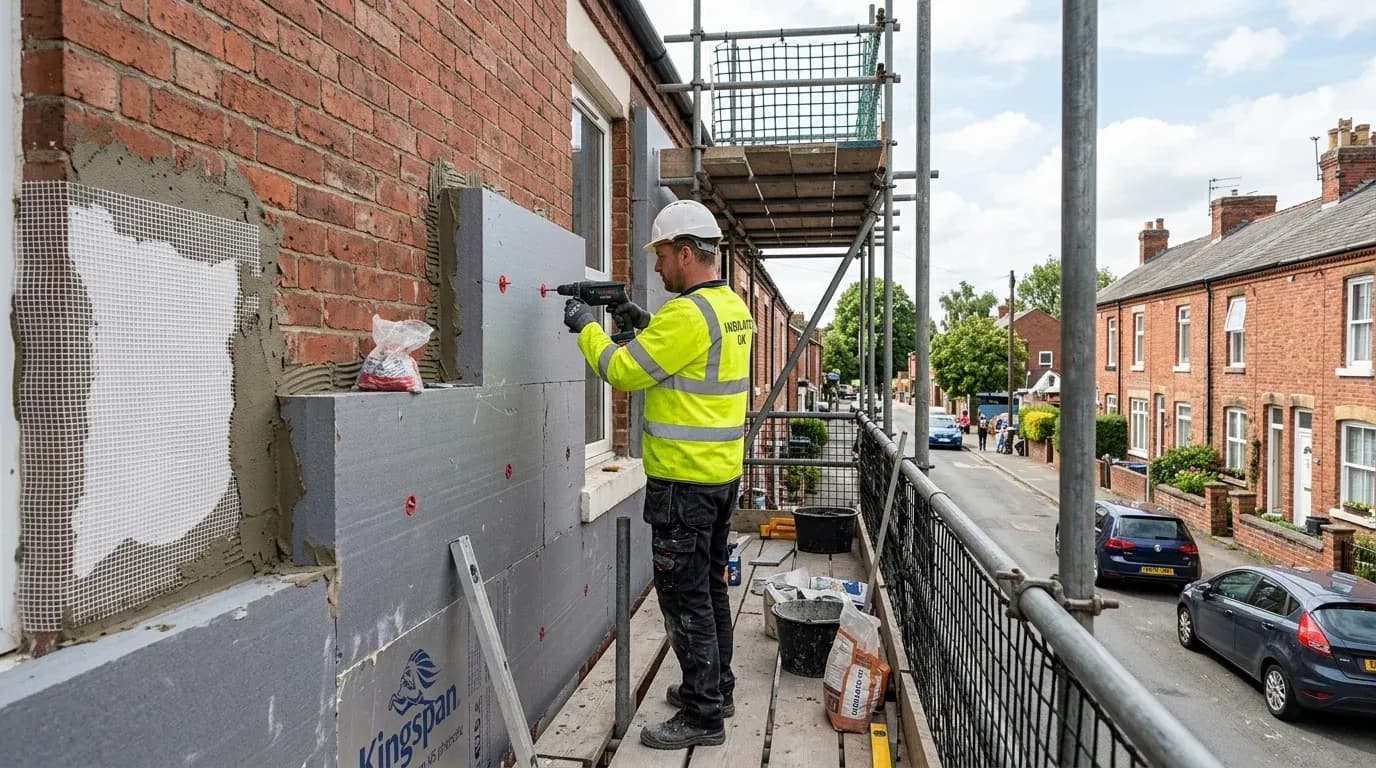
Internal solid wall insulation (IWI) costs £60 to £120 per m², working out to roughly £5,000 to £12,000 for a 3-bed semi. External wall insulation (EWI) with a render finish costs £80 to £180 per m², or £8,000 to £18,000 for the same property. Government grants through ECO4 and the Warm Homes: Local Grant can cover a significant portion of the cost, and some households pay nothing at all. Annual energy savings of £200 to £500 help offset the investment over time.
Internal Wall Insulation (IWI) Prices
Prices for rigid insulation board or stud wall systems fitted internally. Includes labour, materials, and making good (skirting boards, window reveals, redecorating).
Mid-terrace (2-bed)
£4,000 to £8,000
Semi-detached (3-bed)
£6,000 to £12,000
Detached (4-bed)
£8,000 to £16,000
External Wall Insulation (EWI) Prices
Prices for insulation boards fixed to external walls with a render or cladding finish. Includes scaffolding, materials, and labour.
Render finish
Mid-terrace (2-bed)
£6,000 to £14,000
Semi-detached (3-bed)
£8,000 to £18,000
Detached (4-bed)
£12,000 to £25,000
Brick slip finish
Mid-terrace (2-bed)
£10,000 to £20,000
Semi-detached (3-bed)
£14,000 to £25,000
Detached (4-bed)
£18,000 to £35,000
Prices exclude government grants. Many households qualify for partial or full funding through ECO4 or the Warm Homes: Local Grant.
Internal vs External: Side-by-Side Comparison
Both approaches insulate the same walls, but the trade-offs are significant. Here is how they compare.
| Factor | Internal (IWI) | External (EWI) |
|---|---|---|
| Typical cost (3-bed semi) | £6,000 to £12,000 | £8,000 to £18,000 |
| Cost per m² | £60 to £120 | £80 to £180 |
| Energy savings per year | £200 to £400 | £250 to £500 |
| Loss of internal space | 50 to 100 mm per wall | None |
| Disruption level | High (internal redecoration needed) | Medium (external scaffolding) |
| Planning permission | Rarely needed | May be needed (conservation areas) |
| Damp risk if done poorly | Higher (vapour barrier critical) | Lower (can fix existing damp) |
| Changes appearance | No | Yes (rendered or clad finish) |
| Installation time | 1 to 2 weeks | 2 to 4 weeks |
Worth knowing: Internal insulation is not just a case of sticking boards to the wall. Every room you insulate needs the skirting boards taken off, electrics moved (sockets, light switches, any wall-mounted wiring), window reveals rebuilt and plastered, and the whole lot redecorated. If you have fitted wardrobes or a kitchen on an external wall, those need coming out too. Factor in the cost and hassle of living around this work, especially if you are doing the whole house.
What Affects the Cost of Solid Wall Insulation?
Wall area and property size
This is the biggest factor. A detached property has four exposed walls, while a mid-terrace only has a front and back. More wall area means more material and more labour. A typical 3-bed semi has roughly 70 to 90 m² of external wall.
Internal vs external insulation
External wall insulation costs 30 to 50% more than internal. It involves scaffolding, weatherproof render or cladding, and more specialised labour. But it performs better thermally and does not eat into your living space, so the extra cost often makes sense on properties where appearance is not a constraint.
Finish type (external only)
Standard render is the cheapest external finish. Brick slips (thin bricks bonded to the insulation) look like original brickwork but cost significantly more. Other options include timber cladding and stone effect panels, each with different price points.
Conservation area or listed building
Properties in conservation areas or with listed status face additional complications. External insulation may be refused outright or require specific materials and finishes to match the local character. Internal insulation is usually the only option for listed buildings, and even that may need listed building consent.
Wall condition and repairs
Existing damp, cracked render, damaged pointing, or structural issues all need sorting before insulation goes on. On older pre-1930s properties, the walls may need repointing or render repairs first. These add £1,000 to £5,000 depending on the extent of the work.
Access and scaffolding
External insulation always needs scaffolding. Tight access between buildings, steep slopes, or tall properties push scaffolding costs up. A straightforward 2-storey semi might need £1,500 to £3,000 of scaffolding, while a 3-storey end-terrace with limited access could be double that.
Damp Risks: What You Need to Know
Solid wall insulation changes the way moisture behaves in your walls. Get it right and your home is warmer, drier, and more comfortable. Get it wrong and you can end up with serious damp and mould that costs thousands to put right.
Internal insulation damp risks
- ✗ Vapour barrier failure - the vapour barrier stops warm moist air from your rooms reaching the cold wall behind the insulation. If it is not continuous, or if it gets punctured by fixings, moisture condenses behind the insulation where you cannot see it. Mould grows before you know there is a problem.
- ✗ Cold bridges at junctions - where internal insulation meets the floor, ceiling, or party wall, there are gaps in the thermal envelope. These cold spots attract condensation and can cause mould in corners and behind furniture.
- ✗ Reduced wall drying - solid walls in older houses rely on being able to dry out inwards. Internal insulation blocks this, so any moisture from driving rain takes longer to evaporate. On exposed properties this can be a real issue.
External insulation benefits for damp
- ✓ Keeps the original wall warm - the wall sits inside the thermal envelope, so it stays at room temperature and condensation risk drops dramatically.
- ✓ Stops penetrating damp - the render or cladding layer acts as a weatherproof barrier, so driving rain no longer reaches the original masonry.
- ✓ No vapour barrier needed - the wall can still dry inwards as normal, which suits the breathable construction of older properties.
Government Grants for Solid Wall Insulation
Solid wall insulation qualifies for significant government funding. Because the upfront cost is high, the grants are correspondingly larger than for cavity walls or loft insulation.
ECO4 (Energy Company Obligation)
ECO4 is funded by the major energy suppliers and can cover the full cost of solid wall insulation for eligible households. You typically qualify if you receive benefits such as Universal Credit, Pension Credit, Child Tax Credit, or similar. The property also needs to be below a certain EPC rating. Because solid wall insulation makes such a big difference to energy efficiency, it scores well under the ECO4 points system, which means installers are keen to carry out this work. ECO4 is open until 31 December 2026.
Warm Homes: Local Grant
The Warm Homes: Local Grant replaced the Great British Insulation Scheme, which closed on 31 March 2026. It is delivered by local councils for lower-income homeowners and private renters whose homes sit in EPC bands D to G, and it runs until 31 March 2028. Solid wall insulation is one of the measures covered. Eligibility and rollout depend on your council, so start with your local authority. Check gov.uk for the current funding options.
Important: Both ECO4 and the Warm Homes: Local Grant require the installer to be TrustMark-registered and PAS 2030-accredited. This is non-negotiable. If an installer is not registered with TrustMark, you will not be eligible for funding and you will not get the 25-year guarantee that comes with compliant work. Check the TrustMark register before accepting any quote.
Solid Wall Insulation Costs by Region
Typical prices for a 3-bed semi-detached house, by UK region. Labour rates and property styles vary significantly across the country.
| Region | Internal (IWI) | vs National |
|---|---|---|
| London | £8,000 to £16,000 | +30% |
| South East | £7,000 to £14,000 | +15% |
| South West | £6,000 to £12,000 | +5% |
| Midlands | £5,500 to £11,000 | Average |
| Yorkshire | £5,000 to £10,000 | -5% |
| North West | £5,000 to £10,500 | -5% |
| North East | £4,500 to £9,500 | -10% |
| Scotland | £5,500 to £11,000 | Average |
| Wales | £5,000 to £10,500 | -5% |
Before grants. Many households pay significantly less after government scheme funding is applied.
How to Get Your Solid Wall Insulation for Less
Solid wall insulation is one of the most expensive energy efficiency measures, so getting the cost down makes a real difference.
Check government grant eligibility before you pay anything
ECO4 and the Warm Homes: Local Grant can cover part or all of the cost of solid wall insulation. Because solid wall insulation is expensive, the grants are proportionally larger than for cavity walls or loft insulation. ECO4 is open until 31 December 2026 for households on qualifying benefits. Even if you are not on benefits, you may qualify through the Warm Homes: Local Grant if your council runs it and your home sits in EPC band D to G. The Great British Insulation Scheme that used to help here closed on 31 March 2026. Contact your energy supplier, your local council, or use the GOV.UK Find ways to save energy tool to check.
Get at least three quotes and compare like for like
The price range for solid wall insulation is wide, and quotes can vary by thousands of pounds for the same job. Make sure each quote specifies the same insulation thickness, the same U-value target, and the same finish. A quote of £8,000 for 50 mm of insulation is not comparable to one for £12,000 with 100 mm. Check that each installer is TrustMark-registered and PAS 2030-accredited, because you will need this for any government grant and for the 25-year guarantee.
Combine with other energy efficiency work
If you are already having scaffolding up for external insulation, it makes sense to get any roof work, gutter replacement, or window upgrades done at the same time. The scaffolding is a significant chunk of the cost and you only want to pay for it once. Some installers offer packages that include loft insulation top-up alongside solid wall insulation, and government grants often cover multiple measures in a single application.
Time it around other renovation work
If you are planning a kitchen refit, bathroom renovation, or rewiring, doing internal wall insulation at the same time saves a huge amount of disruption and cost. The walls need to come apart anyway for internal insulation (skirting boards off, electrics moved, window reveals rebuilt), so combining it with a renovation means you are not paying to undo and redo finished rooms.
Insist on a proper moisture risk assessment
This is not optional. Solid wall insulation changes the way moisture moves through your walls, and getting it wrong causes serious damp and mould problems that cost thousands to fix. A PAS 2030-accredited installer will carry out a moisture risk assessment as standard. If someone skips this step or brushes it off, find a different installer. The assessment should check the wall condition, local exposure to driving rain, existing ventilation, and the suitability of the chosen system.
TrustMark and PAS 2030: Non-Negotiable
Any installer carrying out solid wall insulation under a government scheme must be TrustMark-registered and PAS 2030-accredited. This is not just a recommendation. Without it, the work will not qualify for ECO4 or Warm Homes funding, you will not receive the backed guarantee, and if something goes wrong you have limited recourse.
PAS 2030 is the installation standard that covers how the work is done. PAS 2035 is the overarching framework that covers the whole retrofit process, including the moisture risk assessment, ventilation checks, and post-installation monitoring. A compliant installer follows both.
Check the TrustMark register to verify any installer before accepting a quote.
What to Expect: The Solid Wall Insulation Process
Whether you choose internal or external insulation, the job typically takes 1 to 2 weeks for a full house. Here's how it usually works.
- 1
Property survey and moisture assessment
A PAS 2030-accredited surveyor inspects the walls, checks for damp, and takes measurements. They assess whether internal (IWI) or external (EWI) insulation suits your property and identify any cold bridges or structural issues.
- 2
Scaffolding and preparation
For external insulation, scaffolding goes up around the property. Window sills, drainpipes, and any obstructions are temporarily removed or extended. For internal insulation, furniture is moved away from walls and skirting boards are removed.
- 3
Insulation boards or render system applied
EWI: rigid insulation boards are mechanically fixed and adhesive-bonded to the external walls. IWI: insulation boards are dry-lined onto internal walls with a vapour barrier fitted to prevent condensation behind the insulation.
- 4
Detailing around windows, doors, and junctions
Insulation is carefully cut and fitted around window reveals, door frames, and wall junctions to eliminate cold bridges. This is one of the most critical steps for long-term performance.
- 5
Finishing and making good
EWI: a render or cladding finish is applied over the insulation. IWI: walls are skimmed or plastered, skirting boards refitted, and electrics reconnected. The installer checks for airtightness and hands over documentation.
Frequently Asked Questions
How much does solid wall insulation cost for a 3-bed semi?
Internal solid wall insulation (IWI) costs between £6,000 and £12,000 for a typical 3-bed semi-detached house in 2026. External wall insulation (EWI) with a render finish costs £8,000 to £18,000 for the same property. Brick slip cladding is the most expensive external option at £14,000 to £25,000. Many households qualify for full or partial funding through ECO4 or the Warm Homes: Local Grant delivered by their council.
Is internal or external wall insulation better?
It depends on the property and your priorities. External wall insulation (EWI) is generally more effective because it wraps the building in a continuous thermal blanket, eliminates cold bridges, and fixes penetrating damp issues. It also preserves your internal floor space. Internal wall insulation (IWI) is cheaper and does not change the outside appearance of your home, but it reduces room sizes by 50 to 100 mm per insulated wall and requires significant internal disruption including moving skirting boards, electrics, and re-doing window reveals.
Can I get a grant for solid wall insulation?
Yes. Solid wall insulation is covered by ECO4, which is open until 31 December 2026, and by the Warm Homes: Local Grant. ECO4 is available to households receiving qualifying benefits such as Universal Credit, Pension Credit, or Child Tax Credit. The Warm Homes: Local Grant is run by local councils for lower-income homeowners and private renters in EPC bands D to G, and it replaced the Great British Insulation Scheme, which closed on 31 March 2026. Both routes require TrustMark-registered, PAS 2030-accredited installers. Your energy supplier, your council, or a registered installer can check your eligibility.
Does solid wall insulation cause damp?
It can if installed incorrectly. Internal wall insulation is the higher risk of the two because it changes where the dew point sits within the wall. A properly installed vapour barrier is absolutely critical to prevent warm, moist indoor air condensing behind the insulation and causing mould. External wall insulation, when done well, actually reduces damp problems because it keeps the original wall warmer and drier. Always use a PAS 2030-accredited installer who understands moisture risk assessment.
Do I need planning permission for external wall insulation?
In most cases, external wall insulation on a standard residential property falls under permitted development and does not need planning permission. However, you will need planning permission if the property is in a conservation area, is a listed building, or if the insulation would project beyond certain limits or alter the front elevation significantly. Always check with your local council before starting work. Properties in national parks or Areas of Outstanding Natural Beauty may also have restrictions.

Written by Chris Kervin, Co-Founder, Less.co.uk
Last updated: · Pricing based on industry data and verified contractor submissions · Methodology
Ready to get your solid walls insulated for less?
Compare free quotes from TrustMark-registered installers near you. Check government grant eligibility at the same time.
Get Free QuotesFree, no obligation · TrustMark-registered installers · Government grant check included
More insulation guides
Compare real quotes for your job
Prices move a lot with your postcode, the access on site and the spec you choose. Get up to 3 free quotes from vetted local tradespeople and see what yours actually comes to, with no obligation to book.