Spray Foam Insulation Cost UK 2026
Spray foam insulation costs £20 to £50 per m² for open-cell or £40 to £80 per m² for closed-cell. A typical loft job runs £1,200 to £3,000 for a 3-bed semi. Before you commit, read our mortgage lending warning below.
£20 to £50
Open-cell (per m²)
£40 to £80
Closed-cell (per m²)
£1,200 to £3k
Loft (3-bed semi)
1 to 2 days
Installation time
Prices updated April 2026 · Based on industry data and contractor submissions.
Quick answer
How much does spray foam insulation cost?
Spray foam insulation costs £20 to £50 per m² for open-cell foam or £40 to £80 per m² for closed-cell. For a typical 3-bed semi, expect to pay £1,200 to £3,000 for a loft, £1,500 to £3,500 for underfloor, or £2,500 to £6,000 for external walls. This is a professional-only job and is not eligible for most government grants. Critically, many mortgage lenders refuse to lend on properties with spray foam in the roof space.
Spray Foam Insulation Prices
Open-cell and closed-cell prices including professional installation. Typical totals are based on a 3-bed semi.
Loft / roof
Open-cell /m²
£20 to £35
Closed-cell /m²
£40 to £60
Typical total (3-bed semi)
£1,200 to £3,000
Underfloor
Open-cell /m²
£25 to £40
Closed-cell /m²
£45 to £70
Typical total (3-bed semi)
£1,500 to £3,500
External walls
Open-cell /m²
£30 to £50
Closed-cell /m²
£50 to £80
Typical total (3-bed semi)
£2,500 to £6,000
Removal (if needed)
Open-cell /m²
-
Closed-cell /m²
-
Typical total (3-bed semi)
£3,000 to £6,000
| Application | Open-cell (per m²) | Closed-cell (per m²) | Typical total (3-bed semi) |
|---|---|---|---|
| Loft / roof | £20 to £35 | £40 to £60 | £1,200 to £3,000 |
| Underfloor | £25 to £40 | £45 to £70 | £1,500 to £3,500 |
| External walls | £30 to £50 | £50 to £80 | £2,500 to £6,000 |
| Removal (if needed) | - | - | £3,000 to £6,000 |
Prices include professional installation. Spray foam is not a DIY job. Installing insulation in a home currently qualifies for 0% VAT until 31 March 2027, after which the reduced 5% rate is expected to return.
Open-Cell vs Closed-Cell Spray Foam
These two behave very differently. Pick the wrong one and you will either overpay or end up with moisture problems.
Lighter, breathable, cheaper
- ✓ £20 to £50 per m²
- ✓ Allows moisture to pass through (breathable)
- ✓ Soft, spongy texture
- ✓ Needs ~100 mm for adequate R-value
- ✓ Best for: loft spaces, interior walls
- ✓ Good sound insulation properties
Rigid, waterproof, structural
- ✓ £40 to £80 per m²
- ✓ Acts as a complete moisture barrier
- ✓ Hard, rigid when cured
- ✓ Needs only ~50 mm for equivalent R-value
- ✓ Best for: underfloor, external walls, damp areas
- ✓ Adds structural strength to surfaces
Which should you choose? For most loft insulation jobs, open-cell is the better option because it allows the roof structure to breathe and costs less. Closed-cell is worth the extra for underfloor insulation, areas prone to damp, or where space is tight and you need the thinnest possible layer.
Mortgage Warning: Read This Before You Proceed
This is the most important section on this page
Many UK mortgage lenders refuse to lend on properties with spray foam insulation in the roof space. This is not a niche concern or a technicality. It is a widespread policy that affects major high-street lenders, and it could leave you unable to sell your home or remortgage in future.
The issue is straightforward: the Royal Institution of Chartered Surveyors (RICS) has flagged that spray foam prevents surveyors from inspecting the condition of roof timbers during a mortgage valuation. Surveyors cannot see whether the wood is rotting, whether there is woodworm, or whether the structural integrity is sound. Because of this, many lenders take the view that the property is too risky to lend against.
What this means in practice:
- ✗ Your buyer's mortgage application may be declined because of the spray foam
- ✗ Your property may be down-valued, leaving a gap between the sale price and the mortgage offer
- ✗ You may need to pay £3,000 to £6,000 to remove the foam before a sale can proceed
- ✗ Remortgaging to a new lender could trigger the same problem
- ✗ Cash buyers are unaffected, but they represent a small fraction of the market
How to reduce the risk if you still want spray foam:
- 1. Contact your current mortgage lender before installation and get their position in writing
- 2. Use a BBA-certified product (Icynene, Huntsman, and some Demilec products carry this). BBA certification does not guarantee lender acceptance, but it significantly improves your chances
- 3. Keep all documentation: installation certificate, BBA certificate, warranty details, photos of timbers before installation, and a timber condition report
- 4. Ask the installer for a 25-year guarantee that is backed by an independent body, not just the company itself
Our honest view: if there is any chance you will sell or remortgage in the next 10 to 15 years, think very carefully before having spray foam installed in your roof space. Traditional insulation methods do not carry this risk.
What Affects the Cost of Spray Foam Insulation
Six things drive the final price.
Foam type (open-cell vs closed-cell)
This is the single biggest factor. Closed-cell costs roughly double per square metre. For a straightforward loft where breathability matters, open-cell is usually the better shout. Underfloor or damp-prone areas? That is where closed-cell earns its premium.
Area to be insulated
Spray foam is priced per square metre, so more surface means a bigger bill. A small terraced loft might be 30 m². A large detached roof? Easily 80 m² or more. Worth noting: for loft jobs, measure the rafter area, not the floor area.
Thickness required
Building regs set minimum thermal performance targets. Open-cell needs about 100 mm to hit the required R-value. Closed-cell gets there in roughly 50 mm. Thicker application means more material, which means a higher bill.
Access and preparation
Awkward roof spaces, low headroom, and lofts full of old boxes all add time. The area needs clearing before spraying starts. If existing insulation needs stripping out first, expect an extra charge on top.
Property size and type
A detached house has far more exposed roof and wall area than a mid-terrace, so the total climbs even though the rate per m² stays the same. Multi-storey properties may need scaffolding for external walls, which adds another layer of cost.
BBA certification of the product
Some products carry BBA (British Board of Agrement) certification, meaning they have been independently tested. BBA-certified foam costs a bit more, but lenders and surveyors are far more likely to accept it. If there is any chance you will sell or remortgage, this is worth paying for.
Pros and Cons of Spray Foam Insulation
The honest answer: spray foam has real advantages, but the downsides are serious enough that you need to weigh them properly.
Advantages
- ✓Excellent thermal performance per millimetre of thickness
- ✓No gaps or cold spots - it fills every crack, unlike batts and rolls
- ✓Closed-cell foam adds structural rigidity and blocks moisture
- ✓Does not settle, sag, or degrade over time like mineral wool can
- ✓Seals draughts effectively - you will notice the difference
- ✓Long lifespan with 25-year warranties as standard
Disadvantages
- ✗Many mortgage lenders will not lend on properties with spray foam in the roof space
- ✗RICS surveyors cannot inspect roof timbers through spray foam, causing valuation issues
- ✗Removal costs £3,000 to £6,000 if you need to sell or remortgage
- ✗Not eligible for ECO4 or Warm Homes: Local Grant funding
- ✗More expensive than traditional insulation methods (mineral wool, rigid board)
- ✗Must be professionally installed, not a DIY job
- ✗If applied incorrectly, can trap moisture and cause timber rot
- ✗Some poorly installed foam has caused condensation problems in roof spaces
Is Spray Foam Insulation Worth It?
It depends on your situation. As an insulation material, spray foam genuinely works well. It fills every gap, it does not settle, and the thermal performance is hard to beat. For underfloor insulation, loft conversions where you need to insulate between rafters, or awkward spaces that rolls and batts cannot reach, it can be the best option going.
But you cannot ignore the mortgage problem. Own your home outright with no plans to sell or borrow against it? The lending risk goes away. Converting your loft into a bedroom where rafter insulation is essential? Spray foam makes practical sense, and the conversion itself adds enough value to offset any surveyor concerns.
In practice, though, most people asking about spray foam just want a warmer loft. For that, mineral wool rolls at 270 mm on the loft floor give you comparable warmth at a fraction of the price, qualify for government grants, and cause zero issues with lenders. That is the comparison worth making before you spend anything.
When spray foam makes sense:
- ✓ Loft conversions where you need to insulate between rafters
- ✓ Underfloor insulation on suspended timber floors
- ✓ Awkward or hard-to-reach spaces that traditional materials cannot fill
- ✓ Properties you own outright with no plans to sell or remortgage
When you should probably choose something else:
- ✗ Standard loft insulation on the floor (mineral wool is cheaper and grant-eligible)
- ✗ Any property with an existing mortgage where the lender has not confirmed acceptance
- ✗ Properties you may sell within the next 10 to 15 years
- ✗ Where you want to take advantage of ECO4 or Warm Homes: Local Grant funding
How to Get Your Spray Foam Insulation for Less
If you have decided spray foam is the right call, here is how to keep costs down and dodge the common pitfalls.
Check with your mortgage lender first
Before spending a penny, phone your mortgage lender and ask their policy on spray foam insulation. If they will not lend on properties with spray foam, you could be creating a serious problem for yourself when you come to sell or remortgage. This one phone call could save you thousands.
Insist on BBA-certified products
If you do go ahead with spray foam, choose an installer that uses BBA-certified products (such as Icynene or Huntsman systems). BBA certification means the product has been independently tested and is more likely to be accepted by mortgage lenders and surveyors. Ask for the BBA certificate number before signing anything.
Consider whether traditional insulation would do the job
For many lofts, mineral wool rolls at 270 mm thickness provide excellent insulation at a fraction of the cost, and they qualify for government grants. Spray foam makes more sense for specific situations like converting a loft into a room, insulating awkward spaces, or underfloor applications where traditional materials are impractical.
Get at least three quotes and compare like for like
Prices vary a lot between installers. When comparing quotes, check whether they are quoting open-cell or closed-cell, the thickness, and whether the product is BBA certified. A cheap open-cell quote next to a mid-range closed-cell one is apples and oranges. Also ask every installer what happens if problems develop down the line.
Ask about ventilation requirements
Spray foam changes how the roof space breathes. Open-cell still lets some moisture through, but closed-cell seals the space completely. Your installer should check the existing ventilation and flag any changes needed. Poor ventilation after installation is one of the main reasons people end up with condensation problems.
Useful resources
- Building Regulations Part L, Insulation requirements for existing buildings
- RICS, Surveyors can advise on spray foam suitability before you commit
What to Expect: The Spray Foam Insulation Process
A typical loft spray foam job takes half a day to a full day. Here's how the process usually runs.
- 1
Pre-installation survey
An installer inspects the loft space, checks ventilation, roof condition, and any existing insulation. They assess whether open-cell or closed-cell foam is appropriate and flag any issues that could affect your mortgage or warranty.
- 2
Preparation and masking
The loft is cleared and any items stored up there are moved. Electrics, pipes, and areas that must not be sprayed are masked off with protective sheeting. Ventilation points are identified and protected.
- 3
Spray application
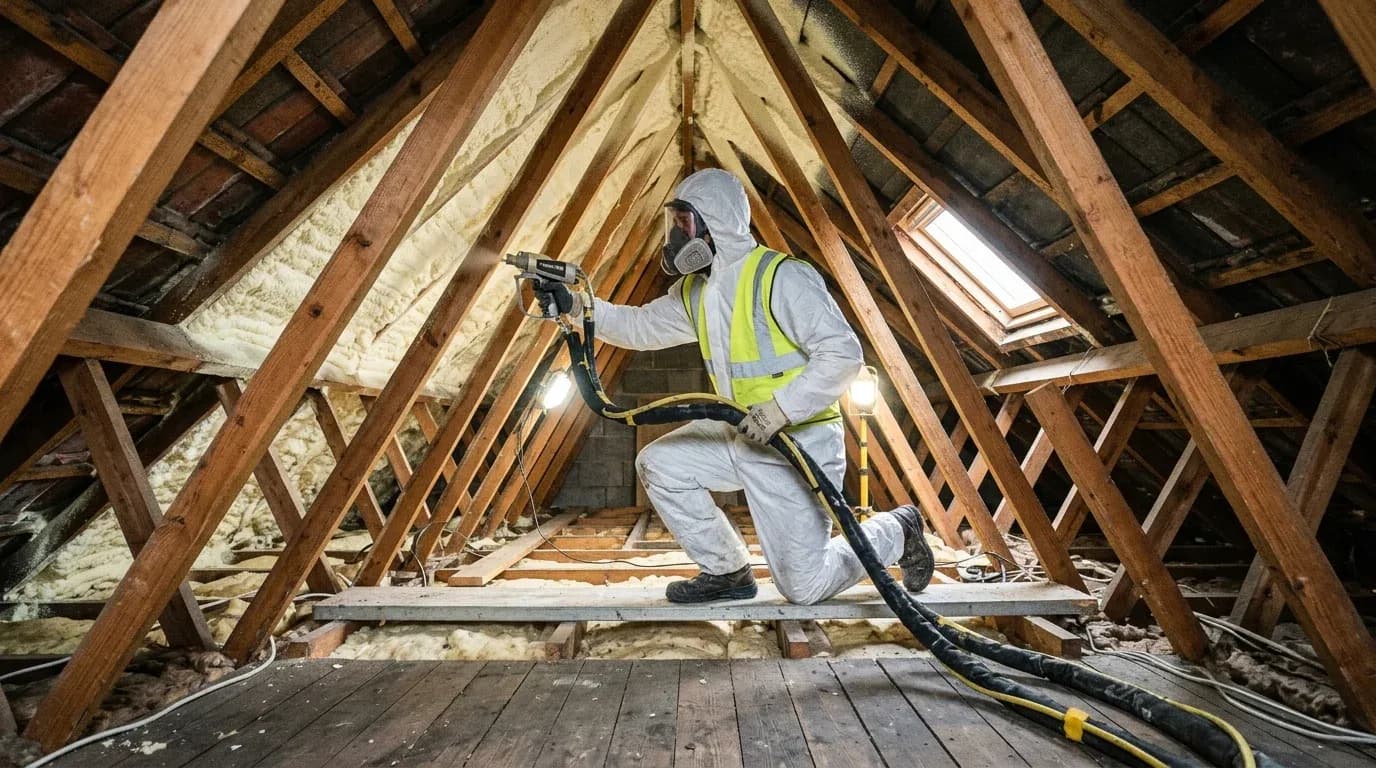
The installer uses a specialist rig to spray the foam directly onto the underside of the roof tiles or between rafters. The foam expands and cures within seconds. Multiple passes build up to the required thickness, typically 100mm for open-cell or 50mm for closed-cell.
- 4
Trimming and tidying
Once cured, any excess foam is trimmed back so it sits flush with the rafters. The installer checks coverage is even and there are no gaps or voids in the insulation layer.
- 5
Ventilation check and sign-off
The installer verifies that roof ventilation has not been blocked and that the installation meets BBA or equivalent certification standards. You receive documentation confirming the product used, thickness applied, and any warranty details.
Frequently Asked Questions
Will spray foam insulation affect my mortgage or ability to sell?
Yes, this is a serious concern. Many UK mortgage lenders refuse to lend on properties with spray foam insulation in the roof space. The RICS (Royal Institution of Chartered Surveyors) has flagged concerns that spray foam prevents surveyors from inspecting the condition of roof timbers, which is a standard part of any mortgage valuation. If you need to sell or remortgage, you may face a down-valuation or need to pay £3,000 to £6,000 to have the foam removed before a lender will proceed. Some BBA-certified spray foam products are more likely to be accepted, but there is no guarantee. Always check with your mortgage lender before having spray foam installed.
How much does spray foam insulation cost for a loft?
Spray foam insulation for a loft in a typical 3-bedroom semi-detached house costs between £1,200 and £3,000 in 2026. Open-cell foam is at the lower end (£20 to £35 per m²) and closed-cell foam at the higher end (£40 to £60 per m²). The total depends on the roof area, foam type, thickness required, and access difficulty.
What is the difference between open-cell and closed-cell spray foam?
Open-cell spray foam is softer, breathable, and cheaper. It needs about 100 mm thickness for adequate thermal performance and is best suited to lofts where some moisture permeability is desirable. Closed-cell foam is rigid, acts as a moisture barrier, adds structural strength, and achieves equivalent insulation in roughly half the thickness (about 50 mm). Closed-cell costs roughly twice as much but performs better in demanding applications like underfloor and external wall insulation.
Can I get a government grant for spray foam insulation?
Spray foam insulation is generally not eligible for the main UK government insulation schemes. ECO4, which runs until 31 December 2026, and the Warm Homes: Local Grant run through your council both prefer traditional insulation methods like mineral wool, cavity fill, and rigid board. The Great British Insulation Scheme closed to new applicants on 31 March 2026. If you are looking for funded insulation, loft insulation with mineral wool rolls or cavity wall insulation are much more likely to qualify.
How long does spray foam insulation last?
Spray foam insulation typically lasts the lifetime of the building when installed correctly. Most manufacturers offer 25-year warranties, and the foam itself does not degrade, settle, or lose performance over time like mineral wool can. The catch is that the foam outlasting you is not really the concern. The mortgage and resale issues are what trip people up.

Written by Chris Kervin, Co-Founder, Less.co.uk
Last updated: · Pricing based on industry data and installer quotes · Methodology
Need help choosing the right insulation?
Compare free quotes from professional insulation installers near you. They can advise on the best type for your property.
Get Free QuotesFree, no obligation · Professional installers · Advice on the best insulation type for your home
More home improvement costs
Compare real quotes for your job
Prices move a lot with your postcode, the access on site and the spec you choose. Get up to 3 free quotes from vetted local tradespeople and see what yours actually comes to, with no obligation to book.