How Much Does Septic Tank Emptying Cost in 2026?
Emptying a household septic tank of up to about 4,500 litres (1,000 gallons) costs about £200, and most firms charge £150 to £250. Bigger tanks cost £300 to £550 or more. A cesspit costs about £300 a tanker load, and because it holds everything that goes down the drains, it can need emptying every month. A home pays no VAT on emptying.
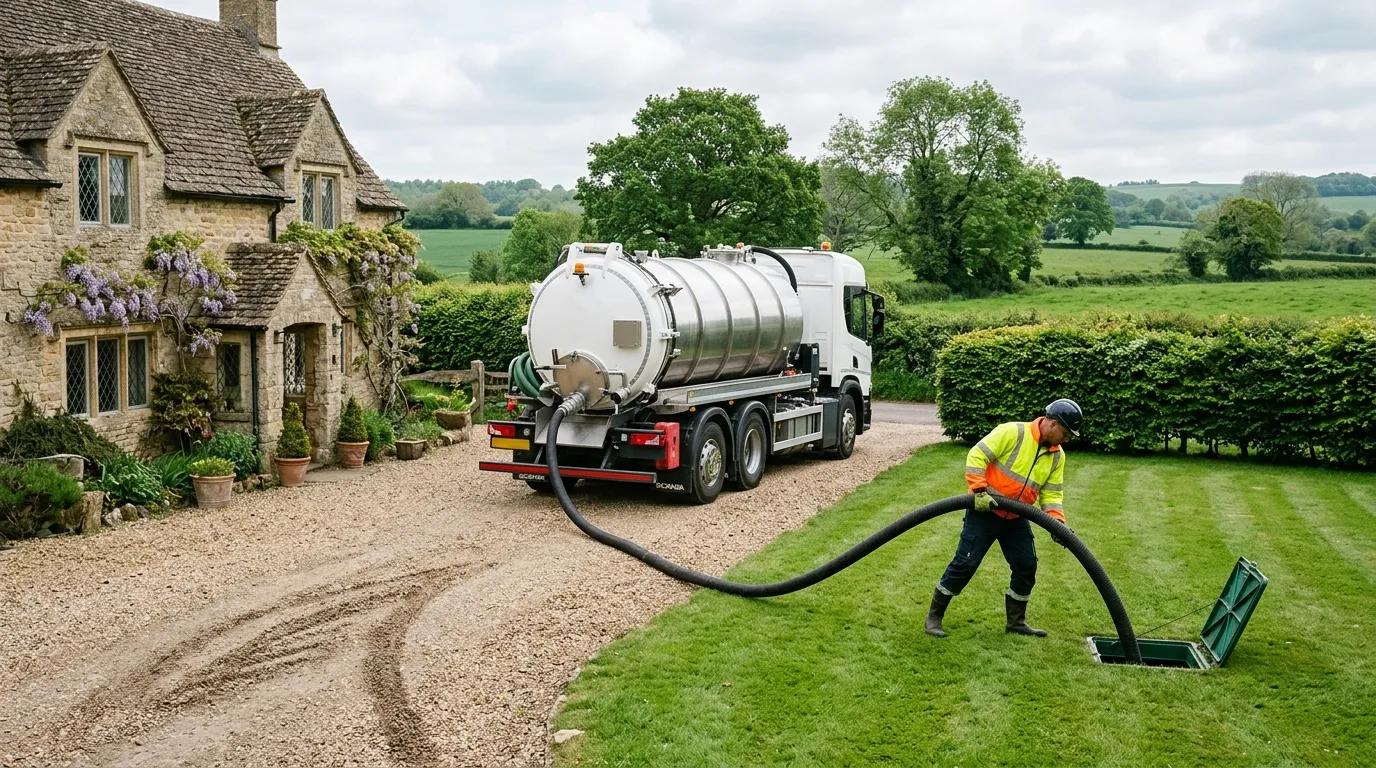
£200
Septic tank empty
£300
Cesspit, per tanker load
£150
Treatment plant service, yearly
0%
VAT on emptying at a home
Last updated . Prices are the ones UK tanker firms publish on their own websites, plus council and water company rates. Only 4 of the roughly 70 firms we checked publish a price for a standard septic tank empty, so every other figure apart from NI Water's charges is a guide. We read every price twice, separately, in November 2026, then re-read the sources that mattered most. Emptying a tank at a home carries no VAT. How we work out our prices.
To cite this page: Less.co.uk, “Septic Tank Emptying Cost 2026”, updated 23 November 2026, https://less.co.uk/home-improvements/drainage/septic-tank-emptying-cost. You're welcome to quote these figures with a link to this page.
Septic Tank Emptying Prices
Tankers charge by how much they take away, so the size of the tank sets the price. Standard prices cover the first hour on site or about 30 metres of hose. The main figure is a rounded middle price, and the range below it is the spread of prices we found.
Septic tank, household size
Up to about 4,500 litres (1,000 gallons)
£200
£150 to £250
Larger septic tankGuide
4,500 to 9,000 litres (1,000 to 2,000 gallons)
£300
£270 to £370
Very large tankGuide
9,000 to 13,500 litres (2,000 to 3,000 gallons)
£400
£330 to £540
Cesspit, per tanker loadGuide
Up to about 9,000 litres. Councils charge less for watery cesspit waste
£300
£180 to £400
Full-size cesspitGuide
About 18,000 litres. It may take two tanker loads
£550
£400 to £750
Sewage treatment plant desludgeGuide
Tankers charge the same as for a septic tank of the same size
£200
£150 to £250
Treatment plant service, yearlyGuide
Parts extra, and VAT usually applies
£150
£100 to £300
Next-day or emergency visitGuide
On top of the price for the empty
+£50
+£25 to +£100
Long hose run or awkward accessGuide
On top of the price, usually past about 30 metres
+£35
+£15 to +£55
Second empty in Northern Ireland within 12 monthsOfficial charge
NI Water's 2026-27 charge for up to 4.5 cubic metres. The first is free
£108
£108 to £142
Few tanker firms publish prices, so these figures come from a handful of firms' own prices and council and water company rates. Treat them as a guide and get quotes.
Emptying a septic tank or cesspit at a home is zero-rated, so no VAT should be added. Servicing usually carries VAT at 20%.
Cesspit Emptying Cost
A cesspit, or cesspool, is a sealed tank with no outlet, so the tanker takes away everything that has gone down the drains. Firms price it the same way as a septic tank, by volume. One tanker load of up to about 9,000 litres costs about £300 (£180 to £400), and emptying a full-size 18,000-litre cesspit costs about £550 (£400 to £750), which may take two loads. No firm we found publishes a cesspit-only price, so these figures lean on council rates. Councils that still run tankers charge less for watery cesspit waste, because the water company charges them less to dispose of it.
A cesspit costs far more to run than a septic tank because it needs emptying so often, and gov.uk gives once a month as an example. Nobody publishes a yearly figure, so we worked one out: Building Regulations assume each person uses 125 litres of water a day, about 45,600 litres a year, and published rates come to about £18 to £46 per 1,000 litres. That's roughly £800 to £2,100 a person a year, or about £2,500 to £3,000 for two people. Treat it as an estimate.
Septic Tank Emptying Cost Calculator
Pick your system, the tank size and how often it's emptied for a rough price per visit and per year.
What have you got?
The tank settles the solids and lets the liquid drain away to a drainage field. Only the sludge and the liquid in the tank are taken away.
How big is the tank?
Firms price by how much they take away, so the tank size sets the price.
Where do you live?
Gov.uk says a septic tank or treatment plant should be emptied at least once a year, or as the manufacturer's instructions say. A cesspit must be emptied regularly, for example once a month.
Your estimate
Each empty
About £200
Typically £150 to £250
Each year
About £200
Typically £150 to £250
A guide based on a small number of published prices, checked November 2026. Get three quotes. Emptying a tank at a home carries no VAT. Only Northern Ireland changes the price here, because we found no reliable regional pattern elsewhere.
Get quotes from local drainage and tanker firms
Tell us the tank size and how close a tanker can park, and local drainage and tanker firms will get in touch with prices. Free, with no obligation to book.
How Often to Empty It, and the Yearly Cost
Septic tank
At least once a year in England, every 12 to 24 months in Wales
About £200 a year
£150 to £250
Sewage treatment plant
Desludge at least once a year or as the manufacturer says, plus a yearly service
About £350 a year
£250 to £550
Cesspit, two people
Regularly, for example once a month
About £2,500 to £3,000 a year
£1,500 to £5,000 or more
The treatment plant figure adds a desludge to a yearly service, and the cesspit figure is our own estimate. To see how fast a cesspit fills, divide the tank size in litres by 125 litres a day for each person. Two people with an 18,000-litre tank fill it in about ten weeks.
Leaving a septic tank too long lets solids wash into the drainage field. Gov.uk warns this can cause damage and pollution and lead to expensive repairs.
What Affects the Price
- 1
How much is taken away
Tankers charge by volume. A West Sussex firm charges £180 for up to 1,000 gallons and £400 for up to 4,000 gallons.
- 2
How close the tanker can park
Standard prices assume the tanker can get within about 30 metres of the tank. One council adds £54.90 for a long pipe or difficult access, and NI Water charges £142 instead of £108.
- 3
How soon you need it
An Anglesey firm adds £25 for a next-day visit, and one council's emergency rate is about 40% higher per 1,000 litres than its booked rate.
- 4
What's in the tank
Councils pass on the water company's disposal charge, which is lower for watery cesspit waste. One council charges direct debit customers £182 a load for weak waste, £295 for standard and £374 for strong, and £374 for any pay-as-you-go visit.
- 5
Time on site
One firm's price covers the first hour, then adds £15 for every 15 minutes after that.
- 6
Distance and local disposal
One firm charges £15 to £30 more in its outlying areas, and a South West firm warns that local disposal sites are limiting bookings.
How Long It Takes and How Soon You Can Book
A national price guide puts a visit at 45 minutes to 3 hours. One firm's price covers the first hour on site, and it says overruns are very rare. For booked visits, one council empties within 10 working days and NI Water within 12 working days, or 2 on its paid fast service. An Anglesey firm works to 5 working days, or the next day for £25 more.
Before the tanker arrives
Clear the lid and the route for the hose. Keep children and pets well away from the tank while it's open, as NI Water reminds its customers. Ask the driver for the firm's waste carrier certificate if you haven't seen it.
Septic Tank and Cesspit Rules Across the UK
England
Most septic tanks and small treatment plants run under the general binding rules, and you don't need a permit if you meet them. For a system that drains to the ground, gov.uk says you must have the sludge removed before it goes past the tank's capacity, and you should do this at least once a year or as the manufacturer's instructions say. The rules cover up to 2,000 litres a day to the ground, or 5,000 litres a day to a river or stream.
- The firm that takes the sludge must be a registered waste carrier. Ask when you book, or ask the tanker driver for a copy of the certificate. You can also search the public register of waste carriers.
- When you sell, you must tell the new owner in writing that there's a sewage discharge, with a description of the system, where its main parts are, any changes made, how to maintain it and any maintenance records.
- A soakaway built for rainwater after December 2007 can't take sewage. You'd need to upgrade to a drainage field, or connect to the public sewer where that's reasonable. Our soakaway guide covers rainwater soakaways.
- If a septic tank drains straight into a river or stream, gov.uk says that as soon as possible you must connect to a public foul sewer, replace the tank with a small sewage treatment plant or install a drainage field. You must have plans in place to do the work within a reasonable timescale, usually 12 months. If you buy or sell a house with one, agree who will replace or upgrade it as a condition of sale.
- The general binding rules don't apply to a cesspool. It must be emptied regularly, for example once a month, by a registered waste carrier, and it mustn't leak or overflow. A new one needs planning permission and Building Regulations approval, and must hold at least 18,000 litres for two people plus 6,800 litres for each extra person.
- For a new septic tank, Approved Document H sets a minimum of 2,700 litres for up to four people, plus 180 litres for each extra person, and says the tank should be within 30 metres of where a tanker can get to.
The gov.uk overview explains who counts as responsible for a system, including shared tanks and tenants.
Scotland, Wales and Northern Ireland
- Scotland: you must register a septic tank or treatment plant serving up to 10 homes with SEPA, for a one-off fee of £198.55. Bigger systems, or ones in sensitive areas, need a licence. A CAR registration held on 31 October 2025 became an EASR authorisation automatically on 1 November 2025, so you don't need to apply again.
- Wales: most septic tanks and package treatment plants need a one-off, free registration with Natural Resources Wales. A system that drains to a river or stream must be a package treatment plant, and the property must normally be at least 30 metres from a public foul sewer. NRW says to have a septic tank emptied every 12 to 24 months by a registered contractor and most treatment plants serviced every 12 months, and to keep records for 5 years.
- Northern Ireland: septic tanks and package plants need a discharge consent from the Northern Ireland Environment Agency under the Water (Northern Ireland) Order 1999. NIEA aims to decide within 4 months, and you can apply online for a consent or a transfer of ownership. Owners must desludge regularly. An older NI Water leaflet says consents normally require it at least every 12 months, so check the conditions on yours. The NIEA leaflet and nidirect have more. NI Water empties one tank a year free, and its 2026-27 charges set £108 for a second empty.
Is There VAT on Septic Tank Emptying?
Not at a home. HMRC's list of VAT rates on different goods and services puts emptying domestic cesspools and septic tanks at 0%, and its VAT manual says emptying is zero-rated for non-industrial users. The law is the VAT Act 1994, Schedule 8, Group 2. A price labelled “plus VAT” should cost a household the same as the price shown. Servicing or repairing a treatment plant isn't on the zero-rated list, so expect VAT at 20% on that.
Repair and Replacement Costs
Regular empties are the cheap part of owning a septic tank. If the tank or the drainage field fails, the bills are far bigger. These figures each come from a single firm, so treat them as a rough guide:
- A new or replacement septic tank: £3,000 to £7,000
- A new sewage treatment plant: £6,000 to £15,000 or more
- A new drainage field: £1,500 to £4,000 or more
For blocked or damaged pipes between the house and the tank, see our drainage costs.
Septic Tank Emptying Prices by Region
We found no reliable regional pattern, and none of the firms we checked in London, Scotland, Wales (apart from one on Anglesey) or Northern Ireland publishes a price. A few things do change what you pay where you live:
- Northern Ireland: NI Water empties one tank a year free and charges £108 for a second empty in 2026-27.
- Councils that run tankers pass on the local water company's disposal charge. In one council area served by two water companies, the rates differ by under £10 a load.
- Distance: an Anglesey firm charges £15 to £30 more across its three areas.
- The South West: the highest starting price we found (£250) is from a firm covering Cornwall, Devon and Somerset, which warns that local disposal sites are limiting bookings.
We haven't applied our usual regional building cost factors here, because they measure building work and nothing we found ties them to tanker prices. Scottish Water's current charges weren't available when we checked, so ask it directly. Quotes from firms near you are the best guide.
How to Get Your Septic Tank Emptied for Less
Get three quotes, and give the tank size
Tell each firm the tank size in litres or gallons and how far the tanker will have to park from the tank, since most firms price by volume. Ask what the price covers, such as the first hour on site or a set length of hose.
Book ahead
Next-day and emergency visits cost £25 to £100 more. We found no firm or council charging less in any particular month, so book when the tank needs it and avoid paying for speed.
Check for a council or water company service
Some English councils still run tankers, and one charges £295 a load on direct debit against £374 pay-as-you-go. In Northern Ireland, NI Water's first empty each year is free.
Make access easy
Clear the lid and keep the route open for the hose. Tell the firm if the tanker will be more than 30 metres from the tank, as that can add £15 to £55.
Don't stretch the gap between empties
Skipping an empty to save £200 is a false saving. Solids that reach the drainage field can mean a new system, and one firm quotes £3,000 to £7,000 for a new septic tank.
Keep water out of a cesspit
Everything that goes down the drains has to be taken away. Fix dripping taps and leaking toilets and keep rainwater out. Each 1,000 litres you keep out saves roughly £20 to £45.
Pay by card and check the firm
Pay by credit card for a job over £100 and you get Section 75 cover. Check the firm is a registered waste carrier and keep the waste transfer note.
Section 75 covers a single item priced over £100 and up to £30,000, and most empties cost more than £100.
Free, with no obligation to book.
Frequently Asked Questions
How much does it cost to empty a septic tank?
Around £200 for a household tank of up to about 4,500 litres (1,000 gallons), and most published prices fall between £150 and £250. A tank twice that size costs about £300, and the largest household tanks £400 to £550 or more. Few firms publish prices, so get a few quotes.
How much does it cost to empty a cesspit?
Tankers charge by volume, so a cesspit costs about the same per load as a septic tank of the same size: around £300 for up to about 9,000 litres. Emptying a full 18,000-litre cesspit, the smallest size allowed for a new one serving two people, costs about £400 to £750. A cesspit holds everything that goes down the drains, so it needs emptying far more often, and we estimate the yearly bill at £1,500 to £5,000 or more.
How often should a septic tank be emptied?
In England, gov.uk says at least once a year or as often as the manufacturer's instructions say. Natural Resources Wales says every 12 to 24 months. In Northern Ireland, check the conditions on your discharge consent. If you leave it too long, solids wash into the drainage field, which costs far more to fix than an empty.
How often does a cesspit need emptying?
Gov.uk gives once a month as an example. To estimate yours, divide the tank size in litres by 125 litres a day for each person in the house. Two people with an 18,000-litre tank would fill it in about ten weeks.
Is there VAT on septic tank emptying?
Not for a home. HMRC lists emptying domestic septic tanks and cesspools at 0% VAT. Emptying for an industrial user is standard-rated, and servicing a treatment plant usually carries VAT at 20%.
Do I need to register my septic tank?
Not in England, where you must meet the general binding rules or hold a permit. In Scotland you register with SEPA for a one-off £198.55, and in Wales with Natural Resources Wales, usually for free. In Northern Ireland you need a discharge consent from the Northern Ireland Environment Agency.
Can my septic tank drain into a stream?
Not in England or Wales. In England, if yours does, gov.uk says you must deal with it as soon as possible by connecting to the public sewer, replacing the tank with a sewage treatment plant or adding a drainage field, with plans in place within a reasonable time, usually 12 months. If you buy or sell a house with one, agree who will do the work as a condition of sale.
Is septic tank emptying free in Northern Ireland?
Once a year, yes. NI Water empties up to 4.5 cubic metres free in any 12 months, as long as the tanker can park within 30 metres of the tank. A second empty in the same 12 months costs £108 in 2026-27, or £142 for difficult access or a visit within two working days.
Reviewed by Chris Kervin, Less.co.uk Home Improvement Costs Specialist
Last updated: · Prices from UK tanker firms and councils · Methodology
Want your tank emptied for less?
Compare a few local firms, give each one the tank size and how close the tanker can park, and check they're a registered waste carrier.
Get Free Septic Tank Emptying QuotesFree, no obligation · Local firms · Compare multiple quotes