How Much Does Damp Proofing Cost in 2026?
Most UK homeowners pay between £1,500 and £3,500for a full damp proof course on a standard three-bedroom house, including replastering. A single-wall DPC injection starts from around £350, while basement tanking can cost £2,000-£6,000 depending on the size and condition of the space.
£2,800
Average cost (3-bed)
£350+
Single wall DPC
£2,000+
Basement tanking
£150 to £350
Damp survey
Prices updated April 2026 · Based on published trade rates and UK market data.
Be cautious with damp diagnoses. Research consistently shows that genuine rising damp is far less common than the industry suggests. Many cases diagnosed as rising damp are actually condensation or penetrating damp from external defects. Always get an independent survey from a PCA-qualified surveyor before committing to expensive treatment.
Damp Proofing Prices at a Glance
Prices below cover the most common damp proofing treatments in the UK, including labour and materials. Replastering is often quoted separately - always ask whether it is included.
Chemical DPC injection (per wall)
Silicone cream injected into mortar course - most common treatment for rising damp
£700
£350 to £1,000
Full house DPC (3-bed semi)
Chemical injection to all external walls, including replastering
£2,800
£1,800 to £4,000
Basement tanking (membrane system)
Waterproof membrane applied to walls and floor of a cellar or basement
£3,500
£2,000 to £6,000
Penetrating damp repair
External repointing, render repair, or gutter fix plus internal replaster
£800
£400 to £1,500
Condensation treatment
Improved ventilation, extractor fans, positive input ventilation (PIV) unit
£500
£250 to £1,000
Cost by Property Type
Full damp proof course (chemical DPC injection to all affected walls) including replastering.
| Property Type | Cost Range |
|---|---|
Mid-terrace (2 to 3 bed) Front and rear only | £1,200 to £2,500 |
End-terrace (2 to 3 bed) Front, rear, and one side | £1,500 to £3,000 |
Semi-detached (3 bed) Front, rear, and one side | £1,800 to £3,500 |
Detached (3 to 4 bed) All four external walls | £2,500 to £5,000 |
Detached (4 to 5 bed) All four external walls, larger footprint | £3,500 to £6,500 |
Prices include DPC injection and replastering to affected areas. Additional costs (skirting replacement, redecoration) are extra.
Labour Cost Breakdown
| Trade | Cost |
|---|---|
| Damp surveyor (independent) | £150 to £350 |
| DPC injection specialist | £300 to £800 |
| Plasterer (salt-resistant render) | £400 to £1,200 |
| Tanking specialist (basement) | £1,000 to £3,000 |
Labour costs vary by region. London rates are typically 25 to 35% higher than the national average.
Get Free Damp Proofing Quotes
Compare prices from local damp proofing firms near you. Fill in a few details and they will get in touch with free, no-obligation quotes. Ask each firm for a written diagnosis. If they disagree on the cause, you have learnt something before spending a penny.
Your details go to our quote partner, Leads.work, who pass them to a few local firms that cover your area. They'll contact you about the job, which may include a phone call. It's free for you, and we're paid a referral fee. How your details are used
Types of Damp Explained
Getting the diagnosis right is the single most important step. The treatment for each type of damp is completely different, and the wrong treatment wastes money without solving the problem.
Rising damp
Costs £350 to £1,000 per wallMoisture from the ground travels upwards through walls by capillary action, typically affecting the bottom metre of internal walls. Genuine rising damp happens when the existing damp proof course (DPC) has failed or was never installed - common in pre-1920s properties. It leaves a distinct tide mark, causes plaster to crumble, and draws hygroscopic salts to the wall surface. Treatment involves installing a new chemical DPC by injection.
Penetrating damp
Costs £400 to £1,500 to fixWater comes through the external wall from outside. Common causes include failed pointing, cracked render, leaking gutters or downpipes, and porous brickwork. Penetrating damp creates damp patches that worsen during wet weather and improve during dry spells. Treatment involves fixing the external defect rather than treating the wall itself - repointing, repairing render, clearing gutters, or applying an external waterproofer.
Condensation
Costs £250 to £1,000 to solveThe most common cause of damp in UK homes. Warm, moist air hits a cold surface and the moisture condenses. It causes steamed-up windows, black mould in corners and behind furniture, and a musty smell. Condensation is worst in winter when windows are closed and heating creates a big temperature difference between inside and outside. Treatment involves improving ventilation - extractor fans, trickle vents, or a PIV (positive input ventilation) unit - not a DPC injection.
Important: A damp meter alone cannot distinguish between rising damp and condensation. Both will give a high moisture reading. A proper survey should include a visual inspection, moisture profiling at different heights, salt analysis (carbonate and nitrate testing), and a check of external factors. If a surveyor diagnoses rising damp within minutes using only a handheld meter, get a second opinion.
What Affects the Cost of Damp Proofing?
Type and severity of damp
A minor condensation problem solved by fitting a PIV unit costs a few hundred pounds. A full rising damp treatment with DPC injection and replastering on all external walls of a detached house can run to £5,000 or more. Basement tanking is the most expensive treatment because it requires specialist materials and careful preparation of every surface.
Property size and wall length
DPC injection is priced per linear metre of wall - typically £25 to £40 per metre for the injection alone. A mid-terrace house with only two external walls costs roughly half as much as a detached house where all four walls need treatment. Taller walls with thicker masonry also cost more because longer drill bits and more injection cream are needed.
Wall construction
Solid brick walls (common in pre-1920s properties) are straightforward to inject. Cavity walls are more complex because the DPC needs to bridge the cavity. Stone walls, rubble-filled walls, and very thick walls all take longer and use more material. Random stone walls in older properties can be particularly challenging because the mortar courses are not regular.
Amount of replastering needed
Replastering is often the biggest part of the total bill. Contaminated plaster must be removed to at least 300mm above the damp line and replaced with a salt-resistant render (typically a sand and cement scratch coat plus a finishing coat). Budget £40 to £60 per square metre for replastering. On a badly affected room, replastering can cost more than the DPC injection itself.
Access and preparation
Ground-floor rooms are straightforward. Basements and cellars often have limited access, poor lighting, and may need rubble or old flooring removed before tanking can begin. External ground levels may need lowering if earth has been banked above the DPC line - this adds landscaping costs.
Your location
Labour rates for specialist damp proofing work are highest in London and the South East (25 to 35% above the national average) and lowest in the North East and Wales. Materials cost roughly the same everywhere - the difference is in the daily rate for the specialist and plasterer.
Additional Costs to Budget For
Damp proofing rarely ends with the injection or tanking. These related costs often appear on the final bill.
| Extra Item | Typical Cost |
|---|---|
| Replastering after DPC (per sqm) | £40 to £60 |
| Skirting board replacement | £8 to £15 per metre |
| External repointing | £30 to £60 per sqm |
| Gutter repair or replacement | £150 to £400 |
| Positive input ventilation (PIV) unit | £250 to £500 installed |
| Sub-floor ventilation | £200 to £600 |
| Redecoration after drying out | £300 to £800 per room |
| Timber treatment (if rot found) | £500 to £2,000 |
Damp Survey Cost
A professional damp survey typically costs £150-£350 depending on the size of the property and whether the surveyor is independent or works for a treatment company.
What to expect from a survey
A thorough damp survey should take 1 to 2 hours for a standard property. The surveyor will use a moisture meter at multiple points and heights, visually inspect walls for salt deposits and tide marks, check external factors (gutters, ground levels, pointing), and test for hygroscopic salts. You should receive a written report explaining the type of damp, the cause, and the recommended treatment with a detailed quote.
| Survey Type | Cost |
|---|---|
| Free survey | Free |
| Independent damp survey | £150-£350 |
| RICS HomeBuyer Report | £400-£700 |
Warning about free surveys. Companies that offer free damp surveys make their money from selling treatment. Multiple studies have found that free surveys significantly over-diagnose rising damp. If you are offered a free survey that diagnoses rising damp, spend the money on an independent survey before agreeing to any work. It could save you thousands.
Damp Proofing Costs by Region
Average prices for a full damp proof course (chemical DPC injection plus replastering) on a three-bedroom semi-detached house, by UK region.
| Region | Average Cost | vs National |
|---|---|---|
| London | £3,800 | +30% |
| South East | £3,300 | +13% |
| East of England | £3,100 | +6% |
| South West | £3,000 | +3% |
| Midlands | £2,900 | Average |
| Yorkshire | £2,600 | -10% |
| North West | £2,700 | -7% |
| North East | £2,400 | -17% |
| Scotland | £2,700 | -7% |
| Wales | £2,500 | -14% |
Based on industry data. Prices for a full DPC treatment on a 3-bed semi-detached house, including replastering.
How to Get Your Damp Proofing for Less
Damp proofing is one of those trades where getting the right diagnosis saves more money than negotiating a cheaper price for the wrong treatment.
Get an independent survey before committing to treatment
Many damp proofing companies offer free surveys, but they have every incentive to recommend treatment. An independent surveyor - one who does not sell damp proofing services - will tell you honestly whether you actually need a new DPC or whether your problem is condensation that can be solved with better ventilation. Spending £200 on an honest survey can save you £2,000 on treatment you did not need.
Fix the cause before treating the symptom
Penetrating damp from a leaking gutter, cracked render, or failed pointing is often misdiagnosed as rising damp. Before paying for a DPC injection, check the basics: are your gutters clear and in good repair? Is there earth banked up above the existing DPC? Are air bricks blocked? Fixing these common issues costs a fraction of damp proofing treatment and may solve the problem entirely.
Check whether condensation is really the problem
A surprising number of damp issues in UK homes are actually condensation. If your windows steam up regularly, black mould grows in corners or behind furniture, and the problem is worst in winter - it is almost certainly condensation. A PIV unit (£250 to £500 installed) or improved ventilation can solve this completely. No amount of DPC injection will fix a condensation problem.
Use a PCA member company
The Property Care Association (PCA) is the trade body for damp proofing specialists. PCA member companies must meet training and quality standards, and their guarantees are backed by an insurance scheme. If the company goes bust, the guarantee is still valid. This matters - damp proofing guarantees typically run 20 to 30 years. A cheaper company without PCA membership may save you money now, but the guarantee is worthless if they close down.
Get three quotes from different companies
Damp proofing quotes can vary enormously. One company might quote £3,000 for a full house DPC while another quotes £1,500 for the same job. The difference is usually in whether replastering is included, how much plaster they plan to remove, and whether they are using the survey as a sales tool. Compare like for like - ask each company exactly what is included and what will cost extra.
Consider DIY for minor DPC injection
If you have a single wall with confirmed rising damp and you are comfortable drilling into masonry, a DIY DPC injection kit costs £30 to £80 and is straightforward to use. You drill holes at regular intervals along the mortar course and inject a silicone cream. The key word is confirmed - do not inject a DPC into a wall where the problem is actually condensation or penetrating damp. A professional survey first is money well spent even if you plan to do the work yourself.
Get the replastering quoted separately
On many jobs the salt-resistant replastering costs as much as the DPC injection itself, at £40 to £60 per square metre. Damp firms usually subcontract the plastering and add their own margin on top. Ask for the injection and the replastering as separate line items, then get your own plasterer to price the render once the walls have dried out. A plasterer who is not VAT registered (turnover under £90,000) will not add 20% VAT either. Just check they use a proper salt-resistant render system rather than standard finishing plaster, or the salts left in the wall will bleed straight through.
Pay your deposit by credit card for protection
Damp proofing jobs usually land between £2,000 and £6,000, which sits inside the range Section 75 of the Consumer Credit Act protects. Pay at least the deposit on a credit card and any purchase between £100 and £30,000 is covered, so if the firm banks your money and folds before finishing, your card provider is jointly liable for a refund. It costs you nothing extra, and it is far safer than handing over a large cash deposit up front.
Comparing quotes is the simplest way to pay less
Getting three or four quotes and comparing them is how most homeowners avoid overpaying. It takes a couple of minutes, with no obligation.
Get my free quotesWhat to Expect: The Damp Proofing Process
A typical DPC injection and replastering job on a three-bedroom house takes around a week of active work, followed by a drying-out period of 4 to 6 weeks before redecorating.
- 1
Survey and diagnosis
A qualified surveyor inspects the property, takes moisture readings at multiple points and heights, checks for salt deposits, and examines external factors. They will produce a written report diagnosing the type of damp and recommending a specific treatment.
- 2
Preparation
Furniture is moved away from affected walls. Skirting boards are removed, and contaminated plaster is hacked off to at least 300mm above the damp line. The exposed wall surface is brushed clean.
- 3
DPC injection
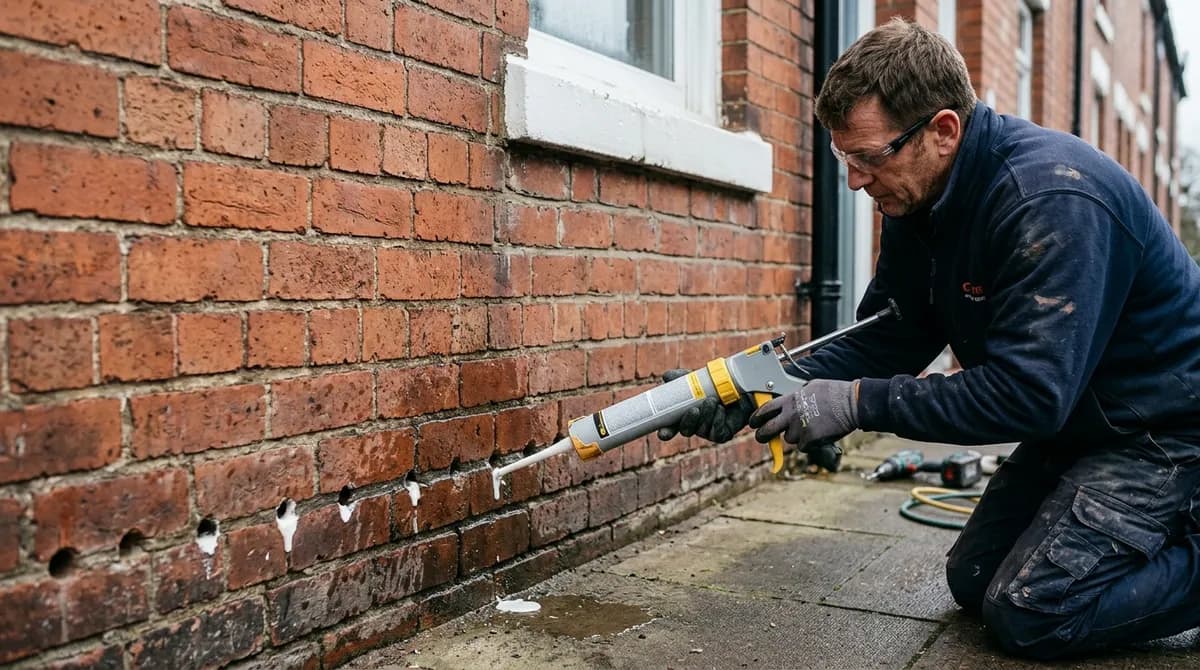
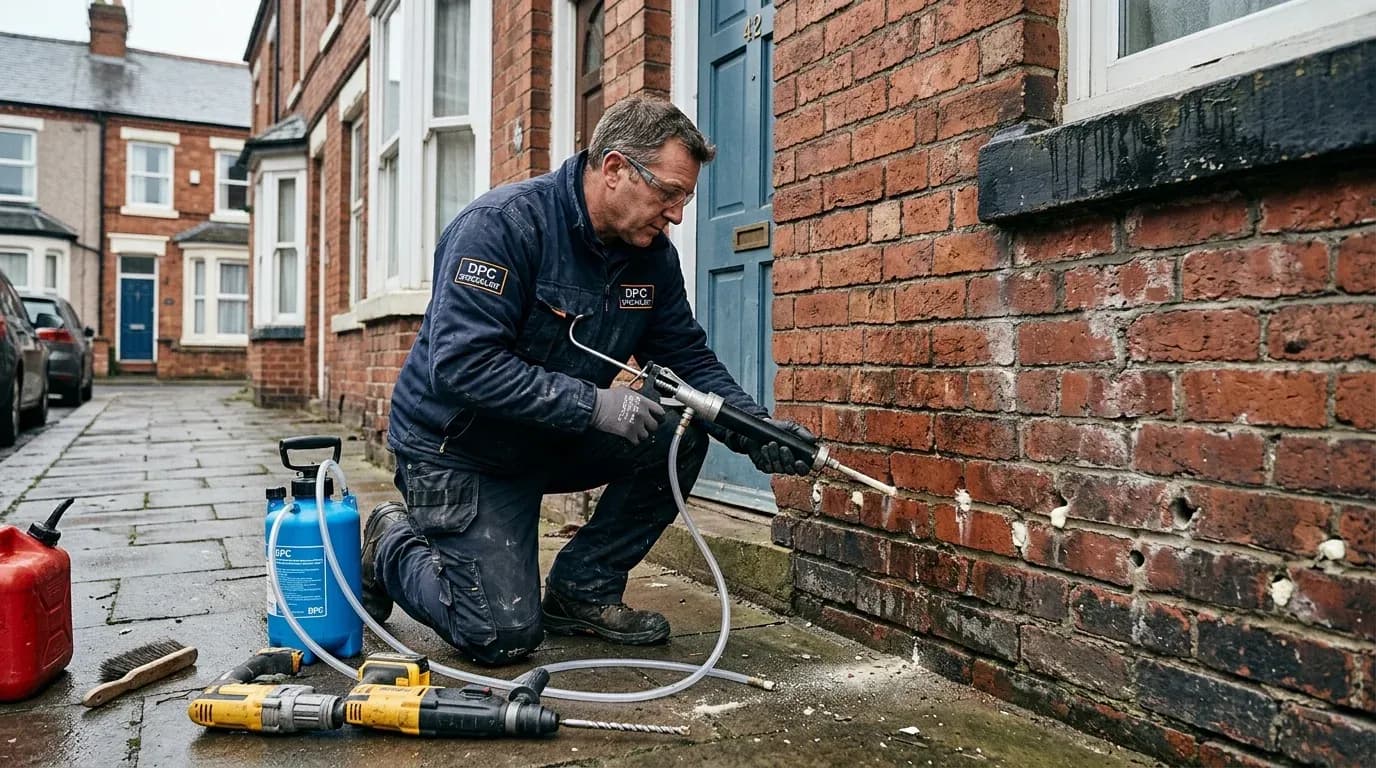
Holes are drilled at regular intervals (typically every 120mm) along the mortar course at DPC level - usually 150mm above external ground level. A silicone-based cream or resin is injected under pressure into each hole, forming a continuous chemical barrier.
- 4
Replastering
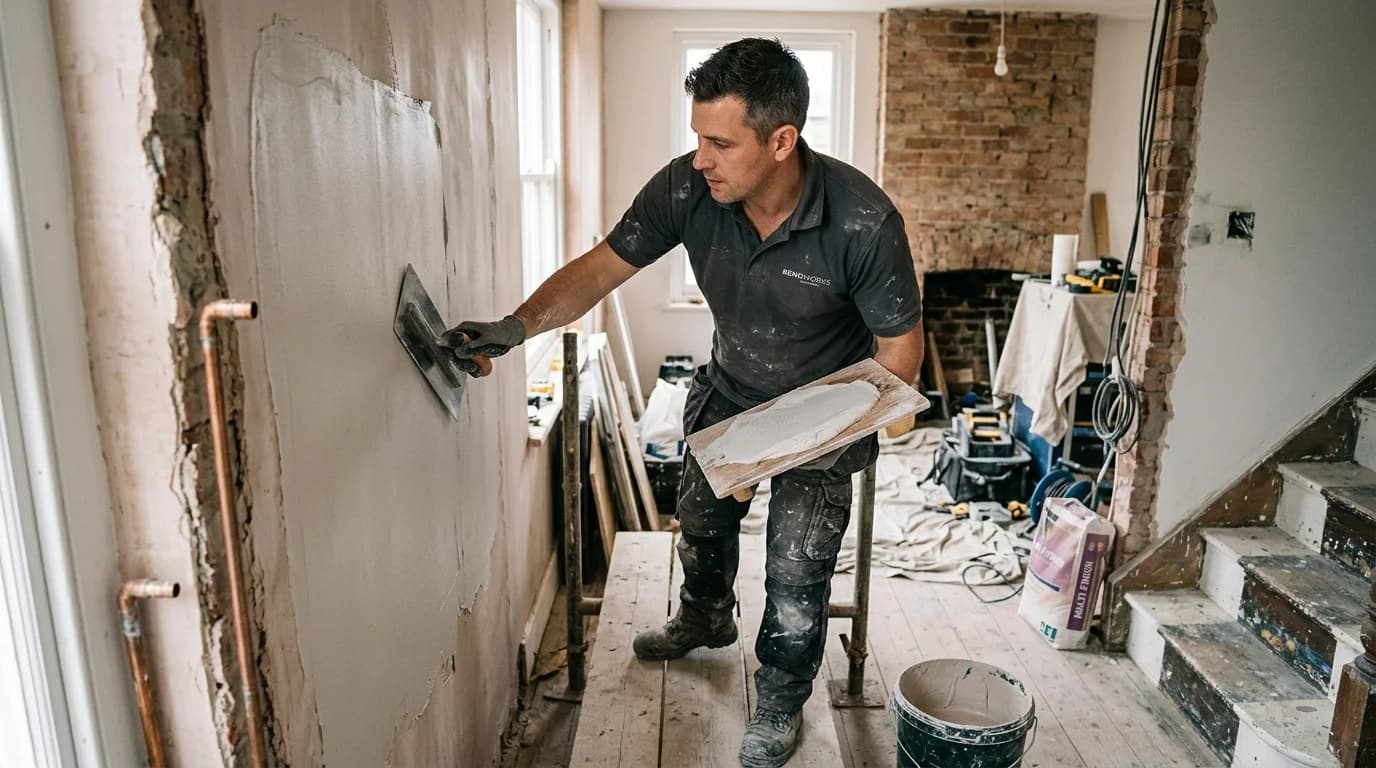
A salt-resistant render is applied in two coats - a sand and cement scratch coat followed by a finishing coat. This is essential because the old plaster is saturated with hygroscopic salts that would continue attracting moisture even after the DPC is working.
- 5
Drying out
The walls need 4 to 6 weeks to dry out fully before redecorating. Good ventilation helps - leave windows open when practical and do not push furniture against treated walls during this period. The company will issue a guarantee certificate, typically for 20 to 30 years.
- 6
Redecoration
Once the walls are dry, new skirting boards can be fitted and the walls painted or papered. Use a breathable paint rather than vinyl emulsion - the wall needs to continue releasing residual moisture for a few months after treatment.
Frequently Asked Questions
How much does damp proofing cost in the UK?
Damp proofing in the UK typically costs between £350 and £5,000 depending on the type of treatment and the size of the property. A chemical DPC injection for a single wall costs £350 to £1,000. A full damp proof course for a three-bedroom semi-detached house runs £1,500 to £3,500. Basement tanking is the most expensive, ranging from £2,000 to £6,000 or more.
How much does a damp survey cost?
A professional damp survey typically costs £150 to £350 depending on the size of the property and the surveyor. Some damp proofing companies offer free surveys, but be cautious - they have an incentive to recommend treatment whether you need it or not. An independent surveyor with no connection to a treatment company will give you an unbiased assessment. PCA-qualified surveyors are the industry standard.
Is rising damp actually common?
Genuine rising damp is far less common than the damp proofing industry suggests. Research from several building scientists - including a well-known study by Jeff Howell - found that most cases diagnosed as rising damp are actually caused by condensation or penetrating damp. A damp meter reading alone is not enough to confirm rising damp. If a surveyor diagnoses rising damp in a matter of minutes using only a hand-held meter, consider getting a second opinion from an independent surveyor.
What is the difference between rising damp and penetrating damp?
Rising damp occurs when moisture from the ground travels upwards through walls by capillary action, typically affecting the lower metre or so of a wall. Penetrating damp comes from outside - rain getting through walls, leaking gutters, or defective pointing. Rising damp leaves a tide mark and causes salts to crystallise on the wall. Penetrating damp tends to create damp patches that get worse during wet weather. The treatment for each is completely different, so correct diagnosis matters.
Do I need to replaster after damp proofing?
Almost always, yes. Once a damp proof course is installed, the contaminated plaster below the treatment line needs to be removed and replaced with a salt-resistant render. This is because the old plaster is saturated with hygroscopic salts drawn up by the rising damp. If you leave the old plaster in place, those salts will continue to attract moisture from the air, making the walls look damp even though the DPC is working. Replastering after damp treatment typically adds £40 to £60 per square metre.
How long does a damp proof course last?
A chemical DPC injection typically comes with a guarantee of 20 to 30 years, and many last considerably longer. The original physical DPC in most houses (a layer of slate or engineering brick) was designed to last the lifetime of the building. Modern chemical treatments use silicone-based creams or resins that are very durable. Most reputable companies offer a transferable guarantee backed by insurance.
Can I do damp proofing myself?
DIY damp proofing is possible for straightforward DPC injection on a single wall - kits cost £30 to £80 and the process involves drilling holes along the mortar course and injecting a silicone cream. However, the diagnosis is the hard part. If you misidentify condensation as rising damp, you will spend money on a DPC that was never needed. For anything beyond a small area, or for basement tanking, professional installation is strongly recommended. PCA member companies will guarantee their work.
Will damp proofing add value to my house?
Damp proofing does not add value in the same way a new kitchen or extension does, but it prevents a significant reduction in value. A damp problem flagged on a homebuyer's survey can knock thousands off a sale price or cause a buyer to walk away entirely. A transferable guarantee from a PCA member company reassures buyers and their solicitors. If you are selling a property with a known damp issue, getting it treated before listing is almost always worth it.
How long does damp proofing take?
A chemical DPC injection for a single wall takes half a day to a full day. A full house treatment for a three-bedroom property typically takes 2 to 3 days for the injection work, plus another 3 to 5 days for replastering. The walls then need 4 to 6 weeks to dry out fully before redecorating. Basement tanking is more involved and can take 3 to 7 days depending on the size and access.
Free, with no obligation to book.

Written by Chris Kervin, Co-Founder of Less.co.uk
Last updated: · Pricing based on published trade rates and UK market data · Methodology