Staircase Renovation: Your Complete Guide
A tired staircase drags down the whole feel of a house. Whether you are refurbishing what you have, fitting a new one, or adding stairs to a loft conversion, this guide covers every option - from a quick cosmetic refresh to a full custom build - along with the Building Regulations you need to get right.
Types of staircase project
Refurbish existing staircase
Sand and stain the treads, replace the spindles and newel posts, fit a new handrail, and paint the risers. The cheapest option if the underlying structure is sound. Transforms the look without the disruption of a full replacement.
Like-for-like replacement (softwood)
Ripping out the old staircase and fitting a new one in the same position using softwood (pine). The standard choice for most homes, especially if you plan to carpet the stairs. Straightforward for an experienced carpenter.
Custom new staircase
A bespoke staircase designed and built to fit your space exactly. Typically in hardwood (oak, ash, or beech) or a combination of timber and glass. Made to measure, so expect 4 to 8 weeks of lead time before installation.
Loft conversion staircase
Adding a new staircase to access a converted loft. Building Regs dictate the position, rise, going, and headroom, which can be tricky in older properties. Space-saver or paddle staircases are an option where floor space is tight, though a standard staircase is always preferable if you can fit one.
Staircase materials
Softwood (pine)
£The most affordable option. Ideal if you are carpeting the stairs or painting them. Pine is light, easy to work with, and widely available. It dents more easily than hardwood, but that matters less under carpet.
Hardwood - Oak
£££The most popular hardwood choice for a natural finish. Oak is hard-wearing, develops a warm character over time, and suits both traditional and contemporary homes. Costs roughly double softwood but lasts decades.
Hardwood - Ash
££Lighter in colour than oak with a smoother grain. Ash is tough and shock-resistant, making it a good choice for high-traffic stairs. Slightly cheaper than oak in most cases.
Glass panels
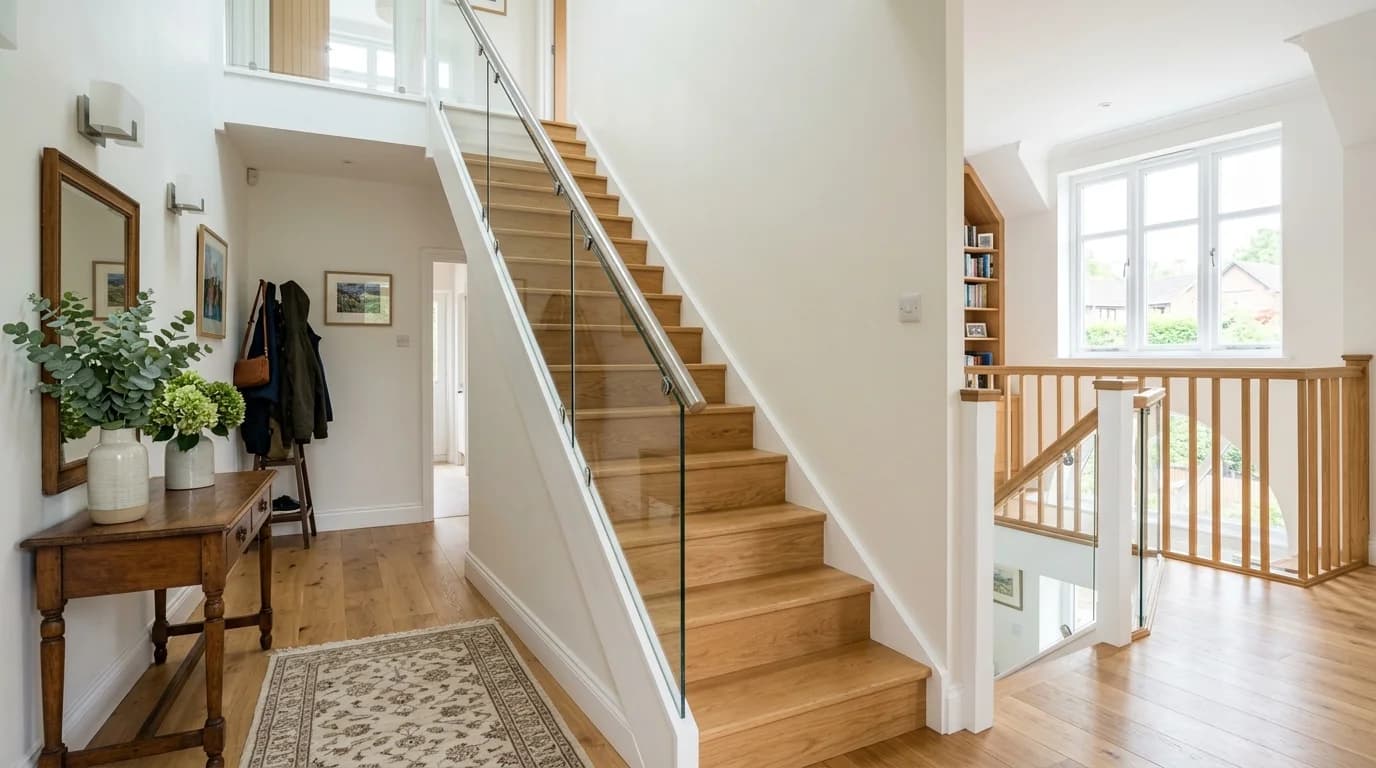
££££Toughened safety glass used for balustrading instead of traditional spindles. Lets light flow through the staircase area, making narrow hallways feel more open. Must comply with Building Regs and be fitted by someone who knows what they are doing.
Metal (steel or wrought iron)
£££Used for spiral staircases, industrial-style open treads, or as baluster infill. Steel staircases suit contemporary interiors. Wrought iron works in period properties. Usually made to measure.
Composite and engineered
££Engineered wood treads or composite materials offer the look of solid timber at a lower cost. They are more dimensionally stable than solid wood, meaning less risk of warping or shrinking, though they cannot be sanded down as many times.
Building Regulations (Part K)
Any new or replacement staircase in England and Wales must meet Building Regulations Approved Document K. Scotland and Northern Ireland have their own equivalent standards but the numbers are similar. Here are the key requirements for domestic stairs:
Source: Building Regulations Approved Document K (England & Wales). Always check the latest version and notify your local Building Control before work starts. A competent carpenter will design the staircase to comply, but you are ultimately responsible for ensuring compliance.
Staircase guides
Staircase cost guide
Prices for refurbishment, replacement, custom builds, and loft conversion stairs in 2026.
New staircase cost
Softwood, hardwood, glass balustrade, and spiral staircase replacement prices.
Loft conversion guide
Full guide to loft conversions including staircase placement and planning.
Extension guide
How extensions affect your staircase and layout options.
All home improvement costs
Browse cost guides for all home improvement topics.
Common questions
Do I need Building Regulations approval to replace a staircase?
Yes. Any new or replacement staircase must comply with Building Regulations Part K. The key numbers: minimum 220mm going, maximum 220mm rise, handrail on at least one side, guarding at least 900mm on the stair and 1,100mm on landings, and gaps between balusters no wider than 100mm. You must notify Building Control.
How long does it take to replace a staircase?
A like-for-like softwood replacement takes 2 to 3 days. A custom hardwood or glass staircase takes 3 to 5 days on site, though it may need 4 to 8 weeks of lead time for manufacturing. Add a day each for plastering and decoration.
Can I refurbish my existing staircase instead of replacing it?
If the strings, treads, and frame are solid, absolutely. Sanding and staining treads, replacing spindles and newel posts, and painting risers can completely transform a staircase for £500 to £1,500 - a fraction of the cost of a full replacement.
What is the best material for a new staircase?
Softwood if you are carpeting or painting. Hardwood (oak or ash) for a natural finish that will last decades. Glass panels if you want a contemporary look and are happy to spend more. The right answer depends on your budget and how the staircase fits the style of your home.
Getting the best deal on a new staircase
Get at least three written quotes
Staircase prices vary considerably between carpenters and joinery companies. The same job, a like-for-like softwood replacement, for example, can differ by hundreds of pounds depending on who you ask. Always get at least three written quotes and check that each one specifies the timber type, baluster style, handrail finish, and whether making good (plastering and decoration) is included. Comparing like for like is the only way to tell whether a quote is good value or just cheap on paper.