Solar Panel Battery Storage Cost UK 2026
Solar battery storage costs £2,500 to £12,000 depending on the capacity you need. A mid-range 5 to 10 kWh system, the most popular choice for a typical 3-bed house, costs £4,000 to £7,000 installed. Adding a battery increases the proportion of solar energy you use yourself from roughly 40% to 80%.
£5,500
Mid-range battery
£200-£350
Extra annual saving
8-15 yrs
Payback period
10-15 yrs
Battery lifespan
Prices updated April 2026 · Based on industry data and contractor submissions.
Quick answer
How much does solar battery storage cost?
A solar battery costs £2,500 to £4,000 for a small 3 to 5 kWh unit, £4,000 to £7,000 for a mid-range 5 to 10 kWh system, and £7,000 to £12,000 for a large 10 to 15 kWh setup. The Tesla Powerwall 3, the most well-known option, costs £8,500 to £12,000 installed. Prices include the battery, inverter (or adapter), and installation by an MCS-certified installer.
Solar Battery Prices by Capacity
Installed prices including VAT (0% for residential solar battery systems in 2026).
Small (3-5 kWh)
Flats, low usage, budget option
£3,200
£2,500 to £4,000
Medium (5-10 kWh)
Average 3-bed house, most popular
£5,500
£4,000 to £7,000
Large (10-15 kWh)
Large homes, EVs, heat pumps
£9,500
£7,000 to £12,000
Prices include installation, commissioning, and DNO notification. 0% VAT applies to residential solar battery installations.
Solar Battery Brands Compared
The most popular solar batteries available in the UK, with prices, capacities, and honest pros and cons.
Tesla Powerwall 3
£8,500 to £12,000Capacity
13.5 kWh
Warranty
10 years
GivEnergy 5.2
£3,000 to £4,500Capacity
5.2 kWh
Warranty
10 years
GivEnergy 9.5
£4,500 to £6,500Capacity
9.5 kWh
Warranty
10 years
Huawei LUNA2000
£3,500 to £8,000Capacity
5-15 kWh
Warranty
10 years
Fox ESS ECS
£2,500 to £6,000Capacity
2.56-10.24 kWh
Warranty
10 years
SolaX T-BAT
£3,500 to £5,000Capacity
5.8 kWh
Warranty
10 years
Battery Payback Period: Is It Worth It?
The basic maths
Without a battery, you use about 40 to 50% of your solar electricity and export the rest at around 15p/kWh. With a battery, you use 70 to 80% yourself, avoiding buying electricity at 24.5p/kWh. The difference, roughly 9.5p per kWh shifted from export to self-consumption, is your saving. For a 4 kW system, that works out at roughly £200 to £350 extra per year.
Standard tariff payback
At £200 to £350 in annual savings, a £5,500 mid-range battery takes 16 to 27 years to pay back on a standard flat-rate tariff. That is longer than most battery warranties. On pure financial terms with a standard tariff, a battery is hard to justify.
Time-of-use tariff payback (the game changer)
On a tariff like Octopus Go (7.5p/kWh overnight, 24.5p/kWh daytime), you charge the battery cheaply overnight and discharge during the day. Combined with solar charging, total annual savings jump to £500 to £800, bringing payback down to 7 to 11 years. This is where batteries start to make proper financial sense.
Energy security value
Numbers aside, a battery gives you backup power during grid outages (if it has this feature, not all do) and protection against future electricity price rises. If energy prices increase, your payback period shortens. Many homeowners value the peace of mind of being less dependent on the grid, even if the pure financial case is marginal.
Hybrid Inverters: What You Need to Know
A hybrid inverter handles both your solar panels and battery in one unit. If you are installing solar panels and a battery at the same time, a hybrid inverter is the most efficient and cost-effective option.
New installation
Choose a hybrid inverter from the start. It manages solar generation, battery charging, grid export, and household supply through a single unit. More efficient and cheaper than having separate components.
Retrofitting to existing solar
You have two options: replace your existing inverter with a hybrid (£500 to £1,000 extra) or add an AC-coupled battery like the Tesla Powerwall that works alongside your current inverter. AC-coupling is simpler but slightly less efficient.
Additional Costs to Budget For
| Extra Item | Typical Cost |
|---|---|
| Hybrid inverter (if replacing existing) | £500 to £1,000 |
| AC-coupled battery adapter | £200 to £500 |
| Electrical panel upgrade | £300 to £600 |
| G99 application (systems over 3.68 kW) | £0 to £300 |
| Smart meter installation | Free |
Solar Battery Costs by Region
Average installed cost for a mid-range 5 to 10 kWh battery system, by UK region.
| Region | Typical Cost | vs National |
|---|---|---|
| London | £6,500 | +18% |
| South East | £5,900 | +7% |
| East of England | £5,700 | +4% |
| South West | £5,500 | Average |
| Midlands | £5,300 | -4% |
| Yorkshire | £5,100 | -7% |
| North West | £5,200 | -5% |
| North East | £4,900 | -11% |
| Scotland | £5,100 | -7% |
| Wales | £5,000 | -9% |
Regional variation driven mainly by labour costs and installer availability. Battery hardware prices are similar nationwide.
How to Get Your Solar Battery for Less
Practical ways to reduce the cost or improve the return on your battery investment.
Install the battery at the same time as solar panels
Getting a battery fitted alongside your solar panel installation saves £500-£1,000 compared to retrofitting later. The installer is already on site, scaffolding is already up, and you avoid paying for a second hybrid inverter or AC-coupling equipment. Most MCS installers offer a package deal that works out cheaper than buying separately.
Use a time-of-use tariff to maximise savings
Tariffs like Octopus Go or Intelligent Octopus charge as little as 7.5p/kWh overnight (compared to 24.5p/kWh during the day). Set your battery to charge from the grid overnight at the cheap rate, then discharge during expensive peak hours. This alone can save an extra £200-£400 per year on top of your solar savings, dramatically improving the battery payback period.
Get three quotes and compare total system costs
Battery prices vary significantly between installers. Some mark up the hardware heavily; others make their money on the installation labour. Always compare at least three quotes and check exactly what is included - inverter, installation, commissioning, DNO notification, and warranty registration. The cheapest quote is not always the best, but overpaying by £1,000+ is easy to avoid.
Right-size your battery for your actual usage
A bigger battery is not always better value. If you have a 4 kWh system and use most of your electricity during the evening, a 5 kWh battery captures nearly all your excess generation. Jumping to a 10 kWh battery doubles the cost but barely increases the savings because there is not enough excess solar to fill it. Check your smart meter data to understand your actual evening and overnight consumption before choosing a size.
Check VAT status - batteries with solar panels are 0% VAT
Solar batteries installed alongside solar panels on residential properties currently benefit from 0% VAT (reduced from the standard 20%). This applies to the battery, inverter, and installation labour. If you are adding a battery to an existing solar system, the 0% VAT rate still applies as long as the battery is for a residential property. This saves you £500-£2,000 depending on the system size.
Useful resources
- MCS, Certified installers for solar and battery storage systems
- Energy Saving Trust, Independent guide to solar panels and battery storage
- Ofgem, Smart Export Guarantee, sell excess energy back to the grid
What to Expect: The Battery Storage Installation Process
A battery storage installation typically takes a single day for a straightforward retrofit. Here's what the process involves.
- 1
Site survey and system design
An MCS-certified installer surveys your existing solar panel system (or designs a combined solar-plus-battery system), checks your consumer unit capacity, and recommends a battery size based on your energy usage and export patterns.
- 2
Choose the battery and inverter setup
You select a battery system, AC-coupled (works with any existing inverter) or DC-coupled (connects directly to the solar panels via a hybrid inverter). The installer confirms compatibility with your existing kit and any Smart Export Guarantee tariff.
- 3
Install the battery unit
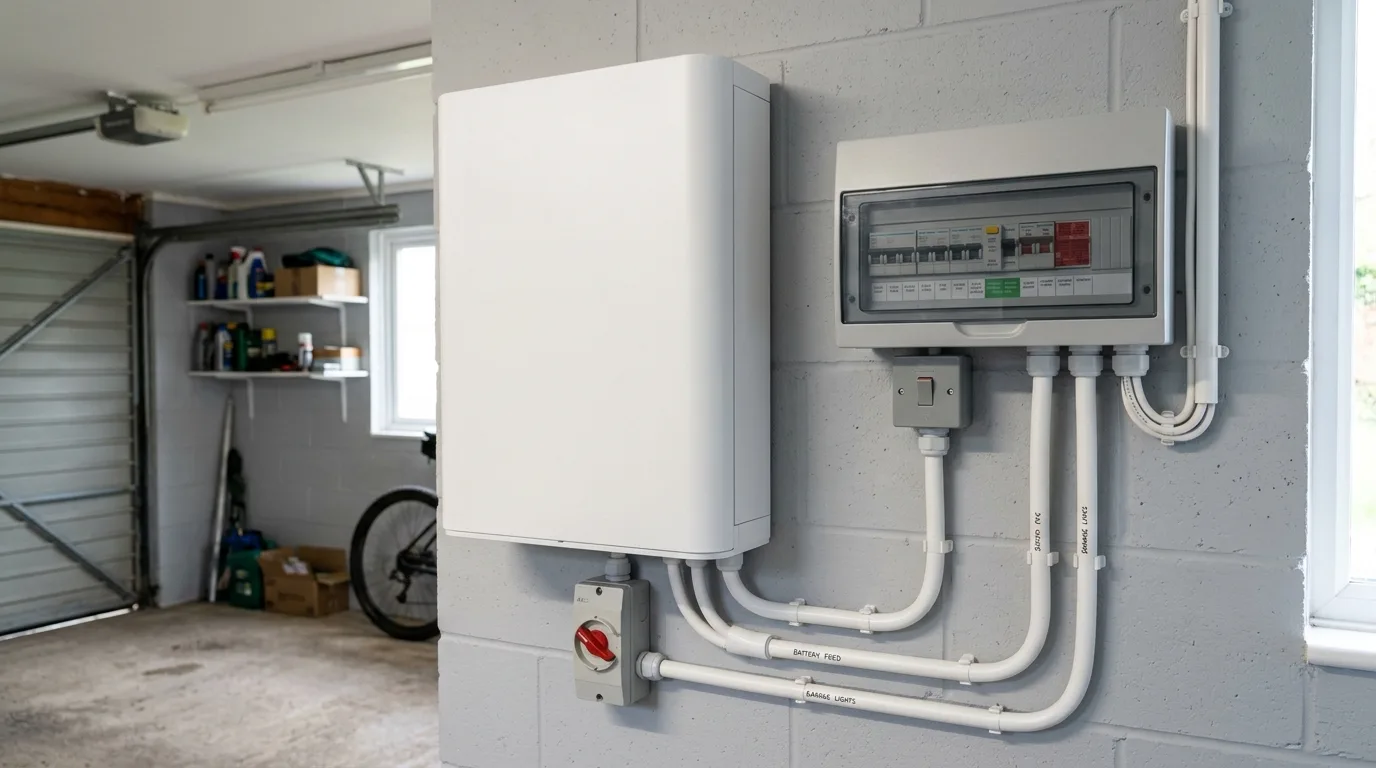
The battery is wall-mounted or floor-standing, typically in a garage, utility room, or cupboard. It needs a dry, ventilated space with a stable temperature. Most domestic batteries weigh 50 to 120kg, so wall fixings must be into solid masonry.
- 4
Connect to the inverter and consumer unit
The battery is wired into the solar inverter (or hybrid inverter) and connected to the household consumer unit. A generation meter and export meter may need updating to work with the new setup.
- 5
Commission and register the system
The installer commissions the system, configures charging schedules and export settings, and registers the installation with MCS. This registration is required to claim the Smart Export Guarantee and may be needed for warranty purposes.
- 6
Handover and monitoring setup
You receive a full handover covering how to monitor the battery via the manufacturer's app, how to adjust charging schedules, and what the warranty covers. Most systems are monitored remotely by the installer for the first year.
Frequently Asked Questions
How much does a solar battery cost in the UK?
A solar battery costs between £2,500 and £12,000 in the UK in 2026, depending on the capacity. A small 3-5 kWh battery costs £2,500-£4,000, a medium 5-10 kWh battery costs £4,000-£7,000, and a large 10-15 kWh battery costs £7,000-£12,000. Installation is typically included in these prices.
Is a solar battery worth the investment?
The financial payback on a solar battery is typically 8-15 years, which is tight given most batteries have a 10-year warranty. However, a battery increases the proportion of solar electricity you use yourself from around 40-50% to 70-80%, saving you more per year. Batteries make much more sense if you are on a time-of-use tariff where you can charge cheaply overnight and discharge during expensive peak hours.
How long does a solar battery last?
Most solar batteries are warrantied for 10 years or a set number of charge cycles (typically 6,000-10,000 cycles). In practice, lithium-ion batteries degrade gradually and most retain 70-80% of their original capacity after 10 years. With careful use, many last 12-15 years before needing replacement.
Can I add a battery to existing solar panels?
Yes, you can retrofit a battery to an existing solar panel system. You will need a hybrid inverter or an AC-coupled battery system. AC-coupled batteries (like the Tesla Powerwall) work with any existing inverter and are the most common retrofit option. A hybrid inverter replacement adds £500-£1,000 to the cost but is more efficient for new installations.
What size solar battery do I need?
For a typical 3-bed house with a 4kW solar panel system, a 5-10 kWh battery is usually right. This stores enough electricity to cover evening and overnight usage. A 3-5 kWh battery works for smaller households or flats with lower consumption. Larger 10-15 kWh batteries suit bigger homes, those with electric vehicles, or properties with heat pumps.

Written by Chris Kervin, Co-Founder, Less.co.uk
Last updated: · Pricing based on installer quotes and manufacturer data · Methodology
Ready to add battery storage for less?
Compare free quotes from MCS-certified solar battery installers near you. No obligation, no hassle.
Get Free QuotesFree, no obligation · MCS-certified installers · 0% VAT on residential batteries
More home improvement costs
Compare real quotes for your job
Prices move a lot with your postcode, the access on site and the spec you choose. Get up to 3 free quotes from vetted local tradespeople and see what yours actually comes to, with no obligation to book.