How Much Does a Home EV Charger Cost to Install in 2026?
A home EV charger costs between £800 and £1,500 fully installed. The charger unit itself costs £300 to £800; installation adds £300 to £700 depending on complexity.
£800 to £1,500
Typical total
£300 to £800
Unit cost
£300 to £700
Installation
Up to £500/socket
EV chargepoint grant
Prices updated April 2026 · Based on industry data and contractor submissions.
Part P notifiable work. Installing an EV charger is notifiable under Part P of the Building Regulations. It must be carried out by a Part P registered electrician or an installer approved by a competent person scheme (NAPIT, NICEIC, or similar). Always verify credentials before work begins.
EV Charger Prices by Type
Prices vary mainly by charger type and the features you choose. Installation cost depends on your property and how much electrical work is needed.
7kW untethered (e.g. Ohme Home Pro)
- Unit cost
- £300 to £500
- Installation
- £300 to £500
- Total
- £600 to £1,000
7kW tethered (e.g. Pod Point Solo 3)
- Unit cost
- £400 to £600
- Installation
- £300 to £500
- Total
- £700 to £1,100
7kW smart charger (e.g. Zappi)
- Unit cost
- £600 to £800
- Installation
- £300 to £500
- Total
- £900 to £1,300
22kW three-phase
- Unit cost
- £800 to £1,200
- Installation
- £500 to £700
- Total
- £1,300 to £1,900
| Charger Type | Unit Cost | Installation | Total |
|---|---|---|---|
| 7kW untethered (e.g. Ohme Home Pro) | £300 to £500 | £300 to £500 | £600 to £1,000 |
| 7kW tethered (e.g. Pod Point Solo 3) | £400 to £600 | £300 to £500 | £700 to £1,100 |
| 7kW smart charger (e.g. Zappi) | £600 to £800 | £300 to £500 | £900 to £1,300 |
| 22kW three-phase | £800 to £1,200 | £500 to £700 | £1,300 to £1,900 |
Prices include supply and installation. Additional costs may apply for consumer unit upgrades, earthing work, or long cable runs.
What Affects EV Charger Installation Cost?
Two identical chargers can cost very different amounts to install depending on your property. Here is what drives the price up.
Distance from consumer unit to charging point
The further the cable run, the more it costs. A charger mounted on a garage wall directly behind the consumer unit might only need a few metres of cable. Running it across the house and through an exterior wall to a driveway 15 metres away adds significantly to labour and materials. Every extra metre of armoured cable adds roughly £5 to £10.
Whether a new circuit is needed
An EV charger needs its own dedicated circuit from the consumer unit. If your board is full, the electrician may need to add extra ways or upgrade the unit entirely - which can add £200 to £500 to the job.
Earthing and bonding upgrades
Older properties often have outdated earthing systems (TT or TN-C-S that does not meet current standards). Your electrician will test this and may need to upgrade it to comply with BS 7671 wiring regulations. Budget an extra £100 to £300 if this comes up.
Three-phase supply
Most UK homes have a single-phase supply, which supports chargers up to 7kW. If you want a faster 22kW charger, you need three-phase power. Getting a three-phase supply installed by your DNO (distribution network operator) can cost £1,000 to £3,000+ on top of the charger itself - and it is only worth it if you genuinely need faster charging.
The OZEV EV Chargepoint Grant
The government’s EV chargepoint grant (formerly the EVHS grant) provides up to £500 per socket towards the cost of installing a home charger, raised from £350 in April 2026. There is a catch: homeowners with their own off-street parking are not eligible. The grant runs until 31 March 2027.
You can still claim if you are a:
- Tenant renting from a private landlord
- Resident of a flat (owner or tenant)
- Tenant in social housing or housing association property
- Household with only on-street parking (added when the scheme was widened)
- Landlord installing chargers for tenants (up to £500 per socket, max 200 sockets)
Your installer needs to be OZEV-approved to apply. They handle the paperwork and deduct the grant from your invoice - you do not need to claim it separately. Check the gov.uk OZEV grants page for the latest eligibility criteria.
7kW vs 22kW: Which Charger Do You Actually Need?
Most UK homes have a single-phase electricity supply, which limits you to a maximum of 7kW charging. This is not a problem - it is plenty for the vast majority of drivers.
7kW (single-phase)
- Adds roughly 30 miles of range per hour
- Full charge overnight (6 to 8 hours)
- Works with every UK home’s electricity supply
- More than enough for daily commuting
- Most charger models and tariffs are designed around 7kW
22kW (three-phase)
- Adds roughly 90 miles of range per hour
- Full charge in 2 to 3 hours
- Requires three-phase power supply (most homes do not have this)
- Your EV must also support 22kW AC charging (many do not)
- Getting three-phase installed costs £1,000 to £3,000+
The average UK driver covers about 20 miles a day. A 7kW charger replenishes that in well under an hour. Unless you are regularly draining a large battery and need a quick turnaround, 7kW is the sensible choice - and far cheaper to install.
Tethered vs Untethered Chargers
This is one of the first choices you will make, and it boils down to convenience versus flexibility.
Tethered
Cable is permanently attached to the charger - just grab it and plug in.
- + Grab and go - no faffing with cables
- + Cable is always there, always ready
- - If the cable gets damaged, the whole unit may need replacing
- - Less flexible if your next car has a different connector
Untethered
Just a socket on the wall - you supply your own cable.
- + Works with any cable or connector type
- + Good if you have two EVs with different plugs
- + Neater look when not in use
- - You need to get the cable out and put it away each time
Most people choose tethered for the convenience. If you only have one EV and park in the same spot each time, tethered makes life easier. Go untethered if you share the charger between vehicles or want to keep your cable in the boot for public charging too.
Can You Charge From a Normal 3-Pin Plug?
Yes. Most EVs come with a “granny cable” - a portable charger that plugs into a standard 13-amp socket. It works, but it is a stop-gap rather than a long-term solution.
| 3-pin plug (2.3kW) | Dedicated charger (7kW) | |
|---|---|---|
| Full charge time (60kWh battery) | 8 to 12 hours | 4 to 5 hours |
| Range added per hour | ~8 miles | ~30 miles |
| Smart scheduling | No | Yes |
| Off-peak tariff support | Manual only | Automatic |
| Safety features | Basic (relies on domestic circuit) | Built-in RCD, load management |
A 3-pin plug puts a sustained 2.3kW load on a domestic socket for hours on end - something the circuit was never designed for. It works, and plenty of people do it, but a dedicated charger is safer, faster, and cheaper to run if you switch to an off-peak EV tariff.
Smart Charging Features Worth Having
All new home chargers sold in the UK must be “smart” by law (since June 2022). But some are smarter than others. Here are the features that actually save you money.
Off-peak tariff scheduling
The biggest money saver. Smart chargers let you set charging windows to match cheap-rate electricity - typically midnight to 5:30am on tariffs like Octopus Go. Some chargers (like the Ohme) integrate directly with your energy provider and adjust automatically.
Solar diversion
If you have solar panels, chargers like the Zappi can use excess solar generation to charge your car for free. The charger monitors your solar output in real time and diverts surplus energy to the car instead of exporting it to the grid.
Load balancing
Prevents your home from drawing more power than your supply can handle. The charger monitors your total household load and reduces the charging rate if you turn on the oven, kettle, or shower. Essential if your main fuse is 60A or 80A rather than 100A.
App control and monitoring
See how much energy you have used, what it cost, and your charging history. Handy for tracking costs and useful if you need to claim business mileage.
Do You Need Planning Permission?
For most homes, no. A wall-mounted EV charger on your house or garage counts as permitted development, so you can install one without applying for planning permission.
You may need permission if:
- Your property is a listed building
- You live in a conservation area
- You want a free-standing charging post visible from a highway
- Your property is in a World Heritage Site, National Park, or Area of Outstanding Natural Beauty
If in doubt, a quick call to your local planning department will confirm whether you need to apply. Most domestic installations sail through without any issues.
How to Get Your EV Charger for Less
The charger itself is only part of the cost. Here is how to bring the total down.
Switch to an off-peak EV tariff
Tariffs like Octopus Go and Intelligent Octopus Go offer electricity at 7.5p/kWh between midnight and 5:30am (compared to 24p+ during the day). A smart charger can schedule your charging automatically. Over a year, this saves the average EV driver £400 to £600 on electricity - the charger pays for itself within a year or two.
Check if you qualify for the EV chargepoint grant
If you rent your home or you own and live in a flat, you can get 75% of the cost, up to £500 per socket, off the installation through the EV chargepoint grant, provided you have private off-street or allocated parking. Your installer handles the application, so it is straightforward. Just make sure they are OZEV-approved. The scheme runs until 31 March 2027.
Get at least three quotes
Prices vary significantly between installers. Some bundle the charger unit into the quote; others charge separately for unit and labour. Get written quotes from at least three OZEV-approved, Part P registered installers. Compare like for like - make sure each quote includes the same charger model, cable routing, and any electrical upgrades.
Pick the right charger for your needs
A basic 7kW untethered charger from a brand like Ohme starts around £300 and does everything most people need - including smart scheduling and app control. Paying £800 for a top-end model only makes sense if you need specific features like solar diversion or vehicle-to-grid capability. Do not overspend on features you will not use.
What to Expect: The EV Charger Installation Process
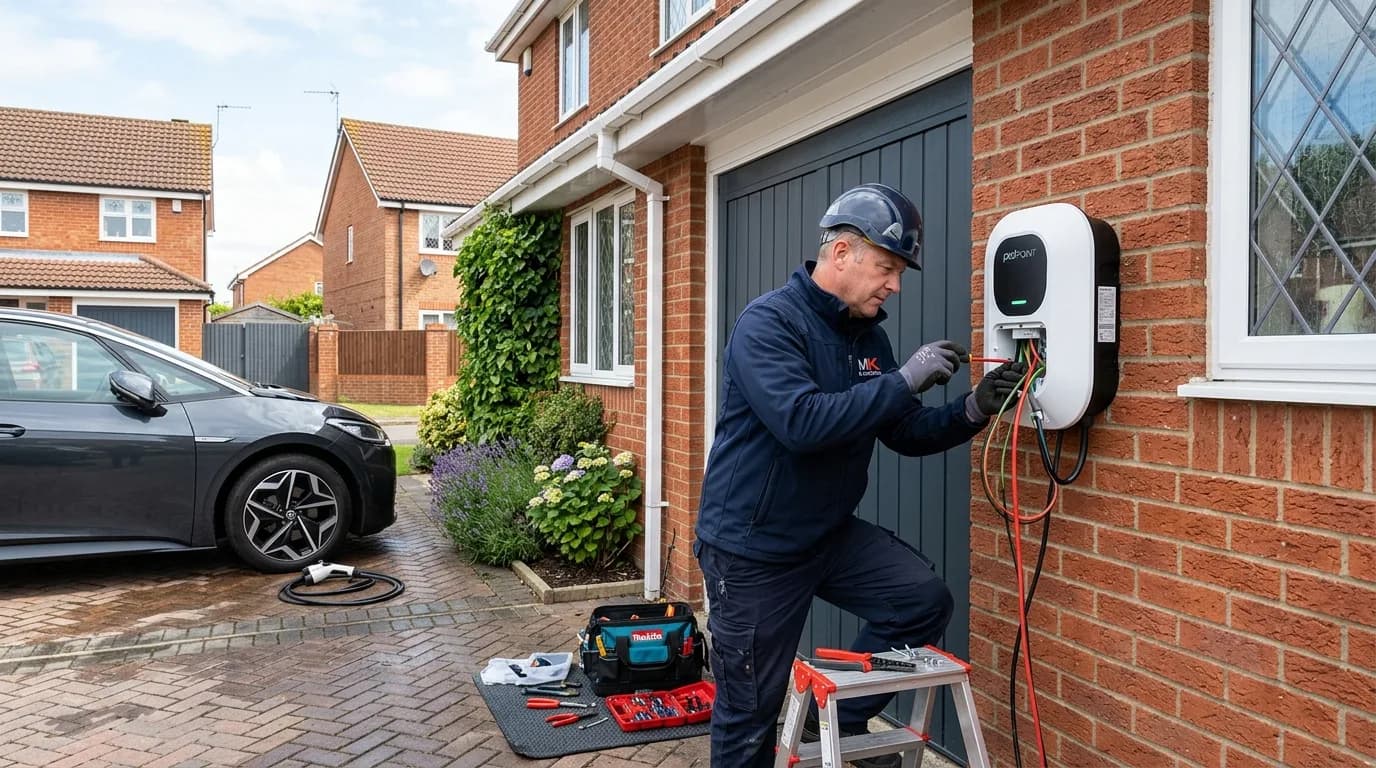
A home EV charger installation typically takes half a day. The installer must be OZEV-approved if you're claiming a grant, and all work must comply with Part P Building Regulations.
- 1
Site survey and electrical assessment
An OZEV-approved installer surveys your property, checks the consumer unit capacity and earthing arrangements (TT or TNS), and confirms where the charger will be mounted relative to your parking space.
- 2
Consumer unit upgrade if needed
If the existing consumer unit cannot support the additional load (a 7kW charger draws 32A), it may need upgrading. A dedicated circuit with its own MCB or RCBO is installed.
- 3
Cable routing
An SWA (steel wire armoured) cable is run from the consumer unit to the charger location, typically through the loft, along external walls, or buried underground. Longer cable runs add to the cost.
- 4
Charger mounting and connection
The charge point is wall-mounted at a convenient height and wired in. Most domestic installations use a 7kW single-phase unit, which will fully charge a typical EV in 6-8 hours overnight.
- 5
Testing and commissioning
The installer tests the circuit, configures the charger (Wi-Fi connection, smart scheduling, and tariff settings), and issues an Electrical Installation Certificate as required by Part P Building Regulations.
Frequently Asked Questions
How much does it cost to install an EV charger at home?
A home EV charger costs £800 to £1,500 fully installed. The charger unit itself runs from £300 to £800 depending on the brand and features, and installation adds £300 to £700 depending on how far the charger is from your consumer unit and whether any electrical upgrades are needed.
Can I get a grant for an EV charger?
The EV chargepoint grant covers up to £500 per socket towards installation costs, raised from £350 in April 2026. It is available to people renting their home, those living in flats, landlords fitting chargers for tenants, and, since the scheme was widened, households that only have on-street parking. Homeowners with their own driveway are not eligible. The grant runs until 31 March 2027, and your installer can apply on your behalf if you qualify.
Do I need a special electrician to install an EV charger?
Yes. EV charger installation is notifiable electrical work under Part P of the Building Regulations. It must be carried out by a Part P registered electrician or an installer approved by a competent person scheme such as NAPIT or NICEIC. Using an unregistered installer means the work is not certified, which can cause problems if you sell your home or make an insurance claim.
Is a 7kW charger fast enough?
For the vast majority of UK homes, 7kW is more than adequate. A 7kW charger adds around 30 miles of range per hour, so an overnight charge of 6 to 8 hours gives you 180 to 240 miles - more than enough for most daily driving. The average UK driver covers about 20 miles a day, so even a couple of hours plugged in each evening keeps you topped up.
Can I charge my EV from a normal 3-pin plug?
Technically yes, and most EVs come with a granny cable for exactly this purpose. A standard 3-pin socket delivers about 2.3kW, which means 8 to 12 hours for a full charge depending on your battery size. It works in a pinch, but it is slow, has no smart features like off-peak scheduling, and puts sustained load on a circuit that was not designed for it. A dedicated charger is safer, faster, and cheaper to run long-term if you use an off-peak tariff.
Do I need planning permission for a home EV charger?
In most cases, no. Installing a wall-mounted EV charger on your house counts as permitted development. However, if your property is a listed building, in a conservation area, or if you want to install a free-standing charging post in front of your house facing a highway, you may need to apply for planning permission. Check with your local council if you are unsure.

Written by Chris Kervin, Co-Founder, Less.co.uk
Last updated: · Pricing based on industry data and verified contractor submissions · Methodology
Ready to get your home charger sorted for less?
Compare free quotes from Part P registered electricians near you. A home charger pays for itself within a year or two if you switch to an off-peak EV tariff.
Compare Free QuotesFree, no obligation · Part P registered · Local electricians only
More home improvement costs