Scaffolding Hire Prices: What to Expect in 2026
Scaffolding hire costs £100 to £350 per week for a basic tower or single elevation, rising to £500 to £900 per week for a full house wrap-around. The erection and dismantling fee is charged separately on top. Here is exactly what to expect, and how to keep the bill down.
£100/wk
Basic tower from
£200/wk
Semi-detached from
£500/wk
Detached from
£400
Erect & dismantle from
Prices updated April 2026 · Based on industry data and contractor submissions.
Scaffolding Hire Prices by Property Type
These figures show both the erection and dismantling cost (a one-off charge) and the ongoing weekly hire rate after the first week. Most quotes include the first week in the erection price, confirm this when you get quotes.
| Property / Scope | Erect + Dismantle | Weekly Hire |
|---|---|---|
Small terraced (front only) Single elevation, first week including erect + dismantle | £400 to £600 | £150 to £250/week |
Semi-detached (one elevation) Front or rear, two-storey | £500 to £800 | £200 to £350/week |
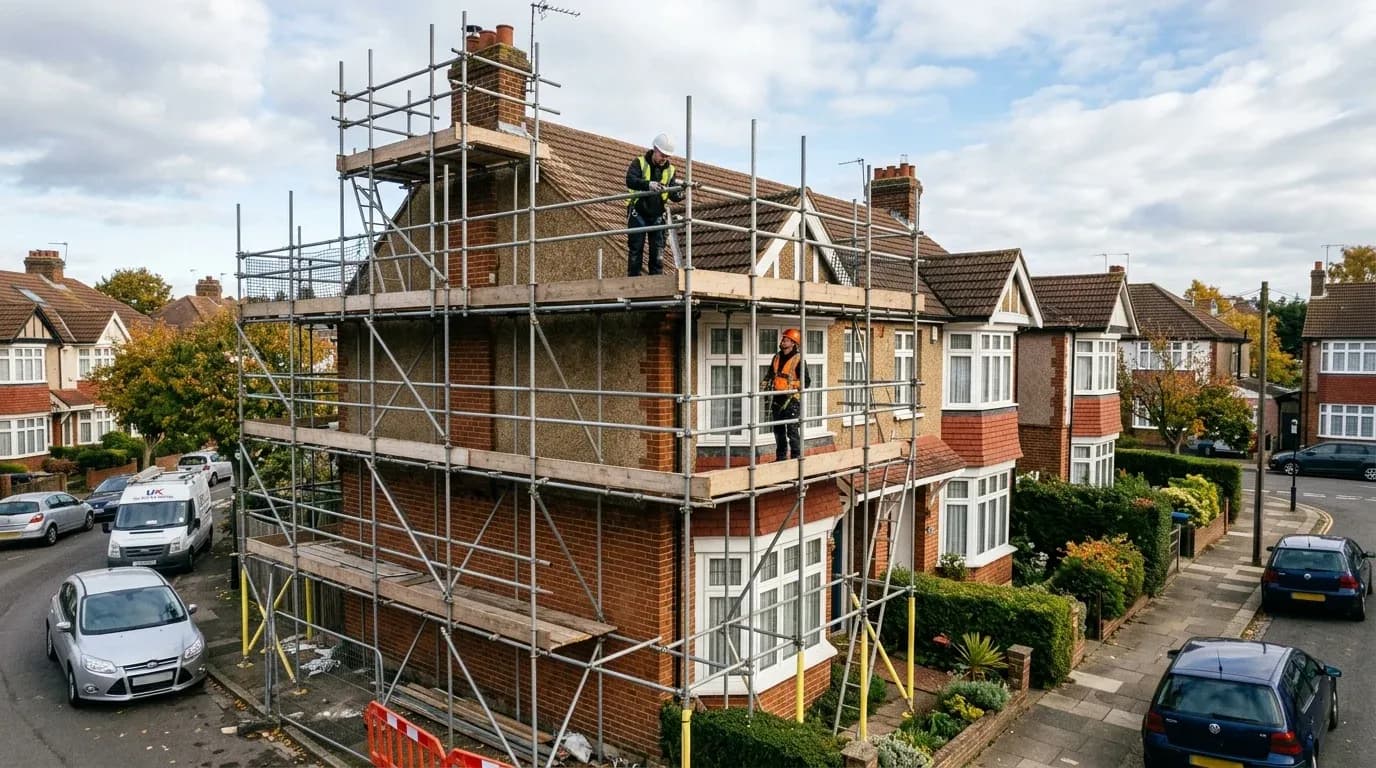
Semi-detached (full wrap) Front, rear, and side elevation | £900 to £1,500 | £350 to £600/week |
Detached (full wrap) All four sides, two-storey house | £1,200 to £2,500 | £500 to £900/week |
Chimney scaffold only Single access tower to chimney height | £300 to £500 | £100 to £200/week |
Prices include VAT. Weekly hire applies from week two onwards in most cases, confirm with your scaffolding company.
What Is Included in Scaffolding Hire?
Understanding what is, and isn't, included in a scaffolding quote can save you from a nasty surprise when the invoice arrives.
Usually included
- Erection by qualified scaffolders
- Weekly hire of all tubes, boards, and fittings
- Guard rails and toe-boards (safety requirement)
- Access ladders
- Dismantling at the end of the hire period
- Scaffold inspection certificate
Often charged as an extra
- Debris netting or containment sheeting
- Solid boarding out at specific levels
- Council pavement licence (£50 to £300)
- Scaffold alarm or security lighting
- Road closure / traffic management signs
- Additional weeks beyond the agreed hire period
Which Jobs Need Scaffolding?
Scaffolding is required any time tradespeople need to work safely at height on an external elevation. Here are the most common situations where you'll need to budget for it.
Roof replacement or repair
Near-universal requirement, roofers need safe access to the full pitch.
External rendering
Needed for all elevations above ground floor.
External painting
Required above fascia height for health and safety reasons.
Repointing and brickwork
Any pointing above first-floor window height needs scaffold access.
Window or door replacement
Upper floor windows usually require scaffolding unless a working platform is used.
Chimney repair or rebuild
A scaffold tower or chimney scaffold is standard practice.
Gutter and fascia replacement
Full house fascia work almost always needs scaffold for safe access.
Loft conversion dormer
The rear elevation and roof structure need scaffold for the build period.
How Long Will You Need the Scaffolding?
The hire duration drives the total cost. Knowing roughly how long each job takes helps you budget accurately and avoids being caught out by extra weekly charges.
| Job Type | Typical Duration |
|---|---|
| Roofing (full house) | 2 to 3 weeks |
| Rendering (per elevation) | 1 to 2 weeks |
| External painting | 1 week |
| Repointing / brickwork | 2 to 4 weeks |
| Window replacement | 2 to 3 days |
| Chimney repair / rebuild | 1 to 2 weeks |
| Gutter and fascia replacement | 1 to 2 weeks |
Durations are for good weather conditions. Factor in an extra week as contingency for rain delays on any external job.
Scaffolding on Public Land: What You Need to Know
If any part of the scaffolding sits over a public pavement or road, which is very common on terraced streets, you need a scaffolding licence from your local council.
Key points about pavement licences
- The licence typically costs £50 to £300 depending on your local authority.
- It can take one to three weeks to process, factor this into your project timeline.
- Your scaffolding company should handle the application, but the cost is passed on to you.
- A pedestrian walkway through the scaffold may be required by the council at additional cost.
- Erecting scaffold on a public road without a licence can result in fines and immediate removal orders.
Always ask your scaffolding company upfront whether a pavement licence is needed and whether they include the application in their service. Most reputable companies handle this routinely.
Safety and Insurance: What to Check
Scaffolding that is poorly erected is genuinely dangerous. Before you agree to any hire, check these things.
CISRS card
The Construction Industry Scaffolders Record Scheme (CISRS) is the nationally recognised training scheme for scaffolders. Ask to see the lead scaffolder's CISRS card. It shows their level of competence, trainee, scaffold operative, or advanced scaffolder.
Public liability insurance
Your scaffolding company must hold public liability insurance, ideally at least £5 million. If a scaffold collapses and damages a neighbour's property or injures a member of the public, this insurance protects you and them. Always ask for a copy of their insurance certificate before work starts.
NASC membership
Membership of the National Access & Scaffolding Confederation (NASC) is the gold standard. Members are independently audited against safety, training, and insurance standards annually. It's not mandatory, but it's a strong sign you're dealing with a serious company.
Scaffold inspection certificate
Once erected, the scaffold should be inspected and a certificate issued. Under HSE scaffolding regulations, scaffolding must be inspected every seven days and after any event that may have affected its stability (high winds, impact damage). Ask for the certificate and keep it safe.
How to Get Your Scaffolding for Less
Scaffolding is often the cost that catches homeowners off guard. A few simple steps can cut the bill significantly.
Combine all jobs that need the scaffold in one go
If you need the gutters replaced, the render patched, and the bedroom windows resealed, do them all at the same time. Each separate mobilisation means another erection and dismantling fee. Grouping jobs can save you £500 to £1,500 on scaffold costs alone.
Keep the hire weeks to an absolute minimum
Weekly hire charges stack up quickly, typically £200 to £600 per week depending on how much scaffold is up. Make sure your tradespeople start work the moment the scaffold goes up, and arrange dismantling for the day work finishes. Delays caused by your contractor shouldn't become your extra scaffold bill.
Get at least three quotes before you commit
Scaffolding companies can vary by £300 to £700 for the same job, especially in competitive urban areas. Always get at least three written quotes and ask each one to break down the erection, weekly hire, and dismantling costs separately. Look for companies that are members of the NASC, they're independently audited and often competitively priced.
Only scaffold the elevations you actually need
A full wrap-around costs significantly more than single or double elevations. If your roofer only needs access to the rear and one side, don't pay for the front. Be specific with the scaffolding company about exactly where access is needed, they can often reduce the quote if you narrow the scope.
Agree the full hire period upfront on long jobs
On a project that runs for months, like an extension or loft conversion, extra weeks are usually charged at around 5% to 10% of the original quote each, so a £1,200 scaffold can cost £60 to £120 for every week it overruns. Give the company the realistic length of the job when you ask for the quote and request a fixed price for the whole period. Most will discount a longer booking rather than let you drift onto open-ended weekly charges.
Useful Resources
Frequently Asked Questions
How much does scaffolding hire cost per week?
After the initial erection, scaffolding hire typically costs £150 to £350 per week for a single elevation on a two-storey house. A full house wrap-around costs £350 to £900 per week. Most erection quotes include the first week's hire, so the weekly charge kicks in from week two onwards.
What does scaffolding hire include?
Standard scaffolding hire includes erection, weekly rental of the scaffold structure, and dismantling at the end. Boarding out (solid working platforms), debris netting, and scaffold sheeting are sometimes extra. Always confirm what's included in writing before you agree a price.
Do I need a council licence for scaffolding?
Yes, if any part of the scaffolding sits on a public pavement or road, you need a licence from your local council. This costs £50 to £300 and typically takes one to three weeks to process. Your scaffolding company should arrange this for you, but the cost is passed on. Always budget for it if you're on a terraced or semi-detached property with a pavement at the front.
How long will I need scaffolding for?
It depends on the job. Painting a single elevation takes around a week. Roofing a full house takes two to three weeks. Repointing a chimney takes a week or two. Rendering takes one to two weeks per elevation. The longer the hire, the more the weekly charges add up, so coordinate your tradespeople to minimise the time the scaffold is standing idle.
Should I hire scaffolding myself or let my contractor arrange it?
In most cases it's better to let your main contractor arrange the scaffolding. They often have a preferred company and get trade rates. If you arrange it yourself, you pay full retail. That said, always ask for the scaffolding cost to be itemised separately on the quote so you can see what you're paying. For longer projects with multiple trades sharing a scaffold, coordinating it yourself can save money.
What qualifications should a scaffolding company have?
Scaffolders should hold a CISRS (Construction Industry Scaffolders Record Scheme) card showing their level of competence. The company should carry public liability insurance of at least £5 million. NASC (National Access & Scaffolding Confederation) membership is a further mark of quality, as member companies are independently audited. Always check these before hiring.

Written by Chris Kervin, Less.co.uk founder
Last updated: April 2026 · Pricing based on industry data and verified contractor submissions · Methodology
Planning a job that needs scaffolding?
Sort out your scaffold early and save. Compare quotes from local companies before your project starts.
Compare Free QuotesFree, no obligation · Local companies · Compare up to 3 quotes