How Much Does an Electric Garage Door Cost in 2026?
An electric garage door costs from £300 to automate an existing door, or from £900 fitted for a new electric roller door. Sectional doors start from £1,200 and side-hinged electric doors from £1,500. Running costs are minimal, most homeowners spend less than £15 a year on electricity.
£900
New electric from
£300
Automation kit from
£150
Fitting from
~£10
Running cost/yr
Prices updated April 2026 · Based on industry data and contractor submissions.
Electrical work. Installing a new power socket for a garage door motor is notifiable work under Building Regulations Part P. It must be carried out or certified by a registered electrician or registered with a competent persons scheme. If your garage already has a socket, this step is not required.
Electric Garage Door Cost at a Glance
Whether you want to automate what you already have or invest in a brand-new electric door, here is what you can expect to pay. Fitting typically adds £150-£300 to the supply price for a standard single door.
| Option | Supply Only | Supply & Fitted |
|---|---|---|
| Automate existing up-and-over (retractable) door | £250 to £400 | £300 to £600 |
| New electric roller door | £700 to £1,400 | £900 to £2,000 |
| New electric sectional door | £900 to £2,200 | £1,200 to £3,000 |
| New electric side-hinged door | £1,100 to £2,800 | £1,500 to £3,500 |
Supply-and-fit prices include removal and disposal of the old door. An electrical socket installation (if required) costs an additional £80-£150.
Can You Automate Your Existing Garage Door?
In many cases, yes, and it is far cheaper than buying a new door. Whether it works depends on the type and condition of your current door.
Up-and-over retractable door
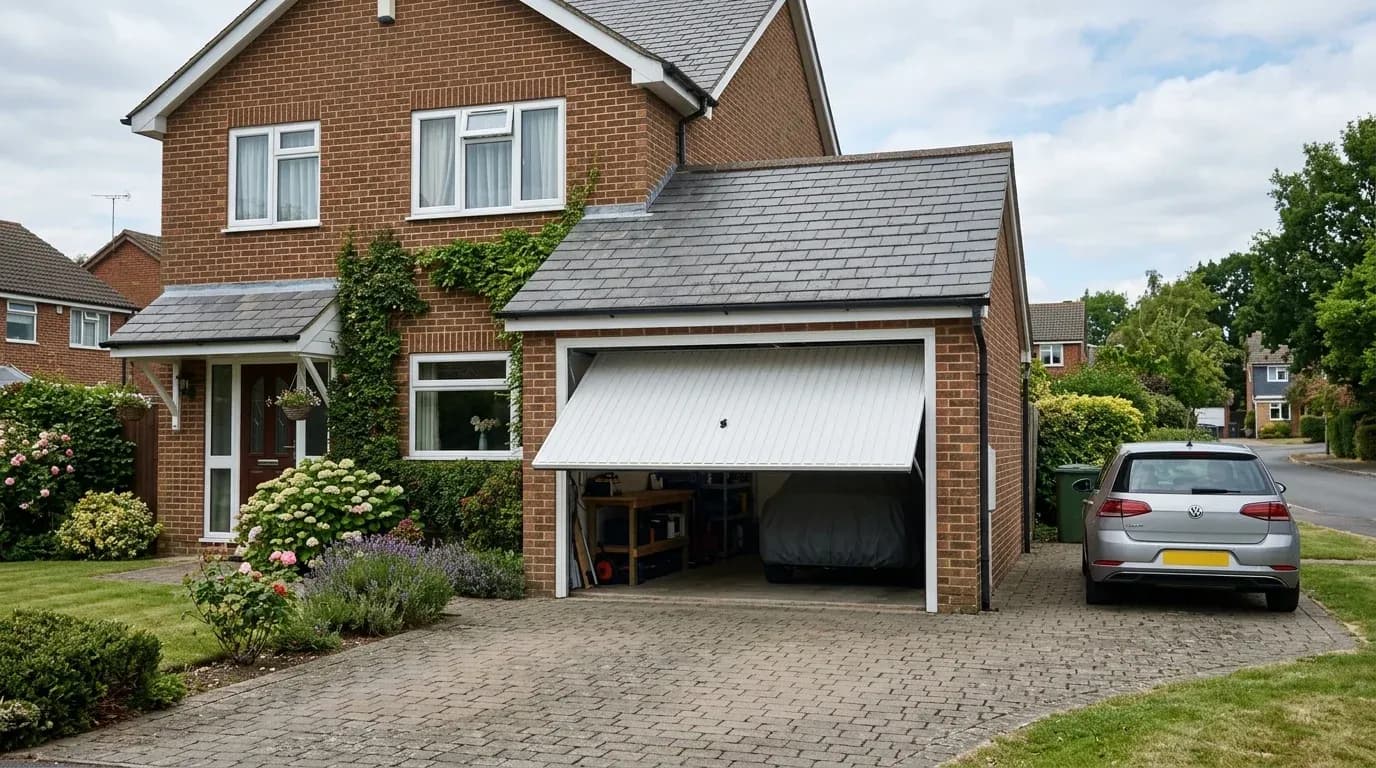
Easiest to automateThe most common garage door type in the UK and the easiest to automate. A retractable door swings the panel up and into the garage on a straight track, the same movement an electric motor naturally produces. Standard automation kits fit most retractable doors without modification. Cost: £300-£450 fitted.
Up-and-over canopy door
Needs an adaptorA canopy door protrudes beyond the garage opening when open, making it slightly harder to automate than a retractable. You will need a canopy adaptor kit to convert the movement. Most installers carry these as standard. Cost: £350-£500 fitted.
Side-hinged doors
More complexSide-hinged doors swing outward like a pair of gates, which requires a different automation mechanism to roller or sectional doors. Specialist kits are available, but the fitting is more involved and access requirements (the motor arms need clearance in front of the door) mean it is not always practical. Cost: £500-£800 fitted, where possible.
Roller and sectional doors
Usually already electricMost new roller and sectional doors are sold with electric motors as standard, or are easily upgraded by the original supplier. If you have an older manual roller door, adding a motor is possible but it is often more cost-effective to replace the whole door with a new electric model, as the motor can be sized correctly for the door weight and drum from the start.
Which Motor Type Should You Choose?
The motor is the heart of any electric garage door system. There are three main types, each with different price points and noise levels.
Chain drive
Budget£250 to £400The most affordable type of garage door motor. A metal chain drives the trolley along a track to open and close the door, the same mechanism as a bicycle chain. Chain drives work reliably for many years but are noticeably louder than belt or direct drive motors. A reasonable choice if the garage is detached from the main house or the noise is not a concern.
Belt drive
Mid-range£350 to £550Uses a reinforced rubber belt instead of a metal chain, making operation significantly quieter and smoother. The most popular choice for attached garages where noise could disturb a bedroom, kitchen, or living room above or alongside. Belt drives cost a little more but the improvement in noise levels is genuinely noticeable. Brands like Chamberlain and Somfy make well-regarded belt drive systems.
Direct drive
Premium£500 to £800The motor itself travels along a stationary chain, there are very few moving parts, which makes direct drive motors exceptionally quiet and long-lasting. Because so little can go wrong mechanically, many direct drive units come with lifetime warranties on the motor. The best choice if you want maximum reliability and the quietest possible operation. Typically used with roller and sectional doors.
Smart Features Worth Looking For
Wi-Fi and smartphone control
Many electric garage door motors now include Wi-Fi connectivity, letting you open, close, and check the status of your door from anywhere using a smartphone app. Particularly useful if you want to let in a delivery driver, check you haven’t left the door open, or monitor access. Usually included as standard on mid-range and premium motors, or available as an add-on module for around £30-£60.
Auto-close timer
An auto-close timer automatically closes the door after a set period (typically 1, 5, or 10 minutes) if it has been left open. A simple but genuinely useful feature for security and energy efficiency, particularly handy if you regularly forget to close the door when you pull onto the drive. Available on most mid-range and premium motor units.
Smart home integration
Higher-end systems from brands like Chamberlain (myQ), Somfy, and Hormann integrate with Amazon Alexa, Google Home, Apple HomeKit, and Ring doorbells, letting you include the garage door in routines and automations. For example, the door can close automatically when you lock your front door, or open when you arrive home based on your phone’s location.
Rolling code remote technology
All reputable electric garage door motors now use rolling code (also called hopping code) technology on the remote controls. The access code changes with every single use, making it impossible for a thief to capture and replay the signal with an electronic device. Look for this as standard, avoid any motor that uses fixed-code remotes.
Essential Safety Features
Modern electric garage doors must meet the EU Machinery Directive (still applied in the UK post-Brexit through retained legislation) and include several built-in safety features. Make sure any door or motor you buy includes all of these.
Auto-reverse sensors
If the door meets an obstruction while closing, a person, a child, a pet, or an object in the way, the motor must detect the resistance and automatically reverse. This is a legal requirement on all electric garage doors sold in the UK. Always test this feature on installation: place a small object in the door’s path and confirm it reverses immediately.
Photocell beams
Infrared photocell beams fitted to the bottom of the door track detect if anything breaks the beam while the door is closing. If triggered, the door stops and reverses. Photocells are standard on sectional and some roller door systems, and provide an additional layer of protection beyond the auto-reverse force sensor.
Manual emergency release
Every electric garage door motor must include a manual release mechanism, typically a red pull-cord, that disconnects the motor from the door so it can be operated by hand during a power cut or motor failure. Make sure you know where it is and how to use it before the installer leaves.
Battery backup
A battery backup unit keeps the motor running for a set number of cycles during a power cut. Not all motors include this as standard, it is sometimes an optional extra at £50-£120. Worth fitting if the garage is your primary entrance, you live in an area with frequent power outages, or you have a medical or mobility reason to always have automatic access.
Running Costs: What Will It Cost to Operate?
Electric garage door motors are extremely energy-efficient. Here is what to expect on your electricity bill.
Annual electricity cost: £8-£15
A typical electric garage door motor draws 200 to 500 watts, but only runs for around 10 to 20 seconds per opening or closing cycle. If you open and close the door twice a day (four cycles), that adds up to around 10 to 15 kWh per year, equivalent to leaving a single light bulb on for a few days. At current UK electricity rates, that is roughly £8-£15 per year in operating costs.
Standby power: £5-£10/year
The motor unit stays on standby to receive remote control signals and maintain the Wi-Fi connection (if fitted). Standby draw is typically 2 to 5 watts, which adds another £5-£10 per year. This is negligible by any measure, the total annual running cost of an electric garage door is very unlikely to exceed £25, even for heavy users.
Security: How Electric Doors Compare to Manual
One of the strongest arguments for an electric garage door is the security upgrade over a manual door. Here is why.
Automatic locking
When an electric door closes, it locks automatically through the motor mechanism. There is no padlock to forget, no handle to force, and no locking bar to be left unlocked by mistake. This is a significant practical security improvement over manual doors, which rely on the owner remembering to lock them.
No external handles
Electric garage doors have no external handle or lock cylinder on the outside face, removing a common point of attack. Manual up-and-over doors typically have a T-handle lock in the centre of the panel, which can be forced relatively quickly with basic tools. Electric doors eliminate this vulnerability entirely.
Remote monitoring
With a Wi-Fi-enabled motor, you can check your door’s status and receive an alert if it is opened unexpectedly, even when you are away from home. Some systems can also be integrated with home security systems and CCTV, creating a comprehensive access control setup for the garage.
How to Get Your Electric Garage Door for Less
A few sensible decisions when buying can cut the cost considerably without compromising on quality or safety.
Always get at least three quotes
Prices for electric garage doors and automation kits vary considerably between installers. We have seen identical motor kits priced at £320 by one firm and £550 by another for the same specification and fitting. Get at least three written quotes, making sure each covers the same motor brand, features, fitting, and any electrical work required. Don’t just take the cheapest, check reviews and ask about the warranty on parts and labour.
Automate your existing door if it’s in good condition
If your current garage door is structurally sound and operates smoothly by hand, adding an automation kit (£300-£600) is far cheaper than buying a whole new electric door (£900+). Most up-and-over retractable doors from the last 20 years can be automated. Get your installer to assess the door first, a door with worn springs, bent tracks, or a damaged frame is not worth automating and a new door is the better investment.
Choose a belt or direct drive motor for attached garages
Chain drive motors are the cheapest option but they are noisy. If your garage sits beneath a bedroom or alongside a kitchen, the rumble of a chain drive at 7am is not something you want. Spending £100-£200 more on a belt or direct drive motor makes a real difference to daily life and is money well spent for an attached garage.
Check if you already have a power socket in the garage
Electric garage door motors need a standard 13-amp socket close to the door. Many garages already have one. If yours does not, factor in the cost of getting an electrician to install one (£80-£150) when comparing quotes. Some installers include a socket in their quote, others do not. Always ask explicitly so you are comparing like for like.
Fit a battery backup at the same time
Most electric garage door motors can be fitted with a battery backup unit that keeps the door working during power cuts. These typically cost £50-£120 and are much cheaper to fit at the same time as the motor installation than to add retrospectively. A particularly worthwhile addition if you use the garage as your main way in and out of the house.
Useful Resources
Authoritative guidance on electric garage door safety, standards, and electrical regulations.
What to Expect: The Electric Garage Door Installation Process
Most electric garage door installations are completed within a single day. Here's how the job typically goes.
- 1
Survey and choose the door type
The installer measures the garage opening, checks the headroom and side room available, and recommends a suitable electric door type, sectional, roller, or automated up-and-over. Power supply location is checked.
- 2
Remove the existing door
The old garage door and hardware are removed. The frame and lintel are inspected and any repairs carried out. If the opening needs adjusting for the new door, this is done now.
- 3
Fit the new door and tracks
The door panels or curtain are assembled and fitted into the guide tracks. For sectional doors, horizontal ceiling tracks are installed. For roller doors, the drum housing is mounted above the opening.
- 4
Install the electric motor
A ceiling-mounted motor (for sectional and up-and-over doors) or tubular motor (for roller doors) is fitted. The motor is connected to a 13-amp socket or fused spur, no special electrical supply is needed for most domestic models.
- 5
Set up safety features and controls
Auto-reverse sensors, obstruction detection, and manual release mechanisms are fitted and tested. Remote control fobs are programmed, and if specified, a wall-mounted keypad or smartphone control is set up.
- 6
Test and handover
The door is cycled multiple times to check smooth operation, correct travel limits, and reliable locking. The installer demonstrates operation including manual override for power cuts, and hands over warranties and spare remotes.
Frequently Asked Questions
How much does it cost to automate an existing garage door?
Automating an existing garage door typically costs £300 to £600 for the motor kit and fitting, depending on the door type and motor quality. Up-and-over retractable doors are the easiest and cheapest to automate (£300 to £450). Canopy-style up-and-over doors need an adaptor kit, pushing costs to £350 to £500. Side-hinged doors are the most complex and expensive to automate, often requiring a specialist kit at £500 to £800.
What is the cheapest type of electric garage door?
Adding an automation kit to an existing up-and-over retractable door is the cheapest option at around £300 to £450 fitted. If you need a completely new electric door, a new electric roller door is the most cost-effective choice, starting at around £900 to £1,200 fitted. New electric sectional doors start from around £1,200 and side-hinged electric doors from around £1,500.
What are the different types of electric garage door motor?
There are three main motor types for electric garage doors. Chain drive motors (£250 to £400) are the most affordable but the loudest in operation. Belt drive motors (£350 to £550) use a rubber belt instead of a metal chain, making them significantly quieter, a better choice if the garage is attached to a bedroom or living room. Direct drive motors (£500 to £800) have the fewest moving parts, are the quietest of all, and generally the most reliable long-term.
How much electricity does an electric garage door use?
Electric garage door motors are very efficient. Most draw around 200 to 500 watts during operation but only run for 10 to 20 seconds per cycle. A typical household opening the door twice a day uses around 10 to 15 kWh per year, which works out at roughly £8 to £15 per year on a standard electricity tariff. Standby power consumption (for the Wi-Fi module and receiver) adds a small additional amount, typically another £5 to £10 per year.
Do I need an electrician to install an electric garage door?
If your garage already has a mains power socket near the door opening, most competent garage door installers can connect the motor without a separate electrician. If there is no socket, you will need a Part P-registered electrician to install one, typically costing £80 to £150. The motor plugs into a standard 13-amp socket, so no specialist wiring is required beyond getting power to the right place.
Are electric garage doors more secure than manual ones?
Yes, in most cases, electric garage doors offer better security than manual alternatives. When an electric door closes, it locks automatically through the motor mechanism, eliminating the padlock or external handle that can be forced on manual doors. Modern electric doors also include rolling code technology on the remote control, meaning the signal changes with every use and cannot be cloned. Many now support smartphone control so you can check whether the door is closed from anywhere, and some include alarm sensors that alert you if the door is opened unexpectedly.

Reviewed by Chris Kervin, Less.co.uk Home Improvement Costs Specialist
Last updated: · Pricing based on industry data and verified contractor submissions · Methodology
Ready to get an electric garage door for less?
We are building our free quote comparison service for garage door installers. Sign up to our newsletter and we will let you know the moment it is live. Getting three quotes typically saves homeowners 15 to 25% on the first price they are offered.
Compare Free QuotesFree, no obligation · Local installers · Compare multiple quotes