How Much Does a New Garage Door Cost in 2026?
A new garage door cost ranges from £400-£2,500including supply and fitting, depending on the type. An electric garage door cost starts from £600, roller garage door cost from £800, and sectional doors from £1,000. Garage door replacement cost includes removing the old door and fitting the new one. Double garage doors are 50 to 80% more than the single equivalent.
£400
Up-and-over from
£800
Roller from
£1,000
Sectional from
£150
Fitting from
Prices updated April 2026 · Based on industry data and contractor submissions.
Planning permission. Replacing a garage door does not usually require planning permission. However, listed buildings, conservation areas, and garages opening onto classified roads may need approval. Check with your local planning authority if in doubt.
New Garage Door Cost at a Glance
How much does a garage door cost for the most common types? Here is the garage door installation cost for every type, including supply and professional fitting for a standard single or double garage opening.
| Door Type | Average Cost | Price Range |
|---|---|---|
| Up-and-over (single, supply + fit) | £750 | £400 to £1,200 |
| Roller (single, supply + fit) | £1,300 | £800 to £2,000 |
| Sectional (single, supply + fit) | £1,600 | £1,000 to £2,500 |
| Side-hinged (single, supply + fit) | £950 | £600 to £1,500 |
| Electric automation (add-on) | £350 | £200 to £500 |
| Double garage door (up-and-over) | £1,200 | £700 to £1,800 |
| Double garage door (roller) | £2,000 | £1,200 to £3,000 |
| Double garage door (sectional) | £2,500 | £1,500 to £4,000 |
Prices include supply and fitting. Old door removal and disposal is usually included. Frame replacement, if needed, is priced separately (typically £100-£300 extra).
Get Free Garage Door Quotes
Compare prices from trusted local garage door installers near you. Fill in a few details and receive up to 4 free, no-obligation quotes.
Garage Door Costs by Material
The material you choose affects both the upfront cost and the long-term maintenance. Here is how the main options compare.
| Material | Single Door | Double Door | Maintenance |
|---|---|---|---|
| Steel | £400 to £1,500 | £700 to £2,500 | Low, wash and lubricate annually |
| Timber | £600 to £2,000 | £1,000 to £3,500 | High, repaint/stain every 3 to 5 years |
| GRP (fibreglass) | £500 to £1,200 | £800 to £2,000 | Low, wash occasionally |
| Aluminium | £800 to £2,500 | £1,200 to £4,000 | Low, virtually maintenance-free |
Prices include supply and fitting. Steel is the most popular choice for UK garage doors due to the balance of cost, durability, and appearance.
Garage Door Types Compared: Electric, Roller, and More
Each type of garage door has different strengths. Here is a closer look at how they compare on the factors that matter most.
Up-and-over, £400-£1,200
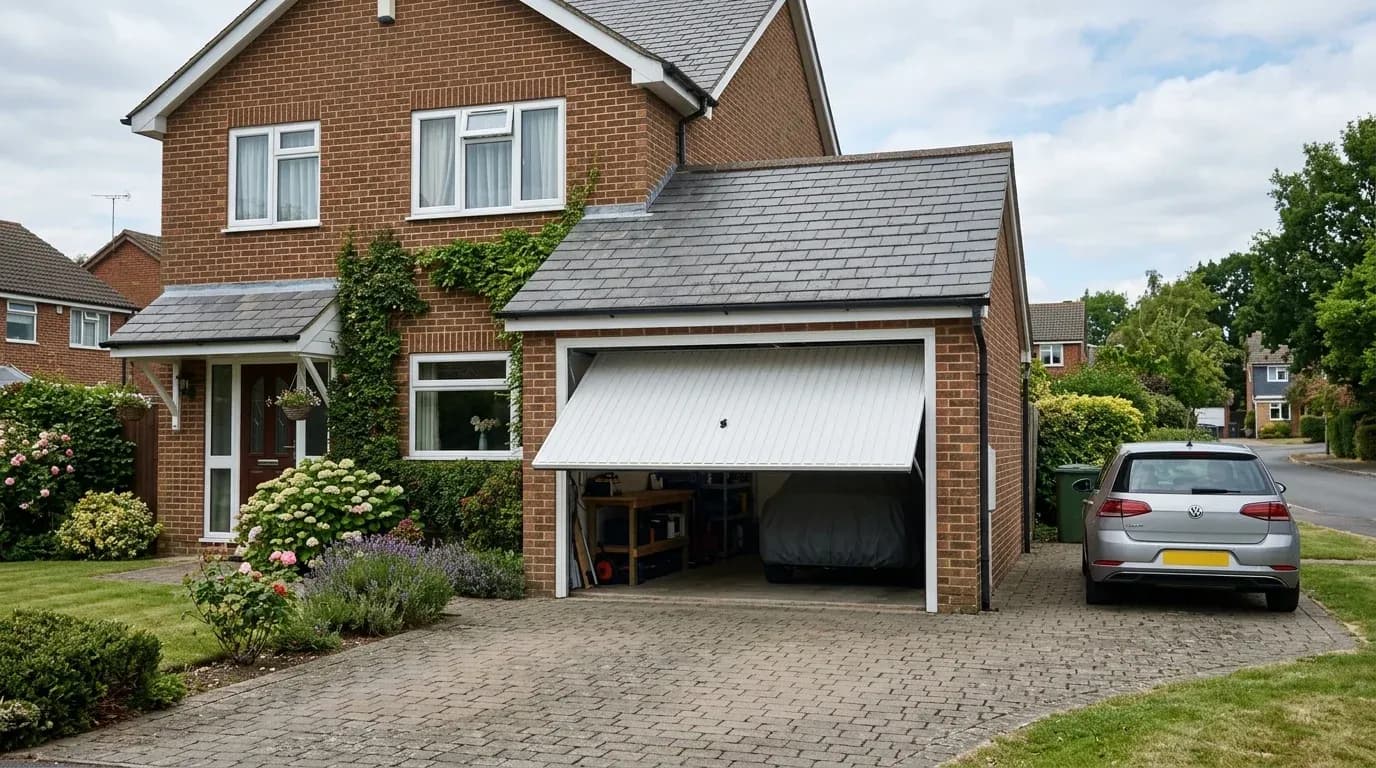
The classic British garage door. A single panel tilts outward and slides up on tracks. Canopy gear is simpler and cheaper; retractable gear runs on full tracks and is better suited to electric operation. The most affordable option and the easiest to find replacement parts for. The downside is it swings outward when opening, so you need clearance space on the driveway.
Roller, £800-£2,000
Rolls vertically into a compact drum above the opening. Takes up no ceiling space inside the garage and no driveway space outside. Ideal for short driveways and garages where ceiling storage is important. Usually comes with electric operation as standard. Slightly noisier than sectional doors but very reliable with minimal maintenance.
Sectional, £1,000-£2,500
Made of horizontal panels that hinge upward on vertical tracks. Provides the best insulation and weather sealing of any type. The panels sit tightly together with rubber seals, making it the quietest option. Does not swing outward. Sits flat against the ceiling when open, so you lose some overhead space. The premium choice for garages that are used as living space, home gyms, or workshops.
Side-hinged, £600-£1,500
Traditional double doors that open outward on side hinges. The simplest mechanism with the fewest things to go wrong. You can open just one side, which is handy for workshop access without fully opening the garage. No ceiling tracks or headroom requirements. The main limitation is you need full clearance on the driveway, and they are harder to automate than other types.
Fitting and Labour Costs
Most garage door prices include fitting, but here is a breakdown of the labour element so you know what you are paying for.
| Item | Typical Cost |
|---|---|
| Standard fitting (single door replacement) | £150 to £300 |
| Standard fitting (double door replacement) | £200 to £400 |
| Frame replacement (if needed) | £100 to £300 |
| Old door removal and disposal | Usually included |
| Electrical supply for motor (if not already present) | £80 to £150 |
| Brickwork adjustment (if opening size changes) | £200 to £500 |
What Affects Garage Door Replacement Cost?
Door type
The type of door is the single biggest cost factor. Up-and-over doors are the most affordable. Roller and sectional doors cost more because the mechanism is more complex and they usually include electric operation. Side-hinged doors sit in the middle.
Single vs double
Double garage doors cost 50 to 80% more than the equivalent single door. The door panel is larger, the mechanism needs to handle more weight, and fitting takes longer. Two single doors side by side can sometimes work out cheaper than one large double door.
Material
Steel is the most affordable and most popular. Timber looks beautiful but costs more and needs regular maintenance. Aluminium is the premium lightweight option. GRP is mid-range but becoming less common as steel and aluminium quality improves.
Electric vs manual
Electric automation adds £200-£500 to any door. Roller and sectional doors usually come with electric operation as standard. Up-and-over and side-hinged doors can be either manual or electric. You will also need a power socket in the garage.
Insulation
Double-skinned insulated doors cost more than single-skin doors but are well worth it if the garage is attached to the house, used as a workspace, or if you want to reduce heat loss. Insulated sectional doors are the best option for thermal performance.
Frame condition
If the existing frame is rotten, damaged, or the wrong size for the new door, it will need replacing. This adds £100-£300 to the cost. A survey visit before ordering will identify whether the frame can be reused.
Garage Door Installation Cost by Region
How much do garage doors cost across different parts of the UK? These figures are for a mid-range single roller door (supply and fit) by region.
| Region | Average Cost | vs National |
|---|---|---|
| London | £1,500 | +25% |
| South East | £1,350 | +13% |
| East of England | £1,280 | +7% |
| South West | £1,250 | +4% |
| Midlands | £1,200 | Average |
| Yorkshire | £1,100 | -8% |
| North West | £1,120 | -7% |
| North East | £1,050 | -13% |
| Scotland | £1,100 | -8% |
| Wales | £1,080 | -10% |
Based on industry data. Average cost for a single electric roller door (supply and fit).
How to Get Your Garage Door for Less
A few practical choices can reduce the cost of a new garage door without sacrificing quality or security.
Compare at least three quotes
Garage door prices vary enormously between suppliers. We have seen the same roller door quoted at £900 by one company and £1,600 by another. Get at least three written quotes and make sure each one specifies the same door type, material, size, and whether automation is included. The cheapest is not always the best, but paying double for the same product is unnecessary.
Consider an up-and-over if budget is tight
Up-and-over doors are the most affordable option and still work perfectly well for most garages. A steel canopy-gear up-and-over door from a reputable manufacturer costs £400-£700 fitted. If you do not need the space-saving benefits of a roller or the insulation of a sectional, this is the best-value choice.
Keep the existing frame if it is sound
If the existing sub-frame is in good condition, solid timber, no rot, square and level, you can save £100-£300 by keeping it and just replacing the door panel and tracks. A fitter can assess whether the frame is reusable during the survey visit.
Buy in winter when demand is lower
Garage door installers are busiest in spring and summer when homeowners are tackling exterior projects. Ordering a new door in November to February can sometimes get you 10 to 15% off, plus faster fitting times. If the job is not urgent, waiting for the quieter months can save you a couple of hundred pounds.
Skip automation if you rarely use the garage
Electric operation is brilliant for daily car parking, but if the garage is mainly storage and only opened a few times a month, the £200-£500 automation cost is harder to justify. A manual up-and-over or side-hinged door with a decent lock does the job at a fraction of the price.
Fix a snapped spring before replacing the whole door
A door that suddenly feels impossibly heavy or won’t stay halfway open has usually just lost a spring or cable, not reached the end of its life. Replacing a broken spring runs around £120 to £200, and a snapped cable around £80 to £150, against £400 to £2,500 for a whole new door. If the panels, tracks, and frame are still sound, a repair buys you several more years for a fraction of the cost. Leave torsion springs to a professional, though, as they are under huge tension and cause serious injuries every year.
Pay the deposit on a credit card
Bespoke garage doors are usually ordered with a deposit up front, sometimes 25 to 50 percent of the price, and every so often an installer folds before the fitting date. Pay any part of the bill on a credit card, even just the deposit, and Section 75 of the Consumer Credit Act makes your card provider jointly liable on any purchase priced over £100 and up to £30,000. It costs nothing extra and protects the full amount if the firm goes under or the door never turns up.
Comparing quotes is the simplest way to pay less
Getting three or four quotes and comparing them is how most homeowners avoid overpaying. It takes a couple of minutes, with no obligation.
Get my free quotesWhat to Expect: The Garage Door Installation Process
A garage door replacement is a straightforward job for an experienced fitter. Most single-door installations are done within half a day. Here's how it typically goes.
- 1
Initial survey and quote
A fitter visits to measure the opening, check the condition of the frame and lintel, and discuss which door types suit your garage. They'll note whether there's a power supply for automation and flag any structural issues before quoting.
- 2
Removal of old door
The existing door, tracks, and springs are carefully removed. If the door is counterbalanced with a heavy torsion spring, this must be released under controlled tension, another reason to leave the job to a professional.
- 3
Frame preparation
The sub-frame is checked for square, level, and structural soundness. Any rotten timber is replaced, and the opening is adjusted if the new door requires different clearances. Roller and sectional doors need adequate headroom above the opening.
- 4
New door installation
The new door, tracks, springs, and hardware are fitted according to the manufacturer's instructions. The door is balanced and adjusted so it opens and closes smoothly without binding or dragging.
- 5
Automation and motor fitting (if applicable)
If the door is electric, the motor unit is mounted to the ceiling or wall, the drive mechanism is connected, and the remote controls are programmed. Safety sensors and auto-reverse are tested to make sure the door stops if it meets an obstruction.
- 6
Testing and handover
The fitter runs the door through several full cycles, checks the seal and weatherproofing, and hands over the remote controls, emergency release key, and any warranty documentation. They'll show you how to operate the manual override in case of a power cut.
Frequently Asked Questions
How much does a new garage door cost?
A new single garage door costs between £400 and £2,500 including supply and fitting, depending on the type. Up-and-over doors are the cheapest at £400 to £1,200. Roller doors cost £800 to £2,000. Sectional doors are £1,000 to £2,500. Side-hinged doors fall between £600 and £1,500. Electric automation adds £200 to £500 on top. Double garage doors cost 50 to 80% more than single doors.
How much does it cost to automate a garage door?
Adding electric automation to a garage door costs £200 to £500 for a new installation, or £300 to £600 to retrofit an existing manual door. The cost includes the motor, remote controls, and safety sensors. You will also need a power socket in the garage if there is not one already, an electrician will charge £80 to £150 to install one. Automation is included in the price of most roller and sectional doors as standard.
How much does a double garage door cost?
A double garage door typically costs 50 to 80% more than the equivalent single door. An up-and-over double door costs £700 to £1,800. A double roller door costs £1,200 to £3,000. A double sectional door costs £1,500 to £4,000. Alternatively, two single doors side by side are sometimes cheaper than one large double door and give you the option to open just one side.
How long does a garage door last?
A well-maintained garage door lasts 20 to 30 years. Steel and aluminium doors need minimal maintenance, occasional washing and lubricating the moving parts. Timber doors need repainting or re-staining every 3 to 5 years to prevent warping and rot. GRP doors are low maintenance but can become brittle and discolour after 15 to 20 years. The motor on an electric door typically lasts 10 to 15 years before it needs replacing.
Can I fit a garage door myself?
It is possible but not recommended unless you are experienced with this type of work. Garage doors are heavy (a steel up-and-over door weighs 50 to 80 kg), and the spring mechanisms are under significant tension, if they snap or are adjusted incorrectly, they can cause serious injury. Professional fitting typically costs £150 to £400 and ensures the door operates safely, is properly balanced, and the warranty remains valid.
Does a new garage door add value to a house?
Yes. A new garage door is one of the best-value home improvements for kerb appeal. Estate agents estimate a new garage door adds £3,000 to £5,000 to the value of a property, depending on the quality and the overall condition of the house. Given that a decent new door costs £800 to £2,000 fitted, it is one of the few home improvements that reliably returns more than it costs.
What is the cheapest type of garage door?
Up-and-over doors are the cheapest option, starting from around £400 for a basic steel canopy-gear door including fitting. Steel is the most affordable material. Manual operation is cheaper than electric. If budget is the main concern, a steel up-and-over door with manual operation is the lowest-cost option that still gives you a decent, functional garage door.
Do I need planning permission for a new garage door?
Usually not. Replacing a garage door, even changing the type or colour, falls under permitted development rights for most UK homes. Exceptions include listed buildings, properties in conservation areas, and garages that open directly onto a classified road. If in doubt, check with your local planning authority before ordering.

Reviewed by Chris Kervin, Less.co.uk Home Improvement Costs Specialist
Last updated: · Pricing based on industry data and verified contractor submissions · Methodology