What Is an EICR?
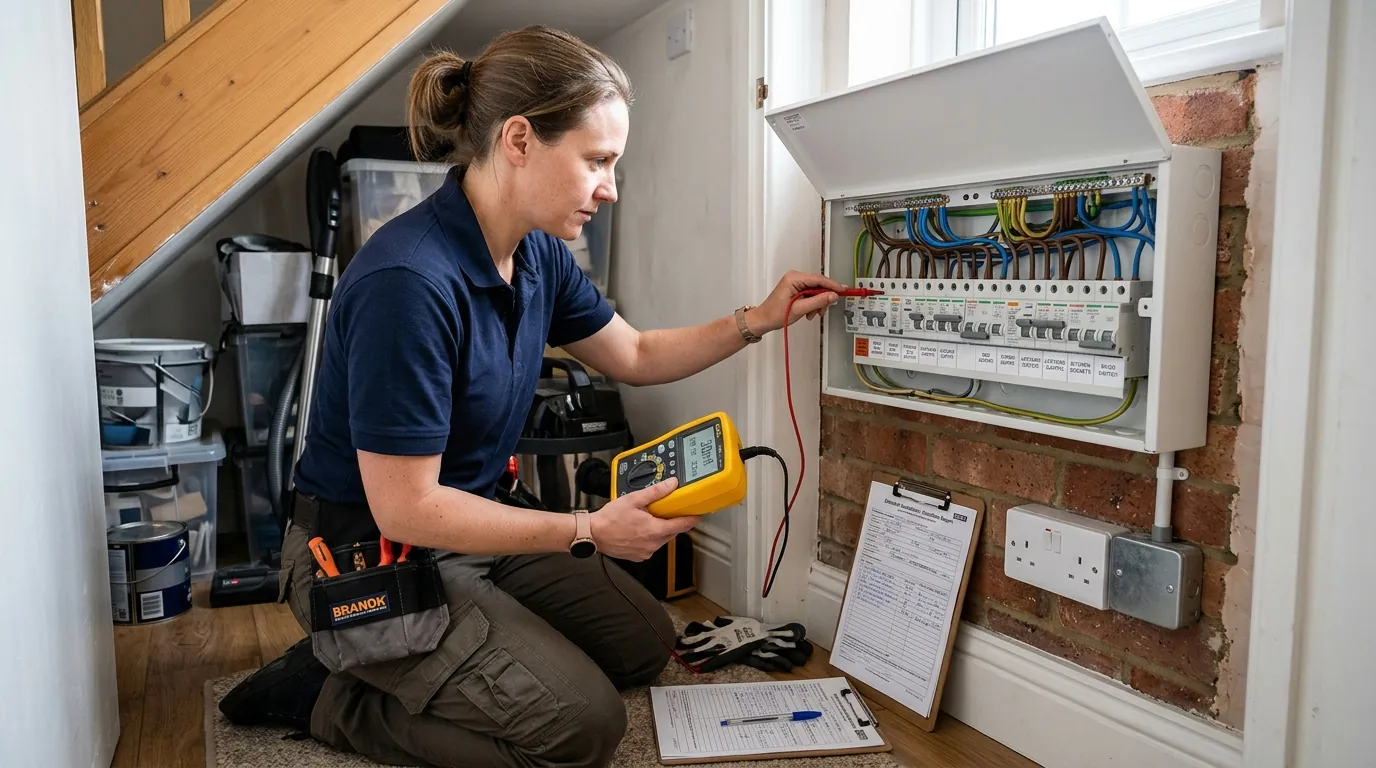
EICR stands for Electrical Installation Condition Report. A qualified electrician inspects and tests the fixed wiring in your home, then writes up anything that's dangerous or out of date. Landlords must have one at least every five years. Homeowners don't have to, but the advice is every 10 years.
5 years
Longest gap allowed between checks in a rented home
10 years
Recommended gap for a home you own
2 to 4 hours
Typical time for a 3-bed house
£200
Average price from an electrician
The short version
- It covers the wiring, the consumer unit, sockets, switches, lights, earthing and bonding. It doesn't cover plug-in appliances.
- Problems get a code: C1 (danger present), C2 (potentially dangerous), FI (further investigation) or C3 (improvement recommended).
- Any C1, C2 or FI makes the report unsatisfactory, and that work needs doing.
- In England, landlords must fix those items within 28 days, and councils can fine landlords up to £40,000.
What an EICR checks
The electrician works through every circuit in the home. Some checks are visual, and some need the power off while they test with specialist equipment. Here's what they look at.
Consumer unit
The fuse board's condition, whether circuits have RCD protection, and whether each one has the right breaker or fuse.
Wiring and cables
Damage, wear and signs of overheating, plus old cable types that may be coming to the end of their life.
Sockets, switches and lights
Loose, cracked or scorched fittings, and accessories that aren't safely fixed.
Earthing and bonding
That the main earth and the bonding to gas and water pipes are in place, so a fault can't make metalwork live.
RCD tests
That the residual current devices switch off fast enough to protect you from an electric shock.
Bathrooms and outdoors
Extra care where water and electricity meet, such as bathroom fittings, showers and garden sockets.
What it doesn't cover
- Plug-in appliances like kettles and lamps. That's a PAT test.
- Gas appliances and pipework. That's a gas safety check.
- The electricity meter and the supplier's main fuse, which belong to the network operator.
What the codes on an EICR mean
Every problem the electrician finds gets one of four codes. The codes decide whether the report passes.
Danger present
Someone could be hurt right now. The electrician will usually make it safe before leaving, for example by isolating the circuit.
Fix immediately
Potentially dangerous
A fault that isn't dangerous at this moment but could become so.
Fix urgently
Further investigation
Something the electrician couldn't check fully on the day, which needs looking into without delay.
Investigate without delay
Improvement recommended
Below today's wiring regulations but not unsafe. Older homes often have a few of these.
Optional, even for landlords
A report with any C1, C2 or FI code is unsatisfactory. One with only C3 codes, or none at all, is satisfactory.
Who needs an EICR?
The rules for landlords differ a little between England, Wales and Scotland. Homeowners aren't required to get one anywhere.
Landlords in England
At least every five years. Give tenants a copy within 28 days, and new tenants before they move in. Fix C1, C2 and FI items within 28 days. This covers private rented homes and, since 2025, social housing. Councils can fine landlords up to £40,000.
Landlords in Wales
A valid electrical condition report for each occupation contract, renewed at least every five years, with a copy for the contract-holder.
Landlords in Scotland
At least every five years under the Repairing Standard, plus PAT testing of any appliances you provide. Tenants get a copy of both reports.
Homeowners
No legal requirement. The advice is every 10 years, and also when you buy a home, before you sell, after a flood, or if breakers keep tripping or you spot scorch marks.
What happens during an EICR
Most 3-bed houses take two to four hours. Bigger homes, and those with more circuits, take longer.
- 1
Agree the job
Tell the electrician the size of the property, how many consumer units it has and roughly how old the wiring is. They'll confirm what they will and won't be able to test.
- 2
Visual inspection
They look over the consumer unit, cables, fittings and earthing for visible problems.
- 3
Dead testing
With the power off, they test each circuit's continuity, insulation resistance and polarity. Save your work and don't plan to cook during this part.
- 4
Live testing
With the power back on, they measure earth fault loop impedance and time how fast the RCDs trip.
- 5
The report
You get a written report listing the circuits tested, any codes, an overall result and the date the next inspection is due.
How long is an EICR valid for?
There's no fixed expiry date. Instead, the report says when the next inspection is due, based on the type of property and the condition of the wiring.
Up to 5 years
Rented homes, or sooner if the report says so
Usually 10 years
Homes you own and live in
Sooner
Older or worn installations, if the electrician recommends it
If you're a landlord and the report recommends three years, three years is your deadline.
EICR or a different certificate?
People often call an EICR an electrical safety certificate or a landlord electrical certificate. They mean the same thing. These are the other documents it gets mixed up with.
| Document | What it covers | When you need it |
|---|---|---|
| EICR | The condition of an existing installation | Periodic checks, letting a home, buying a home |
| Electrical Installation Certificate (EIC) | New work meets the wiring regulations | A rewire, a new circuit or a new consumer unit |
| Minor Works Certificate | A small job on an existing circuit | Adding a socket or moving a light |
| PAT test | Plug-in appliances | Kettles, microwaves and other appliances a landlord provides |
| Gas safety certificate (CP12) | Gas appliances and pipework | Every year for landlords, by a Gas Safe registered engineer |
| Visual condition report | A look round without testing | Not enough for landlords |
EICR
The condition of an existing installation
Periodic checks, letting a home, buying a home
Electrical Installation Certificate (EIC)
New work meets the wiring regulations
A rewire, a new circuit or a new consumer unit
Minor Works Certificate
A small job on an existing circuit
Adding a socket or moving a light
PAT test
Plug-in appliances
Kettles, microwaves and other appliances a landlord provides
Gas safety certificate (CP12)
Gas appliances and pipework
Every year for landlords, by a Gas Safe registered engineer
Visual condition report
A look round without testing
Not enough for landlords
What if your EICR is unsatisfactory?
The report lists each problem with its code, and the electrician can usually quote for the repairs there and then. You don't have to use the same electrician, but whoever does the work should give you a certificate for it, and you should keep it with the report.
Landlords in England must finish the work within 28 days, or sooner if the report says so. Then they need written confirmation from the electrician, which goes to the tenants and the council within 28 days of the work being finished.
Homeowners have no legal deadline, but C1 and C2 items are real safety risks, so it's worth fixing them quickly. Common fixes include a new consumer unit, added RCD protection, earthing and bonding work, and replacing damaged sockets. Very old wiring sometimes means a rewire.
How much does an EICR cost?
In our October 2026 survey of 82 UK firms' prices, electricians charged an average of £200 for a 3-bed house. Landlord-certificate companies charged £129, and a 1-bed flat costs £125 on average. Our EICR cost guide has prices by size of home and region, and the full research tracks how prices have changed.
Get free EICR quotes
Tell us about the property and local electricians will get in touch with prices. Free, with no obligation to book.
Who can carry out an EICR?
The law asks for a qualified and competent person. In practice, choose an electrician registered with a government-approved scheme such as NICEIC or NAPIT, and check them on the Electrical Competent Person register. Inspection and testing is a separate skill, so ask whether they're qualified in it before you book.
Frequently asked questions
What does EICR stand for?+
EICR stands for Electrical Installation Condition Report. It's the report an electrician writes after inspecting and testing the fixed wiring in a property, listing anything that's dangerous, potentially dangerous or below current standards.
Is an EICR a legal requirement?+
For landlords, yes. Landlords in England, Wales and Scotland must have the electrics in a rented home inspected and tested at least every five years. Homeowners don't have to get one by law, but the usual advice is every 10 years, and when you buy a home.
How long is an EICR valid for?+
The report gives a date for the next inspection. For a rented home that's five years at most, and sooner if the electrician says so. For a home you own it's usually 10 years. If the installation is old or in poor condition, the electrician can set a shorter gap.
How long does an EICR take?+
Most 3-bed houses take two to four hours. Bigger homes and those with more circuits take longer. The power will be off for part of the visit while the electrician tests each circuit.
Is an EICR the same as an electrical safety certificate?+
In everyday use, yes. People call it an electrical safety certificate or a landlord electrical certificate, but the document itself is an Electrical Installation Condition Report.
What does C3 mean on an EICR?+
C3 means improvement recommended. Part of the installation doesn't meet today's wiring regulations, but it isn't unsafe. You don't have to act on a C3, and a report with only C3 codes is still satisfactory.
Do I need an EICR to sell my house?+
No, there's no legal requirement. Some buyers and their solicitors ask for one, and a recent satisfactory report can stop wiring questions holding up a sale.
How much does an EICR cost?+
In our October 2026 survey, electricians charged an average of £200 for a 3-bed house and landlord-certificate companies £129. A 1-bed flat costs £125 on average.
Sources
- GOV.UK: Electrical safety standards in the private and social rented sectors
- legislation.gov.uk: Renting Homes (Fitness for Human Habitation) (Wales) Regulations 2022, regulation 6
- gov.scot: Repairing Standard statutory guidance, installations for the supply of electricity
- Electrical Safety First: how often to get the electrics checked in a home you own
- Electrical Competent Person register: check an electrician is registered

Written by Chris Kervin, Co-Founder, Less.co.uk
Last updated: · Checked against GOV.UK, Welsh and Scottish Government guidance · Methodology