How Much Does an EICR Cost in 2026?
An EICR costs between £150 and £300 for a standard 3-bed house. The inspection takes 2 to 4 hours and is required by law for landlords every 5 years.
£150 to £300
3-bed house
From £100
1-bed flat
2 to 4 hours
Time taken
5 years
Valid for
Prices updated April 2026 · Based on industry data and contractor submissions.
Landlord legal requirement. Since 1 April 2021, all rented properties in England must have a valid EICR. Failure to comply can result in fines of up to £30,000. The EICR must be carried out by a qualified person - a registered electrician who is a member of a competent person scheme.
EICR Prices by Property Size
The main factor is the size of your property - more rooms mean more circuits to test, which takes longer.
1-bed flat
- EICR cost
- £100 to £150
- Time
- 1 to 2 hours
2-bed house
- EICR cost
- £120 to £200
- Time
- 2 to 3 hours
3-bed house
- EICR cost
- £150 to £300
- Time
- 2 to 4 hours
4+ bed house
- EICR cost
- £200 to £400
- Time
- 3 to 5 hours
HMO (per unit)
- EICR cost
- £100 to £200
- Time
- 1 to 2 hours
| Property | EICR Cost | Time |
|---|---|---|
| 1-bed flat | £100 to £150 | 1 to 2 hours |
| 2-bed house | £120 to £200 | 2 to 3 hours |
| 3-bed house | £150 to £300 | 2 to 4 hours |
| 4+ bed house | £200 to £400 | 3 to 5 hours |
| HMO (per unit) | £100 to £200 | 1 to 2 hours |
Prices are for the inspection and report only. Remedial work to fix any issues found is charged separately.
What Is an EICR?
An EICR - Electrical Installation Condition Report - is a thorough inspection and test of all the fixed electrical wiring in a property. That covers everything built into the building: the consumer unit (fuse board), all circuits, sockets, switches, light fittings, earthing, and bonding.
It does not cover portable appliances like kettles or lamps (that is a PAT test) or anything plugged into a socket. It only covers the permanent installation.
The purpose is straightforward: to identify anything that is dangerous, potentially dangerous, or no longer meets current safety standards. The electrician tests every circuit, checks every connection, and gives you a detailed report with a clear pass or fail.
Who Needs an EICR?
Landlords - legally required every 5 years
Since 1 April 2021, the Electrical Safety Standards in the Private Rented Sector (England) Regulations 2020 require landlords to have an EICR carried out before new tenants move in and at least every 5 years thereafter. This applies to all private rented properties in England. Failure to comply can result in a fine of up to £30,000 and you may be prevented from evicting tenants using Section 21.
Homeowners - recommended every 10 years
There is no legal requirement for homeowners, but the IET Wiring Regulations (BS 7671) recommend an inspection every 10 years for domestic properties. It is also a good idea after any major electrical work, if you are buying an older property, or if you notice problems like frequently tripping circuits or burning smells near sockets.
Home buyers - strongly recommended before exchange
A standard homebuyer survey does not include electrical testing. If you are buying a property - particularly one built before 2000 - getting an EICR before you exchange contracts gives you a clear picture of what you are taking on. If the report flags issues, you can negotiate the price or ask the seller to fix them before completion.
What Happens During an EICR?
The electrician will need access to every room and the consumer unit. They will turn circuits off one at a time during testing, so expect some disruption - but the power is not off the whole time.
- 1
Visual inspection
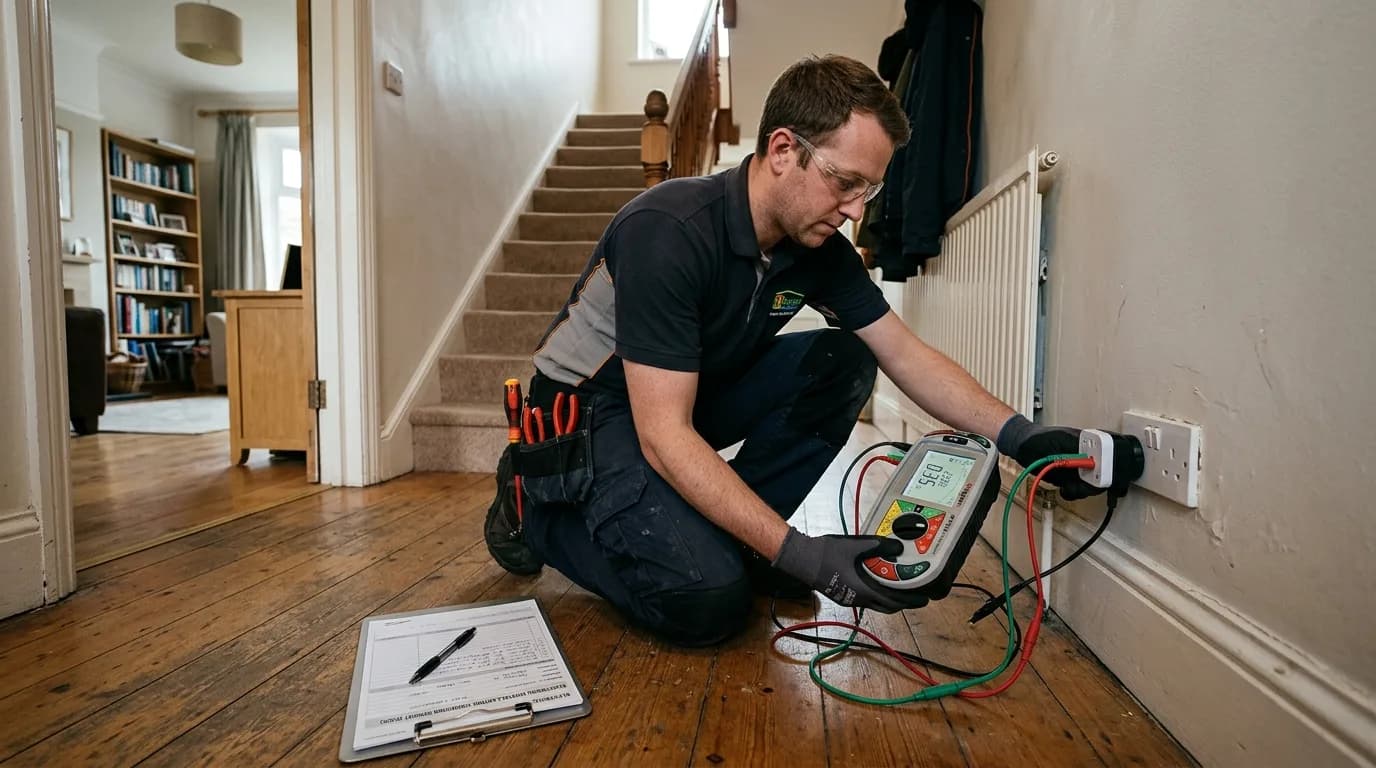
The electrician walks through the property checking every visible part of the electrical installation - sockets, switches, light fittings, the consumer unit, and any exposed wiring. They are looking for damage, wear, outdated components, and anything that does not meet current standards.
- 2
Testing every circuit
Using specialist testing equipment, the electrician tests each circuit in your consumer unit individually. This includes measuring insulation resistance, earth fault loop impedance, and polarity. Each test checks that the circuit is safe, properly connected, and capable of tripping the protective devices in a fault.
- 3
Earthing and bonding checks
The electrician verifies that your earthing system is intact and meets current regulations. They also check the bonding - the safety connections between metal pipes (gas, water) and the earth terminal. Poor earthing is one of the most common reasons for an unsatisfactory EICR.
- 4
RCD testing
If your consumer unit has RCDs (residual current devices), the electrician tests each one to confirm it trips within the required time. An RCD that does not trip fast enough will not protect you from electric shock. This is a critical safety test.
- 5
Report and classification
After testing, the electrician compiles the EICR document. Every observation is classified as C1, C2, C3, or FI (further investigation needed). You will get the overall result: satisfactory or unsatisfactory. A satisfactory result means your electrics are in good working order with no dangerous issues.
What the Results Mean
Every issue the electrician finds gets a classification code. Here is what each one means and what you need to do about it.
Danger present
Something is actively dangerous right now. The electrician may isolate the circuit on the spot to make it safe. This must be fixed immediately - it poses a real risk of electric shock or fire.
Potentially dangerous
Not immediately dangerous, but could become so. These issues need urgent remedial work. Common C2 findings include lack of RCD protection on socket circuits, missing earthing, or deteriorated wiring insulation.
Improvement recommended
Advisory only - not dangerous, but would bring the installation closer to current standards. C3 items do not cause an EICR to fail. Common examples include recommending additional sockets or upgrading older (but still safe) components.
All clear
No C1 or C2 issues found. Your electrical installation is in good condition and safe to use. You may still have C3 observations (improvements recommended), but these are optional.
What If Your EICR Fails?
If the report comes back as unsatisfactory, it means the electrician found C1 or C2 issues. Do not panic - this is more common than you might think, particularly in older properties.
The electrician will list every issue and can usually quote for the remedial work on the spot. Common fixes include:
- Upgrading the consumer unit to one with RCD protection - £350 to £600
- Replacing deteriorated wiring on individual circuits - £150 to £400 per circuit
- Improving earthing and bonding - £100 to £300
- Replacing damaged sockets or switches - £30 to £80 each
- Full rewire (worst case, very old properties) - £3,000 to £6,000+
Budget £200 to £2,000 for remedial work on a typical property. The exact cost depends entirely on what is found. Once the work is completed, the electrician will retest the affected circuits and issue an updated report confirming the installation is now satisfactory.
Landlord Legal Obligations
If you rent out property in England, here is exactly what the law requires of you.
Have an EICR carried out before new tenants move in
The inspection must be done by a qualified person - a registered electrician who is a member of a competent person scheme such as NAPIT, NICEIC, or ELECSA.
Renew the EICR at least every 5 years
The interval starts from the date of the previous report. Do not leave it to the last minute - if the report finds issues, you need time to fix them before the old one expires.
Provide a copy to tenants within 28 days
Every tenant in the property must receive a copy of the current EICR within 28 days of the inspection being completed, or before they move in if it is a new tenancy.
Provide a copy to the local authority on request
Your local council can request a copy at any time. You must provide it within 7 days of the request.
Complete any remedial work within 28 days
If the EICR is unsatisfactory, you must have the C1 and C2 issues fixed within 28 days (or sooner if the electrician specifies). You then need written confirmation from the electrician that the work has been completed.
Retain the report for the duration of the tenancy
Keep the EICR on file for the entire tenancy and for at least 5 years after it ends.
How to Get Your EICR for Less
The inspection itself is not expensive, but the remedial work can add up. Here is how to keep costs down.
Get at least three quotes
EICR prices vary quite a bit between electricians. Some charge a flat fee; others price by the number of circuits. Get written quotes from at least three qualified electricians and check what is included - particularly whether they cover re-testing after any remedial work.
Bundle it with other electrical work
If you are already having electrical work done - a new consumer unit, additional sockets, or rewiring - ask the electrician to carry out the EICR at the same time. Many will reduce the EICR fee since they are already on site and testing circuits as part of the other job.
Fix small issues before the inspection
If you know you have cracked sockets, missing socket covers, or dangling wires, sort them out before the EICR. These are cheap fixes that could otherwise trigger observations on the report. Replacing a cracked faceplate costs a couple of pounds; having it flagged and remediated by the inspector costs far more.
Ask about the remedial work quote upfront
If the EICR finds C1 or C2 issues, you will need them fixed. Some electricians offer a combined EICR-plus-remedial price. Others will charge separately. Ask before booking whether their quote includes any minor remedial work, or whether everything found will be quoted on top. Knowing this upfront avoids surprises.
Useful resources
- NICEIC, Find a registered electrician for your EICR inspection
- Building Regulations Part P, Legal requirements for domestic electrical installations
- NAPIT, Another approved competent person scheme for electricians
Frequently Asked Questions
Is an EICR a legal requirement?
For landlords, yes. Since 1 April 2021, all rented properties in England must have a valid EICR before new tenants move in, and the report must be renewed every 5 years. Failure to comply can result in fines of up to £30,000. For homeowners, an EICR is not legally required, but it is strongly recommended every 10 years or when buying or selling a property.
How often do I need an EICR?
Landlords must have an EICR carried out at least every 5 years by law. Homeowners should get one every 10 years, or sooner if you are buying or selling, have had major electrical work done, or notice any signs of electrical problems such as flickering lights, tripping circuits, or burning smells near sockets.
What happens if my EICR fails?
If the electrician finds C1 (danger present) or C2 (potentially dangerous) issues, your EICR will be classified as unsatisfactory. The report will list every issue found. C1 items need immediate attention - the electrician may isolate the dangerous circuit on the spot. C2 items need urgent remedial work. Once the problems are fixed, you will need a follow-up inspection to confirm the work has been done and the installation is now satisfactory.
Can I sell my house without an EICR?
Legally, yes - there is no law requiring homeowners to have an EICR before selling. However, many conveyancing solicitors and buyers now request one as part of the sale process. If your electrics are old or there is no evidence of recent inspection, a buyer may use it as a negotiating tool to reduce the price. Getting an EICR before listing can save you from last-minute surprises and strengthen your position.
What is the difference between an EICR and a PAT test?
An EICR inspects the fixed electrical installation - the wiring, consumer unit, sockets, switches, and earthing built into the property. A PAT (Portable Appliance Test) checks individual portable electrical items like kettles, toasters, and extension leads. They test completely different things. A property can pass an EICR with flying colours and still have faulty portable appliances, and vice versa.

Written by Chris Kervin, Co-Founder, Less.co.uk
Last updated: · Pricing based on industry data and verified contractor submissions · Methodology
Ready to get your electrics checked for less?
Compare free quotes from qualified electricians near you. Whether you are a landlord meeting your legal obligation or a homeowner wanting peace of mind, an EICR gives you a clear picture of your electrical safety.
Compare Free QuotesFree, no obligation · Qualified electricians · Local professionals only
More home improvement costs