How Much Does Rising Damp Treatment Cost in 2026?
Most homeowners pay between £3,000 and £6,000 for rising damp treatment on a standard house, covering a chemical DPC injection and replastering with salt-resistant render. But before you commit to anything, read the section on misdiagnosis. Genuine rising damp is less common than you might think.
£1,500
DPC injection from
£2,000
Replastering from
£150
Survey from
£3 to 6k
Total (typical)
Prices updated April 2026 · Based on industry data and contractor submissions.
Read this before you book anyone. Multiple independent studies have found that the majority of “rising damp” diagnoses from treatment companies are actually condensation or penetrating damp. Get an independent survey, one from a surveyor who is not selling treatment, before spending thousands. See the full section below for details.
Rising Damp Treatment Costs at a Glance
Prices below cover the main stages of a rising damp treatment job. The survey and injection are usually quoted by specialists; replastering is often a separate plasterer’s quote. Always confirm what is included before accepting any price.
Damp survey (specialist)
Independent survey to confirm diagnosis before committing to treatment
£250
£150 to £350
Chemical DPC injection (semi-detached)
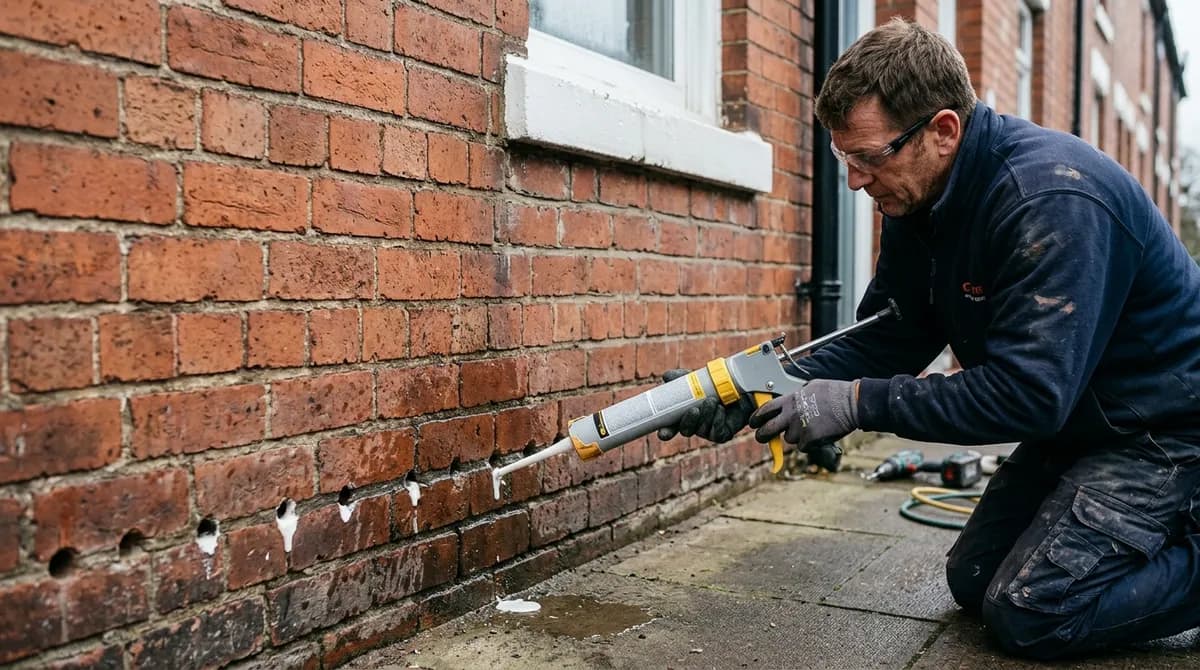
Silicone cream injected into mortar course, front and rear external walls
£2,000
£1,500 to £2,500
Chemical DPC injection (detached)
Full perimeter treatment, all four external walls
£3,500
£2,500 to £4,500
Replastering with salt-resistant render
Strip and replaster to 1m above tide mark, essential after DPC injection
£3,000
£2,000 to £4,000
External waterproofing
Applied to outer face of wall where internal injection is not practical
£2,250
£1,500 to £3,000
Additional Costs to Budget For
| Extra Item | Typical Cost |
|---|---|
| Skirting board replacement | £8 to £15 per metre |
| Timber treatment (if rot found) | £500 to £2,000 |
| Sub-floor ventilation | £200 to £600 |
| External ground lowering | £300 to £800 |
| Redecoration after drying out | £300 to £800 per room |
Prices are national averages for 2026. London and the South East typically run 25 to 35% higher.
What is rising damp?
Rising damp is moisture from the ground travelling upwards through masonry by capillary action, the same process that draws water up through a paper towel. It happens when the damp proof course (DPC) in a wall has failed or was never there in the first place. Pre-1920s properties often have no DPC at all; older slate or bitumen DPCs in Victorian and Edwardian houses can crack and break down over time.
The classic signs are a tide mark on the wall at around knee height, white salt deposits on the plaster, crumbling or blistering paint, and a musty smell at low level. Rising damp rarely affects walls higher than about a metre, capillary action can only carry moisture so far against gravity.
The treatment is a chemical damp proof course: holes drilled at intervals along the mortar course, silicone cream injected into each one, and the old contaminated plaster stripped back and replaced with a salt-resistant render. It is not a complicated job, but it needs to be done on the right problem.
Is it really rising damp? The honest answer.
Here is something the damp treatment industry would rather you did not know: genuine rising damp is far less common than the number of diagnosis reports would suggest. Building scientist Jeff Howell spent years surveying properties that had been diagnosed with rising damp and found that the majority were actually suffering from condensation, penetrating damp, or both.
The problem is structural. Companies that offer free surveys make their money from selling treatment. A moisture meter will give a high reading on a wall with condensation just as readily as it will on a wall with genuine rising damp. A quick scan with a handheld meter, a tick on a form, and a three-thousand-pound quote, it happens all the time.
A proper damp survey takes time. A qualified surveyor should spend at least an hour on a standard property. They should take moisture readings at multiple heights, look for salt deposits, check external ground levels, inspect gutters and downpipes, and test for hygroscopic salts. If someone diagnoses rising damp after ten minutes with a meter, treat that report with scepticism.
Signs that point towards rising damp
- A clear tide mark at a consistent height (usually 0.5 to 1m), with damp below and dry above
- White salt deposits (efflorescence) on the wall surface, especially nitrate salts
- Damp that does not change much with the seasons
- Older property (pre-1920) with no original DPC, or a DPC that has been bridged by raised ground levels
- Timber skirting boards showing signs of wet rot at the base
Signs that suggest condensation instead
- Black mould growth in corners, behind furniture, or on cold external walls
- Windows steaming up regularly, especially in winter
- Damp that is worse in cold weather and improves in summer
- No tide mark, just general dampness across the lower wall or around window reveals
- Problem in a well-insulated modern property (condensation is far more common here than rising damp)
Signs that suggest penetrating damp instead
- Damp patches that worsen during or after heavy rain
- Damp higher up the wall or at a single point rather than running across the base
- Defective gutters, downpipes, or roof drainage nearby
- Cracked render or failed pointing on the external face of the wall
- Damp on an internal wall (rising damp only affects external walls)
How chemical DPC injection works
Once rising damp is properly confirmed, a chemical DPC injection is the standard solution. Here is what happens from start to finish.
- 1
Survey and confirmation
A qualified surveyor assesses the property, takes readings at multiple heights, checks external factors, and tests plaster samples for hygroscopic salts. A written report confirms the diagnosis and specifies the treatment.
- 2
Preparation
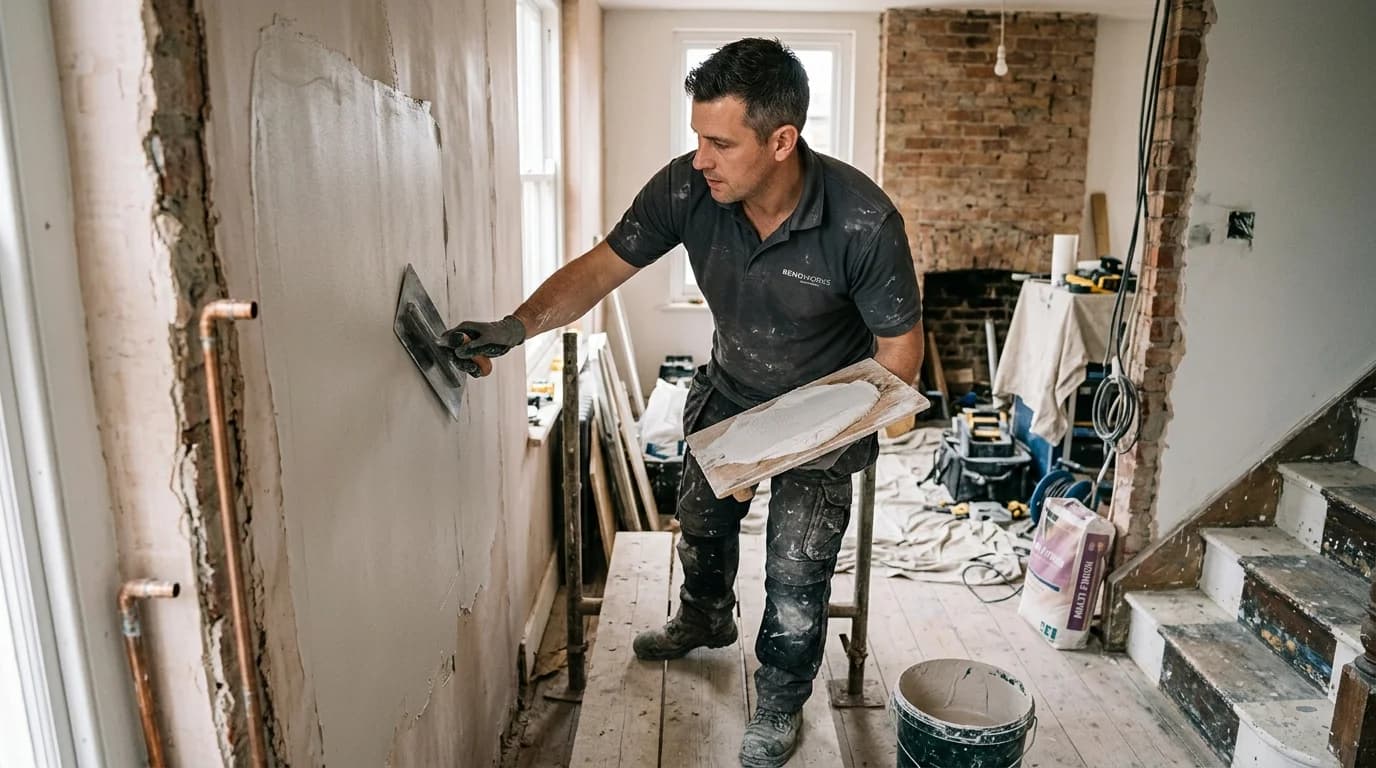
Furniture and skirting boards are removed from the affected area. The contaminated plaster is hacked back to the masonry to at least 1 metre above the visible tide mark, not just to the tide mark itself, because salts are present in the plaster above it.
- 3
Drilling
Holes are drilled at regular intervals, typically every 120mm, along the mortar course at DPC height, usually around 150mm above external ground level. Holes go to roughly two-thirds of the wall depth.
- 4
Injection
A silicone-based cream is injected into each hole. The cream spreads through the mortar joints and cures to form a continuous water-repellent barrier across the full thickness of the wall. Some contractors use a low-pressure injection; others use a gravity-feed cream that you leave to soak in. Both methods are effective when applied correctly.
- 5
Replastering
Once the injection is complete, a salt-resistant render is applied in two coats, a sand and cement scratch coat followed by a finishing coat. Standard plaster will fail here because the salts left in the wall will keep pulling moisture through it. The render must go to at least 1 metre above the tide mark.
- 6
Drying out
The walls need 4 to 6 weeks to dry out before you redecorate. Keep the room ventilated, and use breathable emulsion paint rather than vinyl when you finally decorate, the wall will still be releasing residual moisture for months after treatment.
Alternatives to chemical DPC injection
Chemical injection is the standard treatment, but it is not the only option. These alternatives are worth knowing about.
External waterproofing
Where access to the internal wall face is difficult, or where the external wall surface is causing problems, a waterproof render or coating can be applied externally. This does not address a failed DPC but can prevent penetrating damp from exacerbating the problem. Costs £1,500 to £3,000 depending on wall area.
Electro-osmotic systems
These systems use a low electrical current to reverse the polarity of moisture in the wall, supposedly pushing water back down rather than allowing it to rise. The evidence for their effectiveness is mixed, and they are not widely used by mainstream contractors. They tend to be recommended when injection is not practical (very thick or rubble-filled walls).
Improving ventilation (if it is condensation)
If the diagnosis turns out to be condensation rather than rising damp, the solution is improved ventilation, extractor fans, trickle vents, or a positive input ventilation (PIV) unit (£250 to £500 installed). No amount of DPC injection will fix a condensation problem. This is why getting the right diagnosis first matters so much.
Fixing external defects (if it is penetrating damp)
If the problem is penetrating damp from a defective gutter, cracked render, or failed pointing, the fix is to sort the external defect. Repointing costs £30 to £60 per square metre; a gutter replacement runs £150 to £400. Again, not a DPC problem, not a DPC solution.
How long does rising damp treatment last?
Most reputable companies guarantee their chemical DPC injection for 20 to 30 years. The silicone materials used are very stable and do not degrade the way older physical DPC materials (slate, bitumen felt) can. Provided the injection is done properly and the replastering is completed with the right render, there is no reason the treatment should not last the lifetime of the building.
The critical caveat: treatment can fail if the cause was not properly addressed. If soil is still banked up to above the DPC line, moisture will continue to enter. If gutters are still directing water at the base of the wall, the wall will stay wet. The DPC is one part of the solution, the external factors matter too.
Always ask about the guarantee
Before you accept any quote, confirm whether the guarantee is insurance-backed. If the company goes under in five years, a 20-year guarantee on their headed paper is worthless. Insurance-backed guarantees transfer to the insurer and remain valid regardless of what happens to the contractor. Ask for this in writing.
How to get your rising damp treated for less
Rising damp treatment is one of the trades most prone to unnecessary work and inflated quotes. The tips below will help you avoid paying for treatment you do not need, and get a fair price if you do.
Get an independent survey before agreeing to anything
Free surveys from damp treatment companies are not impartial. The company making the diagnosis is the same one quoting you for the work, that is a conflict of interest. Spending £200 on an independent surveyor who has nothing to sell can save you £3,000+ on treatment you never needed. If the independent survey confirms rising damp, you will have three quotes to compare rather than one.
Get three quotes from PCA member companies
Once you have a confirmed diagnosis, collect at least three quotes from companies registered with the Property Care Association. Quotes for the same job can vary by 50% or more, often because one company includes replastering and another quotes it separately. Always ask exactly what is and is not included in the price.
Check the basics before paying for injection
Before committing to chemical injection, confirm that simpler issues have been ruled out. Is soil banked up above the DPC line? Are air bricks blocked? Is there a leaking gutter soaking the wall? These are cheap fixes. A good independent surveyor will check them, a sales-driven free survey often will not.
Ask for an insurance-backed guarantee
A 20-year guarantee is only worth something if the company is still trading in 20 years. Most reputable firms offer guarantees backed by an insurance scheme, if they close, the guarantee transfers to the insurer. Always ask specifically whether the guarantee is insurance-backed before signing anything.
Price the replastering separately from the injection
Replastering with salt-resistant render is the single biggest cost of a rising damp job at £2,000 to £4,000, and the injection is often the cheaper part. Damp firms tend to roll the plastering into one price and add a margin on the subcontracted work. Ask for the injection and the replastering as separate line items, and consider getting your own plasterer to price the render once the wall has dried out. Just make sure whoever does it uses a proper salt-resistant render, not standard finishing plaster, or the salts in the wall will come straight through.
What to Expect: The Rising Damp Treatment Process
Rising damp treatment is not a one-day job. The injection itself is quick, but the drying and replastering take weeks. Here's the full process.
- 1
Damp survey and diagnosis
A qualified damp surveyor (ideally CSRT-registered) inspects the property using a moisture meter and sometimes a carbide test to distinguish rising damp from condensation or penetrating damp. A proper diagnosis is critical, many damp problems are misdiagnosed.
- 2
Remove contaminated plaster
The existing plaster is hacked off to a height of at least 300mm above the visible damp line. This removes the salt-contaminated material that would otherwise continue to draw moisture even after the new DPC is installed.
- 3
Inject the new damp-proof course
Holes are drilled into the mortar course at regular intervals (typically 120mm apart) just above external ground level. A silicone-based DPC cream is injected into each hole, where it spreads through the mortar to create a chemical barrier against rising moisture.
- 4
Allow drying time
The walls are left to dry out naturally, which can take several weeks to several months depending on wall thickness and ventilation. Dehumidifiers or increased ventilation can speed the process. Replastering too soon traps moisture behind the new finish.
- 5
Replaster with salt-resistant render
Once sufficiently dry, the walls are replastered using a specialist salt-resistant render system. This prevents any residual salts in the masonry from migrating through to the new plaster surface. The contractor issues a guarantee, typically 20 to 30 years.
Frequently asked questions
How much does rising damp treatment cost?
Rising damp treatment typically costs £3,000 to £6,000 for a standard three-bedroom semi-detached house, including a chemical DPC injection and replastering with salt-resistant render. A specialist damp survey costs £150 to £350. The DPC injection itself runs £1,500 to £2,500 for a semi-detached or £2,500 to £4,500 for a detached property, plus £2,000 to £4,000 for replastering.
Do I definitely have rising damp?
Possibly not. Research, including a well-known study by building scientist Jeff Howell, has found that genuine rising damp is far less common than the damp treatment industry suggests. Many properties diagnosed with rising damp actually have condensation or penetrating damp from a defective gutter, cracked render, or failed pointing. The key is getting a diagnosis from an independent surveyor who has no financial interest in recommending treatment.
What is rising damp?
Rising damp is moisture from the ground moving upwards through masonry by capillary action. It typically affects the lower metre or so of a wall and occurs when the damp proof course (DPC) has failed or was never installed, common in pre-1920s properties. The signs include a tide mark on the wall, salt deposits crystallising on the plaster, and crumbling skirting boards. It is treated by injecting a chemical DPC into the mortar course and replastering with salt-resistant render.
How does chemical DPC injection work?
A row of holes is drilled along the mortar course at DPC height, typically about 150mm above external ground level. A silicone-based cream or resin is injected into the holes under pressure. The silicone spreads through the mortar, forming a continuous water-repellent barrier across the wall. The old plaster is then stripped back to 1 metre above the damp line and replaced with a salt-resistant render in two coats.
How long does rising damp treatment last?
Chemical DPC injection typically comes with a guarantee of 20 to 30 years, and many companies offer insurance-backed guarantees that remain valid if the company ceases trading. The injection itself is very durable, silicone-based materials do not degrade in the same way physical materials can. The replastering is the element that needs the most care during drying-out; walls should be allowed 4 to 6 weeks before redecorating.
Do I need to replaster after rising damp treatment?
Yes, almost always. The plaster below the treatment line is saturated with hygroscopic salts drawn up by the rising damp. If you leave it in place, those salts will keep pulling moisture from the air and the walls will look damp even after the DPC is working. The old plaster must come off to at least 1 metre above the tide mark, and a salt-resistant render is applied in its place. Replastering typically costs £2,000 to £4,000 depending on the extent of the affected area.
Useful resources
Building Regulations Approved Document F: Ventilation
The official Building Regs guidance on ventilation requirements. Relevant if you are dealing with condensation rather than rising damp.
RICS: Find an independent surveyor
The Royal Institution of Chartered Surveyors directory. Use this to find an independent, qualified surveyor for a damp assessment, one with no treatment to sell.
Property Care Association: Find accredited contractors
The PCA is the trade body for damp proofing and timber treatment specialists. Member companies must meet quality and training standards, and their guarantees are insurance-backed.

Written by Chris Kervin, Co-Founder of Less.co.uk
Last updated: · Pricing based on industry data and verified contractor submissions · Methodology
Ready to get your damp sorted for less?
Compare quotes from PCA-accredited damp proofing specialists. Get an independent survey first, it could save you thousands.
Get Free QuotesComing soon, sign up to our newsletter to be the first to know.
More Home Improvement Cost Guides
Compare real quotes for your job
Prices move a lot with your postcode, the access on site and the spec you choose. Get up to 3 free quotes from vetted local tradespeople and see what yours actually comes to, with no obligation to book.