Bi-Fold Doors: Your Complete Guide
Bi-fold doors are the go-to choice for opening up a room to the garden. They fold and stack neatly to one side, giving you an almost fully open wall. Not cheap, but they genuinely change how you use a room. This guide covers materials, configurations, costs, and what to look out for when getting quotes.
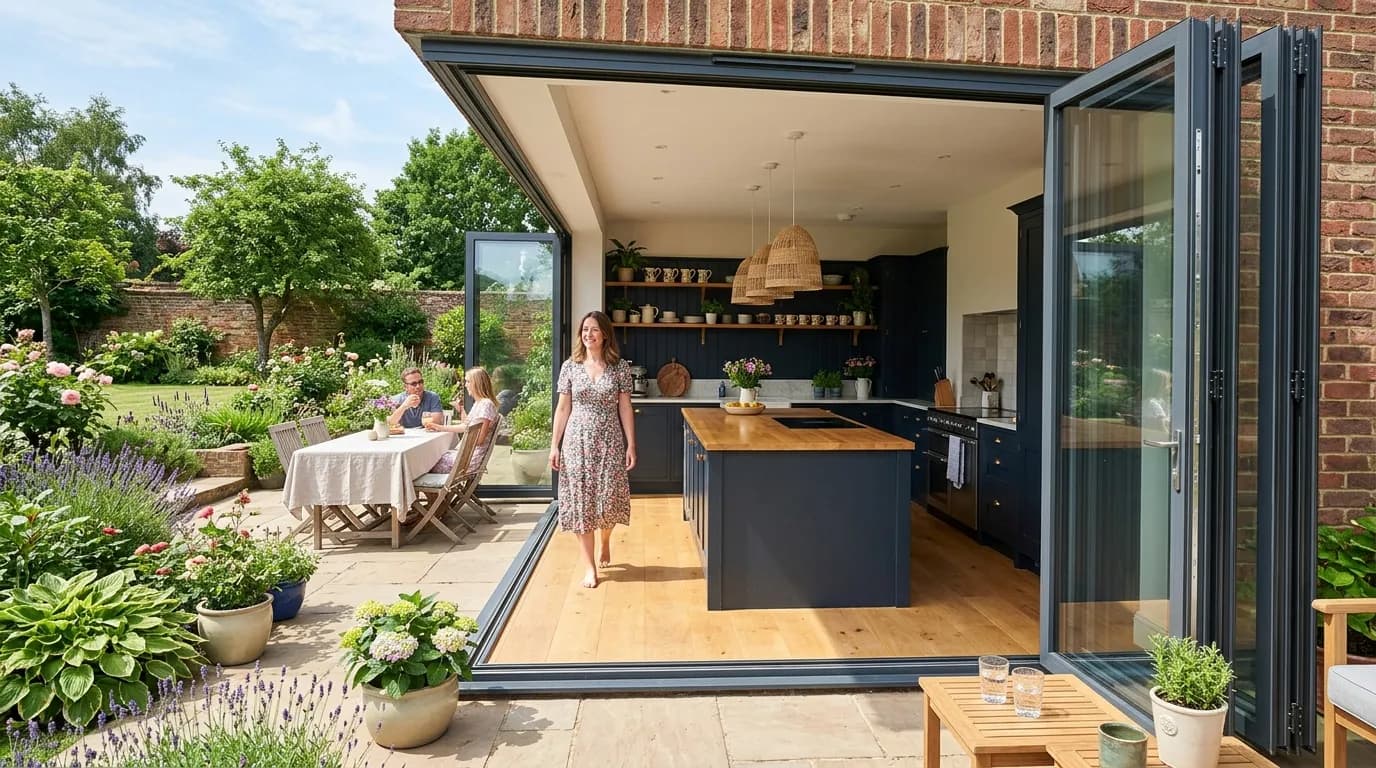
How bi-fold doors work
Bi-fold doors are multiple glass panels connected by hinges. Open them and the panels fold against each other like a concertina, stacking to one or both sides of the opening. Most fold to one side, but wider sets can split in the middle.
Each set has a traffic door (sometimes called a lead door) that opens like a normal door on its own. So you do not need to fold the whole lot just to nip out to the garden. The panels run on tracks top and bottom, with rollers guiding the fold.
The big advantage over sliding patio doors is the opening width. A slider gives you about half the opening because one panel sits behind the other. Bi-folds give you 90% or more of the full width. When they are open on a warm day, the room genuinely feels twice the size.
Panel configurations
2-panel (1.8m wide)
The smallest configuration. Suits narrow openings like a kitchen door or small living room. One panel folds against the other. Compact and affordable, but the opening is relatively modest.
3-panel (2.4m wide)
The most popular choice for UK homes. Three panels give a good balance of opening width and cost. Typically two panels fold to one side and the third acts as the traffic door. Works well for standard patio openings.
4-panel (3.2m wide)
A generous opening that works brilliantly for kitchen-diners and open-plan living spaces. Four panels can fold 3+1 or 2+2 (splitting to both sides). Needs a structural lintel if you are widening an existing opening.
5 or 6-panel (4.0m to 4.8m wide)
The full wall experience. Five or six panels create a dramatic opening that genuinely blurs the line between inside and outside. Popular for extensions and new builds. Expect to need structural work and possibly planning input for openings this wide.
Materials compared
The frame material is the biggest decision after size. It affects price, how much glass you actually see, and how long the doors last.
| Feature | Aluminium | uPVC | Timber |
|---|---|---|---|
| Market share (bi-folds) | 90%+ | ~8% | ~2% |
| Frame width | 35-55mm (slimmest) | 70-80mm (widest) | 55-70mm |
| 3-panel cost (installed) | £3,500 - £5,500 | £2,500 - £3,500 | £4,000 - £6,500 |
| Lifespan | 30-45 years | 20-30 years | 50+ years (maintained) |
| Maintenance | Wipe clean, virtually none | Wipe clean, virtually none | Sand and repaint every 3-5 years |
| Colour options | Any RAL colour, dual colour available | Limited (white, grey, black, woodgrain) | Any paint or stain colour |
| Best for | Most homes, modern and traditional | Budget-conscious projects | Listed buildings, premium finishes |
Key brands to know
The UK market has a handful of well-known manufacturers. Your installer will typically work with one or two of these, so the brand often depends on who you hire.
Origin
UK-manufactured aluminium bi-folds with a 20-year guarantee. Premium end of the market, but widely regarded as one of the best. Made to order in Buckinghamshire with lead times of just 5 to 7 working days, which is unusually fast.
Schuco
German-engineered aluminium systems favoured by high-end installers. Excellent build quality and thermal performance. You will see Schuco specified on architect-designed projects where the spec really matters.
Smart Systems
UK-based manufacturer offering a good mid-range aluminium option. The Visofold range is popular with installers and offers solid performance at a competitive price point. Good availability nationwide.
Visoglide (by Smart)
A sliding door system rather than bi-fold, but worth knowing about as an alternative. If you want the slim-frame aluminium look but prefer sliding to folding, Visoglide is a strong option at a lower price.
Bi-fold doors vs patio doors
Not sure whether bi-folds or standard patio doors are right for your home? Here is a quick comparison to help you decide.
| Factor | Bi-fold doors | Sliding patio doors |
|---|---|---|
| Opening width | 90%+ of the full width | About 50% (one panel slides behind the other) |
| Cost (3m opening, alu) | £3,500 - £5,500 | £1,200 - £2,500 |
| Best for | Entertaining, indoor-outdoor living, extensions | Everyday use, views, smaller budgets |
| Maintenance | More moving parts (hinges, rollers, track) | Fewer moving parts, simpler mechanism |
| Security | Multi-point locking on all panels | Multi-point locking, generally simpler to secure |
| Thermal performance | Good, but more joints means slightly more heat loss | Slightly better (fewer joints and seals) |
See our patio doors guide for a full comparison of all door types.
Bi-fold door guides
Bi-fold door cost guide
Full pricing by panel configuration and material. Aluminium, uPVC, and timber costs for 2 to 6-panel sets.
Patio door cost guide
Compare bi-fold costs with sliding, French, and inline patio door prices side by side.
Double glazing cost guide
Replacing windows at the same time as fitting bi-folds? Bundle the work for a better price.
Extension cost guide
Building an extension? Bi-fold doors are one of the most popular finishing touches.
Common questions
How many panels do I need for my bi-fold doors?
The number of panels depends on the width of your opening. A 2-panel bi-fold suits openings around 1.8 metres wide. Three panels work for 2.4 metres, four panels for 3.2 metres, and five panels for 4 metres. Six panels cover openings up to 4.8 metres. Most homes go for 3 or 4 panels. Your installer will measure the opening and recommend the best configuration based on the space available and how the doors fold.
Are aluminium bi-fold doors better than uPVC?
Aluminium is the most popular material for bi-fold doors, accounting for over 90% of installations. The frames are slimmer (35 to 55mm compared to 70 to 80mm for uPVC), so you get more glass and more natural light. Aluminium is also stronger, which matters when you have multiple heavy panels. uPVC is 30% to 40% cheaper and perfectly functional, but the thicker frames reduce the glass area and the range of colours is more limited. For bi-folds specifically, aluminium is worth the extra spend for most homeowners.
Do bi-fold doors need planning permission?
In most cases, no. Replacing an existing window or door opening with bi-fold doors falls under permitted development rights. If you are creating a new opening in a wall, you still do not usually need planning permission, provided the property is not listed, is not in a conservation area (if altering the front), and the work does not affect a party wall. You will always need Building Regulations approval for structural changes like removing sections of wall or fitting new lintels. A structural engineer can confirm what is needed for your project.
How long do bi-fold doors last?
Aluminium bi-fold doors last 30 to 45 years. The powder-coated finish may need attention after 20 to 25 years, but the frames themselves are very durable. uPVC bi-folds last 20 to 30 years with no maintenance. Timber bi-folds can last 50 years or more if you keep on top of the maintenance, which means sanding and repainting every 3 to 5 years. The sealed glass units typically last 15 to 25 years before the seals degrade and you start to see condensation between the panes.
Can I fit bi-fold doors myself?
Technically yes, but it is not advisable for most people. Bi-fold doors are heavy (each aluminium panel weighs 30 to 50kg), the frame needs to be perfectly level and square for the doors to operate smoothly, and any replacement glazing must comply with Building Regulations Part L. If your installer is FENSA registered, they handle the compliance paperwork. If you fit the doors yourself, you need to arrange a Building Control inspection through your local council, which costs £200 to £400. Getting the alignment wrong can cause the doors to bind, leak, or not lock properly.
Getting the best deal on bi-fold doors
Get at least three written quotes
Bi-fold door prices vary enormously between installers. The same 3-panel aluminium set can differ by £1,000 or more depending on the brand, the installer's margin, and whether structural work is included. Always get at least three written quotes that each specify the manufacturer, material, number of panels, colour, glass specification, and whether the price includes any structural alterations. Comparing like for like stops you overpaying, or choosing the cheapest quote only to find it does not include the lintel.
Useful resources
- FENSA, Check your installer is registered and can self-certify Building Regulations compliance
- Planning Portal: Doors and windows, Permitted development rules for replacing or adding doors
- Building Regulations Part K: Impact and safety glazing, Safety glazing requirements for doors and low-level windows
Open up your home for less
Find out exactly what bi-fold doors cost and how to get the best deal.
See 2026 prices