Water Softeners: Your Complete Guide
If you live in a hard water area, limescale is silently damaging your boiler, blocking your showerhead, and shortening the life of your appliances. A water softener fixes the problem at source. You can check your area's water hardness on the Drinking Water Inspectorate (DWI) website. This guide covers how they work, what they cost, and whether one makes sense for your home.
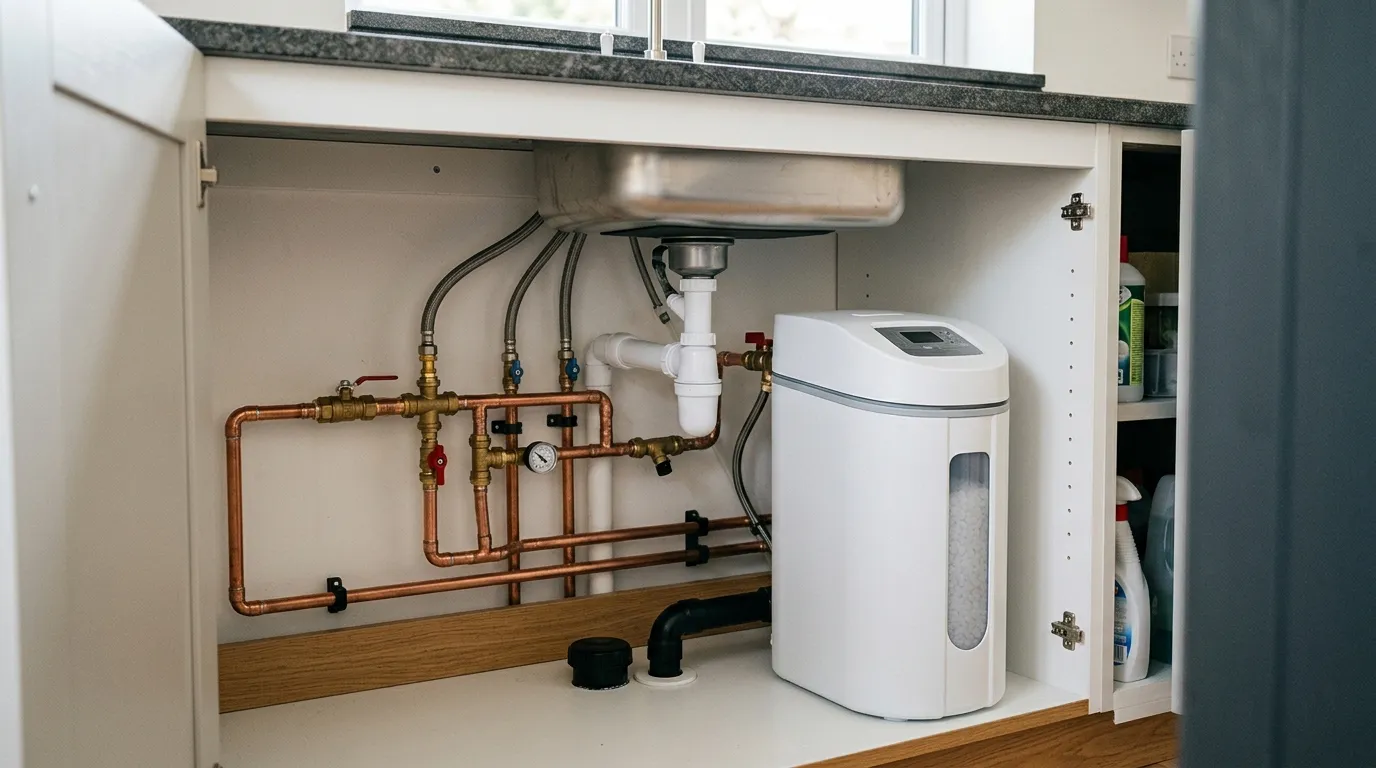
Types of water softener
Salt-based ion exchange
The most effective type. Uses resin beads and salt to remove calcium and magnesium from the water. Produces genuinely soft water. Needs monthly salt top-ups and a drain connection for regeneration wastewater.
Salt-free conditioner
Does not actually soften the water - it changes the structure of the minerals so they are less likely to form scale. No salt, no wastewater, no maintenance. Less effective than ion exchange but better than nothing in moderately hard areas.
Magnetic / electrolytic
A small device that clips onto the pipe and uses a magnetic field to alter the mineral crystals. Cheapest option (£50 to £150) with no running costs. Mixed evidence on effectiveness - may help in moderately hard areas but will not match a proper softener.
Reverse osmosis (drinking water)
Filters water through a membrane that removes almost everything, including minerals. Used for drinking water taps rather than whole-house softening. Often installed alongside a water softener to provide pure drinking water.
Water softener guides
Water softener cost guide
Installation prices, running costs, salt costs, and how to get the best deal.
Running costs breakdown
Salt, electricity, servicing, and whether a water softener pays for itself.
Boiler cost guide
New boiler prices - limescale is one of the top causes of boiler breakdowns.
Bathroom cost guide
New bathroom prices including taps and showers that benefit from soft water.
Get at least three quotes
Water softener installation prices vary between plumbers depending on the unit they recommend, the complexity of the pipework, and whether a drain connection is needed. Get at least three written quotes so you can compare the unit, the installation cost, and any ongoing maintenance charges like for like. Some installers bundle the unit and fitting into one price while others charge separately, so make sure you are comparing the full cost.
Common questions
Do I need a water softener?
If you live in a hard water area (over 200 mg/l calcium carbonate), a water softener protects your boiler, washing machine, dishwasher, and taps from limescale damage. It also makes cleaning easier and uses less soap and detergent. In soft water areas (under 100 mg/l), you do not need one. You can check your area's water hardness on the Drinking Water Inspectorate website or your water supplier's site.
How does a water softener work?
A salt-based water softener uses ion exchange resin to swap calcium and magnesium ions (which cause hardness) for sodium ions. The water passes through a tank of resin beads that attract and hold the hard minerals. Periodically, the unit flushes the resin with salt brine to regenerate it - this is called the regeneration cycle and happens automatically, usually at night.
Is softened water safe to drink?
Softened water contains slightly more sodium than hard water, but the amount is very small and safe for most people. However, it is recommended practice (under British Water's Code of Practice) to keep at least one tap in the house (usually the kitchen cold tap) unsoftened for drinking water. This also provides unsoftened water for filling fish tanks and watering certain plants.
Where is the water hardest in the UK?
The hardest water in the UK is in London and the South East, East Anglia, and the East Midlands - areas supplied by groundwater from chalk and limestone aquifers. The softest water is in Scotland, Wales, the South West, and parts of the North West, where water comes from surface sources like reservoirs and rivers.
Fed up with limescale?
See what a water softener costs and whether it makes sense for your area.
See 2026 prices