Do You Need Planning Permission for a Garden Room?
The short answer is: probably not. Most garden rooms in England qualify under permitted development rights and do not need a planning application. But there are specific rules on height, size, and location that you must follow, and some properties are excluded entirely.
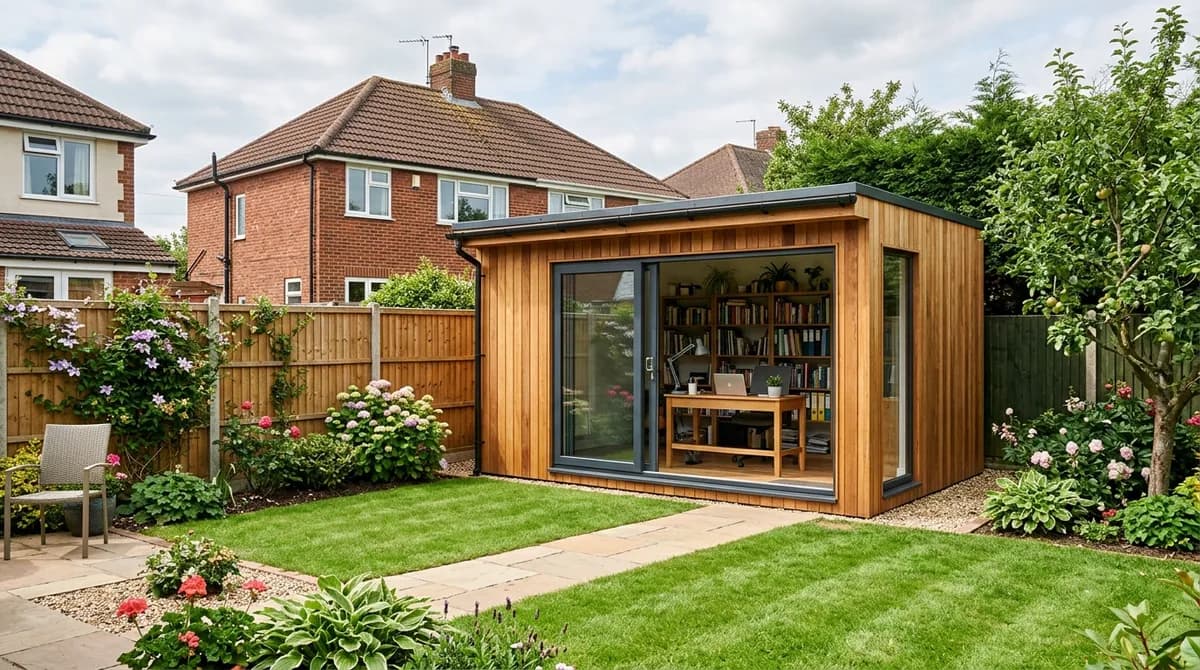
No PP needed
Most garden rooms
2.5m
Max height (near boundary)
50%
Max garden coverage
£274
LDC cost
Rules apply to England. Wales, Scotland, and Northern Ireland have separate planning legislation, check with your local authority.
Quick answer: Most garden rooms do not need planning permission under permitted development rights, provided they are single storey, stay within height limits, cover no more than 50% of the garden, and are not in your front garden. If you are in a conservation area, AONB, national park, or own a listed building, stricter rules apply and you may need a full planning application.
Permitted Development Rules for Garden Rooms
Under Schedule 2, Part 1, Class E of the Town and Country Planning (General Permitted Development) (England) Order 2015, outbuildings including garden rooms are permitted development (no planning application needed) provided all of the following conditions are met:
Must not cover more than 50% of the garden
The total area of all outbuildings, extensions, and other additions within the curtilage of the house must not exceed 50% of the total garden area. This is cumulative, if you already have a large extension or shed, that counts towards the 50%.
Maximum height: 2.5m within 2m of a boundary
If any part of the garden room is within 2 metres of any boundary (your fence, wall, or the edge of your property), the maximum overall height is 2.5 metres. This applies to the total height, not just the eaves.
Maximum height: 4m for a dual-pitched roof
If the building is more than 2 metres from all boundaries and has a dual-pitched (ridged) roof, the maximum height is 4 metres. A dual-pitched roof has two sloping sides that meet at a central ridge.
Maximum height: 3m for any other roof type
If the building is more than 2 metres from all boundaries and has a flat roof, a mono-pitch (lean-to) roof, or any other roof type that is not a full dual-pitched roof, the maximum height is 3 metres.
Single storey only
Garden rooms under permitted development must be single storey. You cannot add a mezzanine level or internal upper floor under these rules.
Not in front of the principal elevation
The garden room must not be placed forward of the principal elevation (the front face) of the original house. In practice, this means it must go in your rear or side garden, not your front garden. If your house faces a road, the front garden is almost certainly out.
No balconies, verandas, or raised platforms
The building must not include a balcony, veranda, or any raised platform. A simple door step or decking at ground level is fine. A raised deck or external elevated platform is not permitted under these rules.
Must not be used as a separate dwelling
The garden room must remain ancillary to the main house, it cannot be used as a self-contained home with its own address. A home office, gym, studio, games room, or annexe for a family member living in the same household is fine.
All conditions must be met. Permitted development is not a tick-one-box situation, your garden room needs to satisfy every single rule above to qualify. If you are unsure, contact your local planning authority before ordering. Most offer free pre-application advice.
When You Do Need Planning Permission
Even if your garden room would otherwise qualify under permitted development, there are circumstances where you will need a full planning application.
Listed buildings
If your home is a listed building, permitted development rights are removed entirely. You need both full planning permission and listed building consent before carrying out any work in the curtilage of the property. The bar for approval is much higher, and the design will need to be sympathetic to the listed structure. Contact Historic England or your local planning authority for guidance.
Conservation areas, AONBs, and National Parks
Properties in a conservation area, Area of Outstanding Natural Beauty (AONB), National Park, or World Heritage Site face additional restrictions. In these areas, any outbuilding over 10m² that is more than 20 metres from the dwelling requires planning permission. The 50% curtilage coverage rule is also applied more strictly. Always check the designated area status of your property on your council's planning portal before proceeding.
Your permitted development rights have been removed
Some properties have had their permitted development rights removed by an Article 4 Direction, a planning condition that removes the usual PD entitlements in a specific area. This sometimes happens in sensitive locations or on new-build estates where the developer wanted to control what homeowners could build. Check your property's title deeds or search your council's planning records for any Article 4 Directions affecting your address.
You want to use it as a separate dwelling
Permitted development only allows garden rooms that are ancillary to the main house, used by the same household. If you want to rent it out as a self-contained flat, use it as a holiday let, or create a genuinely independent dwelling with its own address, you need planning permission for a change of use. This is more complex and may not be granted depending on your property and local planning policies.
The building exceeds permitted development size limits
If your garden room is taller than the permitted height limits, or the building plus existing outbuildings exceeds 50% of the garden area, you will need to apply for planning permission. This is not automatically refused, it just means your local planning authority will assess the proposal against local planning policies.
Building Regulations: What Applies to Garden Rooms?
Planning permission and Building Regulations are two separate things. Even if your garden room does not need planning permission, it may still need Building Regulations approval. Here is how the rules break down by size and use.
| Scenario | Building Regs? |
|---|---|
| Under 15m², detached, 1m+ from boundary | Exempt |
| Under 15m², within 1m of boundary | Part B applies |
| 15m² to 30m² floor area | Relaxed Regs |
| Over 30m² floor area | Full Regs |
| Used for sleeping (any size) | Full Regs |
| With plumbing (WC, shower, sink) | Part H applies |
| Electrical installation (all sizes) | Part P always |
The 15m² exemption threshold
Garden rooms under 15m² floor area are exempt from Building Regulations, provided the building is single storey and detached. The most common exemption caveat is fire safety: if any part of the building is within 1 metre of a boundary, the external walls must be constructed or clad with a material that achieves 30 minutes' fire resistance. Most reputable garden room suppliers build to this standard as a matter of course, but it is worth asking before you order.
Between 15m² and 30m²: relaxed but not exempt
If your garden room exceeds 15m² but stays under 30m², Building Regulations do apply, but in a more relaxed form. The main requirements are structural stability (the building must not collapse) and fire safety (smoke alarms, appropriate exit routes). In practice, a well-built garden room from a reputable UK supplier will typically meet these requirements without much additional work, but you should confirm this with your supplier and submit a Building Regulations application to your local authority.
Sleeping accommodation: full Building Regs always
If you plan to use the garden room as a bedroom, whether for a family member, a dependent relative, or as a regular sleeping space, full Building Regulations apply regardless of size. This covers structural safety, thermal insulation (Part L), ventilation (Part F), fire safety (Part B), and means of escape. If you are creating an annexe for an elderly parent, for example, you will also need to consider Part M (access and facilities for disabled people). Check the full requirements at Gov.uk.
Should You Get a Lawful Development Certificate?
A Lawful Development Certificate (LDC) is an official document from your local planning authority confirming that your garden room is lawful under permitted development. You are not legally required to get one, your garden room is lawful whether or not you have the certificate, but there are good reasons to consider it.
Why you might want one
- Gives official written confirmation that no planning permission was needed
- Extremely useful when selling your home, solicitors often ask for it
- Removes any future ambiguity if planning rules change
- Provides peace of mind if your neighbours later raise objections
- Quick to obtain, most decisions within 8 weeks
Why you might skip it
- Costs £274 in council application fees (England)
- Not legally required, PD rights apply automatically
- Adds time before you can order your garden room
- Most sales proceed without one, especially for newer builds
- Retrospective LDC can be applied for later if needed
How to apply for a Lawful Development Certificate
- 1Submit an application via the Planning Portal or directly to your local planning authority. The application type is “Lawful Development Certificate for a proposed use or development”.
- 2Include a site plan, floor plan, and elevations of the proposed garden room, along with a written description of the development.
- 3Pay the application fee. A lawful development certificate for a proposed use or development costs £274 in England, which is half the £548 householder planning application fee.
- 4The council has 8 weeks to decide. If your proposal meets the PD criteria, they must issue the certificate. If refused, you can appeal.
Fee information correct as of April 2026. Check your local authority’s website for the current fee schedule, as these can vary.
Council Tax: Does a Garden Room Count?
A garden room used as a home office, gym, studio, or hobby space is generally not subject to a separate council tax banding, it is considered part of the main dwelling.
However, if the garden room is used as a self-contained dwelling, with sleeping accommodation, cooking facilities, and its own entrance used independently from the main house, the Valuation Office Agency (VOA) may assess it for a separate council tax banding. This can happen even if you only use it as an annexe for a family member.
Annexe discount available
If your garden room is assessed as an annexe and occupied by a dependent relative (over 65, or severely mentally impaired, or substantially and permanently disabled), it may qualify for a 50% council tax discount. Check with your local council for the current rules.
How to Navigate Garden Room Planning for Less
Planning and Building Regulations do not have to cost you a lot of time or money if you get a few things right from the start.
Check your property status before ordering
Before committing to a garden room, spend 10 minutes checking whether your property is in a conservation area, AONB, or has any Article 4 Directions. Search your postcode on your local council's planning portal, most have an interactive map. This takes almost no time and could save you from ordering a garden room that turns out to need planning permission.
Design to the permitted development limits
If your garden room will be near a boundary, designing to 2.4m total height (rather than 2.5m) gives you a comfortable margin and removes any ambiguity about measurement methods. Most standard garden room designs from reputable UK suppliers already factor in the PD height limits, but always confirm before ordering.
Get a Lawful Development Certificate if you plan to sell
If you intend to sell your home within the next 10 to 15 years, the £274 for a Lawful Development Certificate in England is easily one of the best value investments you can make on your garden room project. Solicitors and mortgage lenders increasingly request written planning confirmation for outbuildings, and having the LDC ready removes a potential sales blocker at a stressful time.
Get at least three quotes, and ask about compliance
A reputable garden room supplier will know the permitted development rules inside out and should be able to tell you whether your chosen design qualifies without planning permission. If a supplier seems vague about PD compliance, treat that as a warning sign. Getting three quotes also lets you compare who includes planning advice as part of the service.
Official Resources and Further Reading
The rules on this page are based on national planning legislation for England. These official sources will give you the definitive guidance for your circumstances.
Planning Portal: Outbuildings permitted development rules
The official resource for householder permitted development. Covers all outbuilding types including garden rooms, sheds, and garages.
Gov.uk: Planning permission guidance
General guidance on when planning permission is needed, how to apply, and what happens if you build without it.
Gov.uk: Building Regulations approval
Explains which projects need Building Regulations approval, how to apply, and what the different Parts of the Regulations cover.
Frequently Asked Questions
Do you need planning permission for a garden room?
Most garden rooms do not need planning permission under permitted development rights. To qualify, the building must be single storey, must not cover more than 50% of the garden, must not be in front of the principal elevation (your front garden), must not have a balcony or veranda, and must not exceed height limits: 2.5m if within 2m of a boundary, 4m for a dual-pitched roof, or 3m for any other roof type. Properties in conservation areas, listed buildings, national parks, and AONBs face stricter rules.
How close to a fence can I build a garden room without planning permission?
You can build a garden room right up to a boundary fence or wall without planning permission, but the maximum height is reduced to 2.5m if any part of the building is within 2m of a boundary. If you keep the building more than 2m away from all boundaries, the height limit increases to 4m (dual-pitched roof) or 3m (any other roof). There is no minimum setback distance required under permitted development rules.
What is a Lawful Development Certificate and do I need one?
A Lawful Development Certificate (LDC) is a formal document from your local planning authority confirming that your garden room is lawful under permitted development rights. You do not legally need one, your garden room is lawful whether you get it or not, but it provides official written confirmation, which is extremely useful when selling your home and removes any ambiguity. An LDC for a garden room costs £274 in council fees in England, plus any agent fees if you use one. Applications are decided within 8 weeks.
Do garden rooms need Building Regulations approval?
It depends on size and use. Garden rooms under 15m² are exempt from Building Regulations if they are detached and at least 1m from any boundary. Between 15m² and 30m², Building Regulations apply but in a relaxed form, mainly covering structural safety and fire precautions. Over 30m², full Building Regulations apply. If the garden room will be used for sleeping, or has a bathroom or shower, full Building Regulations apply regardless of size. Electrical work always requires a Part P registered electrician regardless of the building size.
Can I use a garden room as a self-contained annexe or granny flat?
You can use a garden room as an annexe for a dependent relative under permitted development in most cases, but you will need full Building Regulations approval for sleeping accommodation regardless of size. If you want to use it as a completely separate self-contained dwelling (a separate home with its own address), you will need planning permission as a change of use, and it may be subject to council tax as a second property. Garden rooms used only by members of the household, even as a regular bedroom, are generally permitted without full planning permission, provided the PD conditions are met.
Do the planning rules for garden rooms apply in Wales and Scotland?
The rules described on this page apply to England. Wales has its own permitted development rules, which are broadly similar but have some differences, check with your local planning authority in Wales. Scotland has separate planning legislation through the Town and Country Planning (General Permitted Development) (Scotland) Order 1992, as amended. Northern Ireland also has its own rules. If you are outside England, always check with your local planning authority to confirm what applies in your area.

Written by Chris Kervin, Co-Founder of Less.co.uk
Last updated: · Based on planning legislation for England · Methodology
Ready to build your garden room?
Get free quotes from local garden room suppliers who design to permitted development rules. Most standard installations do not need planning permission, and the right supplier will confirm this for your specific site.
Compare Free QuotesComing soon, sign up to our newsletter to be the first to know.