Home CCTV: Your Complete Guide
Home CCTV has come a long way from grainy black-and-white footage. Modern systems offer 4K resolution, night vision, and smartphone alerts - and you can have a full setup fitted for less than you might think. This guide covers camera types, installation costs, and the UK rules you need to follow, including the ICO's guidance on domestic CCTV and data protection.
Types of CCTV camera
Bullet cameras
The classic tubular shape you see on most homes. Good for monitoring a specific area like a driveway or front door. Usually weatherproof with built-in infrared for night vision. Easy to aim and adjust. The most popular choice for domestic CCTV.
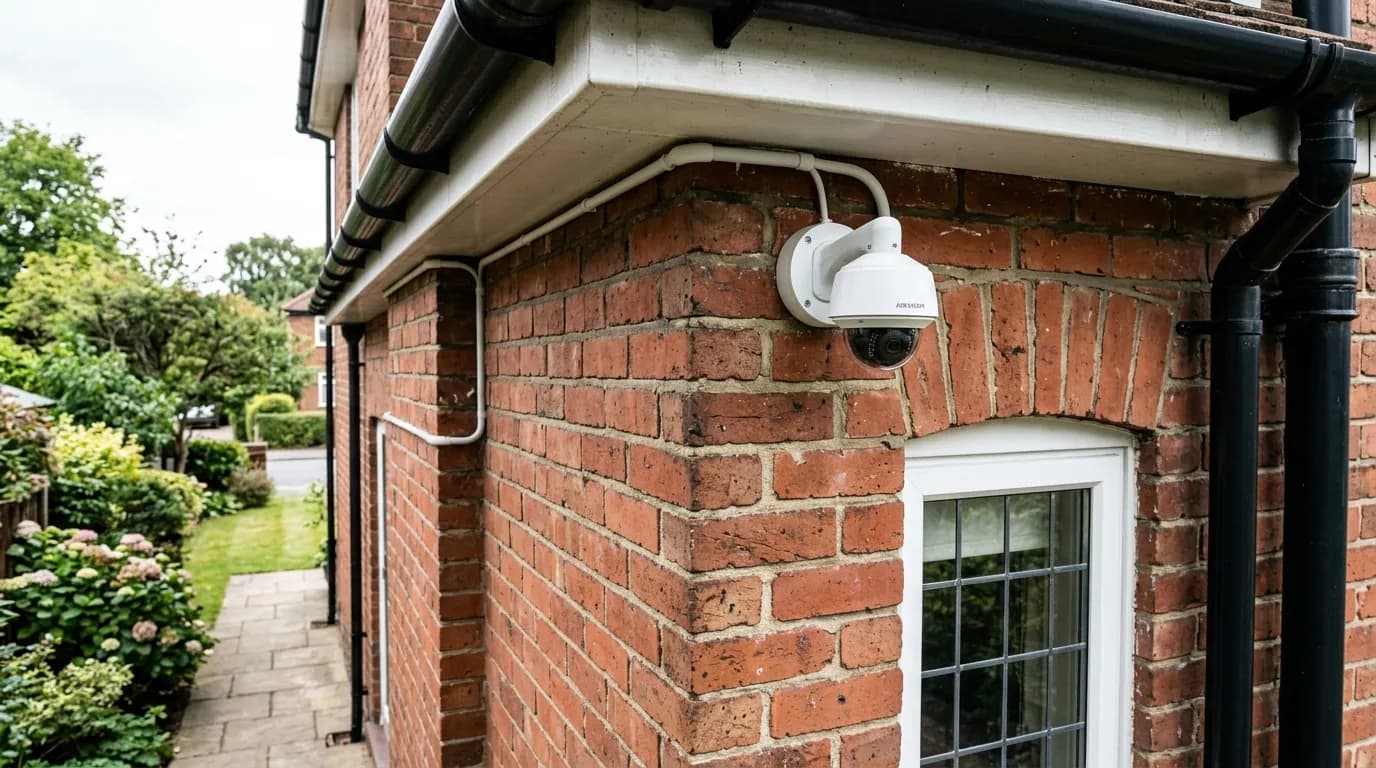
Dome cameras
Compact, dome-shaped cameras that sit flush against a wall or soffit. Harder to tamper with because the lens direction is not obvious from below. Common on commercial buildings but increasingly used at home for a tidier look.
PTZ cameras (pan-tilt-zoom)
Motorised cameras that can rotate, tilt, and zoom remotely via an app. Cover a much wider area than fixed cameras. More expensive and more complex to set up, but useful if you want to monitor a large garden or multiple angles from one camera.
Doorbell cameras
A video doorbell like Ring or Google Nest that records your front door area and lets you speak to visitors remotely. Not a full CCTV system, but a good starting point for front-of-house security. Easy to install yourself. Usually requires a cloud subscription for recording.
CCTV guides
CCTV installation cost guide
Full pricing for 2, 4, and 8 camera systems. Wired vs wireless, professional installation, and monthly monitoring.
Wireless CCTV cost guide
Ring, Arlo, Eufy, and more. DIY camera prices, subscriptions, and whether wireless is enough.
Electrical work cost guide
Electrician costs for wiring, sockets, and other work - often needed alongside CCTV.
Electric gate cost guide
Electric gate prices - a common pairing with home CCTV for security.
Common questions
Do I need permission to install CCTV at home?
You do not need planning permission to install CCTV on your property. However, if your cameras capture footage beyond your property boundary - such as a neighbour's garden, a shared driveway, or a public pavement - you have responsibilities under data protection law. The ICO recommends pointing cameras only at your own property where possible. If cameras do cover public areas, you should put up signs saying CCTV is in use.
What is better - wired or wireless CCTV?
Wired systems are more reliable. They do not drop out when your WiFi signal weakens, and they provide a consistent power supply so there is no need to charge batteries. Wireless cameras are easier to install (no cable runs through walls) and can be repositioned more easily. For a permanent home system, wired is usually the better choice. For renters or anyone who does not want to drill holes, wireless makes more sense.
How much storage do CCTV cameras need?
A single 2MP camera recording continuously uses roughly 15 to 20GB per day. A 4-camera system recording 24/7 would fill a 1TB hard drive in about two weeks. Most systems use motion-activated recording to reduce storage needs by 70 to 80%. Cloud storage plans typically cost £3 to £10 per camera per month. Local NVR or DVR systems store footage on a hard drive with no monthly fees.
Can CCTV footage be used as evidence?
Yes. CCTV footage is regularly used as evidence by UK police and in court cases. For it to be admissible, the footage should be clear enough to identify people, timestamped correctly, and stored securely so it has not been tampered with. Higher resolution cameras (4MP or above) produce much more useful footage than basic 1080p models.
Getting the best deal on CCTV
Get at least three written quotes
CCTV installation prices vary a lot between security firms. The same 4-camera setup can differ by hundreds of pounds depending on the camera brand, resolution, recording method, and how complex the cable routing is. Always get at least three written quotes and check that each one specifies the camera model and resolution, the recording system (NVR, DVR, or cloud), whether cabling is included, and any ongoing subscription costs. Comparing like for like ensures you do not end up overpaying or choosing a cheaper system that does not actually do the job.
Want to secure your home?
Find out what a CCTV system costs and get the right setup for your property.
See 2026 prices