Skip Hire: Your Complete Guide to Sizes, Costs & Permits
Whether you are clearing out a garage, renovating a bathroom, or knocking down a wall, chances are you will need a skip. The trouble is working out what size to get, whether you need a permit, and how to avoid paying over the odds. If the skip sits on a public road, you will need a permit from your local council. This guide covers every size from mini to roll-on-roll-off, what can and cannot go in a skip, and how to keep costs down.
Skip sizes explained
Mini skip (2 cubic yards)
The smallest option, holding roughly 30 bin bags. Good for a small bathroom strip-out, clearing a shed, or a weekend garden tidy. Fits on most driveways and is easy to fill without a ramp.
Midi skip (4 cubic yards)
Holds around 45 bin bags. The right choice for a single-room clearance, a moderate garden project, or stripping out a kitchen. Popular with homeowners doing smaller renovation jobs.
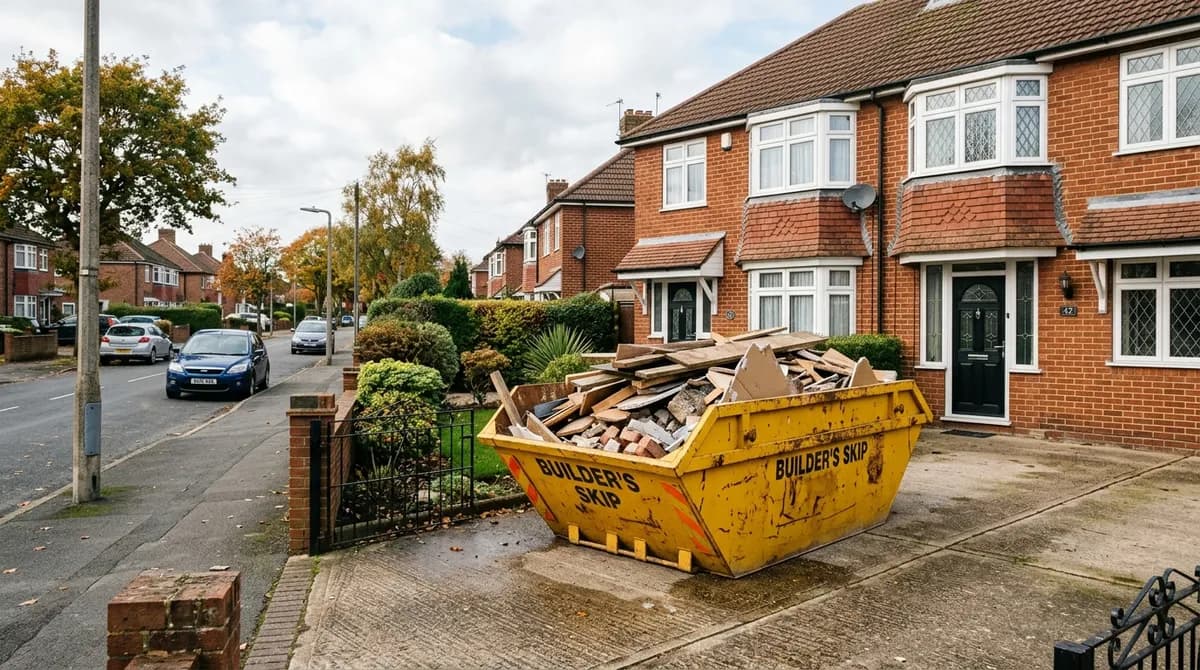
Builder's skip (8 cubic yards)
The standard skip for home renovations - holds about 80 bin bags. This is by far the most commonly hired size, suitable for bathroom refits, kitchen renovations, and general house clearances. Most skip companies have these readily available.
Large skip (12 cubic yards)
Holds roughly 120 bin bags. You would typically hire this for an extension, loft conversion, or a complete room renovation where the waste includes rubble, timber, and plasterboard. Needs a decent amount of space on your drive.
Maxi skip (14 cubic yards)
One step up from the large skip - around 140 bin bags. Used for major renovations, structural work, or whole-house clearances where the waste volume is significant but a roll-on-roll-off would be overkill.
Roll-on-roll-off (20 to 40 cubic yards)
The biggest option, mainly used on commercial sites or major building projects. Delivered on a specialist lorry. You would rarely need one for a domestic job unless you are demolishing a garage or doing a complete house renovation down to the shell.
What can and cannot go in a skip
Accepted waste
- General household waste and furniture
- Garden waste, soil, and turf
- Wood, timber, and plywood
- Rubble, bricks, concrete, and tiles
- Metals and scrap
- Plasterboard (often needs a separate skip)
- Cardboard and packaging
Prohibited items
- Asbestos (requires specialist removal)
- Tyres
- Batteries (car or household)
- Gas bottles and cylinders
- Fridges and freezers
- Paint, solvents, and chemicals
- Electrical items (WEEE waste)
- Fluorescent tubes and light bulbs
- Medical or clinical waste
If in doubt, ask the skip company before loading. Putting prohibited items in a skip can result in the whole load being rejected at the waste transfer station, and you may be charged extra for sorting.
Skip permits - when do you need one?
On a public road or pavement - permit required
If the skip sits on any public highway, pavement, grass verge, or council-maintained land, you need a skip permit from your local council. The skip company usually arranges this for you and adds it to the bill. Permit costs vary from £20 to £65 depending on the council and how long the skip will be there.
On your own driveway or land - no permit needed
If the skip fits entirely on your private property - your driveway, front garden, or yard - you do not need a permit. This is the cheapest and simplest option, and it avoids any restrictions on how long you can keep the skip.
Lights and markings
Skips on a public road must have reflective markings and lights at night. A reputable skip company handles this automatically - they fit amber lights and reflective tape before delivery. If you are arranging your own skip, make sure this is included.
Parking bay or restricted area
If the only place for the skip is a residents' parking bay, bus lane, or near a junction, the council may refuse the permit or impose additional conditions. Check with your skip company before booking - they deal with these situations regularly and can advise on alternatives.
Alternatives to skip hire
Grab lorry (wait-and-load)
A lorry with a mechanical grab arm turns up, you load the waste, and it takes it away immediately. No permit needed because the lorry does not stay. Costs £200 to £400 and is ideal if you have the waste ready to go or cannot leave a skip on the road.
Man and van
Hire a licensed waste carrier with a van or truck. They load and remove your waste in one visit. Typically £100 to £300 depending on volume. Good for smaller clearances, furniture removal, or when access is difficult for a skip lorry.
Council tip (HWRC)
Your local Household Waste Recycling Centre is free to use for domestic waste. You need to book a slot online in most council areas and there are limits on how much you can bring per visit. Works well if you have a car or trailer and the time to make multiple trips.
Skip bags
Heavy-duty bags that hold about 1 cubic yard of waste - roughly a builder's wheelbarrow load. You buy the bag for £5 to £15, fill it, and book a collection for £60 to £100. Good for small jobs where a mini skip would be too much.
Skip hire guides
Skip hire cost guide
Full price breakdown for every skip size, from mini to roll-on-roll-off, in 2026.
Skip sizes & prices guide
Which skip size for your job? Visual guide with bin bag equivalents and project matching.
Extension cost guide
What an extension costs - a job that almost always needs a skip.
Loft conversion costs
Loft conversion prices across the UK, including waste removal.
Get at least three quotes
Skip hire prices vary noticeably between companies in the same area, especially for larger skips. The price depends on the skip size, hire duration, waste type, and whether a permit is needed. Get at least three written quotes before booking so you can compare the total cost like for like. Check what is included - some companies bundle the permit fee while others add it on top, and overweight charges can catch you out if you are filling the skip with heavy rubble.
Common questions
Do I need a permit for a skip?
You need a permit if the skip is placed on a public road, pavement, or grass verge. Your local council issues the permit, typically for £20 to £65. If the skip sits entirely on your private land - driveway, garden, or yard - no permit is needed.
What size skip do I need?
For a small bathroom refit or garden clearance, a midi skip (4 cubic yards) is usually enough. For a kitchen or bathroom renovation, a builder's skip (8 cubic yards) is the most popular choice. For extensions or whole-house clearances, go for a 12-yard skip or bigger.
What cannot go in a skip?
Hazardous waste is banned. That includes asbestos, tyres, batteries, gas bottles, fridges, paint, solvents, and electrical items. Most companies also require plasterboard to go in a separate skip.
How long can I keep a skip for?
Standard hire is 7 to 14 days. If you need longer, most companies offer extended hire for £5 to £10 per day. If the skip is on a public road, you may need to extend the council permit too.