How Much Does Patio Laying Cost in 2026?
Patio laying costs vary from £50/m² for concrete slabs up to £250/m² for granite setts. The labour element alone runs at £30 to £50/m² on top of materials. The total depends on what you choose, how big the patio is, and how much ground preparation is needed.
£50/m²
Concrete slabs from
£100/m²
Porcelain from
£110/m²
Natural stone from
£30 to £50/m²
Labour cost
Prices updated April 2026 · Based on industry data and contractor submissions.
Patio Laying Cost per m² by Material
All prices below are fully installed, they include excavation, sub-base, mortar bed, laying, and pointing. The supply price is what you pay for just the paving material. Labour to lay a patio runs at £30 to £50/m² regardless of material; the difference in total cost is almost entirely down to the slab price.
| Material | Supply/m² | Laid/m² |
|---|---|---|
| Concrete paving slabs | £15 to £25 | £50 to £80 |
| Indian sandstone | £30 to £50 | £80 to £130 |
| Porcelain paving | £35 to £60 | £100 to £180 |
| Limestone | £40 to £65 | £110 to £200 |
| Granite setts | £50 to £80 | £140 to £250 |
| Block paving | £20 to £40 | £80 to £140 |
Prices include excavation, MOT Type 1 sub-base, mortar bed, laying, and pointing. London and South East add approximately 25 to 35%.
Total Cost by Patio Size
| Patio Size | Concrete | Sandstone |
|---|---|---|
| 10m² (small courtyard) | £500 to £800 | £800 to £1,300 |
| 20m² (standard patio) | £1,000 to £1,600 | £1,600 to £2,600 |
| 30m² (large patio) | £1,500 to £2,400 | £2,400 to £3,900 |
| 50m² (very large) | £2,500 to £4,000 | £4,000 to £6,500 |
Prices for a standard rear garden patio with full sub-base. Front garden patios may cost more if permeable paving is required.
Ground Preparation: Where Most of the Labour Cost Goes
The preparation work, digging out, compacting the sub-base, and getting everything level, takes just as long as the actual laying. It is also the part most often skimped on when contractors cut corners. A proper preparation adds £30 to £50/m² to the job but is the difference between a patio that lasts 20 years and one that sinks after two winters.
The total excavation depth needs to be 150 to 200mm below your finished patio level. That means digging out the topsoil and subsoil, removing it by skip or grab lorry, laying and compacting 100mm of MOT Type 1 hardcore, and then applying the mortar bed on top. On top of that, the patio needs to slope slightly away from the house, a fall of 1:60 (about 15mm per metre), to ensure rainwater drains away rather than pooling against the walls.
Excavation
150 to 200mmMachine dig where access allows, hand dig otherwise. Soil needs removing by skip or grab lorry.
£8 to £15/m²
Sub-base (MOT Type 1)
100mm minimumCompacted hardcore creates a stable foundation. The most important step, never skip it.
£15 to £25/m²
Mortar bed
30 to 50mmSand and cement mix on which slabs are bedded. Porcelain paving needs a specific adhesive instead.
£5 to £10/m²
Pointing / jointing
N/AFills the gaps between slabs. Resin jointing compound costs more but lasts longer and resists weeds.
£5 to £15/m²
Edging
N/AKerb edging or concrete haunching holds the perimeter slabs in place.
£10 to £25/lin.m
Watch out for: Quotes that seem unusually cheap often skip proper sub-base preparation. Always ask whether the quote includes excavation, MOT Type 1 hardcore, and disposal of spoil, these three items account for around half the total labour cost.
Patterns and Layouts: How They Affect the Price
The pattern you choose affects how long the job takes, how much material is wasted in cutting, and therefore how much it costs. For most homeowners, a simple stacked or offset pattern looks clean and modern, the complex herringbone and opus patterns are worth considering if you want a premium finish and can accommodate the extra cost.
| Pattern | Cost Impact |
|---|---|
| Stack bond (grid) | Standard |
| Stretcher bond (offset) | +5% |
| Herringbone | +15 to 20% |
| Opus / random | +15 to 25% |
Drainage: Getting the Fall Right
Every patio must slope away from the house to prevent water pooling against the walls. The standard fall is 1:60, roughly 15mm drop for every metre of patio. On a 4-metre-deep patio, that means the far edge sits about 60mm lower than the edge against the house.
The patio surface must also finish at least 150mm below the damp-proof course (DPC) in your house wall. If the ground level is already close to the DPC, you may need to excavate deeper than usual or install a drainage channel against the house, both of which add to the cost. This is one of the most common mistakes in DIY patio projects and causes serious damp problems inside the house.
Linear drainage channel (against house wall)
Essential where the patio sits close to the DPC or has poor natural drainage
£50 to £100/lin.m
Soakaway
Needed if there is no suitable drainage outlet nearby; connects to the drainage channel
£200 to £500
Permeable paving (front gardens over 5m²)
Required by planning rules for front gardens, allows water to drain through the surface
+£10 to £20/m²
Do You Need Planning Permission to Lay a Patio?
In most cases, no. Laying a patio in a rear garden falls under permitted development rights in England and Wales, no planning application is needed. The rules are slightly different for front gardens.
Rear garden patios
Almost always permitted development, no planning permission needed regardless of size or material.
Front gardens over 5m²
Must use permeable paving (such as block paving with open joints, gravel, or permeable concrete) OR direct rainwater to a lawn or border. Impermeable surfaces over 5m² need planning permission.
Conservation areas and listed buildings
Additional restrictions may apply. Check with your local planning authority before starting work.
Full guidance on paving your front garden is on the Planning Portal: Paving and drainage rules.
How to Get Your Patio Laid for Less
Patio laying is one of the more competitive trades, prices can vary significantly between installers. Here is how to make sure you get a fair deal without cutting corners on quality.
Always get at least three quotes
Patio prices vary enormously between installers, sometimes by 40 to 50% for identical work. Get three quotes on the same specification, same material, same size, same sub-base depth, so you are comparing like for like. The cheapest quote is not always the best value; check what is and is not included, particularly excavation and disposal of spoil.
Concrete slabs look great when well laid
The cheapest material does not have to mean the worst result. Good quality concrete slabs in a riven or textured finish, laid well with tight joints and consistent pointing, can look genuinely attractive. At £50 to £80/m² installed, they cost half the price of porcelain, for a small courtyard or utility area, they are often the sensible choice.
Buy your paving materials directly
Sourcing slabs yourself from a builders merchant, quarry, or online trade supplier can save 15 to 25% compared with buying through your installer. Arrange delivery to coincide with the job start date, most installers are happy to work with materials you supply. Just make sure you order 10% extra to allow for cuts and breakages.
Keep the shape rectangular and the pattern simple
A rectangular patio with a straightforward stacked or offset pattern minimises cutting waste and saves labour time. Every curve, angle, or intricate pattern adds cost. If you want visual interest, achieve it with a contrasting border or stepping stone feature rather than a complex overall pattern, the impact is similar but the cost is much lower.
Ask whether the quote includes VAT
Smaller landscaping firms with a turnover under the £90,000 VAT threshold do not have to charge the 20% VAT that a larger registered company adds to its labour. On a mid-sized patio that can be a few hundred pounds of difference for identical work. When you compare quotes, check whether each price includes VAT so you are comparing the full figure, not just the headline number.
Useful Resources
Planning Portal: Paving and drainage rules
Official guidance on front garden paving rules, permeable surfaces, and when planning permission is needed.
BALI: British Association of Landscape Industries
Find BALI-registered landscapers and patio installers. Members follow a code of conduct and carry industry-standard insurance.
What to Expect: The Patio Laying Process
A typical patio installation takes 2-3 days for a standard 15-20m² area. Here's what your landscaper will do at each stage.
- 1
Planning and marking out
The area is measured and marked with string lines. Ground levels, drainage falls (a minimum 1:60 gradient away from the house), and access points are established.
- 2
Excavation and ground preparation
Turf and topsoil are removed to the required depth, typically 150-200mm. The exposed ground is compacted with a wacker plate to create a firm, level base.
- 3
Sub-base installation
A layer of MOT Type 1 hardcore (usually 75-100mm) is spread and compacted in layers. This provides a stable, well-drained foundation that prevents the patio from sinking over time.
- 4
Mortar bed and slab laying
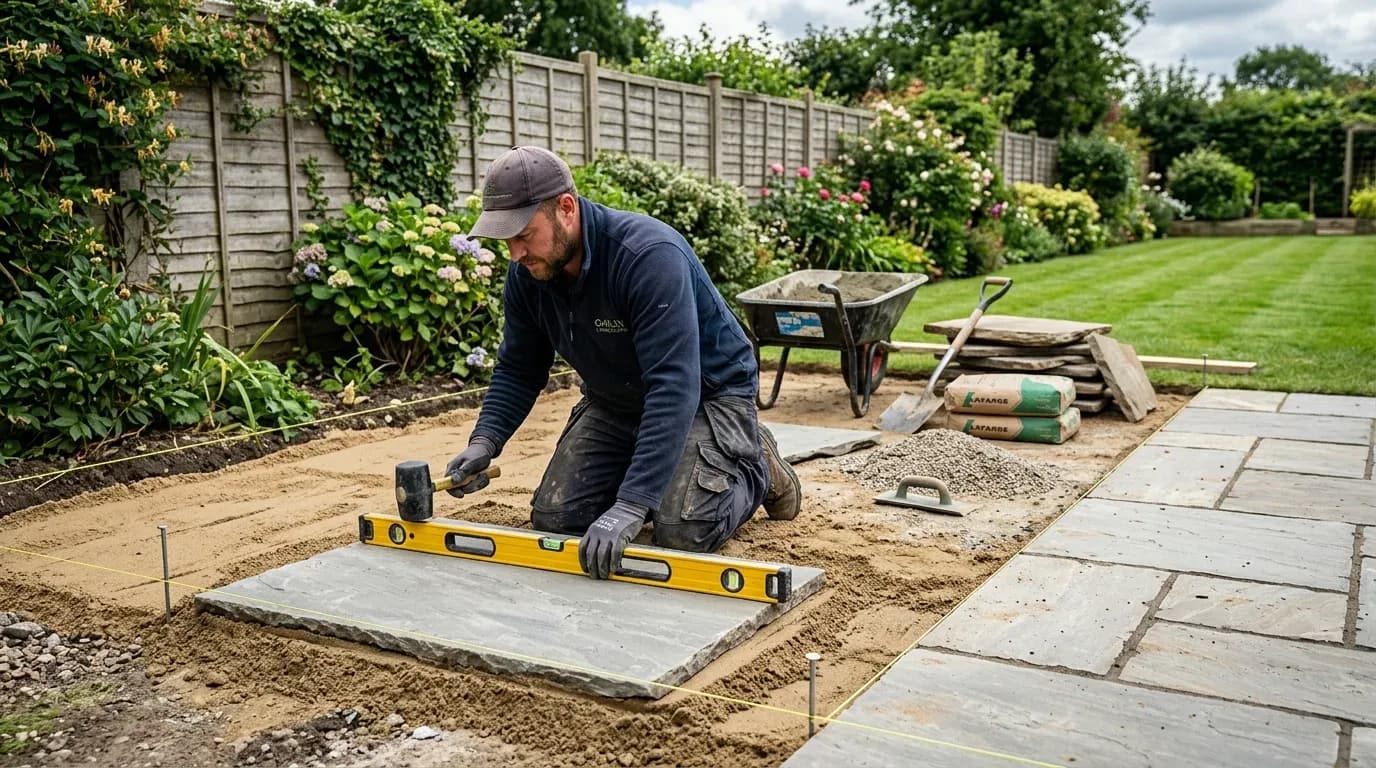
A cement and sharp sand mortar mix (typically 4:1) is prepared. Each slab is laid on a full mortar bed, tapped level with a rubber mallet, and spaced evenly using spacers or small pieces of timber.
- 5
Cutting and edging
Slabs are cut to fit around edges, manhole covers, drainage channels, and other obstacles using a diamond blade disc cutter. Edge restraints or haunching may be added for stability.
- 6
Jointing and finishing
Joints are filled with a pointing compound, resin-based jointing material, or brushed-in mortar. The patio is cleaned down and left to cure for 24-48 hours before walking on it.
Frequently Asked Questions
How much does it cost to lay a patio per m²?
Patio laying costs range from £50/m² for concrete slabs up to £250/m² for granite setts. The most popular options sit in the middle: Indian sandstone runs £80 to £130/m² fully laid, porcelain paving costs £100 to £180/m², and limestone falls in the £110 to £200/m² range. These prices include excavation, sub-base, mortar bed, laying, and pointing.
How much does a patio layer charge per day?
A patio layer or landscaper charges £200 to £300 per day in the UK. Most jobs involve two people, the layer and a labourer, which brings the typical daily cost to £350 to £500. Most patio installers quote a fixed price per m² rather than a day rate, which makes it easier to compare quotes. A day rate quote can end up more expensive if the job takes longer than expected.
What preparation is needed before laying a patio?
Proper patio preparation involves excavating the area to 150 to 200mm below the finished level, compacting a sub-base of at least 100mm of MOT Type 1 hardcore, then applying a mortar bed (or sand bed for block paving). The ground preparation is where most of the labour cost goes, it takes as long as the laying itself. Skipping or skimping on sub-base preparation is the main reason patios sink and fail.
Which patio pattern is cheapest to lay?
Stack bond (slabs laid in a simple grid) is the cheapest pattern because it requires minimal cutting and is the fastest to lay. Stretcher bond (offset rows like brickwork) costs slightly more. Herringbone and basket weave patterns require significantly more cutting and time, expect to pay 10 to 20% more for labour on a herringbone patio compared with a simple grid. Random/opus pattern (mixing slab sizes) is also time-consuming and adds to cost.
Do I need planning permission to lay a patio?
Most rear garden patios do not need planning permission, they fall under permitted development. However, if you are paving a front garden with more than 5m² of impermeable surface, you must use permeable paving or direct rainwater to a lawn or planted border. This rule applies to prevent surface water flooding. Patios in conservation areas or on listed properties may need permission. Always check with your local council if you are unsure.
How long does it take to lay a 20m² patio?
A 20m² patio typically takes 3 to 4 days for an experienced team. Day 1 covers excavation and sub-base compaction. Days 2 to 3 involve laying the slabs. Day 4 is for pointing and tidying up. Wet weather can delay the job because mortar cannot be laid in rain. Allow extra time if the site has difficult access, complex patterns, or significant groundwork is needed.

Reviewed by Chris Kervin, Less.co.uk Home Improvement Costs Specialist
Last updated: · Pricing based on industry data and verified contractor submissions · Methodology
Ready to get your patio laid for less?
Compare free quotes from local patio installers near you. Getting three quotes on the same specification is the best way to find a fair price, and often saves hundreds of pounds.
Compare Free QuotesComing soon, sign up to our newsletter to be the first to know.
More home improvement costs