Garden Fence Cost & Fencing Guide 2026
How much does a new garden fence cost? Fence panels start from around £60 per metre installed, close board fencing from £80, and composite fencing from £120. This guide compares all the main garden fencing types, explains boundary rules and height limits, and helps you decide what is worth the extra spend. For planning rules, the Planning Portal fencing guidance is the official reference.
Quick answer
How much does a new fence cost?
A standard panel fence costs £65 to £110 per metre installed. Close board (featherboard) runs £80 to £130 per metre. Composite fencing costs £120 to £200 per metre. For a typical 15-metre garden, expect to pay £1,200 to £3,000 depending on the type.
View the full fencing cost guideTypes of garden fencing
The type of fence you choose affects cost, durability, appearance, and how much maintenance it needs over the years. Here are the main options available in the UK.
Lap panel fence
The cheapest and most common option. Overlapping horizontal strips of timber in a frame. Available at every DIY store. Reasonable for sheltered gardens but can blow out in strong winds. Typical lifespan: 8 to 12 years with treatment.
Close board (featherboard) fence
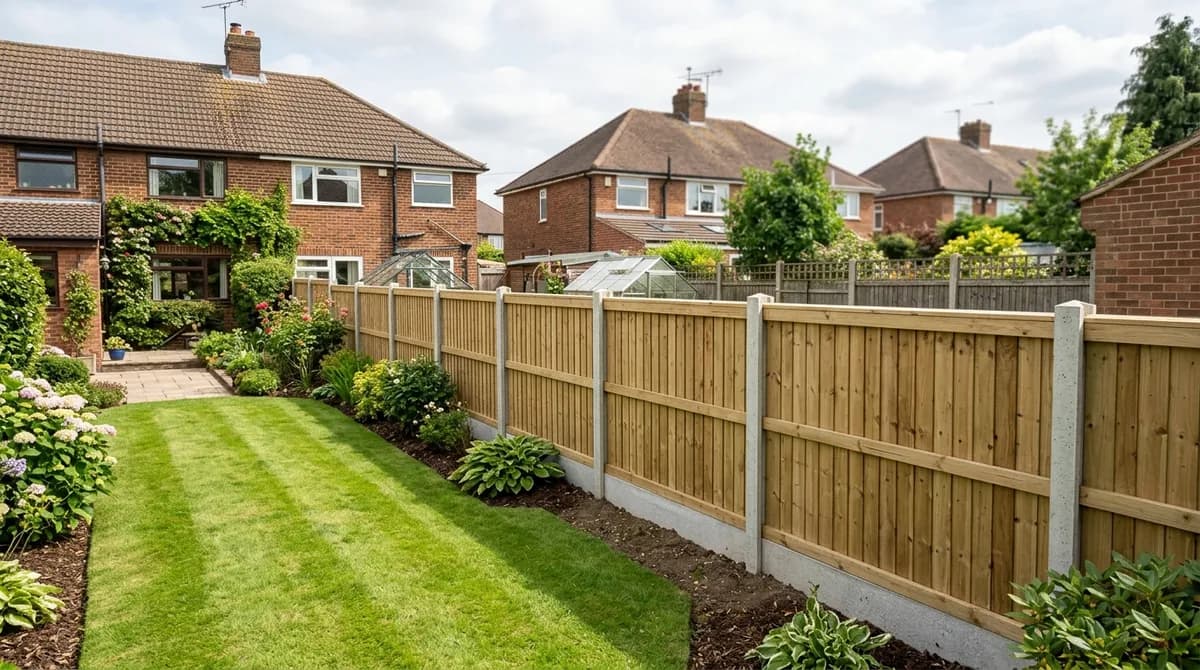
Individual vertical boards nailed to horizontal arris rails, with each board overlapping the next. Stronger than panels because it flexes in the wind rather than catching it. Individual boards can be replaced if damaged. The most popular choice for durability. Lifespan: 15 to 20 years.
Picket fence
Short (0.9m to 1.2m), open-topped fence with vertical pales spaced apart. Mainly decorative - used for front gardens and boundaries where privacy is not the priority. Cheaper than full-height fencing. Can be painted or left natural.
Composite fencing
Made from a mix of wood fibres and plastic (WPC). Looks similar to timber but does not rot, warp, or need treating. Costs roughly twice as much as close board but lasts 25 years or more with virtually no maintenance. Growing in popularity for good reason.
Metal fencing (railings / palisade)
Steel or aluminium fencing, usually powder-coated. Maintenance-free and extremely durable. More expensive than timber and offers less privacy unless combined with a hedge or climbers. Common in front gardens and more urban settings.
Things to think about before you install
Boundary ownership
Before you do anything, check who owns the boundary. Your title deeds will show a T-mark indicating responsibility. If there is no T-mark, neither neighbour is legally obliged to maintain the fence. Talk to your neighbour before replacing anything - disputes about boundaries are common, stressful, and avoidable with a quick conversation.
Concrete posts or timber?
Concrete posts cost slightly more upfront but last 25+ years compared to 10 to 15 for timber. They are also compatible with slotted panels, which makes future panel replacement much easier. For a fence you want to last, concrete posts are worth the small extra cost.
Gravel boards matter
A gravel board sits at the base of the fence between the posts, lifting the panel off the ground. Without one, the bottom of the panel sits in damp soil and rots within a few years. Concrete gravel boards are better than timber ones for the same reason.
Planning permission
Fences up to 2 metres high do not normally need planning permission. If the fence borders a highway or public footpath, the limit is 1 metre. The Planning Portal has a useful guide to permitted development for fences, gates, and garden walls at planningportal.co.uk. Listed buildings and conservation areas may have stricter rules. If in doubt, a quick call to your local council's planning department will clarify.
How to find a good fencing contractor
Use a specialist, not a general handyman
A dedicated fencing contractor will be faster, more experienced, and often cheaper than a general builder or handyman. They buy materials in bulk, own the right tools, and have done hundreds of fence runs. Ask how many fences they install per week - it should be several.
Get a written quote with full specification
The quote should list the exact fence type (panel, close board, composite), post type (timber or concrete), whether gravel boards are included, whether old fence removal and disposal is covered, and the total linear metres. Without this detail, you cannot compare quotes properly.
Ask about concrete curing time
A contractor who sets posts in concrete and hangs panels the same day is cutting corners. Concrete needs at least 24 hours to cure properly. If they are setting posts in postcrete (fast-setting mix), same-day panel fitting is acceptable - but ask which product they use.
Get at least three quotes
Fencing quotes can vary by 30-50% for the same fence run. Get three written quotes specifying the same panel type, post material, whether gravel boards are included, and whether old fence removal is covered. A quote that just says '15 metres of fencing - £1,800' does not give you enough detail to compare against another contractor.
Check reviews and ask for references
Fencing is a trade where a quick Google Maps or Facebook review check tells you a lot. A contractor with 50+ positive reviews and photos of recent work is a safer bet than the cheapest quote from someone with no online presence.
Fencing guides
Common questions about fencing
What is the cheapest type of garden fence?
Lap panel fencing is the cheapest option at around £50 to £75 per metre fully installed. The panels are made from overlapping strips of timber and are widely available at B&Q, Wickes, and most timber merchants. They are not the strongest option - wind and impact damage are more common than with close board - but for a sheltered garden on a budget, they do the job.
Can I put up a fence myself?
Yes, if you are reasonably handy. The hardest part is setting the posts level and plumb in concrete. If you get the posts right, fitting panels between them is straightforward. You will need a post hole digger or spade, a spirit level, postcrete or concrete, a saw, and screws or clips. Allow a full weekend for a 15-metre fence run. For close board fencing, a professional will get a cleaner finish because it requires more precise cutting and alignment.
How tall can a garden fence be without planning permission?
In England and Wales, garden fences up to 2 metres (6 feet 6 inches) high do not normally require planning permission. The gov.uk guidance on permitted development sets out the rules. If the fence borders a highway, public footpath, or bridleway, the limit drops to 1 metre. Trellis on top of a solid fence counts towards the total height. If your property is listed or in a conservation area, check with your local planning authority before putting up any fencing.
Is composite fencing worth the extra cost?
Composite fencing costs roughly twice as much as close board, but it requires almost no maintenance and can last 25 years or more. It does not rot, warp, or need treating. If you factor in the cost of treating a timber fence every 2 to 3 years, and replacing it after 15 years, composite works out comparable over its lifetime. It is a good choice if you want a low-maintenance garden boundary.
When is the best time to install a fence?
Late spring through to early autumn is the best time for fencing work. The ground is softer and easier to dig post holes in than frozen or waterlogged winter soil. Concrete sets better in warmer, drier conditions too. That said, fencing contractors are less busy in winter, so you may get a better price or shorter wait time if you book between November and February.
Quote service coming soon
Get free quotes from fencing contractors near you
Free, no obligation. Read the cost guide first so you know what a fair price looks like before anyone gives you a number.