How Much Does Composite Decking Cost in 2026?
Composite decking costs from £80 per m² fully fitted, compared with £70 to £110/m² for treated softwood. It costs more upfront, but lasts 25+ years without a drop of oil or stain. Here's what you'll actually pay in 2026, which brands are worth it, and how it stacks up against timber over the long run.
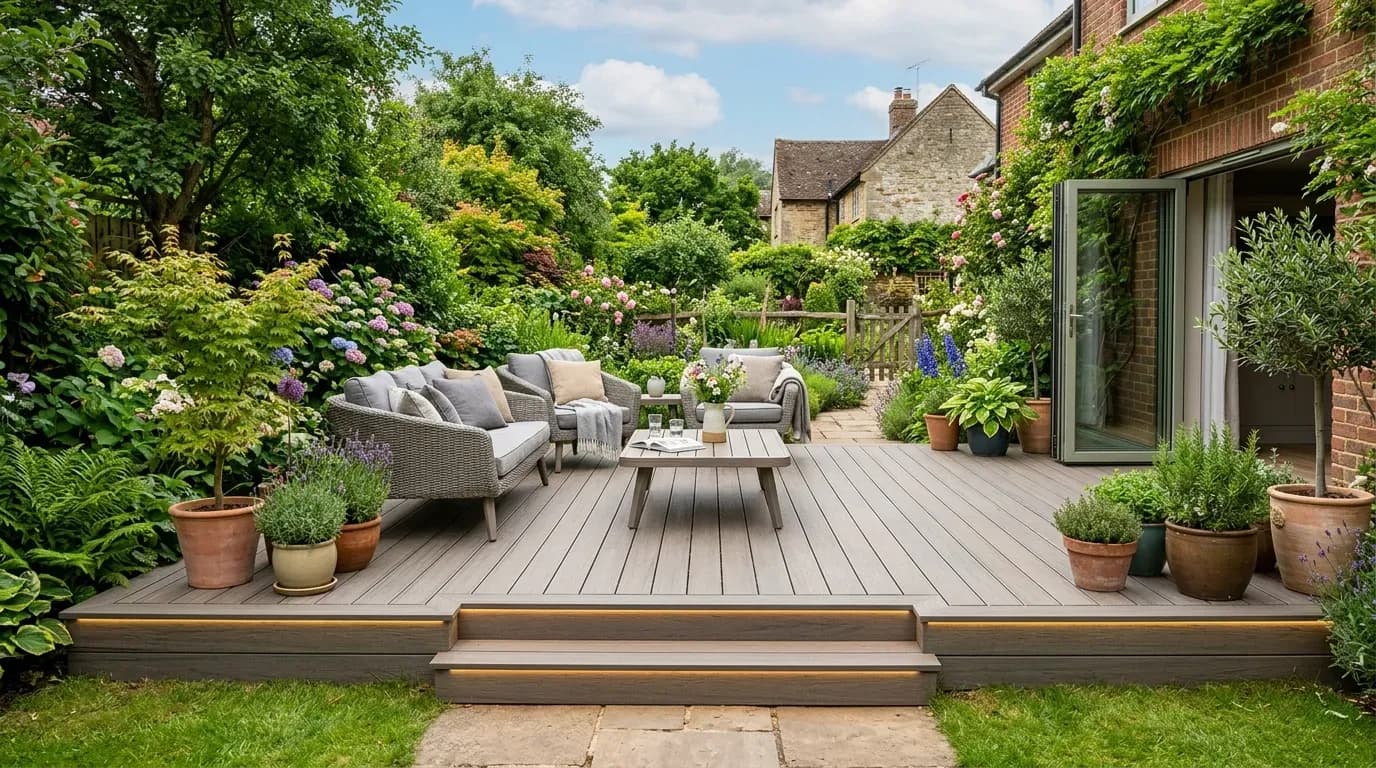
£80/m²
From fitted
£30 to £80/m²
Boards supply only
25+ years
Typical lifespan
None needed
Annual treatment
Prices updated April 2026 · Based on industry data and contractor submissions.
Composite Decking Cost per m²
All prices below include installation labour and a new treated timber subframe. The supply price is for boards only, and the fitted price is what you'd expect to pay a contractor for the complete job.
| Board Type | Supply/m² | Fitted/m² |
|---|---|---|
| Budget composite (hollow core) | £30 to £45 | £70 to £95 |
| Mid-range composite (capped) | £40 to £60 | £85 to £115 |
| Premium composite (solid core) | £55 to £80 | £100 to £140 |
| Subframe and fixings | £15 to £25 | Included above |
Total Project Cost by Deck Size
| Deck Size | Budget (hollow) | Mid (capped) | Premium (solid) |
|---|---|---|---|
| Small (10m²) | £700 to £950 | £850 to £1,150 | £1,000 to £1,400 |
| Medium (20m²) | £1,400 to £1,900 | £1,700 to £2,300 | £2,000 to £2,800 |
| Large (30m²) | £2,100 to £2,850 | £2,550 to £3,450 | £3,000 to £4,200 |
| Extra large (50m²) | £3,500 to £4,750 | £4,250 to £5,750 | £5,000 to £7,000 |
Prices include boards, subframe, fixings, and installation labour. Based on a simple rectangular ground-level deck.
Composite vs Timber Decking: the Real Cost Comparison
Timber wins on upfront cost, a treated softwood deck costs around 20 to 30% less to install. But the picture changes completely once you factor in maintenance. Timber needs oiling or staining every year, plus anti-slip treatment. Skip a couple of years and you're looking at rot, splitting, and algae. Composite decking simply doesn't need any of that.
| Factor | Softwood Timber | Composite |
|---|---|---|
| Upfront cost (20m²) | £1,400 to £2,200 | £1,700 to £2,800 |
| Annual maintenance | £50 to £150/yr | £0 to £20/yr |
| 10-year total cost | £1,900 to £3,700 | £1,700 to £2,800 |
| Lifespan | 10 to 15 years | 25 to 30+ years |
| Appearance after 5 years | Greys/fades without treatment | Stays colour-stable |
| Slip resistance | Can get slippery when wet | Textured surface, better grip |
| Natural feel underfoot | Warm, authentic wood feel | Slightly plastic feel at budget end |
| Heat in direct sun | Warm but bearable | Can get very hot in summer |
The 10-year view: A 20m² softwood deck installed for ~£1,800 costs around £100/year in oil and treatments. Over 10 years that's £2,800 total, and you'll likely need to replace the deck around year 12 to 15. A composite deck at ~£2,200 upfront costs virtually nothing to maintain and should still be in excellent condition at year 25.
Hollow-Core vs Solid-Core Composite
Not all composite decking is built the same way. The core construction makes a real difference to weight, strength, price, and longevity.
Hollow-core
- • Channels run through the board, lighter weight
- • Less material = lower cost (£30 to £45/m²)
- • Fine for standard residential gardens
- • Can flex slightly under heavy point loads
- • Most budget composite brands use this construction
£70 to £95/m² fitted
Solid-core
- • Fully solid board, denser and heavier
- • More rigid, better for high-traffic areas
- • Premium look and feel underfoot
- • Higher material cost (£55 to £80/m²)
- • Used by Millboard and top-end brands
£100 to £140/m² fitted
For most domestic gardens, capped hollow-core composite is the sweet spot, it has a protective polymer outer layer to prevent fading and staining, at a much lower price than solid-core. Save the premium solid-core for high-use areas or if you want the absolute best finish.
Top Composite Decking Brands in the UK
Brand matters more with composite decking than it does with timber. Cheap uncapped composite fades, stains, and looks tired within a few years. These are the brands worth considering.
Millboard
Premium£70 to £90/m² boards
Premium solid-core composite, looks extremely realistic. 25-year warranty. Made in the UK.
Trex
Mid-Premium£45 to £65/m² boards
America's best-selling composite brand, widely stocked in the UK. 25-year warranty. Capped composite.
TimberTech
Mid-Premium£50 to £70/m² boards
Strong capped composite range. Good colour retention. 30-year fade and stain warranty on premium lines.
Cladco
Budget-Mid£30 to £45/m² boards
Popular UK-based supplier. Hollow-core boards at competitive prices. Good entry-level composite option.
Eva-Last
Mid-range£35 to £55/m² boards
Bamboo-composite hybrid boards. Lighter and strong. Distinctive grain patterns. Mid-range price.
Does Composite Decking Need Planning Permission?
Most composite decking is covered by permitted development rights and does not need planning permission. The rules are the same whether you use composite or timber, it's the height and coverage that matters, not the material.
Usually no permission needed
- • Deck surface no higher than 300mm above ground
- • Covers no more than 50% of the garden
- • Not in front of the principal elevation
- • Property is not in a conservation area
- • Building is not listed
Check with your local council if
- • Deck will be over 300mm above ground
- • You live in a conservation area
- • Your home is a listed building
- • Deck covers more than half the garden
- • Deck is in front of the house
When in doubt, check the Planning Portal's guidance on decking or speak to your local planning authority before work starts. It's free to check and saves you any headaches down the line.
How to Maintain Composite Decking
This is where composite earns its price premium. You won't be spending a weekend every spring on your hands and knees with a tin of decking oil. Maintenance is simple and takes an hour, twice a year.
Twice-yearly clean
Give the deck a thorough hose down or scrub with warm soapy water and a stiff brush every six months. This removes built-up dirt, pollen, and the early stages of any algae growth. A garden pressure washer on a low setting works well, keep it moving to avoid concentrating in one spot.
Mould and algae in shaded spots
If your deck is shaded for much of the day, you may get moss or algae building up in the board grooves. A specialist composite deck cleaner (available from most decking suppliers) will deal with this without damaging the board surface. Avoid bleach, it can strip the colour from some board types.
No painting, oiling, or staining, ever
Unlike softwood, composite boards do not need treating with any oil, stain, or sealant. The boards are manufactured with colour and UV resistance built in. Applying oil or paint to composite decking can actually cause problems by blocking drainage grooves and trapping moisture.
Check the subframe occasionally
The composite boards will outlast a timber subframe. After 10 to 12 years, it's worth checking the condition of the joists and bearers underneath. Treated timber subframes last 15 to 20 years typically, but damp or poorly ventilated areas can reduce this. Some installers now offer composite or aluminium subframes for a fully maintenance-free deck.
How to Get Your Composite Decking for Less
Composite decking is a considered purchase. There are genuine ways to reduce the upfront cost without ending up with something that looks cheap or lets you down within a few years.
Get three quotes and compare like for like
Always get at least three quotes from composite decking installers. Make sure each one covers the same scope, boards, subframe, fixings, and any edging or fascia. Quotes can vary by 30 to 40% for identical work, so shopping around is the single most effective way to reduce the cost.
Choose mid-range capped composite over budget hollow-core
The difference between budget hollow-core and mid-range capped composite is typically £15 to £20/m² on boards. That's £300 to £400 extra on a 20m² deck, but the protective polymer layer on capped boards is worth it. Without the cap, composite boards can fade, stain, and absorb moisture at the cut ends.
Buy the boards direct and pay labour only
Composite boards are widely available from trade suppliers and online retailers at 15 to 30% less than contractor supply prices. Buy the boards yourself and ask the installer to quote for labour and subframe materials only. Most will agree, just confirm quantities and board dimensions with them first.
Keep the shape simple and the deck at ground level
A simple rectangular ground-level deck is the most cost-effective option. Angled corners, curves, and multiple levels all add cutting time, waste, and labour costs. Raised composite decking also needs a more substantial structural frame, if your garden allows it, keeping the deck close to ground level saves 20 to 40% on the total bill.
Check end-of-season sales for board deals
Composite decking boards often go into clearance at the end of summer (September-October) and after Christmas. If you can plan ahead and buy boards in autumn or winter for a spring installation, you can save 15 to 25% on materials. Store them flat in a dry space until the installer is ready.
Pay the deposit by credit card, not cash
A composite deck is a big outlay, so protect it. On any job priced over £100 and up to £30,000, paying even the deposit on a credit card makes the card provider jointly liable under Section 75 if the installer takes your money and the work is never finished. Putting just the deposit on the card covers the whole job, so avoid handing over a large cash deposit up front.
Useful Resources
What to Expect: The Composite Decking Installation Process
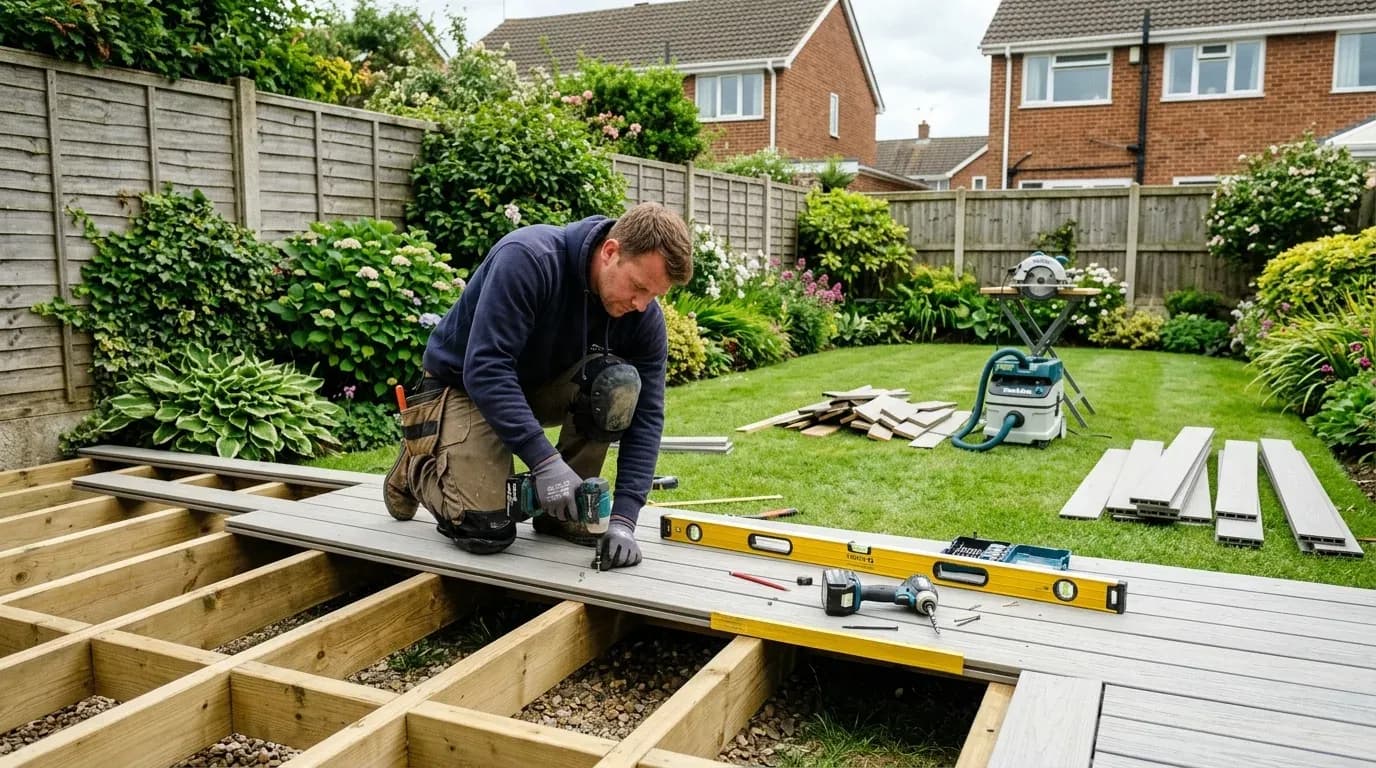
A typical 15m² composite deck takes two to three days to install. Here's how the project runs from groundwork to handover.
- 1
Design and ground preparation
The area is measured and a layout is agreed. Turf, soil, or old decking is cleared. The ground is levelled and compacted. A weed membrane is laid to prevent growth underneath, composite decking does not rot, but weeds growing through gaps looks terrible.
- 2
Build the sub-frame
Treated timber or aluminium joists are laid on a solid base (concrete pads, adjustable pedestals, or compacted hardcore). Joists are spaced at 300 to 400mm centres depending on the composite board manufacturer's requirements. The sub-frame must be level and properly supported.
- 3
Fix the composite boards
Boards are laid across the joists using hidden clip fixings (most composite systems use these rather than screws through the face). A small expansion gap is left between boards and at edges to allow for thermal movement, composite expands more than timber in heat.
- 4
Cut and fit edges and borders
Boards are cut to length using a standard mitre saw. Fascia boards or edge trims are fitted around the perimeter to hide the sub-frame and give a clean finished edge. Any steps, ramps, or changes of level are built at this stage.
- 5
Install balustrades and lighting (optional)
If the deck is raised above 600mm, a balustrade is required under Building Regulations. LED deck lights, post cap lights, or strip lighting are wired in if specified, the cabling should be run before the boards go down.
- 6
Final check and handover
The installer checks all fixings are secure, expansion gaps are consistent, and the deck drains properly. You receive care instructions, composite decking needs very little maintenance, but an occasional wash with soapy water keeps it looking fresh.
Frequently Asked Questions
How much does composite decking cost per m² in the UK?
Composite decking costs £80 to £140 per m² fully installed in the UK. The boards themselves cost £30 to £80 per m² depending on quality. Budget hollow-core boards run £30 to £45/m², mid-range capped composite costs £40 to £60/m², and premium solid-core boards like Millboard cost £55 to £80/m². Installation labour and a new subframe add around £40 to £60 per m² on top.
Is composite decking worth the extra cost over timber?
For most homeowners, yes. Composite decking costs more upfront than treated softwood but lasts 25+ years without annual oiling, staining, or anti-slip treatment. Over a 10-year period, composite typically works out cheaper once you account for zero maintenance costs. It won't splinter, rot, or warp, and it looks as good in year 15 as it did when fitted.
What is the difference between hollow-core and solid-core composite decking?
Hollow-core composite decking has channels running through the board to reduce weight and cost. It's lighter, cheaper, and easier to install, but not quite as strong or rigid as solid-core. Solid-core boards are heavier, denser, and more durable under heavy use, premium brands like Millboard use solid-core construction. For a residential garden deck, hollow-core or capped composite is perfectly sufficient.
Does composite decking need planning permission?
Most composite decking falls under permitted development and does not need planning permission, provided it sits no higher than 300mm above ground level and covers no more than 50% of the garden. If you're planning a raised deck over 300mm high, or the property is in a conservation area or is a listed building, check with your local council before work starts.
How long does composite decking last?
Quality composite decking lasts 25 to 30 years. Most reputable manufacturers offer 20 to 25 year warranties. The boards won't rot, splinter, or fade significantly if you choose a capped composite (one with a protective polymer outer layer). The timber subframe beneath the boards may need attention before the boards do, treated timber joists typically last 15 to 20 years.
What maintenance does composite decking need?
Composite decking needs very little maintenance compared to timber. Hose it down or brush it with soapy water twice a year to remove dirt and algae. In shaded or damp areas, an occasional treatment with a specialist composite deck cleaner will prevent moss and mould. You never need to oil, stain, or paint composite boards, that's one of its biggest advantages over softwood.

Written by Chris Kervin, Less.co.uk founder
Last updated: · Pricing based on industry data and verified contractor submissions · Methodology
Ready to get your composite decking for less?
The best way to make sure you're getting a fair price is to compare quotes from at least three local installers. Getting multiple quotes takes 10 minutes and can save hundreds of pounds.
Compare Free QuotesComing soon, sign up to our newsletter to be the first to know.
More home improvement costs