How Much Does a Retaining Wall Cost in 2026?
Retaining walls hold back soil on sloped sites and cost between £120 and £500 per square metre depending on the material. A typical garden retaining wall costs around £1,500 to £6,000 fully installed, including drainage.
from £150/m²
Block (rendered)
from £200/m²
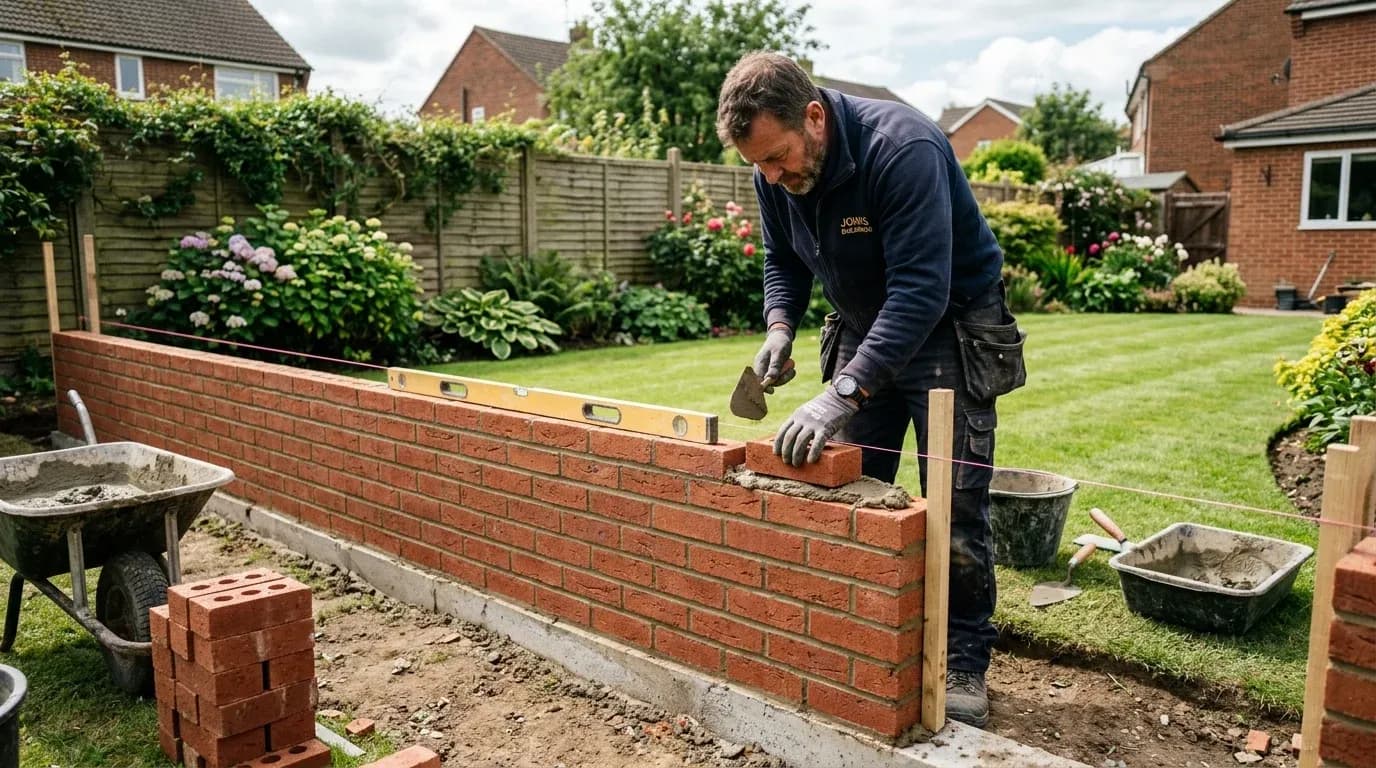
Brick
from £300/m²
Natural stone
from £300
Structural engineer
Prices updated April 2026 · Based on industry data and contractor submissions.
Retaining Wall Cost by Material
Prices per square metre, including materials, drainage, and installation. All based on a typical residential garden retaining wall.
| Material | Cost per m² |
|---|---|
Sleeper wall (timber) Informal look, quick to install, suits garden terracing up to 600mm | £120 - £250/m² |
Sleeper wall (concrete) Longer lasting than timber, similar look but much more durable | £150 - £250/m² |
Gabion basket Wire cages filled with stone, modern look, excellent drainage built in | £150 - £350/m² |
Crib wall / modular system Interlocking concrete or timber modules, good for larger terracing projects | £120 - £250/m² |
Concrete block (rendered) Strongest and most economical masonry option, typically rendered for a clean finish | £150 - £250/m² |
Brick Traditional and attractive, suits period properties and formal gardens | £200 - £350/m² |
Natural stone Sandstone, limestone, or local stone, premium finish, suits rural settings | £300 - £500/m² |
All prices include drainage (weep holes or French drain). Walls over 1m may require a structural engineer, see below.
Retaining Wall Cost by Height
Height is the biggest factor in retaining wall cost, taller walls need bigger foundations, more materials, and often a structural engineer.
| Wall Height | Typical Total Cost |
|---|---|
| Up to 600mm (low terrace) | £400 - £900 |
| 600mm - 1m | £900 - £2,500 |
| 1m - 1.5m | £2,000 - £5,000 |
| 1.5m - 2m | £4,000 - £9,000 |
| Over 2m | £7,000 - £15,000+ |
Total cost estimates for a typical 5-metre-wide retaining wall including foundations, drainage, and labour.
Extra Costs to Budget For
These costs are often quoted separately, or left out of a quote entirely. Check before agreeing to anything.
| Item | Typical Cost |
|---|---|
| Structural engineer design fee | £300 - £600 |
| French drain (behind wall) | £30 - £60/m |
| Weep holes in masonry | £5 - £10 each |
| Geotextile membrane | £2 - £4/m² |
| Excavation / groundwork | £200 - £600 |
| Skip hire | £200 - £350 |
| Building Control application fee | £200 - £500 |
Why Height Changes Everything
Under 600mm, straightforward
A low retaining wall under 600mm is the most manageable project. Simple concrete strip foundations work fine in most soils. A competent builder can complete the job in a day or two. Timber sleepers at this height are even a viable DIY option for a patient weekend warrior. Just do not skip the drainage.
600mm to 1 metre, where most garden walls sit
The most common height for terracing a sloped garden. Needs proper strip foundations at least 300 to 450mm deep. The soil load is meaningful, so the wall needs to be built properly, not just stacked up. Drainage is essential. A solid concrete block wall is the most practical and cost-effective choice at this height.
Over 1 metre, get an engineer involved
Once you go above 1 metre, the forces on the wall become significant. A structural engineer should design the foundation specification and wall thickness. This is not bureaucracy for its own sake, walls over 1 metre that fail can cause serious damage. A typical engineering design for a garden retaining wall costs £300 to £600 and is money well spent.
Over 2 metres, planning permission likely needed
Retaining walls over 2 metres that form part of a structure will usually need Building Regulations approval and may need planning permission too. At this height you are firmly in specialist contractor territory. Budget for the full package: structural engineer, Building Control application, proper drainage design, and an experienced builder.
Drainage: The Part Most People Get Wrong
Without proper drainage, a retaining wall will fail.
Water pressure, not just soil weight, is the leading cause of retaining wall collapse. When rain saturates the ground behind a wall, that water has to go somewhere. If it cannot drain away, it pushes outward. Even well-built walls eventually give way if water is trapped behind them.
Weep holes
Small gaps left in the mortar joints at the base of the wall face, typically every 1 to 2 metres, allow water to seep through rather than build up. They are cheap (£5 to £10 each to install) and essential on any masonry retaining wall. Make sure yours are included.
French drain
A perforated pipe laid in gravel directly behind the wall, wrapped in geotextile membrane to prevent soil clogging. Water drains into the gravel, runs along the pipe, and exits at each end or into a soakaway. This is the gold standard for retaining wall drainage and typically adds £30 to £60 per metre to the cost.
Granular backfill
Using gravel or crushed stone rather than the excavated clay soil to backfill behind the wall dramatically improves drainage. Clay holds water; gravel lets it through. On clay sites, this step alone can make the difference between a wall that lasts 40 years and one that starts moving within a decade.
Retaining Wall Types Compared
Concrete block (rendered)
The workhorse of retaining walls. Concrete block is strong, readily available, and the cheapest masonry option per square metre. On its own it looks industrial, but a sand-cement render transforms it. This is the most practical choice for most gardens, especially where the wall will be hidden by planting.
Brick
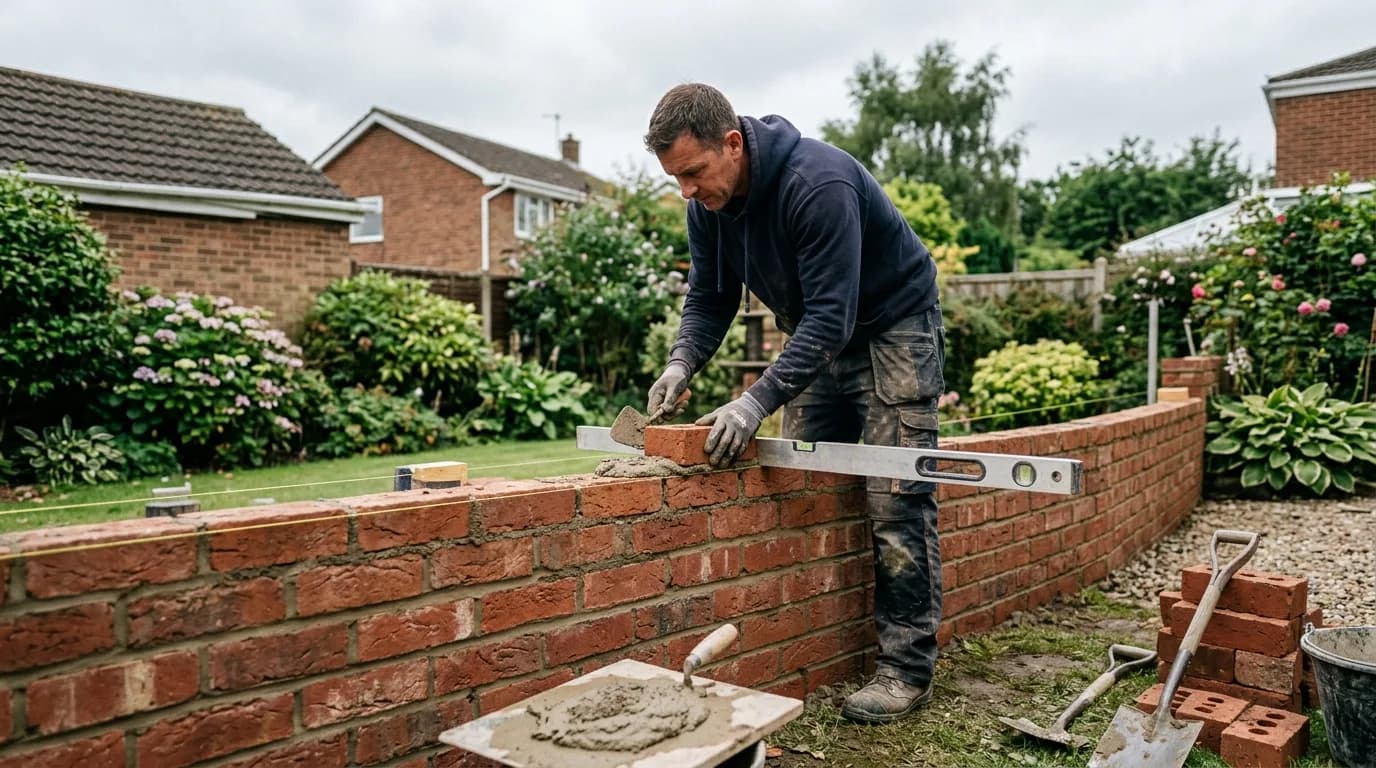
A brick retaining wall looks excellent and suits a wide range of garden styles. It is more expensive than block, mainly because bricks are smaller and take longer to lay. Engineering bricks (which are denser and less porous) are the right choice for walls below ground level or in wet conditions, standard house bricks are not suitable.
Natural stone
The most expensive option but hard to beat for character. Works beautifully in rural gardens and period properties. Dry stone retaining walls (no mortar) are a specialist craft and rely on correctly placed stone to stay stable. Mortar-jointed stone walls are more forgiving and more common for retaining use.
Timber sleepers
The fastest and cheapest way to create a low retaining wall. Treated softwood sleepers stacked horizontally and fixed with vertical timber posts are a popular DIY option for terracing up to about 600mm. They look natural and work well in informal and cottage gardens. Downside: timber rots over time. Concrete sleepers look similar but last far longer.
Gabion baskets
Wire mesh cages filled with crushed stone or cobbles. Increasingly popular in contemporary garden design. The main advantage is drainage, water passes straight through the stone fill with no pressure buildup. This makes gabions a very forgiving retaining solution. They also look striking and are relatively quick to install.
Crib walls and modular systems
Interlocking precast concrete or timber modules that stack without mortar. Good for large terracing projects where speed of installation matters. The open face allows plants to grow through, which looks natural and improves drainage. Popular on commercial sites and large residential gardens.
When Do You Need a Structural Engineer?
A structural engineer is not always required, but get this wrong on a tall wall and the consequences can be serious.
Wall over 1 metre high
This is the standard trigger point. At 1 metre plus, the lateral forces from soil and water pressure are significant enough that a proper engineering design is needed to size foundations, specify wall thickness, and confirm the drainage arrangement.
Clay soil
Clay expands and contracts with moisture, placing additional and unpredictable loads on retaining walls. Even a 800mm wall on clay soil benefits from engineering input. On heavy clay, foundations need to go much deeper, getting this wrong on clay is how walls end up leaning.
Near buildings or drains
If the retaining wall is within 3 metres of a house wall, garage, or buried drain, an engineer should assess the risk of foundation settlement. Excavating for a retaining wall near a building can undermine existing foundations if not done carefully.
Heavy loading behind the wall
Garden furniture, a shed, or vehicles parked on the raised area all add to the soil load the wall must resist. If anything heavy is going on the raised ground, mention it to the engineer so it can be factored in.
Building Regulations & Planning Permission
Most garden retaining walls do not need planning permission, but some do need Building Control sign-off. Here is what to check.
Planning permission
A retaining wall under 1 metre next to a highway and under 2 metres elsewhere is generally permitted development. Over those heights, or in a conservation area, listed building, or Area of Outstanding Natural Beauty, you will need to check with your local planning authority before starting.
Planning Portal: wall height rules→Building Regulations (Part A: Structure)
Retaining walls that form part of a building or support the foundations of a building need Building Regulations approval. Tall freestanding retaining walls that hold back significant loads, particularly near structures, may also be subject to Part A. A structural engineer will advise whether Building Control approval is needed for your specific wall.
Building Regs Part A: Structural requirements→Party Wall Act
If your retaining wall is on or near a shared boundary, the Party Wall etc. Act 1996 may apply. Excavating within 3 metres of a neighbouring structure, even for foundations, can require a party wall notice. If in doubt, serve notice: it is far cheaper than a dispute after the fact.
How to Get Your Retaining Wall for Less
A retaining wall is a structural element, corners cut here can lead to expensive failures later. But there are sensible ways to reduce costs without compromising safety.
Get three quotes from specialist builders
Always get at least three quotes for a retaining wall, and make sure each one covers the same scope: excavation, foundations, drainage, walling material, and backfill. A builder who quotes low but leaves drainage out of scope can end up costing you far more in the long run.
Use timber sleepers for informal retaining up to 600mm
For low terracing in informal gardens, treated timber sleepers are the most cost-effective option by a distance. They look natural, install quickly, and a competent DIYer can often fit them without a builder. Just make sure drainage is sorted behind the wall, even at 600mm, trapped water will eventually push them over.
Consider stepped terracing instead of one tall wall
One 1.5-metre retaining wall is significantly more expensive (and more complex) than two 750mm walls creating two terraced levels. Stepped terracing also looks more natural, gives you planting beds, and is far less likely to require a structural engineer. If your garden allows it, it is worth exploring.
Choose concrete block over brick for rear walls
If the retaining wall is at the back of the garden and you plan to plant in front of it, a rendered concrete block wall gives you the same structural performance as brick at 30 to 40% less cost. Save the brick or stone finish for walls you can actually see from the house.
Do the drainage yourself to cut labour costs
Laying a French drain behind a retaining wall is not complicated, perforated pipe in a gravel trench covered with geotextile membrane, and a competent DIYer can handle it. If a builder is quoting separately for drainage, doing this part yourself could save £200 to £500 on a typical garden project.
Use gabion baskets to skip the drainage bill
Gabion baskets are wire cages filled with stone, and water passes straight through them, so you avoid the cost of a separate French drain (£30 to £60 per metre). They also sit on a compacted stone base rather than deep concrete foundations, which trims the groundwork on a low to mid-height wall. The baskets themselves are not the cheapest walling material, but where a rugged, modern look suits the garden those drainage and foundation savings close much of the gap.
Ask whether the builder is VAT registered
A sole trader with turnover under the £90,000 VAT threshold does not charge VAT. On a smaller retaining wall, using a builder who is not VAT registered can save up to 20% on the labour element compared with a larger firm. Ask before you compare quotes so you are weighing up like for like.
What to Expect: The Retaining Wall Construction Process
Building a retaining wall is a structural job that follows a careful sequence. Here is what to expect.
- 1
Site survey and design
A structural engineer or experienced landscaper assesses the site, soil type, water table, and height requirements. For walls over 1 metre, a structural engineer's design is usually required to meet Building Regulations.
- 2
Excavation and foundations
A trench is dug below the frost line, typically 600mm deep for a 1-metre wall. Concrete strip foundations are poured and left to cure for at least 24 hours before building begins.
- 3
Wall construction
The wall is built course by course using the specified materials, concrete block, brick, or natural stone. Steel reinforcement and concrete infill are added for taller walls to ensure structural integrity.
- 4
Drainage installation
Drainage is critical for retaining walls. A perforated pipe is laid behind the wall base, surrounded by gravel, with weep holes through the wall face at regular intervals to prevent water pressure building up.
- 5
Backfilling and finishing
Free-draining gravel is backfilled behind the wall. The wall face is pointed or rendered as required, and coping stones are fitted on top to protect from water ingress.
Frequently Asked Questions
How much does a retaining wall cost per square metre in the UK?
A retaining wall costs between £120 and £500 per square metre depending on the material and height. Timber or concrete sleepers are cheapest at £120 to £250/m². Gabion baskets cost £150 to £350/m². Concrete block (rendered) runs £150 to £250/m². Brick costs £200 to £350/m². Natural stone is the most expensive at £300 to £500/m². Prices include materials, drainage, and labour.
Do I need a structural engineer for a retaining wall?
You need a structural engineer for any retaining wall over 1 metre high, walls on clay soil, walls near buildings or drains, and walls holding back significant loads such as a slope behind a house. A structural engineer typically charges £300 to £600 for a retaining wall design. Skipping this step on a tall wall is a serious risk, a retaining wall failure can damage property and injure people.
Do retaining walls need planning permission?
Retaining walls under 1 metre next to a highway and under 2 metres elsewhere generally do not need planning permission. However, walls over 1 metre that are structural, particularly those near buildings or affecting drainage, may need Building Control approval under Building Regulations Part A (Structure). If your property is listed or in a conservation area, check with your local council before starting.
Why is drainage so important for a retaining wall?
Water pressure is the number one cause of retaining wall failure. When rain soaks into the soil behind a wall, the water has nowhere to go. That pressure pushes outward and can topple even a well-built wall. Weep holes (small gaps in the wall face) and a French drain behind the wall both allow water to escape before pressure builds up. Any retaining wall without adequate drainage will eventually fail.
How long do retaining walls last?
A well-built retaining wall with proper drainage should last 30 to 50 years or more. Brick and concrete block walls are the most durable. Natural stone can last a century if well maintained. Timber sleepers typically last 15 to 25 years before the wood begins to rot. Concrete sleepers last much longer, 30 to 50 years. The biggest factor in longevity is drainage: a wall with poor drainage will fail long before its time.
Can I build a retaining wall myself?
Sleeper walls up to 600mm high are a viable DIY project for a competent amateur. You still need to get the drainage right. Anything above 600mm requires proper foundations and ideally a professional builder. Over 1 metre, you genuinely need a structural engineer involved. DIY retaining walls over 1 metre that fail can cause significant damage to gardens, fences, and neighbouring properties, and you could be liable.
Useful resources
Related cost guides

Reviewed by Chris Kervin, Less.co.uk Home Improvement Costs Specialist
Last updated: · Pricing based on industry data and verified contractor submissions · Methodology
Quote service coming soon
Get free quotes from local builders
Tell us about your retaining wall project and we will connect you with experienced builders in your area. Free, no obligation.
Compare Free Quotes